
Notas
algorithms
Conteúdo das notas (5)
Página 1
algorithms are designed to solve problems. programming languages are used to implement algorithms.
they create the programs (software) that communicate instructions to a computer.
Página 2
they have the ability to :
input data from a device such as a keyboard.
output data to devices like screens.
process calculations like addition and subtraction.
process decisions based on certain conditions being met.
process repetition for a certain number of times, or while a condition is met, or until a condition is met.
Página 3
advantages
different people can work on different sub-problems
disadvantages
the solutions to the sub-problem tasks might not combine to solve the original problems.
poorly understood problems are hard to decompose.
Página 4
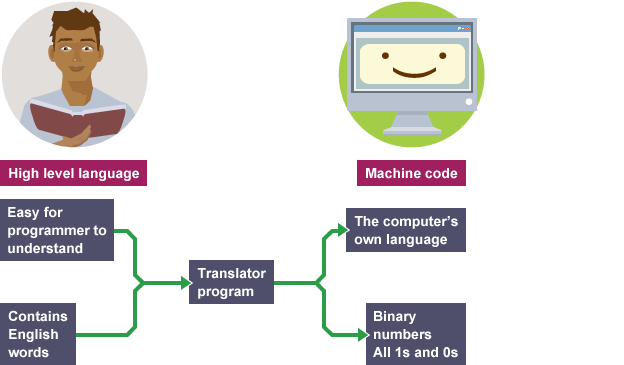
Languages are defined as human-readable or machine-readable.
Human-readable instructions are encoded in a language that humans can use and understand, while machine-readable instructions are in a language that computers understand, and are in binary code.
Languages are also described as high level or low level. Low-level languages, such as assembly language, more closely reflect the mechanical workings of the CPU.
High-level languages include Java, JavaScript, C++, Ruby, BASIC or Python, while low-level languages include C, assembly language, and machine code.
A computer's CPU only understands (executes)
series of binary numbers - so all programming languages are converted
into binary code. Low-level instructions can be processed more speedily
than high-level languages, but they are more difficult for people to
read and write.
For major web applications
and powerful games, developers need to know how to code in low-level
languages in order to maximise the speed and efficiency of a program.
Modern games are typically programmed using a variety of languages.
Página 5
Trace tables
When testing more complex examples of software, it is sometimes necessary to test a number of conditions and sub-conditions at the same time.
A trace table, also called a trace matrix,
can be used to record the outcomes of the test. The trace table for a
very simple example, such as x=y+2, would look like this:
y
x
13
15
25
27
1200
1202
A trace table might appear to look very similar to a test plan, but without the other headings like 'expected outcome' and 'actual outcome'.
Syntax, execution and logic errors
There are three types of error that you need to understand.
Syntax error
This is an error in the spelling
or grammar used when coding. Missing a letter, character or forgetting
to include inverted commas/speech marks are common examples of syntax
errors. A syntax error will be identified by the translation software as
it will be unable to convert the source code into machine code.
Execution error
Sometimes called a run time
error. Execution errors only become evident during run time. An
execution error occurs when a program is asked to do something that it
cannot, resulting in a ‘crash’. The widely used example of a run time
error is asking a program to divide by 0.
The code contains no syntax or
logic errors but when it runs it can't perform the task that it has been
programmed to carry out. Another example is where an attempt is made to
access an item in an array which does not exist eg item 11 in an array
size 10.
Logic error
An error in the logic of the code
such as using ˂ instead of ˃ or AND instead of OR. The program will
execute the code but will produce unexpected results. Logic errors are
usually resolved by carrying out a dry run, using a trace table or
setting breakpoints to help identify the section of code that contains
the logic error.
Algorithm specification
Analysis, exemplification and implementation of algorithms including:
input validation
find minimum
find maximum
count occurences
linear search
Analysis of other algorithms of similar complexity.
Standard algorithms
There is always more than one
way to implement a standard algorithm. The examples used have been
designed as revision materials that exemplify some of the ways to
implement these algorithms. In each case, it is presumed that these
algorithms are procedures in their own right.
That is to say that many
languages will contain pre-defined functions to find maximum and minimum
values. It may also be the case that programmers create their own
functions to return the value of a linear search or count occurrence
algorithm.
The purpose of this revision
guide is not to show in depth examples of how to create and call these
functions. This section is for revision purposes and simply exemplifies
the structure of each algorithm.
Examples are presented in the reference language issued by the SQA as well as in the following high level languages:
Visual Studio 2010 (VB 10.0) - o Should be accessible to
users of VB5, VB6, VS2008 and subsequent versions of Visual
Basic.NET/Visual Studio
LiveCode
Python
Java (Using BlueJ)
True Basic
Xojo - Formerly REALbasic
Pascal
Comal
In an exam setting the
reference language examples could be used within questions. It is
crucial that you understand the reference language examples.
Worked examples in high level
languages are designed to aid revision during class work tasks, unit
assessment and coursework tasks. They are not exhaustive as there are
many ways to implement each algorithm.
Meaningful identifiers
It is always important to use
meaningful identifiers within an algorithm. For example, if you wish to
store a minimum value, this would be represented by the identifier
‘minimum’.
This avoids confusion and
uncertainty and allows multiple programmers to make sense of algorithms
that may not have been designed by the programmer creating the code.
Sometimes, high level
languages make use of shorthand identifiers that are regarded as
semi-standards. For example, Java programmers often use ‘i' to represent
an index or counter.
To avoid confusion, counter is used throughout this section to represent an index value when referencing an array within a loop.
Informações
- Descrição
- GCSE Computer Science Notas sobre algorithms, criado por naomi umoru em 01-06-2016.
- Criado por
- naomi umoru
- Visualizações
- 3
- Avaliação