
Atomic Bonding, Structure and Reactions
Slides do conjunto (8)
-
Atomic Structure, Bonding and Reactions
-
History of the Atomic Structure
- https://www.youtube.com/watch?v=IsA_oIXdF_8&feature=iv&src_vid=1bpG1lEjJfY&annotation_id=annotation_40275 (Incorporar)
- John Dalton (1803)
- History of the development of atomic structure
- J.J. Thomson (1897)
- Atoms are divisible
- Each atom consists of electrons, protons and neutrons (i.e. subatomic particles)
- Plum Pudding Model
- Ernest Rutherford (1911)
- All the positive charge and most of the mass is concentrated in a very small region = nucleus
- Electrons surround this region and occupy most of the volume of the atom
-
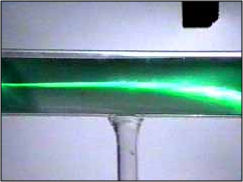
- Cathode Ray is produced when an electric current is passed through a gas (at low Pressure)
- (gas is in a sealed tube with metal disks – electrodes – at each end)
- When current passed through a gas glowed
- Beam could be deflected by a charged object held nearby so the cathode ray must contain tiny charged particles If the cathode ray is attracted to a positively charged plate, what can you
- infer about the charge of the particles that make up the cathode ray? Negatively charged = electrons Must be equal no. positively
- charged particles (as atoms are neutral!) = protons
-
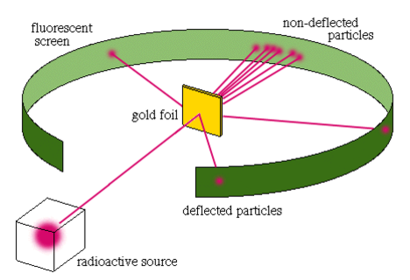
- Big alpha particles (nuclei of helium atoms -> 2p+) were directed at a very thin sheet of gold foil
- Predicted there would be some deflection – due to positive charges distributed throughout the gold BUT….Most particles passed straight through -> concluded that atom is mostly empty space!A very small fraction bounced off foil at very large angles – so must be region
- of positive charge
-
Properties of a Subatomic Particle
-
- Atomic Number
- The atomic number is the number of protons in the nucleus of an atom
- For example:
- all oxygen atoms have 8 protons therefore its atomic number is 8
- Mass Number
- The mass number helps you determine the composition of an atom. This is the total number of protons and neutrons in the nucleus of an atom however, the number of protons do not always equal the number of neutrons.
- EQUATION:
- Number of Neutrons = Mass Number - Atomic Number
-
- Isotopes are atoms that have the same number of protons but different number of neutrons. Therefore, they have the same atomic number but a different mass number.
- For example:
- Neon -20 has:
- 10 Protons
- 10 Electrons
- 10 Neutrons
- while Neon -21 has:
- 10 Protons
- 10 Electrons
- 11 Neutrons
-
- The actual mass of a proton is very small (i.e. 1.67 x 10^-24) and the total mass of even the largest atom is also incredibly small. Because of this, scientists found it was more useful to compare the relative mass of atoms. The Carbon -12 isotope was chosen as the reference and was assigned a mass of 12 amu (Atomic Mass Unit). The natural percentage abundance is fixed for each isotope as is its mass.
- ATOMIC MASS is a weighted average mass of the atoms in a naturally occurring sample of the element.
- EQUATION:
- Atomic Mass = (mass isotope 1 x relative abundance) + (mass isotope 2 x relative abundance) + (mass isotope 3 x relative abundance) ...
Informações
- Descrição
- Queensland Certificate of Education (QCE) Chemistry (Term 1 (2016) - Atomic Structure, Bonding and Reactions) Slides sobre Atomic Bonding, Structure and Reactions, criado por Emma Barrie em 14-02-2016.
- Criado por
- Emma Barrie · fev 2016
- Atualizado
- 8 dez 2016
- Visualizações
- 111
- Tags
- Avaliação