
Notas
Lecture 1 - Illusions in Space and Time
Conteúdo das notas (7)
Página 1
Chapter 0
Photons (light) enter the eye and are analysed
" The camera never lies, because the camera doesn’t have to tell us what it sees—but our visual system does." Vision is active (we have to interpret what we see), not passive.
! We don't see physical reality, we only take what we need to understand it and behave appropriately.
Ishihara plate = the circle thing with the dots and there's a number in different colours that you can't see if you're colour blind or a dog/cat apparently
Most people have the ability to distinguish between red and green, a trait rare in the mammal world
However, in the dark, we lose our ability to see colours.
Página 2
Vision in action & Illusions
When analysing something, our eyes never stay still. They move an average of 3-4 times per second, on the most "interesting" parts of the scene. That is because our vision is sharp only in the point we are focusing on.
It is believed that we use the LQ info to decide where to focus our attention.
Illusions
Shepard, 1990 Table Illusion - two tables of the exact same shape look completely different because our brains insist on seeing them as 3D objects rather than 2D drawings
This effect is the cause for many other illusions
The Thatcher illusion (Thompson, 1980) - Upside down faces, but with inverted features look okay until you look at them the right way. We are unable to read it correctly when it is upside-down.
The Adelson Illusion - Chess board with cylinder casting "shadow" over square B. Square A looks way darker than B but they are the same colour. (B being in the "shadow", we assume it's real colour is lighter than what actually shows.
The Hermann Grid - Blue sqares on white background, grey "dots" seem to appear in-between them
The Moon Illusion - Moon on the horizon looks much bigger than up in the sky, because we perceive it as further away and thus it appears bigger even though it has the same size.
Illusions rarely take place in nature, therefore our perception is usually accurate.
Some illusions are caused by the fact that we adapt to certain stimuli, such as fast speed, and when they change, it seems to affect us differently than it normally would. (slow speeds seem even slower if they follow fast ones)
Inhibition results in 2 types of illusions:
Inhibition over time => after-effect type illusions (you see negative of the previous colour on a white background)
Inhibition over space => simultaneous contrast illusions (2 colours appear different because of colours surrounding them when they are identical)
Excitation leads to: filling-in "illusions" (we fill large spaces with info we get from edges)
Página 3
Damage to the system
Visual neglect - people fail to recognise/process one half of anything they look at.
The brain
Photoreceptors = receptors for light that pick up photons and interpret them them into electric signals
Over 50% of our cortex is dedicated to visual processing, separated into different areas which have different roles (hence why we can lose very specific abilities like seeing movement, or faces, or depth). All these areas are highly interconnected.
Página 4
Chapter 1
The eye
Sclera = whites of our eyes
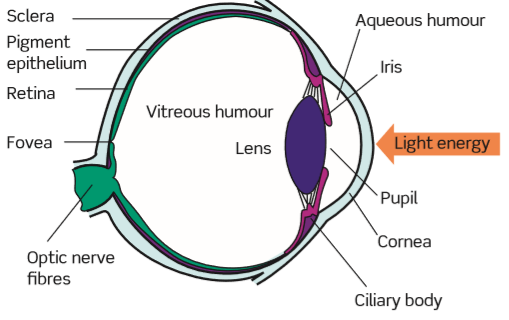
Light changes direction when it enters the cornea because it travels faster through air than our eye. Therefore, like a cars wheel on sand, it moves slower and the other wheels change direction to catch up.
Ciliary muscles contract => Lens is rounder - for close vision
Ciliary muscles relax => Lens is stretched - for distant vision
Emmetropic eye - lens right shape for eye lenght
Myopic eye - eye too long or opticts too strong
Hypermetropic eye - eye too short or optics too weak
From receptors -> bipolar cells -> ganglion cells -> brain
Página 5
The eye - Photoreceptors
2 types: rods and cones
Rods are filled with rhodopsin
3 types of cones for red, green and blue light (colour vision)
Rods are for nighttime vision and cones for daytime.
Rods are more sensitive to green and cones to yellow
Cones are mostly concentrated in the fovea while rods mostly outside of it (absent from the fovea)
There are no blue cones in the fovea
Ganglion cells and blood vessels leave the eye through the blind spot
Colourblind people have unusual arrangements with either their red or green cones
This book is ridiculous
Página 6
The eye - Ganglion Cells
They can be large (M cells) or small (P cells).
P cells distinguish between signals from red and green cones.
M cells gather info about movement.
Both send signals to the lateral geniculate nucleus (LGN)
Página 7
Chapter 3
Trigger features
= conditions that need to be met for a cell to fire
Neural doctrine: your perception of your grandmother is nothing more than the activity of those cells that are active when your grandmother hails into view
Informações
- Descrição
- Ch. 0, Ch. 1 to pp. 37 and Ch. 3, pp. 84-85
- Criado por
- Andra . · nov 2016
- Atualizado
- 6 abr 2018
- Visualizações
- 167
- Tags
- Avaliação