
Notas
Plate Tectonics
Conteúdo das notas (1)
Página 1
The Earth has a layered structure, including the core, mantle and crust. The crust and upper mantle are cracked into large pieces called tectonic plates. These plates move slowly, but can cause earthquakes and volcanoes where they meet.
The Earth’s crust, its atmosphere and oceans are the only sources of the resources that humans need.
The Earth is almost a sphere. These are its main layers, starting with the outermost:
crust (relatively thin and rocky)
mantle (has the properties of a solid, but can flow very slowly)
core (made from liquid nickel and iron)
The radius of the core is just over half the radius of the Earth. The core itself consists of a solid inner core and a liquid outer core.
The Earth's crust and upper part of the mantle are broken into large pieces called tectonic plates. These are constantly moving at a few centimetres each year. Although this doesn't sound like very much, over millions of years the movement allows whole continents to shift thousands of kilometres apart. This process is called continental drift.
The plates move because of convection currents in the Earth’s mantle. These are driven by the heat produced by the natural decay of radioactive elements in the Earth.
Where tectonic plates meet, the Earth's crust becomes unstable as the plates push against each other, or ride under or over each other. Earthquakes and volcanic eruptions happen at the boundaries between plates, and the crust may ‘crumple’ to form mountain ranges.
It is difficult to predict exactly when an earthquake might happen and how bad it will be, even in places known for having earthquakes.
The theory of plate tectonics and continental drift was proposed at the beginning of the last century by a German scientist, Alfred Wegener.
Before Wegener developed his theory, it was thought that mountains formed because the Earth was cooling down, and in doing so contracted. This was believed to form wrinkles, or mountains, in the Earth’s crust.
Wegener suggested that mountains were formed when the edge of a drifting continent collided with another, causing it to crumple and fold. For example, the Himalayas were formed when India came into contact with Asia. It took more than 50 years for Wegener’s theory to be accepted. One of the reasons was that it was difficult to work out how whole continents could move: it was not until the 1960s that enough evidence was discovered to support the theory fully.
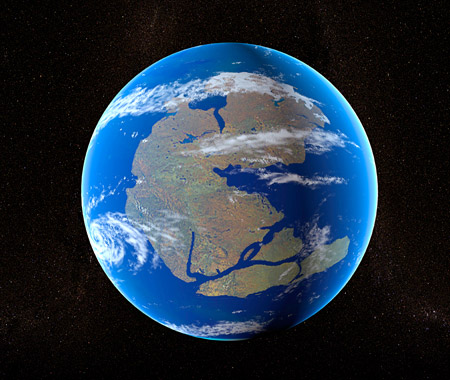
Earth around 200 million years ago, at the time of Pangaea
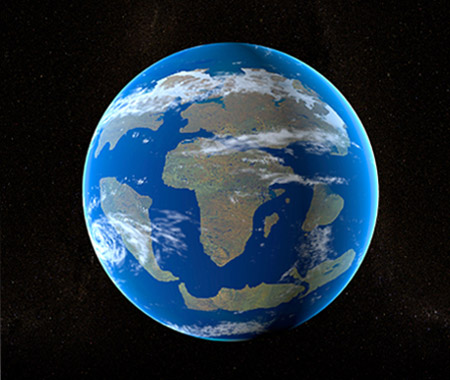
The single landmass began to crack and divide, due to the slow currents of magna beneath it
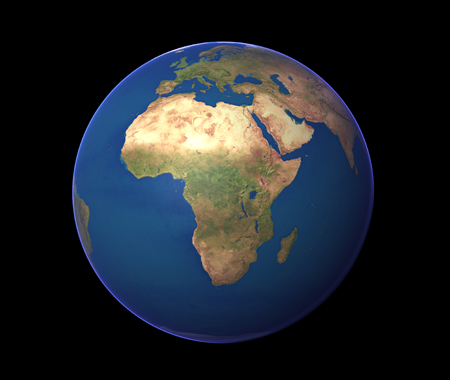
The positions of the continents today
There are two main types of tectonic plate:
Oceanic plates occur under the oceans.
Continental plates form the land.Oceanic plates are denser than continental plates. They are pushed down underneath continental plates if they meet.
Where tectonic plates meet, the Earth’s crust becomes unstable as the plates slide past each other, push against each other, or ride under or over one another. Earthquakes and volcanic eruptions happen at the boundaries between plates. Magma (molten rock) is less dense than the crust. It can rise to the surface through weaknesses in the crust, forming a volcano.
Geologists study volcanoes to try to predict future eruptions. Volcanoes can be very destructive, but some people choose to live near them because volcanic soil is very fertile.
The movement of tectonic plates can be sudden and disastrous, causing an earthquake. It is difficult to predict exactly when and where an earthquake will happen, even when a lot of data is available.
New Page
Informações
- Descrição
- Science Notas sobre Plate Tectonics, criado por Ollie James Chapman em 12-05-2013.
- Criado por
- Ollie James Chapman · mai 2013
- Atualizado
- 19 fev 2016
- Visualizações
- 73
- Tags
- Avaliação