
Quiz
Chapter 05
Crie uma conta grátis para terminar este quiz
Salve seu progresso e veja sua nota final.
Já tem uma conta? Inicie sessão
Perguntas do quiz (54)
1Based on the relationships among light, electromagnetic radiation, and photons, select all of the correct statements from the following list.
- ALight can act both as a wave and a particle.
- BHigh frequency photons carry more energy than long wavelength photons.
- CX-rays and gamma rays are long wavelength photons.
- DDifferent types of electromagnetic radiation are fundamentally different types of waves.
- EAll electromagnetic waves travel at the speed of light.
- FThe only type of electromagnetic radiation that is actually considered light is visible light.
- GA photon is a particle of light.
2Based on the different types of optical telescopes and their relative strengths and weaknesses, select all of the correct statements from the following list.
- AChromatic aberration limits the useful size of any type of telescope.
- BThe largest telescopes are refractors.
- CObservatories are built on mountains because the telescopes will be closer to space.
- DThe diameter of a telescope controls its magnification.
- EWhen referring to the size of a telescope, astronomers are talking about the distance from the objective to the eyepiece.
- FTelescopes linked together as an interferometer have an effective size equal to the size of the telescopes added together.
- GRecently built modern telescopes are reflectors.
3Based on the instruments used by astronomers to analyze light, select all of the correct statements from the following list.
- AAbsolutely nothing is known about an object until its spectrum is observed.
- BPrisms and gratings spread light out into its spectrum by bending the direction of different wavelengths of light in different directions.
- CSpectral lines observed from astronomical objects tell astronomers what atoms are present.
- DPhotography in astronomy has mostly been replaced by CCD imaging.
- EPhotometers are still necessary to measure the brightness of the images gathered by telescopes.
- FThe colors seen in all astronomical images are the true colors of the objects.
- GIn modern spectrographs, gratings have replaced prisms.
4Based on astronomy from space-based telescopes, select all of the correct statements from the following list.
- ACosmic rays are the absolute highest-energy type of electromagnetic wave.
- BEnough infrared energy gets to Earth's surface that infrared telescopes do not need to be put in orbit.
- CThe Hubble Space Telescope makes observations at all wavelengths.
- DEarth's atmosphere has no effect on visible light, so there is no need to place an optical telescope in space.
- EMost types of electromagnetic waves are not visible to ground-based telescopes.
- FThere would be no limit to what an optical telescope in space could see.
- GThe Chandra and Spitzer telescopes are all in space.
5If a telescope has a resolving power of 0.1 sec of arc, what do two stars 1.5 seconds of arc apart look like through this telescope?
- Atwo separate blobs of light
- B11 blobs of light
- Cthree separate blobs of light
- Done blob of light
- Efour separate blobs of light
6Which is better, the resolving power of an 8-m telescope on Earth without adaptive optics or that of the 2.5-m Hubble Space Telescope?
- A8-m telescope
- BHubble Space Telescope
- CThere is no way to tell.
7The visible part of the electromagnetic spectrum can be divided into seven color bands: red, orange, yellow, green, blue, indigo, and violet (from long to short wavelength). A single photon of which of these colors has the greatest amount of energy?
- Ared
- Bgreen
- Corange
- Dviolet
- Eblue
8The entire electromagnetic spectrum can be divided into seven bands: radio, microwave, infrared, visible, ultraviolet, X-ray, and gamma ray (from longest to shortest wavelength). To which of these two bands is Earth's atmosphere the most transparent?
- Aultraviolet and infrared
- Bvisible and radio
- CX-ray and gamma ray
- Dvisible and ultraviolet
- Emicrowave and radio
9In this figure you can see that different wavelengths of light are refracted (bent) by different amounts. Which wavelengths are bent by the greatest amount?
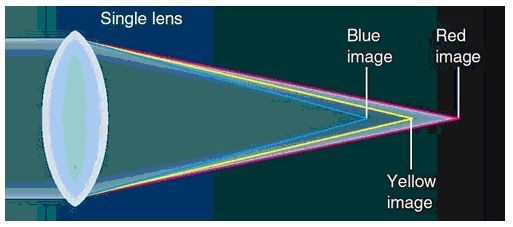
- Ashort wavelengths
- Blong wavelengths
- Cwavelengths intermediate between long and short wavelengths
- DIt cannot be determined from the figure.
- ENone of these choices are correct.
10If you were to make a telescope using the two lenses shown here, which lens should you use for the primary (objective) and which for the eyepiece?
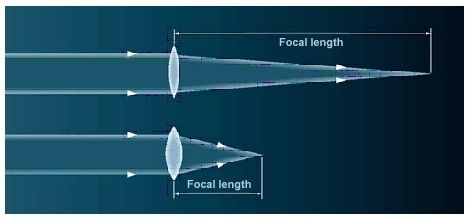
- AThese lenses do not have the correct shape to be used in a telescope.
- BOne uses top lens for the eyepiece and bottom lens for the primary.
- CThere is not enough information provided to answer.
- DOne uses top lens for the primary and bottom lens for the eyepiece.
- EOne uses top lens for the primary and bottom lens for the eyepiece and one uses top lens for the eyepiece and bottom lens for the primary, depending on the type of telescope.
11Astronomers are both hindered and assisted by chromatic aberration. In which device is chromatic aberration a big problem for astronomers?
- Athe primary mirrors of reflecting telescopes
- Bthe primary lenses of refracting telescopes
- Cthe primary lenses of refracting telescopes and prisms
- Dprisms
- Ethe primary lenses of refracting telescopes and the primary mirrors of reflecting telescopes
12Telescope mirrors have a reflective coating on their front surface as shown here. What major problem would be introduced if the reflective coating were beneath the glass surface?
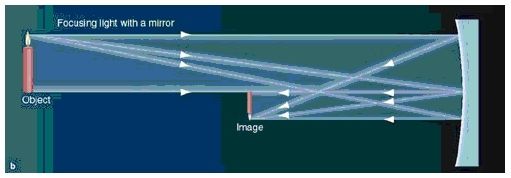
- AThere would be some chromatic aberration.
- BLight would be absorbed by the glass.
- CThe image would be blurry.
- DLight pollution would distort the image.
- EAll of these choices are correct.
13Why have no large refracting telescopes been built since 1900?
- AAll of these choices are correct.
- BRefracting telescopes suffer from chromatic aberration.
- CMaking large glass lenses without interior defects is difficult.
- DRefracting telescopes have several surfaces to shape and polish.
- ELarge glass lenses are more difficult to support than large mirrors.
14Of the two telescopes shown here, which will allow you to see dimmer objects?
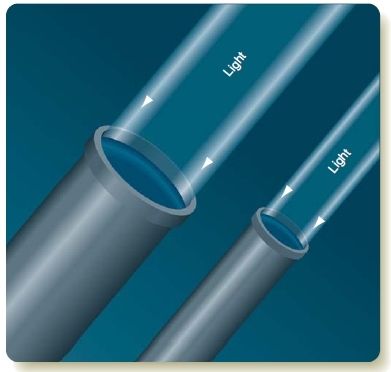
- Athe telescope on the left
- Bthe telescope on the right
- CIt depends on the type of telescope.
15What do large diameter, gently curved convex (thicker in the middle) lenses and large diameter gently curved concave (thinner in the middle) mirrors have in common?
- AThey both have long focal lengths.
- BThey both have long focal lengths and can be used as primary light collectors for a telescope.
- CThey can be used as primary light collectors for a telescope.
- DThey both have short focal lengths.
- EThey both have short focal lengths and can be used as primary light collectors for a telescope.
16Which power of a telescope might be expressed as "0.5 seconds of arc"?
- Amagnifying power
- Blight-gathering power and resolving power
- Cresolving power
- Dlight-gathering power and magnifying power
- Elight-gathering power
17Which power of a telescope is the least important?
- Amagnifying power
- Blight-gathering power and magnifying power
- Clight-gathering power and resolving power
- Dresolving power
- Elight-gathering power
18Which theoretical power of an optical telescope is determined by the diameter of the primary mirror or lens?
- Alight-gathering power and magnifying power
- Bmagnifying power
- Clight-gathering power and resolving power
- Dlight-gathering power
- Eresolving power
19What advantage do the builders of large telescopes today have over the previous generation of telescope builders?
- AAll of these choices are correct.
- BLarge mirrors can now be made thinner and lighter than before.
- CTracking celestial objects today is computer controlled and can take advantage of simpler, stronger mounts.
- DHigh-speed computing today can be used to reduce the effect of Earth's atmosphere.
- ETracking celestial objects today is computer controlled and can take advantage of simpler, stronger mounts and high-speed computing today can be used to reduce the effect of Earth's atmosphere.
20In which device do astronomers take advantage of chromatic aberration?
- Athe prism
- Bthe primary mirrors of reflecting telescopes
- Cthe primary lenses of refracting telescopes
- Dthe primary mirrors of reflecting and refracting telescopes
- EAll of these choices are correct.
21Which power of a large ground-based optical telescope is severely limited by Earth's atmosphere on a cloudless night?
- Alight-gathering and magnification
- Blight-gathering power
- Cmagnifying power
- Dresolving power
- Elight-gathering and resolving power
22What do the newer light-sensitive electronic CCD chips do better than the older photographic plates coated with light-sensitive chemicals?
- AAll of these choices are correct.
- BThey have a greater sensitivity to light.
- CThey can detect both bright and dim objects in a single exposure.
- DPhotometry can be done with the CCD images
- EThe CCD images are easier to manipulate.
23What is a disadvantage of radio telescopes compared to optical telescopes?
- AAll of these choices are correct.
- BRadio photons have lower energy, thus radio waves have low intensity.
- Cinterference from nearby sources of radio waves
- Dpoor resolving power
- ERadio photons have lower energy, thus radio waves have low intensity and interference from nearby sources of radio waves.
24Radio telescopes are often connected together to do interferometry. What is the primary problem overcome by radio interferometry?
- Ainterference from nearby sources of radio waves
- Bpoor magnifying power
- Cpoor resolving power
- Dthe low energy of radio photons
- Epoor light-gathering power
25Why are near-infrared telescopes located on mountaintops and ultraviolet telescopes in Earth's orbit?
- AThe primary ultraviolet blocker, ozone, is located high in the atmosphere, far above mountaintops.
- BThe primary infrared blocker, water vapor, is mostly in the lower atmosphere and ultraviolet telescopes require the low temperature of space to operate.
- CThe primary infrared blocker, water vapor, is mostly in the lower atmosphere and the primary ultraviolet blocker, ozone, is located high in the atmosphere, far above mountaintops.
- DThe primary infrared blocker, water vapor, is mostly in the lower atmosphere.
- EUltraviolet telescopes require the low temperature of space to operate.
26Why must far-infrared telescopes be cooled to a low temperature?
- Ato reduce interfering heat radiation emitted by the telescope
- Bto protect the sensitive electronic amplifiers from overheating by sunlight
- Cto improve their poor resolving power
- Dto improve their poor magnifying power
- Eto make use of the vast supplies of helium stockpiled by the United States
27Why are the sources of cosmic rays difficult to locate?
- ACosmic rays are charged particles, thus their paths are curved by magnetic fields, which masks the location of their source.
- BCosmic rays are neutral particles that weakly interact with matter and are difficult to detect.
- CCosmic rays are theoretical and have never been detected.
- DCosmic rays are high-energy photons that penetrate the surfaces of telescope mirrors rather than reflect to a focal point.
- ECosmic rays are positively and negatively charged particles, which masks the location of their source.
28Which is not a type of electromagnetic wave?
- Avisible light
- Bradio
- Cinfrared
- Dsound
29Which is something that all electromagnetic waves have in common?
- Aspeed
- Bamount of energy they deliver
- Cfrequency
- Dwavelength
- EAll of these choices are correct.
30Which is not a reason to fail to classify sound as an electromagnetic wave?
- AIts wavelength is too short.
- BIt travels much slower than light.
- CIt cannot travel in a vacuum.
- DActually, sound is an electromagnetic wave, since radio waves are sound waves.
31Which type of telescope is more expensive?
- Aa reflector, no matter what
- Bfor the same size objective, refractors
- Ca refractor, no matter what
- Dfor the same size objective, reflectors
32With limited funds, which type of telescope would be your choice?
- Aa reflector, because they gather more light
- Ba reflector, because it is less expensive than the same size refractor, and can be made larger than a refractor
- CActually, it does not really matter which you choose; the size of a telescope is the distance between the eyepiece and the objective.
- Da refractor, because they have better resolution
33Why do nocturnal animals usually have large pupils in their eyes?
- ATo gather more light, so they can see better at night.
- BActually, their pupils are not any bigger than other animals
- CThey do not see bright sunlight, which causes pupils to get smaller.
- DDarkness makes pupils expand.
34Which is the reason that radio telescopes are often put in valleys?
- Ainterference
- Bpoor resolution
- Clow intensity
- DAll of these are reasons for putting a radio telescope in a valley.
35Which reason to build a large radio telescope also applies to optical telescopes?
- Along wavelength light
- BActually, none of these are reasons to build a large optical telescope
- Cbetter resolution
- Dlow-intensity light
36Which reason for building a large telescope applies only to radio telescopes?
- Abetter resolution
- Bcollect more light
- CAll of these are good reasons to build a big optical or radio telescope.
- Dlong wavelength light
37Which could be a disadvantage of a thin or "floppy" telescope mirror?
- AIt is easier to break.
- BIt requires computer control.
- CActually, there is no disadvantage of a floppy mirror.
- DIt tends to sag under its own weight.
38Not long ago, an astronomer said: "Some people think I should give up photographic plates."
What device could replace photographic plates in astronomy?- Aspectrograph
- Bfalse-color imager
- Cphotometer
- DCCD
39Which is true of chromatic aberration?
- AIt creates fringes around an image.
- BIt is caused by refraction.
- CAll of these choices are true.
- DIt affects telescopes.
40Which is true about a prism spectrograph?
- AIt divides light into the individual components of its spectrum.
- BIt is not caused by refraction.
- CAll of these choices are true.
- DThe prism has replaced the grating as the operative element in the spectrograph.
41When telescopes in different locations work together, it is called which of the following?
- Ainterferometery
- Badaptive optics
- Cspectroscopy
- Damplification
42Why are telescopes in different locations working together especially desirable for radio telescopes?
- Abecause radio telescopes have such poor resolution
- Bbecause radio telescopes are so large
- Cbecause they can avoid interference from a single location
- Dbecause of the high intensity of radio sources
43If two radio telescopes work together, which of the following is the size of the effective telescope?
- AIt is equal to the distance between the telescopes.
- BIt is equal to the diameter of the bigger telescope, but with better resolution.
- CIt is equal to the diameter of the smaller telescope, but with better resolution.
- DIt is equal to the diameter of the two telescopes put together.
44Why are there arrays of many more than two radio telescopes working together?
- AEvery additional telescope added to the array increases the size of the effective telescope.
- BAdditional telescopes in different locations (especially remote locations) give a greater chance of one of them not being subject to interference.
- CAdditional telescopes in between the two farthest-separated telescopes increases the gathering power and resolving power of the effective telescope.
- DSince it is the distance between the telescopes that is important, there is no need for an array of more than two telescopes.
45Why do radio telescopes have such poor resolution?
- Abecause radio waves have such a long wavelength
- Bbecause they are so large
- Cbecause of the low intensity of radio sources
- Dbecause radio telescopes have so much interference from radio and TV transmissions
46Why must telescopes observing in the far infrared be cooled to low temperatures?
- AThis is done to match the relatively cool temperature of something emitting infrared radiation.
- BIf not cooled, the telescope will give off more infrared radiation than what it is observing.
- CActually, infrared telescopes do not have to be cooled any more than other telescopes.
- DThey must be cooled because objects emitting infrared radiation are hot, and observing them will heat up the telescope.
47Which is better observed by an X-ray telescope than an infrared telescope?
- Anewborn stars in dusty nebulae
- Bglowing dust warmed by hot, young stars in distant galaxies
- Chot gas trapped in galactic clusters
- Dcomets
48What is the cause of the distortion shown in the image on the left?
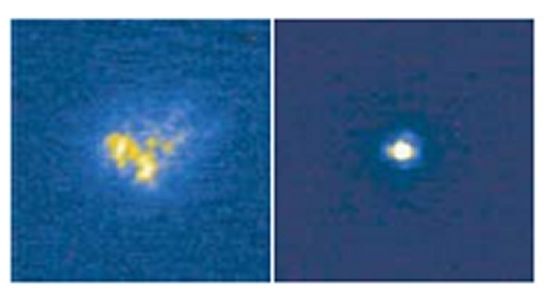
- Apoor resolution
- Blight pollution
- CEarth's atmosphere
- Dchromatic aberration
49How was the image on the left corrected to give the image on the right?
- Awith a correcting plate
- Bwith an achromatic lens
- Cwith adaptive optics
- Dwith a spectrograph
50The image below is an X-ray image of an exploded star. The colors in the image are

- Afalse colors that represent areas of different intensity within the image.
- Bcaused by atmospheric turbulence.
- Cthe actual colors of the object.
- Dregions of different temperature within the object.
51Which list has the colors of visible light in order of increasing wavelength from left to right?
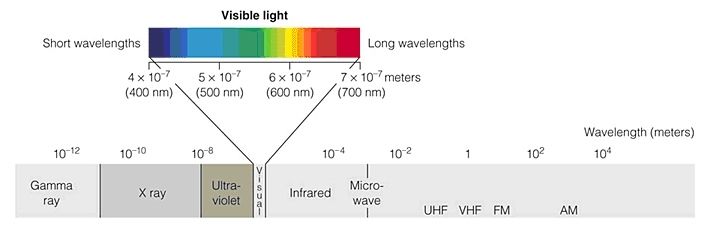
- Ablue, green, yellow, red
- Byellow, red, blue, green
- Cred, blue, green, yellow
- Dblue, green, red, yellow
- Egreen, yellow, red, blue
52Which of the lists below has the colors of visible light in order of increasing frequency from left to right?
- Ablue, red, yellow, green
- Byellow, green, blue, red
- Cgreen, blue, red, yellow
- Dred, yellow, green, blue
53Which of the following lists has the types of electromagnetic radiation in order of decreasing wavelength from left to right?
- Aradio, infrared, visible, ultraviolet, gamma-ray
- Bvisible, ultraviolet, gamma-ray, radio, infrared
- Cultraviolet, gamma-ray, radio, infrared, visible
- Dinfrared, visible, ultraviolet, gamma-ray, radio
54Which of the different telescopes designed for the following specific types of electromagnetic waves has to be at the highest altitude from the surface of the Earth to be useful?
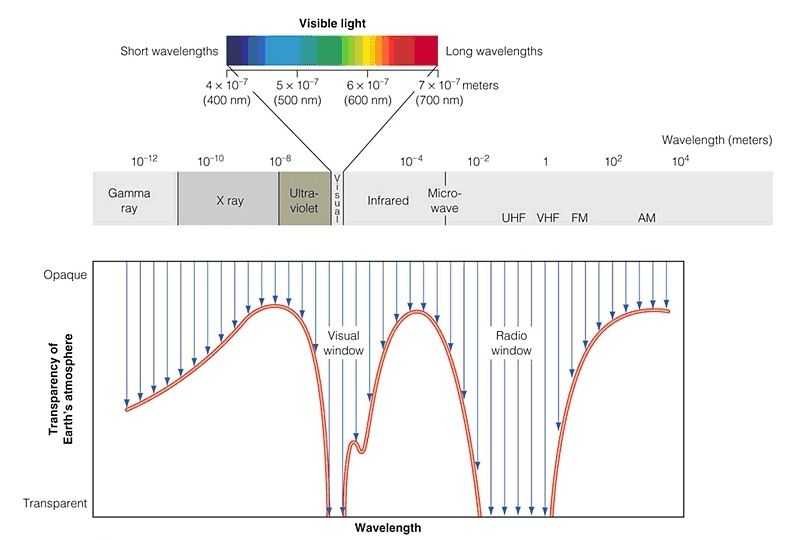
- Anear (to visible) infrared
- Bvisible
- Cradio
- Dfar UV to X-ray
Informações
- Descrição
- Astronomy Quiz sobre Chapter 05, criado por Lisa Ye em 12-02-2018.
- Autor
- Lisa Ye
- Idioma
- English
- Visualizações
- 0
- Etiquetas
- Avaliação
- Ainda sem avaliações Avalie este quiz