
Quiz
Unit 2
Este quiz tem tipos de pergunta que abrem no player de sempre.
Perguntas do quiz (44)
1Virus Particles – Function and formation
[blank_start]Protect[blank_end] the genome:
-Sunlight, physical, chemical, enzymatic, environmental - drying, heat
-There are [blank_start]nucleases[blank_end] everywhere. We perspire huge amounts of RNases.
-Consider this fact. What conclusions do you come to?
-The protein shell (capsid) is very tough and flexible.
-[blank_start]Bind to[blank_end] target cell and allow [blank_start]deposit[blank_end] of the genome into the cell [blank_start]cytoplasm[blank_end].
To help with this, the protein subunits in a virus capsid are [blank_start]redundant[blank_end], i.e. many copies per particle. Thus, if one gets damaged, others can hopefully still complete the job.
-[blank_start]Recognize and package[blank_end] the viral genome.- AProtect
- BRecognize and package
- CBind to
- Ddeposit
- Ecytoplasm
- Fnucleases
- Gredundant
2The parts of a virion:
Most viruses have proteins that fulfill the following rolls:
[blank_start]NC or N - Nucleocapsid[blank_end]. This is the protein that surrounds the genome, packaging it and protecting it.
[blank_start]M - Matrix[blank_end] - If the virion has an envelope, the matrix protein interacts with the lipid to help it associate with the rest of the virion. Often, the matrix protein is sandwiched between the lipid and the NC.
[blank_start]Envelope protein[blank_end]. There isn't as common of a name for these proteins. These are the proteins that are imbedded in the envelope and help the virus [blank_start]bind to and fuse[blank_end] with the target membrane. There can be multiple envelope proteins. These typically go through a [blank_start]conformational shift[blank_end] to allow fusion.- ANC or N - Nucleocapsid
- BM - Matrix
- CEnvelope protein
- Dbind to and fuse
- Econformational shift
3The parts of a virion
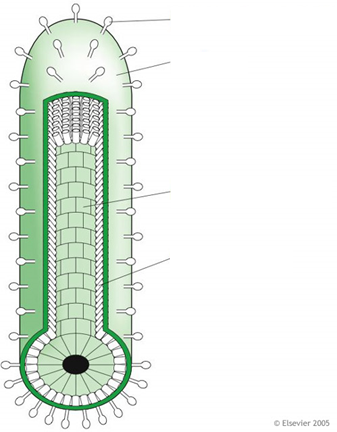
- AEnvelope glycoprotein (G)
- BEnvelope
- CNucleocapsid (N) protein
- DMatrix (M) protein
4viral genomic space is at a premium, especially in terms of the capsid. The solution most viruses have chosen is to have a capsid that is composed of multiple [blank_start]identical[blank_end] protein molecules.
- Aidentical
5To maximize [blank_start]space[blank_end] and to minimize the [blank_start]complexity[blank_end] of the [blank_start]capsid[blank_end], virus particles form [blank_start]regular[blank_end] geometric shapes. However, they need to form these shapes with proteins that are made are [blank_start]irregularly[blank_end] shaped.
- Aspace
- Bcomplexity
- Ccapsid
- Dregular
- Eirregularly
6Viral capsids tend to be in the [blank_start]minimum[blank_end] free energy state.
- Aminimum
71957: When mixtures of purified Tobacco mosaic virus (TMV) RNA and coat protein were incubated together, virus particles formed.
- AVerdadeiro
- BFalso
8While some viruses are very fragile, many are able to persist in the environment for long periods of time.
- AVerdadeiro
- BFalso
9Stability is not an important feature of virus particles.
- AVerdadeiro
- BFalso
10Assembly of virus particles includes [blank_start]hydrophobic[blank_end] and [blank_start]electrostatic[blank_end] interactions - only rarely are [blank_start]covalent[blank_end] bonds involved in holding together the multiple subunits. This is because the subunits need to [blank_start]disassemble[blank_end] once the virus has found its host so that the viral genome can [blank_start]be deposited[blank_end] into the cell [blank_start]cytoplasm[blank_end].
- Ahydrophobic
- Belectrostatic
- Ccovalent
- Ddisassemble
- Ebe deposited
- Fcytoplasm
11Simply mixing the proteins and viral genome for simple viruses will NOT result in the formation of infectious virions.
- AVerdadeiro
- BFalso
12For each capsid structure, there is a [blank_start]critical threshold[blank_end] (based on the physics of the proteins) under which assembly is inhibited and above which assembly is encouraged. This allows viruses to make sure that as many parts of the virion are present prior to assembly to ensure that as many infectious virions are produced as are needed.
- Acritical threshold
13[blank_start]Atomic force microscopy[blank_end] (AFM). This involves pushing a sample against a cantilever and a sensor that and detect the [blank_start]deflection[blank_end] of the cantilever.
AFM nanoindentation is where the sample is pushed hard enough into the cantilevel to result in a [blank_start]deformation[blank_end] of the sample.- AAtomic force microscopy
- Bdeflection
- Cdeformation
14Many plant viruses show [blank_start]helical[blank_end] symmetry
- Ahelical
15There are no known [blank_start]helical[blank_end], [blank_start]naked[blank_end] (i.e. non-enveloped) animal viruses.
There are a large number of animal viruses based on helical symmetry, but all have a [blank_start]lipid[blank_end] envelope.
Helical animal viruses have [blank_start]single[blank_end]-stranded, ([blank_start]-[blank_end])sense [blank_start]RNA[blank_end] genomes- Ahelical
- Bnaked
- Clipid
- Dsingle
- E-
- FRNA
16Virus nucleic acid and a basic, nucleic acid-binding protein condense together to form a helical [blank_start]nucleocapsid[blank_end].
The envelope and its associated proteins are derived from the [blank_start]membranes[blank_end] of the host cell and added to the nucleocapsid core of the virus during [blank_start]budding[blank_end].- Anucleocapsid
- Bmembranes
- Cbudding
17Tobacco mosaic virus (TMV) represents one of the two major structural classes seen in viruses: [blank_start]helical[blank_end] symmetry
The simplest way to arrange multiple, identical protein subunits is to use [blank_start]rotational[blank_end] symmetry.- Ahelical
- Brotational
18Many helical viruses have an envelope, such as Rhabdoviruses
- AVerdadeiro
- BFalso
19The criteria for arranging subunits on the surface of a quasispherical solid are less complex than those for a helix.
- AVerdadeiro
- BFalso
20Icosahedral capsids:
Protein molecules are [blank_start]irregularly[blank_end] shaped, not regular equilateral triangles, so the simplest icosahedral capsids are built up by using [blank_start]three[blank_end] identical subunits to form each [blank_start]triangular[blank_end] face. Also, icosahedrons give the most interior [blank_start]space[blank_end].
[blank_start]60[blank_end] identical subunits are required to form the smallest complete capsid. A few simple virus particles are constructed in this way; e.g. Microviridae, such as fX174.
Most icosahedral capsids contain [blank_start]more[blank_end] than [blank_start]60[blank_end] subunits.
With more than 60 subunits it is impossible for all the subunits to be arranged [blank_start]equivalently[blank_end].
1962: Caspar and Klug proposed the idea of [blank_start]quasi[blank_end]-equivalence- Airregularly
- Bthree
- Ctriangular
- Dspace
- E60
- Fmore
- G60
- Hequivalently
- Iquasi
21The capsid symmetry doesn't indicate how many proteins will make up each pentamer and hexamer.
- AVerdadeiro
- BFalso
22The theoretical basis for the structure of isometric viruses was put on a firm foundation by Caspar and Klug (1962) with their concept of [blank_start]identical[blank_end] elements in [blank_start]quasi[blank_end]-equivalent environments. They defined all possible polyhedra in terms of [blank_start]structure[blank_end] units.
- Astructure
- Bidentical
- Cquasi
23As you get bigger capsids, there are often other proteins involved in holding it all together as it assembles.
- AVerdadeiro
- BFalso
24Most viral capsid proteins are based on a similar structure, described as an ‘[blank_start]8[blank_end]-strand anti-[blank_start]parallel[blank_end] beta-[blank_start]barrel[blank_end]’ or ‘Jelly-roll b-barrel’, found in all T = [blank_start]3[blank_end] icosahedral [blank_start]RNA[blank_end] virus capsids.
- A8
- Bparallel
- Cbarrel
- DRNA
- E3
25‘Naked’ virus particles, i.e. those in which the capsid proteins are exposed to the external environment, are released by [blank_start]lysis[blank_end].
Many viruses have devised strategies to exit from the infected cell without its total destruction.
All living cells are covered by a membrane composed of a lipid bilayer. Viruses leaving the cell must, therefore, allow this membrane to remain intact.
This is achieved by extrusion ([blank_start]budding[blank_end]) of the particle through the membrane.- Alysis
- Bbudding
26Most enveloped viruses use ER membranes as sites of assembly.
- AVerdadeiro
- BFalso
27The site of assembly varies for different viruses - Specific viruses use specific organelle membranes, but across the spectrum, all membranes appear to be used.
- AVerdadeiro
- BFalso
28During budding, Viruses often also capture specific host proteins into the envelope.
- AVerdadeiro
- BFalso
29Matrix proteins: internal virion proteins whose function is effectively to link the internal [blank_start]nucleocapsid[blank_end] assembly to the [blank_start]envelope[blank_end].
- Anucleocapsid
- Benvelope
30[blank_start]Glycoproteins[blank_end]: transmembrane proteins anchored to the membrane by a hydrophobic domain:
External [blank_start]glycoproteins[blank_end], anchored in the envelope by a single [blank_start]transmembrane[blank_end] domain- AGlycoproteins
- Bglycoproteins
- Ctransmembrane
31[blank_start]Transport channel protein[blank_end]s: contain multiple hydrophobic transmembrane domains, forming a protein-lined channel through the envelope.
- ATransport channel protein
32Certain viruses, such as bacteriophages and herpesviruses have a complex capsid assembly process and thus require the use of [blank_start]scaffold[blank_end] proteins.
- Ascaffold
33Scaffold proteins eventually will get in the way of the genome packaging.
Thus these proteins need to be either recycled and used as something else, or more often, degraded.- AVerdadeiro
- BFalso
34Baculoviruses form a capsid which is surrounded by an envelope. There are envelope proteins on the tip of the virion.
The virions often are encapsilated within a tough structure called an “[blank_start]occlusion body[blank_end]”.- Aocclusion body
35Occlusion bodies help protect the virions from cellular defenses.
- AVerdadeiro
- BFalso
36DNA and RNA are full of [blank_start]negative[blank_end] charges. Viruses use a variety of strategies to counter act this eventual ionic repulsion.
There are many [blank_start]positively[blank_end] charged amino acids that face the interior of the [blank_start]capsid[blank_end].
Viruses with dsDNA often have [blank_start]histone[blank_end]s or [blank_start]histone[blank_end]-like proteins to help pack the DNA.
Some viruses use [blank_start]motors[blank_end] to shove the genome into the capsid. The [blank_start]motors[blank_end] are pretty powerful and can fill the capsids pretty tightly.- Anegative
- Bpositively
- Ccapsid
- Dhistone
- Ehistone
- Fmotors
- Gmotors
37Since viruses shutoff host machinery they do not have to differentiate between host genetic material and their own.
- AVerdadeiro
- BFalso
38Specific nucleotide sequences in the genome (the [blank_start]packaging[blank_end] signal) permit the virus to select genomic nucleic acids from the cellular background.
- Apackaging
39Accurate and efficient genome packaging requires information not only from the linear nucleotide sequence of the genome, but also from regions of [blank_start]secondary[blank_end] structure.
- Asecondary
40Label picture
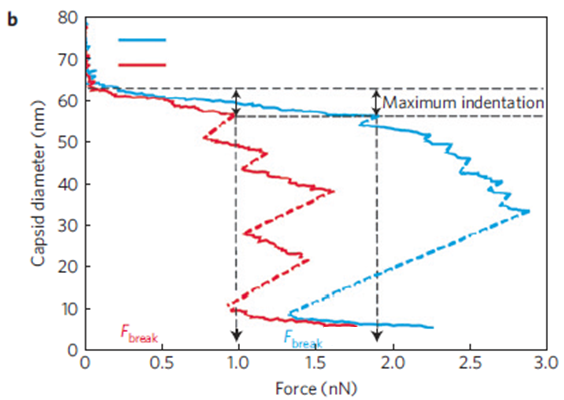
- AFull wt capsid
- BEmpty wt capsid
41All viruses with negative-sense RNA genomes must carry with them a virus-specific RNA-[blank_start]dependent[blank_end] RNA [blank_start]polymerase[blank_end].
- Adependent
- Bpolymerase
42Many viruses also carry proteins that help with the next infection. Often these proteins help overcome the immediate host anti-[blank_start]viral[blank_end] response.
- Aviral
43Viruses rarely bud with anything other than their own proteins.
- AVerdadeiro
- BFalso
44Label image.
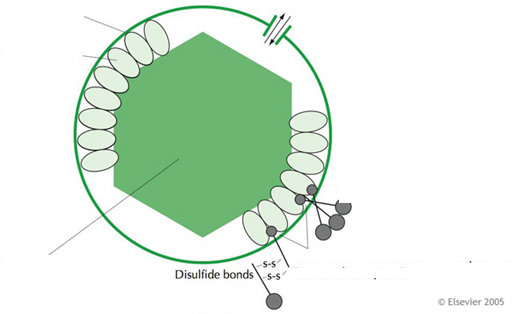
- Atransport channel
- Bglycoprotein (timer "spike")
- Cinternal "tails" interact w matrix prot.
- Dlipid envelope
- Ematrix proteins
- Fnucleocapsid
- Gexternal glycoprotein
Informações
- Descrição
- Virology (Exam I) Quiz sobre Unit 2, criado por Brooks Johnson em 26-09-2020.
- Autor
- Brooks Johnson
- Idioma
- English
- Visualizações
- 0
- Etiquetas
- Avaliação
- Ainda sem avaliações Avalie este quiz