
Quiz
Science 9: Unit 4 - Electricity MEGA QUIZ
Este quiz tem tipos de pergunta que abrem no player de sempre.
Perguntas do quiz (47)
1Positive Charge: [blank_start]Not enough[blank_end] electrons compared to protons
Negative Charge: [blank_start]Too many[blank_end] electrons compared to protons
Neutral Charge: [blank_start]Balance of[blank_end] electrons and protons - ANot enough
- BToo many
- CBalance of
- DToo many
- ENot enough
- FBalance of
- GBalance of
- HNot enough
- IToo many
2What is a Conductor?
- AHave freely moving electrons, allow electrons to flow
- BHave static electrons, don't allow electrons to flow
- CAllows electrons to flow, but adds resistance
- DAllows electrons to flow, has no resistance
3What is an Insulator?
- AHave static electrons, don't allow electrons to flow
- BHave freely moving electrons, allow electrons to flow
- CAllows electrons to flow, but adds resistance
- DThe flow of electrons depends on the temperature
4What is a Resistor?
- AAllows electrons to flow, but adds resistance
- BAllows electrons to flow, has no resistance
- CHave static electrons, don't allow electrons to flow
- DHave freely moving electrons, allow electrons to flow
5What is a Superconductor?
- AAllows electrons to flow, has no resistance
- BThe flow of electrons depends on the temperature
- CAllows electrons to flow, but adds resistance
- DHave freely moving electrons, allow electrons to flow
6What is a Semiconductor?
- AHave static electrons, don't allow electrons to flow
- BAllows electrons to flow, but adds resistance
- CThe flow of electrons depends on temperature
- DAllows electrons to flow, has no resistance
7What are the Laws of Electrical charges?
- ALike charges attract
- BLike charges repel
- COpposite charges attract
- DNeutral objects are attracted to charged
- ENeutral objects are repelled by charged
- FOpposite charges repel
8Label the Diagram of Charge Separation:
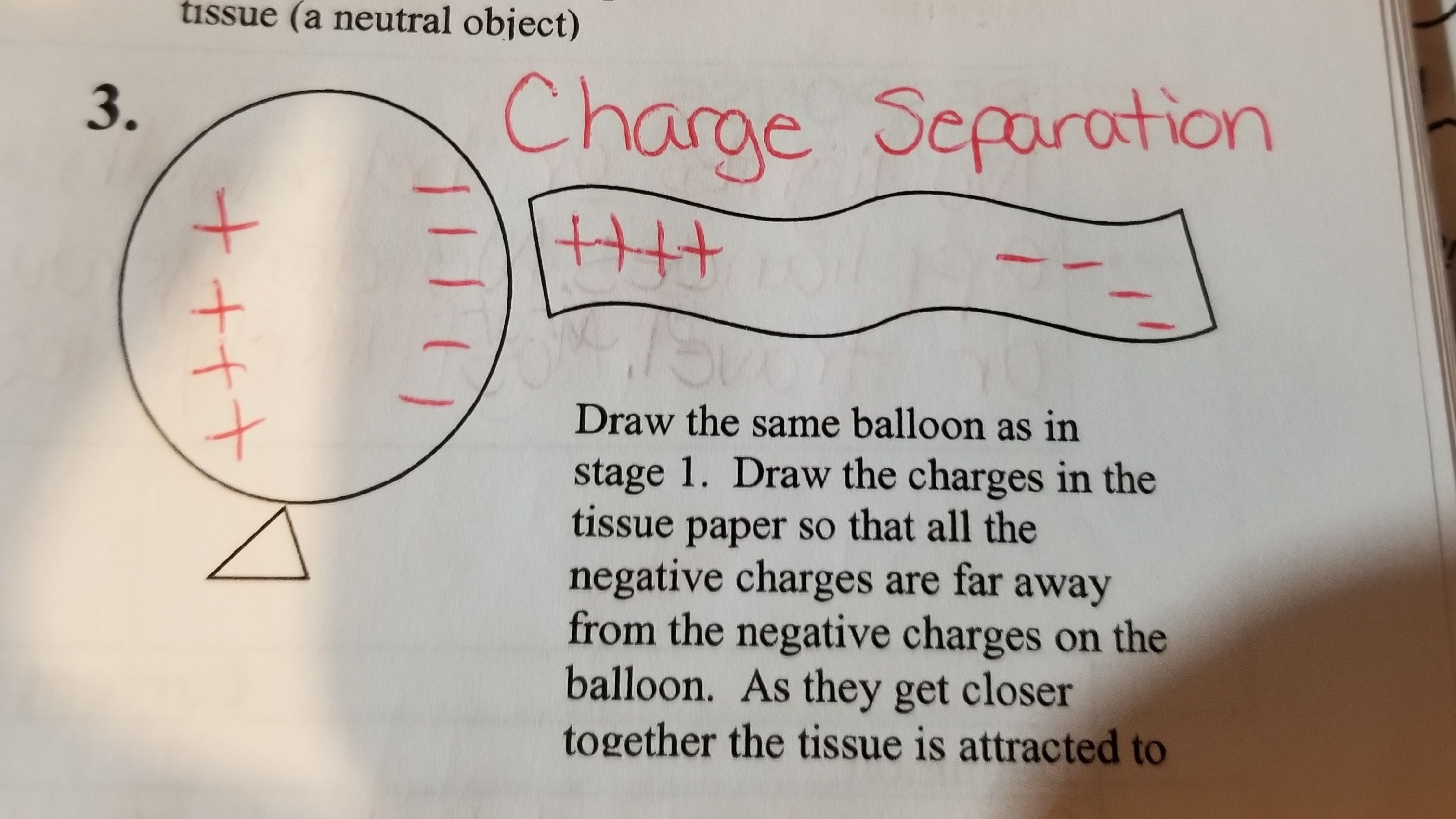
- AProtons
- BElectrons
- CElectrons
- DProtons
9Check all that are properties of Static electricity:
- AHappens in insulators
- BBuildup of electrons
- CTemporary discharge
- DHappens in conductors
- EMovement of electrons
- FPermanent current
10Check all that are properties of Current electricity:
- AHappens in conductors
- BPermanent current
- CMovement of electrons
- DHappens in insulators
- ETemporary discharge
- FBuildup of electrons
11Current electricity flows from [blank_start]negative to positive[blank_end].
- Anegative to positive
- Bpositive to negative
12Fill in the Blanks for Dry Cells:
Use a [blank_start]paste[blank_end] electrolyte. The electrolytes mix together and create [blank_start]free electrons[blank_end]. These electrons flow through an [blank_start]electrode[blank_end] and a wire from the [blank_start]negative to positive[blank_end] terminal.- Apaste
- Bliquid
- Cfree electrons
- Dstatic protons
- Eelectrode
- Felectrolyte
- Gnegative to positive
- Hpositive to negative
13Fill in the Blanks for Wet Cells:
Uses [blank_start]liquid[blank_end] electrolyte. A [blank_start]negative[blank_end] [blank_start]electrode[blank_end] soaks in the [blank_start]electrolyte[blank_end] and dissolves, which creates [blank_start]free electrons[blank_end] that flow through it over to the next [blank_start]positive[blank_end] terminal.- Aliquid
- Bpaste
- Cnegative
- Dpositive
- Eelectrode
- Felectrolyte
- Gelectrolyte
- Helectrode
- Ifree electrons
- Jstatic protons
- Kpositive
- Lnegative
14Primary Cells: [blank_start]Non-rechargeable[blank_end]
Secondary Cells: [blank_start]Rechargeable[blank_end]- ANon-rechargeable
- BRechargeable
- CRechargeable
- DNon-rechargeable
15Direct Current: Current moves in [blank_start]one direction[blank_end]
Alternate Current: Current moves [blank_start]back and forth[blank_end]- Aone direction
- Btwo directions
- Cback and forth
- Dback and forth
- Eone direction
- Ftwo directions
16Check all that are Direct Current devices:
- APhones
- BFlat-screen TVs
- CFlashlights
- DElectric vehicles
- ELaptops
- FToaster
- GMicrowave
17Check all that are Alternating Current devices:
- AToaster
- BMicrowave
- CKettle
- DBuildings/Houses
- ELaptops
- FPhones
- GFlat-screen TVs
18Electric Circuit: A pathway used to control electricity. It flows as long as there's:
forms)
- There's an [blank_start]energy source[blank_end]
- There's a [blank_start]complete path[blank_end]- Aenergy source
- Binsulator
- Ccomplete path
- Dincomplete path
19Open Circuit: [blank_start]Doesn't make a complete loop[blank_end]; [blank_start]doesn't work[blank_end]
Closed Circuit: [blank_start]Makes a complete loop[blank_end]; [blank_start]works[blank_end]- ADoesn't make a complete loop
- BMakes a complete loop
- CMakes a complete loop
- DDoesn't make a complete loop
- Eworks
- Fdoesn't work
- Gdoesn't work
- Hworks
20Parts of a circuit:
An Energy Source: [blank_start]A battery[blank_end]
A Conductor: [blank_start]A wire[blank_end]
A Load: [blank_start]Something to power[blank_end]- AA battery
- BA wire
- CSomething to power
- DA wire
- EA battery
- FSomething to power
- GSomething to power
- HA battery
- IA wire
21What is Current?
- AA measure of how many electrons pass a certain point per second
- BThe amount of energy supplied to a current
- CMeasuring the potential energy between two points on a circuit
- DThe measure of how difficult is it for electrons to flow through a substance
22What is Voltage?
- AA measure of how many electrons pass a certain point per second
- BThe amount of energy supplied to a current
- CMeasuring the potential energy between two points on a circuit
- DThe measure of how difficult is it for electrons to flow through a substance
23What is Potential Difference?
- AA measure of how many electrons pass a certain point per second
- BThe amount of energy supplied to a current
- CMeasuring the potential energy between two points on a circuit
- DThe measure of how difficult is it for electrons to flow through a substance
24What is Resistance?
- AA measure of how many electrons pass a certain point per second
- BThe amount of energy supplied to a current
- CMeasuring the potential energy between two points on a circuit
- DThe measure of how difficult is it for electrons to flow through a substance
25What are the Units used for each?
Current - [blank_start]Amperes[blank_end]
Voltage - [blank_start]Volts[blank_end]
Resistance - [blank_start]Ohms[blank_end]- AAmperes
- BVolts
- CWatts
- DVolts
- EAmperes
- FWatts
- GOhms
- HJoules
- I%
26Check all that are factors that would INCREASE Resistance:
- ALonger wire
- BThinner wire
- CHotter wire
- DLess conductive materials
- EShorter wire
- FThicker wire
- GColder wire
- HMore conductive materials
27Switch: Controls the flow of electrons [blank_start]but closing and opening the circuit[blank_end] Eg. [blank_start]Lightswitch[blank_end]
- Off = [blank_start]Open[blank_end]
- On = [blank_start]Closed[blank_end]- Abut closing and opening the circuit
- Bby lowering power levels
- Cby raising power levels
- DOpen
- EClosed
- FClosed
- GOpen
- HLightswitch
- IDimmer switch
28Rheostat(Variable Resistor): Adjusts the resistance (difficulty to flow)[blank_start]of a circuit[blank_end] Eg. Dimmer switch
- [blank_start]More[blank_end] resistance = [blank_start]Less[blank_end] power = [blank_start]Dimmer[blank_end] lights- Aby extending and shortening wire
- Bby heating and cooling wire
- CMore
- DLess
- ELess
- FMore
- GDimmer
- HBrighter
29Series Circuit: A circuit that has [blank_start]all of its components in a row[blank_end]
- More devices = [blank_start]More resistance[blank_end]
Parallel Circuit: A circuit that has [blank_start]many paths for each component[blank_end]
- More devices = [blank_start]Less resistance[blank_end]- Aall of its components in a row
- Bmany paths for each component
- Cmany paths for each component
- Dall of its components in a row
- EMore resistance
- FLess resistance
- GLess resistance
- HMore resistance
30How are the Circuits assembled below?
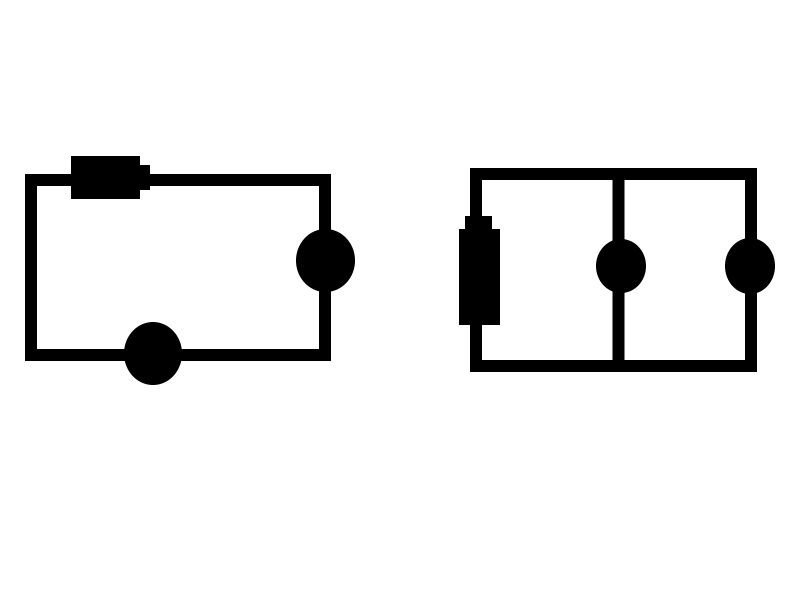
- ASeries Circuit
- BParallel Circuit
- CParallel Circuit
- DSeries Circuit
31We use Schematic Diagrams to map out circuits.
- AVerdadeiro
- BFalso
32Fill in the Blanks for Schematic Symbols:
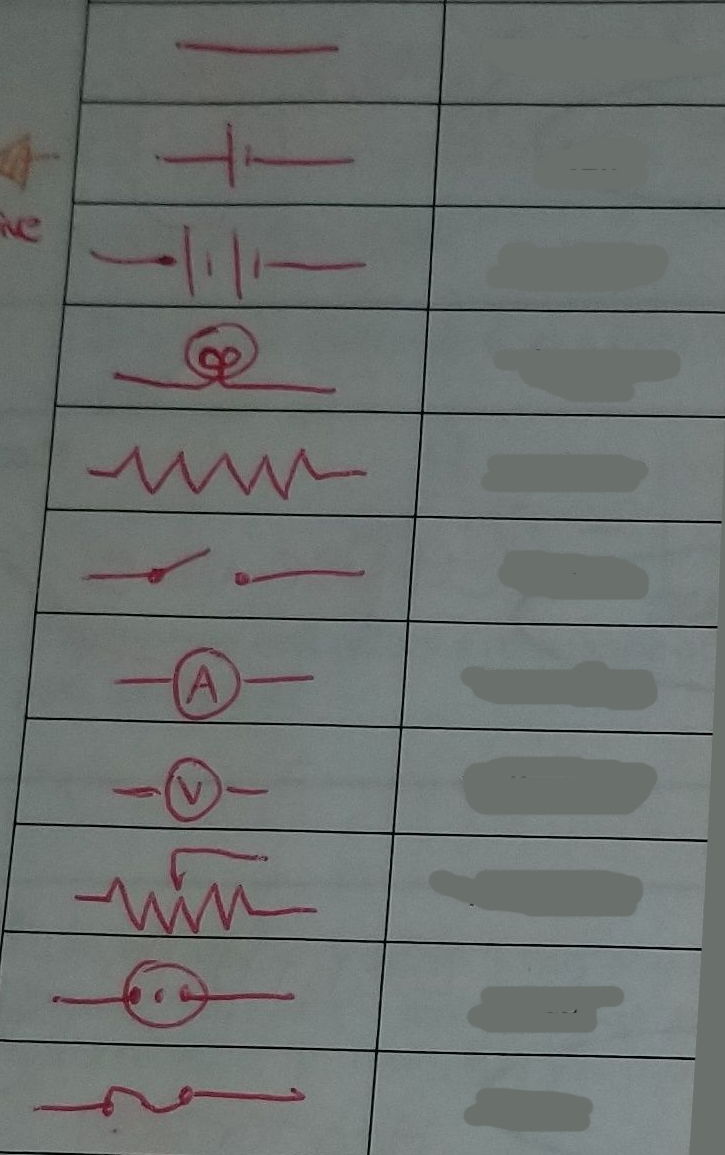
- AA conductor
- BAn insulator
- CA fuse
- DA breaker
- EA motor
- FA generator
- GRheostat
- HSwitch
- IVoltmeter
- JAmmeter
- KAmmeter
- LVoltmeter
- MSwitch
- NRheostat
- OResistor
- PConductor
- QInsulator
- RLight
- SGenerator
- TMotor
- UA battery
- VA cell
- WA cell
- XA battery
33Microcircuits use switches.
- AVerdadeiro
- BFalso
34Ohms Law: As long as the [blank_start]temperature[blank_end] stays the same, the [blank_start]resistance[blank_end] is constant, and the [blank_start]current and voltage[blank_end] are [blank_start]proportional[blank_end].
- Atemperature
- Bresistance
- Ccurrent and voltage
- Dresistance
- Etemperature
- Fcurrent and voltage
- Gcurrent and voltage
- Hresistance
- Itemperature
- Jproportional
- Kdisproportional
35Current and Voltage [blank_start]go up[blank_end] = Resistance [blank_start]goes down[blank_end]
- Agoes up
- Bgoes down
- Cgoes down
- Dgoes up
36Potential Energy: Energy [blank_start]being stored[blank_end]
Kinetic Energy: Energy [blank_start]in motion[blank_end]- Abeing stored
- Bin motion
- Cin motion
- Dbeing stored
37The energy conversions in an Incandescent Lightbulb:
E[blank_start]lectric[blank_end] > H[blank_start]eat[blank_end] > L[blank_start]ight[blank_end]- Alectric
- Beat
- Cight
38Electromagnet: A wire wrapped around an iron core. It creates a [blank_start]temporary[blank_end] magnet.
- The direction of current = [blank_start]Polarity[blank_end]
- Amperage in the wire/ Amount of coils = [blank_start]Strength of the magnet[blank_end]- Atemporary
- Bpermanent
- CPolarity
- DStrength of the magnet
- EStrength of the magnet
- FPolarity
39Electric Motor: Converts [blank_start]electrical[blank_end] energy into [blank_start]mechanical[blank_end] energy. Has an [blank_start]electromagnet(coil and iron core)[blank_end] rotating on an armature around [blank_start]permanent magnets[blank_end]. Every time the [blank_start]electromagnet[blank_end] rotates, a [blank_start]communitator[blank_end] switches the [blank_start]direction[blank_end] of the current, making the magnets continuously spin.
- Aelectrical
- Bmechanical
- Cmechanical
- Delectrical
- Eelectromagnet(coil and iron core)
- Fpermanent magnet
- Gpermanent magnets
- Helectromagnet
- Icommunitator
- Jbrush
- Kelectromagnet
- Lpermanent magnet
- Mdirection
- Npolarity
40Label the Motor:

- APermanent magnet
- BElectromagnet
- CElectromagnet
- DPermanent magnet
- ECommunitator
- FBrush
- GBrush
- HCommunitator
41Electromagnetic Induction: Converts [blank_start]mechanical[blank_end] energy to [blank_start]electrical[blank_end] energy. The [blank_start]electromagnet[blank_end] is rotated by [blank_start]mechanical[blank_end] means with [blank_start]permanent magnets[blank_end] surrounding it.
- Amechanical
- Belectrical
- Celectrical
- Dmechanical
- Eelectromagnet
- Fpermanent magnet
- Gmechanical
- Helectrical
- Ipermanent magnets
- Jelectromagnets
42Label the Generator:
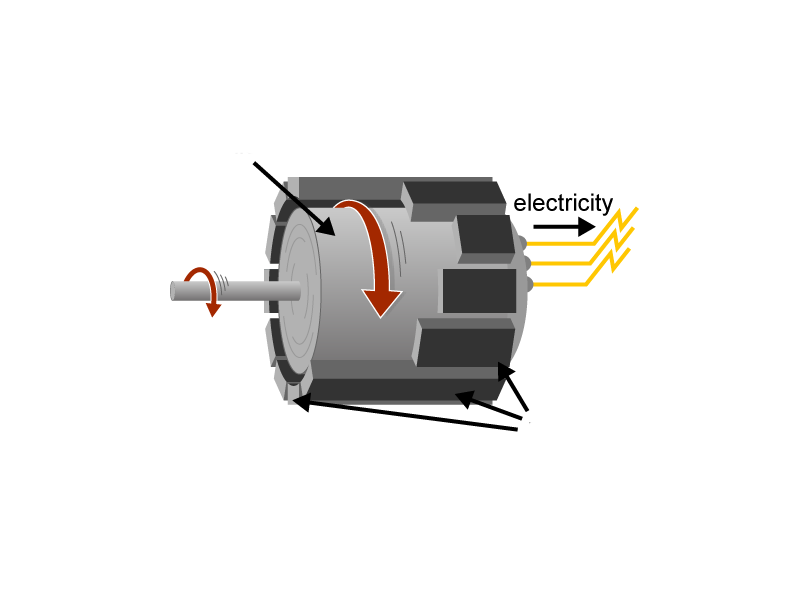
- ARotated by mechanical means
- BRotated by electrical means
- CElectromagnets
- DPermanent magnets
- EPermanent magnets
- FElectromagnets
43Law of Conservation of Energy: Energy [blank_start]cannot[blank_end] be created or destroyed, it is only converted. So no matter what, an electrical device's output energy is [blank_start]the same as[blank_end] the input because some is released as heat or light, etc.
- Athe same as
- Bdifferent from
- Ccannot
- Dcan
44What is Efficiency?
- AHow much energy is used for its intended use
- BHow much energy is used for its unintended use
- CHow much energy is used in total
- DHow much energy is not used
45What is used to measure our energy usage at home?
- AKilowatts per Hour
- BKilowatts per Second
- CWatts per Second
- DWatts per Hour
46What are some good safety points when it comes to electricity usage?
- ANever use electric devices near water
- BDon't use a damaged power cord
- CUnplug devices when examining them
- DOnly put proper prongs in plugs
- EDon't overload outlets
- FStay away from power lines
- GPlug in devices when examining them
- HA damaged power cord works better
- IStay close to power lines
- JPull on the plug, not the cord
47Dam: Using [blank_start]water[blank_end] to turn a turbine. [blank_start]Expensive[blank_end], [blank_start]high[blank_end] energy output.
Coal: Uses [blank_start]steam[blank_end] to turn a turbine. [blank_start]Polluting[blank_end], [blank_start]high[blank_end] energy output.
Nuclear: [blank_start]Splitting an atom[blank_end] to create electricity. [blank_start]Destructive[blank_end], [blank_start]high[blank_end] energy output.
Solar: Converts [blank_start]sunlight[blank_end] to electricity. Takes up space, [blank_start]medium[blank_end] energy output.
Wind: Uses [blank_start]wind[blank_end] to turn a turbine. Takes up space, [blank_start]high[blank_end] energy output.- Awater
- Bsteam
- Csteam
- Dwater
- Ehigh
- Fmedium
- Glow
- Hhigh
- Imedium
- Jlow
- KExpensive
- LDestructive
- MPolluting
- NPolluting
- OExpensive
- PDestructive
- Qhigh
- Rmedium
- Slow
- TDestructive
- UExpensive
- VPolluting
- WSplitting an atom
- XUsing burning
- Ymedium
- Zhigh
- AAlow
- ABhigh
- ACmedium
- ADlow
- AEwind
- AFsunlight
- AGsunlight
- AHwind
Informações
- Descrição
- Use this on the Final and PAT.
- Autor
- Riley Babuik
- Idioma
- English
- Visualizações
- 58
- Etiquetas
- Avaliação
- Ainda sem avaliações Avalie este quiz