
Quiz
Evo 1. The Diversity Of Life, Chapter 26: Introduction to virusses
Este quiz tem tipos de pergunta que abrem no player de sempre.
Perguntas do quiz (8)
1The [blank_start]funghus Armillaria osteyae[blank_end] is the largest living organism in the world.
- Afungus Armillaria osteyae
2Virusses were accidently discovered by [blank_start]Adolf Mayer[blank_end] in an attempt to find the bacteria or toxins causing the [blank_start]mosaic[blank_end] disease in [blank_start]tabacco[blank_end] plants ([blank_start]1889[blank_end]). Later, [blank_start]Martinus Beijerinck[blank_end] coined the term virus ([blank_start]1935[blank_end]).
- AAdolf Mayer
- Bmosaic
- Ctabacco
- D1889
- EMartinus Beijerinck
- F1935
3Virusses can have:
- ADNA
- BRNA
- Cone stranded genome
- Ddouble sided genome
- EATP synthesis mechanisms
- Fprotein translation mechanisms
- Glineair genome
- Hcirculair genome
4Viruses are made up of nucleic acid (DNA or RNA) enclosed in a protein coat (the capsid) and sometimes wrapped in a membranous envelope. The individual protein subuntis making up the capsid are called capsomeres. Although diverse in size and shape, viruses have many common structural features. (all micrographs are colorized TEMs)
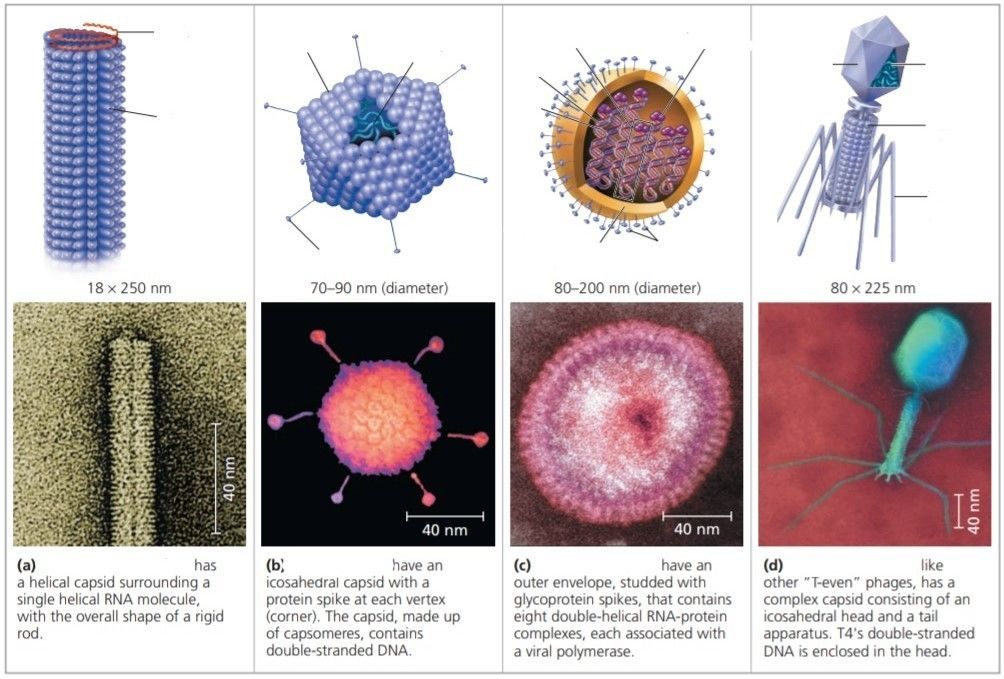
- Aone stranded RNA
- BCapsomere of the capsid
- CMembranous envelope
- Ddouble stranded DNA
- Ecapsomere of the capsid
- Fprotein spike
- Gviral polymerase
- Hglycoprotein spikes
- IRNA protein complex
- JProtein
- KRNA
- LHead
- MDNA
- NTail sheath
- OTail fiber
- PTabacco mosaic disease
- Qadenoviruses
- Rinfluenza viruses
- Sbacteriophage T4
5A virus is an intracellular parasite that uses the equipment and small molecules of its host cell to replicate. In this simplest of viral cycles, the parasite is a DNA virus wth a capsid consisting of a single type of protein. Describe what happens to the virus and the host cell in 1 to 4.
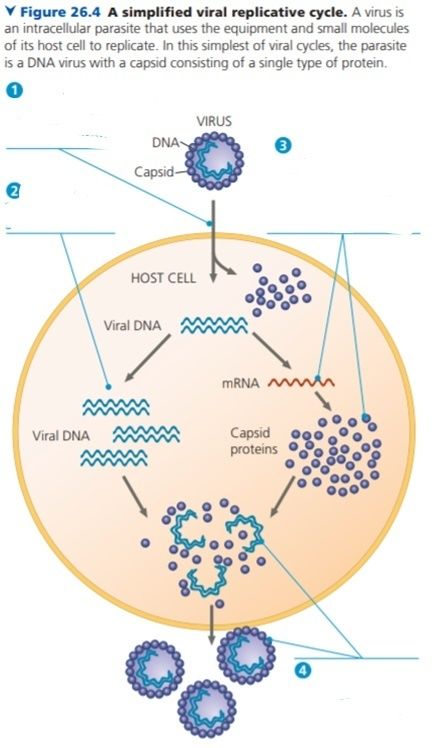
- AThe virus enters the cell and is....
- BHost enzymes replicate the viral genome
- CMeanwhile, host enzymes transcribe the..
- DViral genomes and capsid proteins self..
6After a (Bacterio)phage leaves a host cel in the last stage of infection, they can either destroy the host cell or leave it intact.
The infection cycle of a phage that bursts the host cell is called a [blank_start]lytic cycle[blank_end]. These cells [blank_start]cannot[blank_end] be reused for DNA replication and [blank_start]cannot[blank_end] reproduce normally. Phages that ONLY undergo a [blank_start]lytic[blank_end] cycle are called [blank_start]virulent[blank_end] phages.
The infection cycle of a phage that leaves the host cell intact is called a [blank_start]lysogene cycle[blank_end]. Phages that undergo a [blank_start]lysogene[blank_end] cycle are called [blank_start]termporate[blank_end] phages. The host cell DNA and the phage DNA intergratie and form a [blank_start]prophage[blank_end]. These cells [blank_start]can[blank_end] reproduce normally. Some [blank_start]prophages[blank_end] do produce harmfull substances.
Both the phage genome and enviromental factors can determine the cycle.- Alytic cycle
- Blysogene cycle
- Ccannot
- Dcan
- Ecannot
- Fcan
- Gvirulent
- Htemporate
- Ilysogene cycle
- Jlytic cycle
- Klysogene
- Llytic
- Mlytic
- Nlysogene
- Otermporate
- Pvirulent
- Qprophage
- Rviral DNA
- Snew phage
- Tcan
- Ucannot
- Vprophages
- Wviral DNAs
- Xnew phages
7The lytic cycle of phage T4, a virulent phage. Drag and drop the correct order of the lytic cycle.
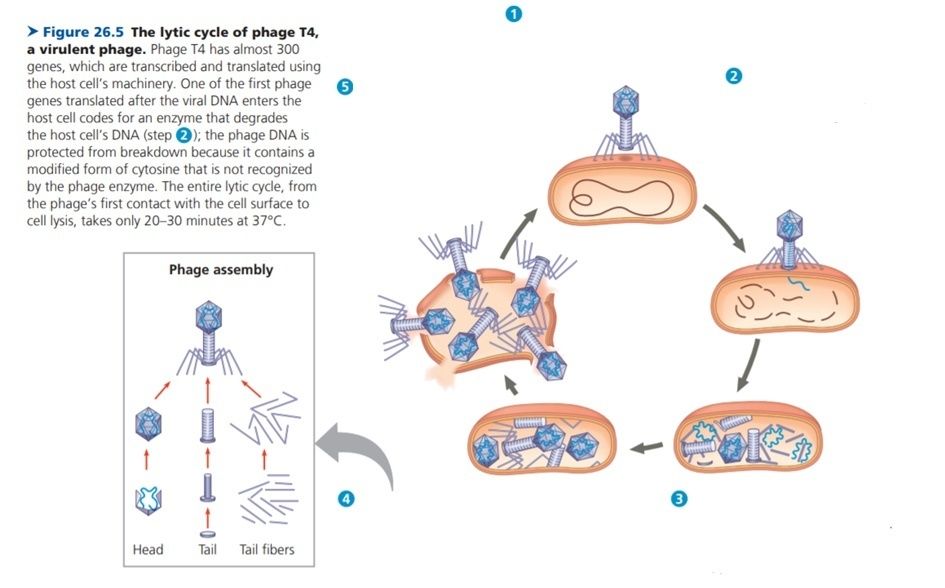
- AAttachement
- BEntry of phage DNA and degr. of host DNA
- CSynthesis of viral genomes and proteins
- DSelf-assembly
- Erelease
8The lytic and lysogenic cycles of phage *lambda*, a temporate phage. Drag and drop the correct cycle.
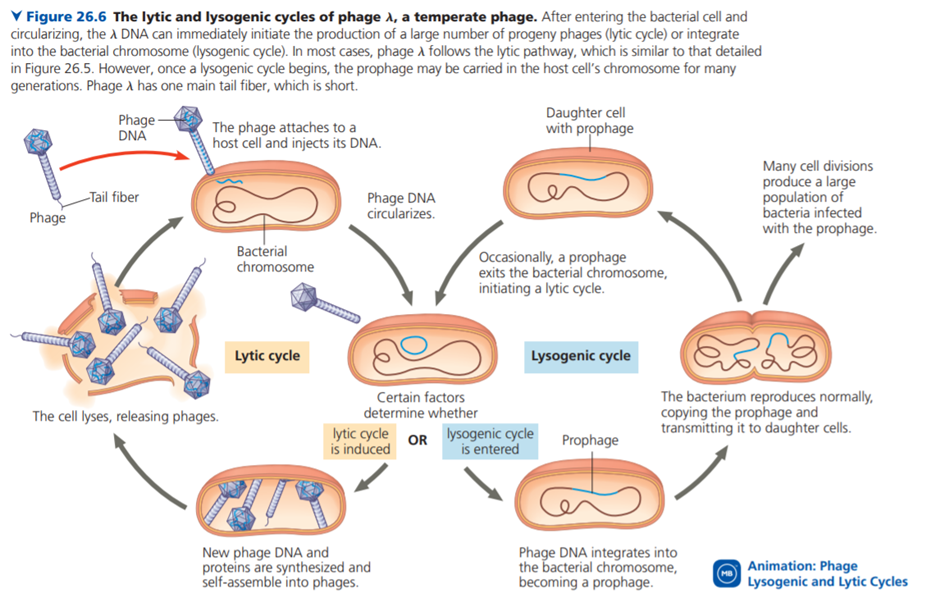
- Alytic
- Blysogenic
Informações
- Descrição
- Quiz sobre Evo 1. The Diversity Of Life, Chapter 26: Introduction to virusses , criado por fleur pietersz em 18-07-2020.
- Autor
- fleur pietersz
- Idioma
- English
- Visualizações
- 138
- Etiquetas
- Avaliação
- Ainda sem avaliações Avalie este quiz