
Quiz
Mock CEPT TEST - Reading section
Este quiz tem tempo limite, por isso abre no player de sempre.
Perguntas do quiz (13)
1That old saucepan will come in ________ when we go camping.
- Aconvenient
- Bfitting
- Chandy
- Dsuitable
2The builders are ______ good progress with the new house.
- Agetting
- Bdoing
- Cmaking
- Dtaking
3What should James do?
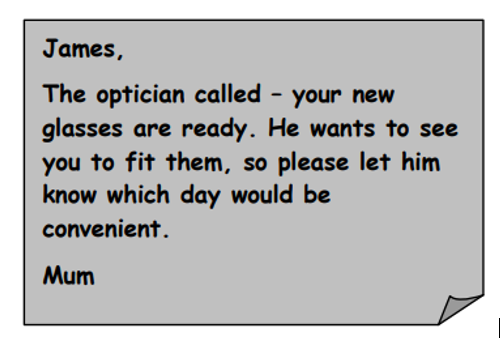
- Aask the optician to repair his glasses.
- Bmake an appointment with the optician.
- Ccall the optician to discuss his eye test.
4What’s the side effect of non-native plants in the island?
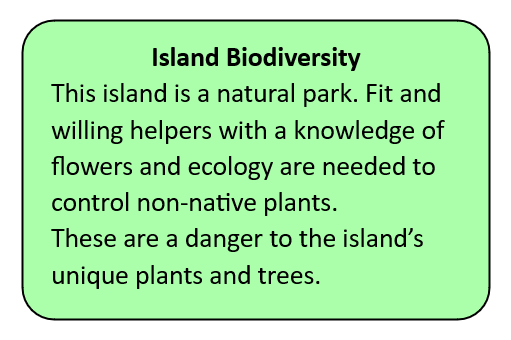
- ANative trees would be dangerous.
- BNative plants would be harmed.
- CFlowers of the island are unique.
5Why we need to play
Human beings are not the only creatures that like to have fun. Many animals play, as do some birds. However, no other creatures spend so much time enjoying themselves as human beings do. Indeed, we [blank_start]_____[blank_end] onto our sense of fun right into adulthood.
So why do human beings spend so much time playing? One reason is that we have time for leisure; animals have very little time to play as most of their life is spent sleeping and [blank_start]_____[blank_end] food.
So, is play just an opportunity for us to [blank_start]_____[blank_end] in enjoyable activities or does it have a more important [blank_start]_____[blank_end]? According to scientists, play has several very real [blank_start]______[blank_end] for us — it helps our physical, intellectual and social development.- Ahold
- Bkeep
- Csave
- Dstay
- Esearching
- Flooking
- Gseeking
- Hgaining
- Iengage
- Jcombine
- Kcontribute
- Linvolve
- Mmotivate
- Npurpose
- Ointention
- Pcause
- Qassets
- Rprofits
- Sservices
- Tbenefits
6Birth of the movies
Moving pictures were invented by the brothers Louis and Auguste Lumière at the end of the 19th century. Movies very [blank_start]______[blank_end] became popular all over the world. In 1907 the first studios were bult in a [blank_start]______[blank_end] of Los Angeles called Hollywood. It was the perfect place, close to many kinds of natural scenery. [blank_start]_____[blank_end] the 1920s, Hollywood was the center of the world film [blank_start]_____[blank_end]. To begin with, the movIes had no sound. Words [blank_start]_____[blank_end] on screen from time to time to explain the story.- Aquickly
- Bimmediately
- Cfast
- Dearly
- Epiece
- Fsite
- Glocation
- Hdistrict
- ITo
- JAt
- KFor
- LBy
- Mindustry
- Ncompany
- Otrade
- Pfirm
- Qdeveloped
- Rhappened
- Sappeared
- Tdisplayed
7Fill the gaps using only ONE word.
TEA
Tea is a popular drink with many people. It is estimated that the consumption of tea in England is [blank_start]____[blank_end] 165 million cups daily. Despite this, the drink [blank_start]____[blank_end] virtually unknown in England until about 400 years ago. The first reference to tea in England comes in a diary written in 1660.
It was believed that tea was good for people as it seemed to be capable [blank_start]____[blank_end] reviving the spirits and curing certain minor illnesses. It has even been suggested [blank_start]____[blank_end] some historians that it played a significant part in the Industrial Revolution. Tea, they say, increased the number of hours that labourers could work in factories as the caffeine in tea made [blank_start]____[blank_end] more energetic and consequently able to work longer hours.- Aover
- Bwas
- Cof
- Dby
- Ethem
8We live on the island of Hale. It's about four kilometres long and two kilometres wide at its broadest point, and it's joined to the mainland by a causeway called the Stand - a narrow road built across the mouth of the river which separates us from the rest of the country. Most of the time you wouldn't know we're on an island because the river mouth between us and the mainland is just a vast stretch of tall grasses and brown mud. But when there's a high tide and the water rises a half a metre or so above the road and nothing can pass until the tide goes out again a few hours later, then you know it's an island.
We were on our way back from the mainland. My older brother, Dominic, had just finished his first year at university in a town 150 km away. Dominic's train was due in at five and he'd asked for a lift back from the station. Now, Dad normally hates being disturbed when he's writing (which is just about all the time), and he also hates having to go anywhere, but despite the typical sighs and moans – why can't he get a taxi? what's wrong with the bus? – I could tell by the sparkle in his eyes that he was really looking forward to seeing Dominic.
So, anyway, Dad and I had driven to the mainland and picked up Dominic from the station. He had been talking non-stop from the moment he'd slung his rucksack in the boot and got in the car. University this, university that, writers, books, parties, people, money, gigs..... And when I say talking, I don't mean talking as in having a conversation, I mean talking as in jabbering like a mad thing. I didn't like it .....the way he spoke and waved his hands around as if he was some kind of intellectual or something. It was embarrassing. It made me feel uncomfortable – that kind of discomfort you feel when someone you like, someone close to you, suddenly starts acting like a complete idiot. And I didn't like the way he was ignoring me, either. For all the attention I was getting I might as well not have been there. I felt a stranger in my own car.
As we approached the island on that Friday afternoon, the tide was low and the Stand welcomed us home, stretched out before us, clear and dry, beautifully hazy in the heat – a raised strip of grey concrete bound by white railings and a low footpath on either side, with rough cobbled banks leading down to the water. Beyond the railings, the water was glinting with that wonderful silver light we sometimes get here in the late afternoon which lazes through to the early evening.
We were about halfway across when I saw the boy. My first thought was how odd it was to see someone walking on the Stand. You don't often see people walking around here. Between Hale and Moulton (the nearest town about thirty kilometres away on the mainland), there's nothing but small cottages, farmland, heathland and a couple of hills. So islanders don't walk “because of that.” If they're going to Moulton they tend to take the bus. So the only pedestrians you're likely to see around here are walkers or bird-watchers. But even from a distance I could tell that the figure ahead didn't fit into either of these categories. I wasn't sure how I knew, I just did.
As we drew closer, he became clearer. He was actually a young man rather than a boy. Although he was on the small side, he wasn't as slight as I'd first thought. He wasn't exactly muscular, but he wasn't weedy-looking either. It's hard to explain. There was a sense of strength about him, a graceful strength that showed in his balance, the way he held himself, the way he walked....
QUESTION
1. In the first paragraph, what is Caitlin's main point about the island?- AIt can be dangerous to try to cross from the mainland.
- BIt is much smaller than it looks from the mainland.
- CIt is only completely cut off at certain times.
- DIt can be a difficult place for people to live in.
9We live on the island of Hale. It's about four kilometres long and two kilometres wide at its broadest point, and it's joined to the mainland by a causeway called the Stand - a narrow road built across the mouth of the river which separates us from the rest of the country. Most of the time you wouldn't know we're on an island because the river mouth between us and the mainland is just a vast stretch of tall grasses and brown mud. But when there's a high tide and the water rises a half a metre or so above the road and nothing can pass until the tide goes out again a few hours later, then you know it's an island.
We were on our way back from the mainland. My older brother, Dominic, had just finished his first year at university in a town 150 km away. Dominic's train was due in at five and he'd asked for a lift back from the station. Now, Dad normally hates being disturbed when he's writing (which is just about all the time), and he also hates having to go anywhere, but despite the typical sighs and moans – why can't he get a taxi? what's wrong with the bus? – I could tell by the sparkle in his eyes that he was really looking forward to seeing Dominic.
So, anyway, Dad and I had driven to the mainland and picked up Dominic from the station. He had been talking non-stop from the moment he'd slung his rucksack in the boot and got in the car. University this, university that, writers, books, parties, people, money, gigs..... And when I say talking, I don't mean talking as in having a conversation, I mean talking as in jabbering like a mad thing. I didn't like it .....the way he spoke and waved his hands around as if he was some kind of intellectual or something. It was embarrassing. It made me feel uncomfortable – that kind of discomfort you feel when someone you like, someone close to you, suddenly starts acting like a complete idiot. And I didn't like the way he was ignoring me, either. For all the attention I was getting I might as well not have been there. I felt a stranger in my own car.
As we approached the island on that Friday afternoon, the tide was low and the Stand welcomed us home, stretched out before us, clear and dry, beautifully hazy in the heat – a raised strip of grey concrete bound by white railings and a low footpath on either side, with rough cobbled banks leading down to the water. Beyond the railings, the water was glinting with that wonderful silver light we sometimes get here in the late afternoon which lazes through to the early evening.
We were about halfway across when I saw the boy. My first thought was how odd it was to see someone walking on the Stand. You don't often see people walking around here. Between Hale and Moulton (the nearest town about thirty kilometres away on the mainland), there's nothing but small cottages, farmland, heathland and a couple of hills. So islanders don't walk “because of that.” If they're going to Moulton they tend to take the bus. So the only pedestrians you're likely to see around here are walkers or bird-watchers. But even from a distance I could tell that the figure ahead didn't fit into either of these categories. I wasn't sure how I knew, I just did.
As we drew closer, he became clearer. He was actually a young man rather than a boy. Although he was on the small side, he wasn't as slight as I'd first thought. He wasn't exactly muscular, but he wasn't weedy-looking either. It's hard to explain. There was a sense of strength about him, a graceful strength that showed in his balance, the way he held himself, the way he walked....
QUESTION
2. What does Caitlin suggest about her father?- AHis writing prevents him from doing things he wants to with his family.
- BHis initial reaction to his son's request is different from usual.
- CHis true feelings are easily hidden from his daughter.
- DHis son's arrival is one event he will take time off for.
10We live on the island of Hale. It's about four kilometres long and two kilometres wide at its broadest point, and it's joined to the mainland by a causeway called the Stand - a narrow road built across the mouth of the river which separates us from the rest of the country. Most of the time you wouldn't know we're on an island because the river mouth between us and the mainland is just a vast stretch of tall grasses and brown mud. But when there's a high tide and the water rises a half a metre or so above the road and nothing can pass until the tide goes out again a few hours later, then you know it's an island.
We were on our way back from the mainland. My older brother, Dominic, had just finished his first year at university in a town 150 km away. Dominic's train was due in at five and he'd asked for a lift back from the station. Now, Dad normally hates being disturbed when he's writing (which is just about all the time), and he also hates having to go anywhere, but despite the typical sighs and moans – why can't he get a taxi? what's wrong with the bus? – I could tell by the sparkle in his eyes that he was really looking forward to seeing Dominic.
So, anyway, Dad and I had driven to the mainland and picked up Dominic from the station. He had been talking non-stop from the moment he'd slung his rucksack in the boot and got in the car. University this, university that, writers, books, parties, people, money, gigs..... And when I say talking, I don't mean talking as in having a conversation, I mean talking as in jabbering like a mad thing. I didn't like it .....the way he spoke and waved his hands around as if he was some kind of intellectual or something. It was embarrassing. It made me feel uncomfortable – that kind of discomfort you feel when someone you like, someone close to you, suddenly starts acting like a complete idiot. And I didn't like the way he was ignoring me, either. For all the attention I was getting I might as well not have been there. I felt a stranger in my own car.
As we approached the island on that Friday afternoon, the tide was low and the Stand welcomed us home, stretched out before us, clear and dry, beautifully hazy in the heat – a raised strip of grey concrete bound by white railings and a low footpath on either side, with rough cobbled banks leading down to the water. Beyond the railings, the water was glinting with that wonderful silver light we sometimes get here in the late afternoon which lazes through to the early evening.
We were about halfway across when I saw the boy. My first thought was how odd it was to see someone walking on the Stand. You don't often see people walking around here. Between Hale and Moulton (the nearest town about thirty kilometres away on the mainland), there's nothing but small cottages, farmland, heathland and a couple of hills. So islanders don't walk “because of that.” If they're going to Moulton they tend to take the bus. So the only pedestrians you're likely to see around here are walkers or bird-watchers. But even from a distance I could tell that the figure ahead didn't fit into either of these categories. I wasn't sure how I knew, I just did.
As we drew closer, he became clearer. He was actually a young man rather than a boy. Although he was on the small side, he wasn't as slight as I'd first thought. He wasn't exactly muscular, but he wasn't weedy-looking either. It's hard to explain. There was a sense of strength about him, a graceful strength that showed in his balance, the way he held himself, the way he walked....
QUESTION
3. Caitlin emphasises her feelings of discomfort because she- Ais embarrassed that she doesn't understand what her brother is talking about.
- Bfeels confused about why she can't relate to her brother any more.
- Cis upset by the unexpected change in her brother's behaviour.
- Dfeels foolish that her brother's attention is so important to her.
11We live on the island of Hale. It's about four kilometres long and two kilometres wide at its broadest point, and it's joined to the mainland by a causeway called the Stand - a narrow road built across the mouth of the river which separates us from the rest of the country. Most of the time you wouldn't know we're on an island because the river mouth between us and the mainland is just a vast stretch of tall grasses and brown mud. But when there's a high tide and the water rises a half a metre or so above the road and nothing can pass until the tide goes out again a few hours later, then you know it's an island.
We were on our way back from the mainland. My older brother, Dominic, had just finished his first year at university in a town 150 km away. Dominic's train was due in at five and he'd asked for a lift back from the station. Now, Dad normally hates being disturbed when he's writing (which is just about all the time), and he also hates having to go anywhere, but despite the typical sighs and moans – why can't he get a taxi? what's wrong with the bus? – I could tell by the sparkle in his eyes that he was really looking forward to seeing Dominic.
So, anyway, Dad and I had driven to the mainland and picked up Dominic from the station. He had been talking non-stop from the moment he'd slung his rucksack in the boot and got in the car. University this, university that, writers, books, parties, people, money, gigs..... And when I say talking, I don't mean talking as in having a conversation, I mean talking as in jabbering like a mad thing. I didn't like it .....the way he spoke and waved his hands around as if he was some kind of intellectual or something. It was embarrassing. It made me feel uncomfortable – that kind of discomfort you feel when someone you like, someone close to you, suddenly starts acting like a complete idiot. And I didn't like the way he was ignoring me, either. For all the attention I was getting I might as well not have been there. I felt a stranger in my own car.
As we approached the island on that Friday afternoon, the tide was low and the Stand welcomed us home, stretched out before us, clear and dry, beautifully hazy in the heat – a raised strip of grey concrete bound by white railings and a low footpath on either side, with rough cobbled banks leading down to the water. Beyond the railings, the water was glinting with that wonderful silver light we sometimes get here in the late afternoon which lazes through to the early evening.
We were about halfway across when I saw the boy. My first thought was how odd it was to see someone walking on the Stand. You don't often see people walking around here. Between Hale and Moulton (the nearest town about thirty kilometres away on the mainland), there's nothing but small cottages, farmland, heathland and a couple of hills. So islanders don't walk “because of that.” If they're going to Moulton they tend to take the bus. So the only pedestrians you're likely to see around here are walkers or bird-watchers. But even from a distance I could tell that the figure ahead didn't fit into either of these categories. I wasn't sure how I knew, I just did.
As we drew closer, he became clearer. He was actually a young man rather than a boy. Although he was on the small side, he wasn't as slight as I'd first thought. He wasn't exactly muscular, but he wasn't weedy-looking either. It's hard to explain. There was a sense of strength about him, a graceful strength that showed in his balance, the way he held himself, the way he walked....
QUESTION
4. In the fourth paragraph, what is Caitlin's purpose in describing the island?- Ato express her positive feelings about it
- Bto explain how the road was built
- Cto illustrate what kind of weather was usual
- Dto describe her journey home
12We live on the island of Hale. It's about four kilometres long and two kilometres wide at its broadest point, and it's joined to the mainland by a causeway called the Stand - a narrow road built across the mouth of the river which separates us from the rest of the country. Most of the time you wouldn't know we're on an island because the river mouth between us and the mainland is just a vast stretch of tall grasses and brown mud. But when there's a high tide and the water rises a half a metre or so above the road and nothing can pass until the tide goes out again a few hours later, then you know it's an island.
We were on our way back from the mainland. My older brother, Dominic, had just finished his first year at university in a town 150 km away. Dominic's train was due in at five and he'd asked for a lift back from the station. Now, Dad normally hates being disturbed when he's writing (which is just about all the time), and he also hates having to go anywhere, but despite the typical sighs and moans – why can't he get a taxi? what's wrong with the bus? – I could tell by the sparkle in his eyes that he was really looking forward to seeing Dominic.
So, anyway, Dad and I had driven to the mainland and picked up Dominic from the station. He had been talking non-stop from the moment he'd slung his rucksack in the boot and got in the car. University this, university that, writers, books, parties, people, money, gigs..... And when I say talking, I don't mean talking as in having a conversation, I mean talking as in jabbering like a mad thing. I didn't like it .....the way he spoke and waved his hands around as if he was some kind of intellectual or something. It was embarrassing. It made me feel uncomfortable – that kind of discomfort you feel when someone you like, someone close to you, suddenly starts acting like a complete idiot. And I didn't like the way he was ignoring me, either. For all the attention I was getting I might as well not have been there. I felt a stranger in my own car.
As we approached the island on that Friday afternoon, the tide was low and the Stand welcomed us home, stretched out before us, clear and dry, beautifully hazy in the heat – a raised strip of grey concrete bound by white railings and a low footpath on either side, with rough cobbled banks leading down to the water. Beyond the railings, the water was glinting with that wonderful silver light we sometimes get here in the late afternoon which lazes through to the early evening.
We were about halfway across when I saw the boy. My first thought was how odd it was to see someone walking on the Stand. You don't often see people walking around here. Between Hale and Moulton (the nearest town about thirty kilometres away on the mainland), there's nothing but small cottages, farmland, heathland and a couple of hills. So islanders don't walk “because of that.” If they're going to Moulton they tend to take the bus. So the only pedestrians you're likely to see around here are walkers or bird-watchers. But even from a distance I could tell that the figure ahead didn't fit into either of these categories. I wasn't sure how I knew, I just did.
As we drew closer, he became clearer. He was actually a young man rather than a boy. Although he was on the small side, he wasn't as slight as I'd first thought. He wasn't exactly muscular, but he wasn't weedy-looking either. It's hard to explain. There was a sense of strength about him, a graceful strength that showed in his balance, the way he held himself, the way he walked....
QUESTION
5. In the fifth paragraph, 'because of that', 'that' refers to the fact that- Alocals think it is odd to walk anywhere.
- Bit is easier for people to take the bus than walk.
- Cpeople have everything they need on the island.
- Dthere is nowhere in particular to walk to from the island.
13We live on the island of Hale. It's about four kilometres long and two kilometres wide at its broadest point, and it's joined to the mainland by a causeway called the Stand - a narrow road built across the mouth of the river which separates us from the rest of the country. Most of the time you wouldn't know we're on an island because the river mouth between us and the mainland is just a vast stretch of tall grasses and brown mud. But when there's a high tide and the water rises a half a metre or so above the road and nothing can pass until the tide goes out again a few hours later, then you know it's an island.
We were on our way back from the mainland. My older brother, Dominic, had just finished his first year at university in a town 150 km away. Dominic's train was due in at five and he'd asked for a lift back from the station. Now, Dad normally hates being disturbed when he's writing (which is just about all the time), and he also hates having to go anywhere, but despite the typical sighs and moans – why can't he get a taxi? what's wrong with the bus? – I could tell by the sparkle in his eyes that he was really looking forward to seeing Dominic.
So, anyway, Dad and I had driven to the mainland and picked up Dominic from the station. He had been talking non-stop from the moment he'd slung his rucksack in the boot and got in the car. University this, university that, writers, books, parties, people, money, gigs..... And when I say talking, I don't mean talking as in having a conversation, I mean talking as in jabbering like a mad thing. I didn't like it .....the way he spoke and waved his hands around as if he was some kind of intellectual or something. It was embarrassing. It made me feel uncomfortable – that kind of discomfort you feel when someone you like, someone close to you, suddenly starts acting like a complete idiot. And I didn't like the way he was ignoring me, either. For all the attention I was getting I might as well not have been there. I felt a stranger in my own car.
As we approached the island on that Friday afternoon, the tide was low and the Stand welcomed us home, stretched out before us, clear and dry, beautifully hazy in the heat – a raised strip of grey concrete bound by white railings and a low footpath on either side, with rough cobbled banks leading down to the water. Beyond the railings, the water was glinting with that wonderful silver light we sometimes get here in the late afternoon which lazes through to the early evening.
We were about halfway across when I saw the boy. My first thought was how odd it was to see someone walking on the Stand. You don't often see people walking around here. Between Hale and Moulton (the nearest town about thirty kilometres away on the mainland), there's nothing but small cottages, farmland, heathland and a couple of hills. So islanders don't walk “because of that.” If they're going to Moulton they tend to take the bus. So the only pedestrians you're likely to see around here are walkers or bird-watchers. But even from a distance I could tell that the figure ahead didn't fit into either of these categories. I wasn't sure how I knew, I just did.
As we drew closer, he became clearer. He was actually a young man rather than a boy. Although he was on the small side, he wasn't as slight as I'd first thought. He wasn't exactly muscular, but he wasn't weedy-looking either. It's hard to explain. There was a sense of strength about him, a graceful strength that showed in his balance, the way he held himself, the way he walked....
QUESTION
6. What do we learn about Caitlin's reactions to the boy?- AShe felt his air of confidence contrasted with his physical appearance.
- BShe was able to come up with a reason for him being there.
- CShe realised her first impression of him was inaccurate.
- DShe thought she had seen him somewhere before.
Informações
- Descrição
- ENGLISH Quiz sobre Mock CEPT TEST - Reading section, criado por Lección Saber em 28-03-2024.
- Autor
- Lección Saber
- Idioma
- English
- Visualizações
- 514
- Etiquetas
- Avaliação
- Ainda sem avaliações Avalie este quiz