
Quiz
Biophysics MCQs Part 2 PMU- 1st YR/2nd Sem
Este quiz tem tipos de pergunta que abrem no player de sempre.
Perguntas do quiz (54)
1Membrane potential operated channels are
- Aactive at fixed value of the membrane potential only
- Bpermanently active
- Cactive in certain range of membrane potential
2Striated muscle are structure bases of
- Aupper levels of gastro intestial
- Blower levels of gastro intestial
- Cnone of these
3Muscle extraction is possible when
- ACa ions are bounded
- BCa contraction increase to 10^-5 mol/s
- CCa to 10 millimols
4Action potential is shape depends on
- AIrritation strength
- BCell type
- CAmount of lipids in the membrane irritated
5Action potential is
- AMinimal value of resting potential
- BMaximum value of resting potential
- CNone of these
6Elevation of calcium concentration is for
- Acontraction
- Binterruption of action potential
- Crelaxion
7Stable membrane is
- Aphasic sm
- Btonic sm
- Cboth
8Average power of contraction of smooth muscle per unit cross section
- Ais smaller than that of striated muscle
- Bbilayer
- Cequal
9Actin and myosin are in [blank_start]cellular fiber network[blank_end]
- Acellular fiber network
10Smooth muscle cells are organised in [blank_start]bundles[blank_end] in strong parallel layers or spherical structures
- Abundles
11Ion channels are
- Atubular links between cells
- Bionized groove upon the membrane
- Cprotein structures in membranes through which ions pass
12Ion channels conductivity during the action potential
- Ahas a constant value
- Bdepends on the level of membrane potential
- Cincreases logarithimacally over the time
13On the border water-air (the free surface of the water) lipids from
- Amonolayer
- Bthree-layered electrically conductive structure
- Clipid gel
14In stationary state the membrane potential
- Astays constant if parameters of the system are stable
- Bis altered in sinus manner
- Cslowly reaches to zero
15Both smooth muscle contractions and skeletal muscle contractions involve thin (actin) filament over the thick (myosin) filaments
- AVerdadeiro
- BFalso
16In smooth muscle contraction, the majority of calcium (Ca2+) needed for contraction enters from extracellular fluid.
- AVerdadeiro
- BFalso
17Troponin and tropomyosin are attached to thick filaments of smooth muscle cells
- AVerdadeiro
- BFalso
18Myosin of the thick filaments of smooth muscle cells must be phosphorylated in order to bind of the thin filaments
- AVerdadeiro
- BFalso
19Nor-epinephrine released from sympathetic nerve terminals in the heart cause a decrease in the pacemaker activity.
- AVerdadeiro
- BFalso
20The rapid upstoke (phase 0) of actin potentials in ventricular and atrial myocytes results from opening of Ca2+ channels.
- AVerdadeiro
- BFalso
21Thick filaments are composed of myosin and thin filaments are primarily composed of actin.
- AVerdadeiro
- BFalso
22Tropomyosin binds Ca2+ causing a conformational change that causes troponin to uncover binding sites on actin for crossbridge attachment.
- AVerdadeiro
- BFalso
23Nifedine is a
- ACalcium (Ca2+) channel blocker
- BSodium (Na+) channel blocker
- CPotassium (K+) channel blocker
24Tetraethylammonium is a blocker for which channel?
- ACalcium (Ca2+) channel
- BSodium (Na+) channel
- CPotassium (K+) channel
25Verapamil is a
- ACalcium (Ca2+) channel blocker
- BSodium (Na+) channel blocker
- CPotassium (K+) channel blocker
26Which is not a type/class of carrier protein?
- AUniport
- BSymport
- CAntiport
- DMicroport
27Ionophores have following action except
- AInhibit ADP to ATP conversion
- BAbolish proton gradient
- CAbolish pH gradient
- DHydrophilic in character
28Diffusion through a semi-permeable membrane with different permeabilities for different substance is called:
- ATran-Diffusion
- BFiltration
- COsmosis
- DDiffusion
29The pressure that would have to be applied to a pure solvent to prevent it from passing into a given solution by osmosis
- AOsmotic Pressure
- BFiltration Pressure
- COsmotic Stability
30Movement of liquid across a semipermeable membrane under hydrostatic pressure is called
- AFiltration
- BHydrostatic Diffusion
- COsmosis
- DNone of these
31GLUT1 and Ionophores valiomycin are examples of
- AUniport
- BSymport
- CAntiport
32Antiport is best described by
- ACarrier protein binds one solutes and transports it across the membrane
- BCarrier protein binds two different solutes and transport them together across the membrane
- CA substrate binds and is transported across the membrane then another substrate binds and is transported in the other direction
33A factors that does NOT affect rate of facilitated diffusion:
- AConcentration gradient across the membrane
- BAmount of carrier proteins available
- CSpeed of carrier and substrate attachment
- DHow fast the protein changes shape after attachment
- EMean Molecular Velocity
34Which of these is not a type of ion channel?
- AReceptor Regulated
- BMembrane Potential-Dependent
- CIon Regulated
35Which of this is not a class of ATPase
- AP-Type
- BF-Type
- CV-Type
- DL-Type
36Which statement is incorrect?
- AP-type- transport Na+, K+, Ca2+ through plasma membrane and in doing so they are phosphorylated
- BF-type- found in mitochondria where they are the prime producers of ATP by using the proton gradient generated by oxidative phosphorylation
- CV-type- only found in plant cells, catalysing ATP hydrolysis to transport solutes
37The downhill (along concentration Gradient) movement of one species driving the uphill (against concentration Gradient) movement of another where metabolic energy is not utilised directly is called
- APrimary Active Transport
- BSecondary Active Transport
- CNone of these
38Which part of the sodium-potassium pump (Na=/K+ ATPase) has an ATP binding site and 3 other sites which have a high affinity for Na+ ion
- Athe part of the protein that faces the cytoplasm (inner part)
- Bthe part of the protein that faces extracellular environment (outer part)
- CBoth of these
39Label Image
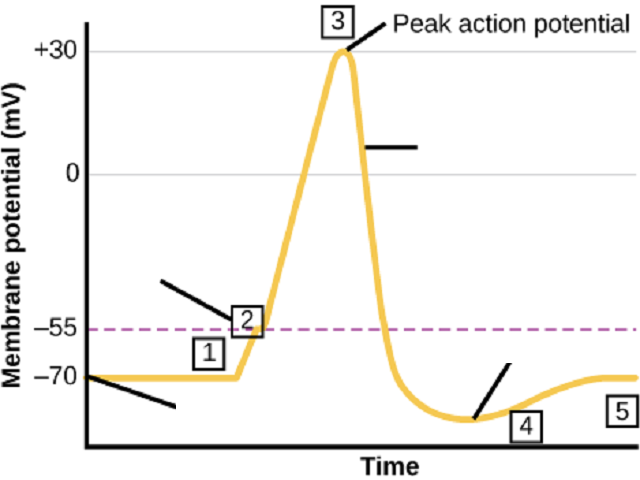
- AResting Potential
- BDepolarization
- CRepolarization
- DHyperpolarization
40The resting potential can be changed by chemical, mechanical or electrical stimulus
- AVerdadeiro
- BFalso
41No refractory period is associated with graded potentials.
- AVerdadeiro
- BFalso
42Quiescent cells
- Arefer to the period when a cell is not dividing
- Brefer to the period when a cell is dividing
- Cnone of these
43If the membrane potential is changed slowly, the electrical current can pass without action potential needing to be initiated.
This phenomena is known as- AAccommodation
- BAction Potential
- CElectronic Potential
- DNone of these
44Fill in the gaps: (symbols like K+ /Na+/Ca2+ are used instead of word)
Phase 0: Rapid depolarization: [blank_start]increased[blank_end] Na+ and [blank_start]decreased[blank_end] K+ conductances
Phase 1: Initial re polarization: decreased [blank_start]Na+[blank_end] and increased [blank_start]K+[blank_end] conductances
Phase 2: [blank_start]Plateau phase[blank_end]: increased [blank_start]Ca2+[blank_end] conductance
Phase 3: Re-polarization: increased [blank_start]K+[blank_end] and decreased [blank_start]Ca2+[blank_end] conductances
Phase 4:[blank_start]Resting potential[blank_end]: [blank_start]increased[blank_end] [blank_start]K+[blank_end] and [blank_start]decreased[blank_end] Na+ and [blank_start]decreased[blank_end] Ca2+ conductance- Aincreased
- Bdecreased
- CPlateau phase
- DNa+
- EK+
- FCa2+
- GK+
- Hdecreased
- IResting potential
- Jincreased
- Kdecreased
- LK+
- MCa2+
45What results in a decrease of AP amplitude and depolarization block therefore the heart stops in diastole?
- AIncreased sodium (Na+) extracellularly
- BIncreased Potassium (K+) extracellularly
- CDecreased Potassium (K+) extracellularly
46What results in shortening of the refractory period therefore a defibrilation risk?
- AIncreased extracellular potassium (K+)
- BDecreased extracellular potassium (K+)
- CIncreased extracellular calcium (Ca+)
47What would cause a sudden decrease of AP depolarization phase and its duration resulting in cells becoming unexcitable?
- AIncreased extracellular potassium (K+)
- BIncreased extracellular sodium (Na+)
- CDecreased extracellular sodium (Na+)
48Which of these statements are true
More than one correct ans.- AZ line – Where the myosin filaments are anchored
- BM line – Where the myosin filaments are anchored
- CA band – The length of a myosin filament, may contain overlapping actin filaments
- DI band – Contains only actin filaments
- EH Zone- Contains only myosin filaments
- FAll are true
- GNone are true
49Which is true for Troponin T
- AConnect troponin to Tropomyosin
- BSuppress interaction between actin and myosin in absence of Ca2+
- CReversible connection with Ca2+ when concentration of Ca2+ is high enough
50Which best describes Isometric muscle contraction?
- AMuscles shortens in length in relationship to the production of movement (i.e. push ups)
- BMuscle length remains the same, no movement occurs but the force (muscle tension) is increased above tonic levels to resist gravity or other forces i.e. holding a shopping bag
- CContraction against increasing force
51[blank_start]Isotonic[blank_end]: Muscles shortens in length in relationship to the production of movement (i.e. push ups)
[blank_start]Isometric[blank_end]: Muscle length remains the same, no movement occurs but the force (muscle tension) is increased above tonic levels to resist gravity or other forces i.e. holding a shopping bag
[blank_start]Auxotonic[blank_end]: Contraction against increasing force- AIsotonic
- BIsometric
- CAuxotonic
52Force<load therefore axotonic/eccentric contraction speed of contraction (V) is
- ASlow
- BFast
- CStays the same
53Electromechanical connection is the dependence between membrane potential and
- AThe contractile activity (CA)
- BJust the membrane potential
- CNone of these
54How long is the latent period between stimuli and muscle contraction
- A2-3 ms
- B2-3 sec
- CNo latent period
- D12-13 ms
Informações
- Descrição
- Biophysics mcqs from pics
- Autor
- Med Student
- Idioma
- English
- Visualizações
- 399
- Etiquetas
- Avaliação
- Ainda sem avaliações Avalie este quiz