
Quiz
Chapter 12 Quiz 1
Este quiz tem tipos de pergunta que abrem no player de sempre.
Perguntas do quiz (32)
1What would have happened if Avery had added an enzyme that digested all the nucleic acids to the mixture of heat-killed bacteria, added the mixture to harmless bacteria, and injected the mixture into mice?
- AThe harmless bacteria would have been transformed, and the mice would have died.
- BThe harmless bacteria would have been transformed, and the mice would have lived.
- CThe harmless bacteria would not have been transfromed, and the mice would have lived.
- DThe harnless bacteria would not have been transformed, and the mice would have died.
2What is inside a bacteriophage?
- Anucliec acid
- Bcarbohydrate
- Cprotein
- Dlipid
3In what way is DNA like a book?
- ADNA has information wrapped in an identifying cover.
- BDNA has information organized with an kind of index.
- CDNA has information that is periodically updated.
- DDNA has stored information, that can be copied and passed on.
4In which cells is the accurate transmission of information most important?
- Asex cells
- Bnerve cells
- Cbone cells
- Dskin cells
5Which of the following is a nucleotide found in DNA?
- Adeoxyribose + phosphate group + polymerase
- Bdeoxyribose + phosphate group + cytosine
- Cadenine + phosphate group + thymine
- Dcytosine + phosphate group + guanine
6The table in Figure 12–3 shows the results of measuring the percentages of the four bases in the DNA of several different organisms. Some of the values are missing from the table. Based on Chargaff’s rule, the percentages of guanine bases in chicken DNA should be around
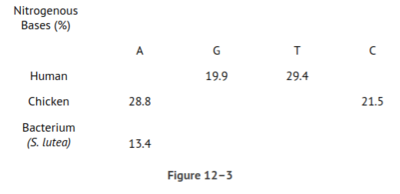
- A19.9%
- B21.5%
- C13.4%
- D28.8%
7Based on Chargaff’s rule, the percentage of cytosine in the DNA of the bacterium, S. Lutea in Figure 12–3, should be around
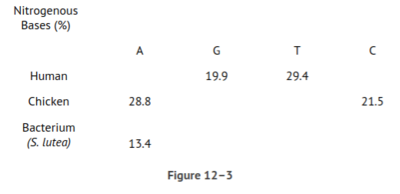
- A73.2
- B29.4%.
- C26.6%.
- D36.6%.
8Which scientist made x-ray diffraction photos of DNA?
- AChargaff
- BAvery
- CFranklin
- DWatson
9What is the chronological order of the important discoveries in the structure of DNA?
- AGriffith-->Avery --> Hershey & Chase--> Franklin makes an X-ray diffraction photo of DNA --> Watson and Crick identify the double helix --> Chargaff’s ratios of nucleotides
- BGriffith-->Avery --> Hershey & Chase--> Chargaff’s ratios of nucleotides --> Franklin makes an X-ray diffraction photo of DNA --> Watson and Crick identify the double helix
- CGriffith-->Avery --> Hershey & Chase--> Franklin makes an X-ray diffraction photo of DNA --> Chargaff’s ratios of nucleotides --> Watson and Crick identify the double helix
- DGriffith-->Avery --> Hershey & Chase--> Chargaff’s ratios of nucleotides --> Watson and Crick identify the double helix --> Franklin makes an X-ray diffraction photo of DNA
10Watson and Crick discovered the two strands in DNA
- Arun in oppisite directions.
- Brun in random directions.
- Crun in perpendicular directions.
- Drun in the same direction.
11Which bacteria killed the mice in Griffin’s transformation experiment?
- Alive harmful bacteria and heat-killed, harmless bacteria
- Blive harmless bacteria, and live, harmful bacteria
- Clive, harmless bacteria and heat-killed, harmful bacteria
- Dlive, harmless bacteria and heat-killed, harmless bacteria
12Griffith called the process he observed transformation because
- Athe harmless bacteria had been transformed.
- Bthe experiment had been transformed.
- Cthe mouse has been transformed.
- Dthe harmful bacteria had been transformed.
13What did Avery conclude caused transformation?
- AA protein was the transforming factor.
- BA carbohydrate was the transforming factor.
- CDNA was the transforming factor.
- DA lipid was the transforming factor.
14What do bacteriophages infect?
- Aviruses.
- Bbacteria.
- Cmice.
- Dhumans.
15Why did Hershey and Chase label the viral DNA with radioactive phosphorous and not radioactive sulfur?
- ADNA contains sulfur and little phosphorous.
- BProteins acids contain sulfur and little phosphorous.
- CDNA contains phosphorus and no sulfur.
- DProteins contain phosphorus and no sulfur.
16Which part of the bacteriophage in Figure 12–1 is the genetic material?
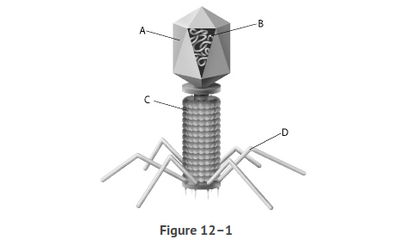
- AA
- BB
- CC
- DD
17Figure 12–2 shows the structure of (not the structure labeled X, the whole figure.)
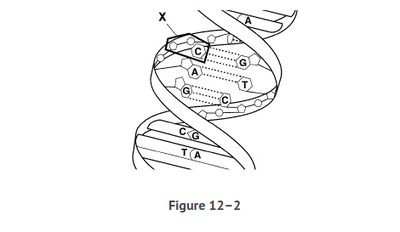
- Aa RNA molecule.
- Ba protein.
- CA DNA molecule.
- Dan amino acid.
18Because of base pairing in DNA, the percentage of
- Aadenine molecules in DNA is much greater than the percentage of thymine molecules.
- Bcytosine molecules in DNA is much greater than the percentage of guanine molecules.
- Cadenine molecules in DNA is about equal to the percentage of guanine molecules.
- Dthymine molecules in DNA is about equal to the percentage of adenine molecules
19Which two bases pair together in DNA?
- Athymine and cytosine
- Bcytosine and guanine
- Cadenine and guanine
- Dguanine and thymine
20What would Hershey and Chase have concluded if both radioactive 32P and 35S were found in the bacteria in their experiment?
- AGenes are made of protein and carbohydrates.
- BBoth the virus’s protein coat and its DNA were injected into the bacteria.
- CThe virus’s protein coat was not injected into the bacteria.
- DThe virus’s DNA was not injected into the bacteria.
21Bacteriophages inject protein into bacteria, altering the bacteria’s genetic information.
- AVerdadeiro
- BFalso
22DNA is a nucleic acid made up of nucleosomes joined into long strands or chains by covalent bonds.
- AVerdadeiro
- BFalso
23The three parts of a DNA nucleotide are the phosphate group, deoxyribose, and the base.
- AVerdadeiro
- BFalso
24When Griffith destroyed the DNA in his mixture containing various molecules from heat-killed bacteria, transformation no longer occurred.
- AVerdadeiro
- BFalso
25Watson and Crick discovered that covalent bonds hold base pairs together at the center of a strand of DNA.
- AVerdadeiro
- BFalso
26The structure labeled X in Figure 12–2 is a(an) [blank_start]_________________________[blank_end].
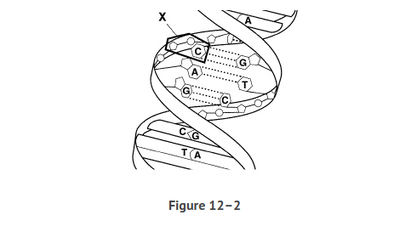
- Anucleotide
27The matching strand to the one in Figure 12–7, reading from the bottom up, would be [blank_start]_________________________[blank_end].
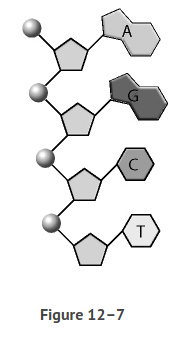
- AAGCT
28The Watson and Crick model of DNA is a(an) [blank_start]_________________________[blank_end], in which two strands are wound around each other.
- Adouble helix
29In figure 12–8, the percentage of guanine would be [blank_start]_________________________[blank_end].
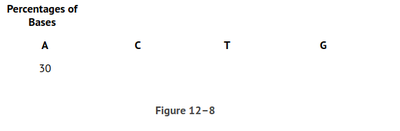
- A20%
30What stores information in a cell?
- ALIpid
- BCarbohydrate
- CDNA
- DProtein
31Interpret Visuals What process did Griffith identify in the series of experiments in Figure 12–11? [blank_start]d[blank_end]
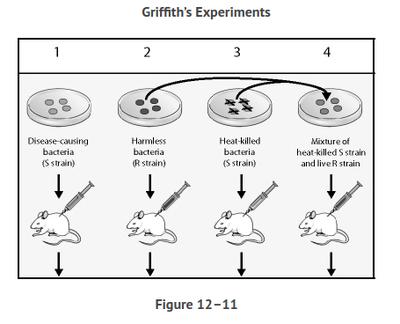
- Atransformation
32Compare and Contrast In which experiments in Figure 12–11 do the mice live?
[blank_start]d[blank_end]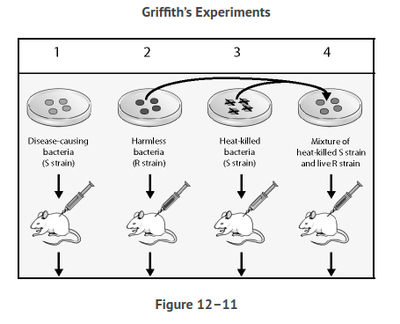
- AExperiments 2 and 3
Informações
- Descrição
- Biology Quiz sobre Chapter 12 Quiz 1, criado por Jack Alkema em 12-01-2017.
- Autor
- Jack Alkema
- Idioma
- English
- Visualizações
- 404
- Etiquetas
- Avaliação
- 4,0 de 5 · 1 avaliação Avalie este quiz