
Flashcards
DNA structure and replication
Flashcards do conjunto (60)
- 1What leads to phenotypic difference and susceptibility to disease? (2)1) Variations in DNA
2) Defects in DNA replication and repair - 2What makes up a nucleotide?A base, sugar and phosphare
- 3What are the four bases?GCAT
- 4How much DNA is in a nucleus (10um)?2 metres
- 5Which bases form pairs?C-G
A-T - 6Which bases are purines and which are pyrimidines?1) A,G
2) T,C - 7Which base-pairs form a stronger connection and why?C-G is stronger as there are three bonds, this affects chromosome structure and function
A-T has two bonds - 8What is the difference between pyrimidines and purines?Pyrimidines have one benzene ring while purines have two.
- 9What are the bonds which form between base-pairs?Hydrogen bonds -
C-G: NH and OH
A-T: OH, NH, OH - 10In which orientation is the new DNA transcribed in?5' to 3' end
- 11What is found at the 5' and 3' end of the DNA?At the 5' end of the sugar backbone is a free phosphate group
At the 3' end is an unlinked OH group - 12What is the template for RNA?DNA
- 13How is DNA organised?Wound around nucleosome (nucleosomal fibre) - there are about 200 nucleotide pairs of DNA wound around a histone and within the linker DNA
- 14What are the parts which make up a nuclesome?8 core histones (H2A, H2B, H3, H4)X2 and one linker histone (H1) which sits in the corner. The H1 histone has a C and N terminal.
- 15What is the nucleosomal fibre wound into?30nm chromatin fibre
- 16What is the chromatin fibre folded into? Give the size of each stage and any associated cell phases.30nm chromatin is folded into an extended chromosome (300nm) or a condensed section of chromosome (700 nm) - 1,000X compaction during interphase. An entire mitotic chromosome is ~1,400 nm and is 10,000 X compaction. Entire mitotic chromosomes can be seen at metaphase. It is not clear how chromatin fibre folds into the 300nm structure.
- 17When are chromosomes most compacted?During metaphase
- 18What are the stages of interphase? How long does interphase last?1) G1-phase, S-phase, G2-phase
2) 20-24hr - 19What are the stages of mitosis? (7)1) Early prophase
2) Late prophase
3) Prometaphase
4) Metaphase
5) Anaphase
6) Telophase
7) Cytokinesis - 20How long does mitosis typically last?30-60 minutes
- 21Describe semiconservative DNA replicationThe parent DNA provides a template strand for each of the daughter DNA helices.
- 22What is the origin of replication?The start sequence/point of unzipping.
- 23Describe DNA replication based on the origin of replication.DNA must always be replicated from the 5' to 3' orientation. Helicase separates the enzyme strands. Single stranded DNA binding proteins keep the strands from reannealing. One DNA strand encodes the leading strand which forms from its 5' end to its 3' end using DNA polymerase 3. The lagging strand also has to form from 5' to 3' end.
- 24Explain what Okazaki fragments are and how they form a complete new strand of DNA.The lagging strand also has to go in the 5' to 3' end but this is essentially in the reverse direction. To get around this a RNA primase lays down an RNA primer. DNA polymerase 3 then lays down new DNA. This process repeats again and again (Okazaki fragments). RNA polymerase I replaces the RNA primer with DNA. DNA ligase then links the Okazaki fragments.
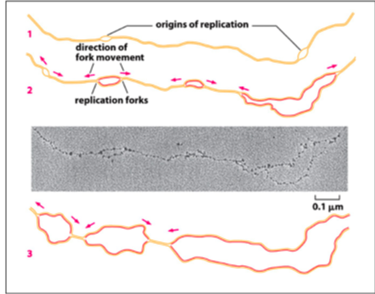
- 25Describe what in this diagram.Electron micrograph shows DNA replicating in the early embryo of a fly. The particles visible along the DNA are nucleosomes. The orange lines in image three are the parental DNA while the red lines are the newly transcribed DNA. Eventually all the 'bubbles' join up to form one long strand of DNA. Eventually all the 'bubbles' join up.
- 26What does topoisomerase do?'Snips' the DNA bonds in bacteria - supercoiling of DNA must be undone (unwound) to prevent bunching and to allow DNA to be replicated.
- 27Which antibiotic can be used to prevent the action of topoisomerase? What is the purpose of this?Quinolones target topoisomerase, this results in supercoiling of DNA and overwound regions. This therefore prevents bacterial replication.
- 28Give four examples of fluoroquinolones.1) Nalidixic acid
2) Ciprofloxacin
3) Levofloxacin
4) Gemifloxacin - 29What are the target topoisomerases of the fluoroquinolones mentioned in the card before? (4)Aerobic gram-positive and gram-negative species.
Some anaerobic gram-negative species and M. tuberculosis. - 30Give an example of an trimethoprim-sulfamethoxazole Ab and the ratio of the two.Co-trimoxazole=trimethoprim:sulfamethoxazole=1:5
- 31What does co-trimoxazole target?Nucleotide synthesis - aerobic gram-positive and gram-negative species.
- 32What is exonucleolytic proof reading?When an incorrect nucleotide is covalently added to a growing chain which is being transcribed it must be removed as RNA polymerase can only continue to extend the chain from a base-paired 3'-OH end of a primer strand. The 3'-to-5' proofreading exonuclease is located at a separate catalytic site (either in a separate subunit or in a separate domain of the polymerase molecule, depending on the RNA polymerase), clips off any unpaired residues at the primer terminus until enough nucleotides have been removed to regenerate a base-paired 3'OH terminus that can prime DNA synthesis. In this way DNA polymerase functions as a self-correcting enzyme that removes its own polymerisation errors.
- 33Roughly how many mistakes are made every time a cell divides? What is therefore needed? How does polymerase correct this?1) 12-20
2) Huge amount of molecular machinery
3) Can correct mistake by adding the correct nucleotide in the space of the wrong one - 34What are the three methods of single strand defect repair?1) Base excision repair
2) Nucleotide excision repair
3) Mismatch repair - 35When is base excision repair needed?When cytosine has been deanimated (i.e is a uracil)
- 36Explain the steps in base excision repairDNA glycosylase removes the uracil. The sugar phosphate which is missing a base is then cut out by the sequential action of AP endonuclease and a phosphodiesterase. The gap is then filled by DNA polymerase and DNA ligase.
- 37What does AP endonuclease derive its name from?It can recognise any site in the DNA helix which is contains a deoxyribose sugar with a missing base - such as site which are missing a purine (apurinic) or a pyrimidine (apyrimidinic)
- 38When is nucleotide excision repair required? When is this seen?When there is a pyrimidine dimer between two adjacent pyrimidines.
This is well characterised in bacteria and in certain cancers/carcinogenic cells/ - 39What do pyrimidine dimers prevent?Cell replication
- 40How does Nucleotide excision repair work?A multienzyme complex (nuclease) recognises the bulky lesion (i.e. dipyrimidine bond) and makes a cut on either side. An associated DNA helicase then removes 12 nucleotides (bacteria) and ~20 in the human/mammalian system (not known for sure) (unzips the DNA). DNA polymerase and DNA ligase insert the correct bases.
- 41What is a mismatched base pair/how does it occur?In vertebrate DNA there are methylated C nucleotides at specified C-G sequences which are associated with inactive genes. Accidental deamination results in the conversion to a T base. This results in the mismatched coupling of T-G.
- 42How is the mismatch corrected?There are two protein which are found in both bacterial and eucaryotic cells: MutS and MutL. MutS recognises and binds to the mismatched base-pair, the MutL then scans along the DNA to find a nick. Once a nick is found, MutL triggers degradation of the nicked strand all the way back to the mismatch.
- 43How are these mismatch errors selectively removed?Because the nicks are largely confined to newly replicated strands in eucaryotes, replication errors are selectively removed.
- 44When might cancer occur due to mismatch errors?If there is no/nick or gap to be found, mismatch errors may accumulate.
- 45Why is it thought that the mismatch repair system is fairly ineffective?Methylated C nucleotides are common sites for mutations in vertebrate DNA - even though only 3% of the C nucleotides in human DNA methylated, mutations in these methylated nucleotides account for about one-third of single-base mutations which have been observed in inherited human diseases.
- 46What does the type of repair system activated depend on? (2)1) Location of cell
2) Point in cell cycle e.g. earlier parts of the cell cycle are associated with mismatch repairs. - 47What are four causes of double strand breaks?1) Ionising radiation
2) Oxidizing agents
3) Replication errors
4) Metabolic products of cell - 48What are the two systems for repairing double strand breaks?1) Non-homologous end joining
2) Homologous recombination - 49What would happen if double strand breaks were not repaired?Chromosomes would breakdown into smaller fragments
- 50What happen in nonhomologous end-joining?Essentially an emergency solution to a double strand break, common outcome in mammalian cells. The two broken ends are juxtaposed and rejoined by DNA ligation. This generally results in the loss of one or more nucleotides.
- 51Why is the loss of nucleotides in nonhomologous repair acceptable?Results in small mutation, but so little of the mammalian genome codes for proteins that this mechanism is an acceptable solution for keeping chromosomes intact.
- 52What prevents the end of chromosomes for being mistaken as broken DNA?Specialised structure of telomeres, therefore preserves natural DNA ends.
- 53What does homologous recombination take advantage off?The fact that cells are diploid
- 54How does homologous recombination work?Recombination proteins recognise areas of DNA sequence matching between two chromosomes (i.e. one has a broken strand, the other does not). A DNA replication process uses the undamaged chromosome as the template for transferring genetic information to the broken chromosome, repairing it with no change in the DNA sequence.
- 55When can homologous recombination occur?In cells that have replicated their DNA but not yet divided - i.e. when the unbroken sister chromosome is available.
- 56What do defects in human genes which normally function to repair mismatched base pairs in DNA resulting from replication errors usually result in?Cancer
- 57Give three examples of genes involved in repair processes that can lead to cancer.1) Xeroderma pigmentosum
2) MutS, MutL
3) BRCA1/2 - 58What phenotypes does a mutation in xeroderma pigmentosum lead to? Which process is being affected?1) Skin cancer, cellular UV sensitivity (individuals are unable to repair certain DNA photoproducts), neurological abnormalities
2) Nucleotide excision repair - 59What phenotype does a mutation in MutS/MutL lead to? Which process is being affected?1) Colon cancer
2) Mismatch repair - 60What phenotypes does a mutation in BRCA1/2 lead to? Which process is being affected?1) Breast cancer
2) Repair by homologous recombination
Informações
- Descrição
- Professor Denise Sheer 03.10.17
- Criado por
- Anna Hogarth
- Visualizações
- 11
- Avaliação