
Flashcards
Economics of health care (HPI4001)
Flashcards do conjunto (105)
- 1What is the definition of "Economics"?The study of choices under conditions of scarcity in order to increase efficiency.

- 2What is the definition of "Health Economics"?The study of choices/behavior of individuals, care providers, organizations and government with regards to health decision making, in order to determine how scare resources are allocated to and within the health care system.
- 3What is the definition of "Health Care Economics"?The applied field of Economics where the study of analysis is the health care industry.

- 4What is the definition of "Scarcity"?The tension between unlimited needs and limited possibilities to fulfill those needs.
- 5What is the definition of "Allocation"?The distribution of scarce resources among competing demands.
- 6What is the definition of "Opportunity Cost"?The cost of the best alternative option.
- 7What is the definition of "Allocative Efficiency" (i.e. Pareto-efficiency)?The distribution or use of resources in which no one can be made better without making somebody else worse off.
- 8What is the definition of a "Market Failure"?When one or more efficiency conditions required for a perfect competition have not been met.
- 9What is the definition of a "Perfect Competition"?A perfect competition is a state that is achieved when there are many consumers and suppliers, a homogenous product, free entry and exist to the marketplace and the availability of perfect information.
- 10Why is "Health Economics" different from traditional Economics?1) The demand for health care is a derived demand (for health)
2) The existence of externalities (e.g. the costs and/or benefits of consumption/production of a good for others than the direct users).
3) Informal asymmetries between health care providers and patients.
4) Uncertainty with respect to both the need for and the effectiveness of health care. - 11Why does health care require government interventions?1) Presence of externalitites (e.g. smoking or vaccination).
2) High research and costs (e.g. patent protection becomes necessary).
3) Market power (e.g. monopolies) require drug price regulations
4) Nature of goods.
5) The uncertainty of demand for health care (e.g. health insurance). - 12What does the "Williams' Diagram" represent?The Williams' Diagram represents the most important subjects that can be studied within the applied field of Health Economics.
- 13What are the challenges of the health care system, according to Pedersen et al. (2012)?1) More demand for health care with rising healthcare expenditures requires making choices.
2) Medical and technological advancement challenges.
3) Healthcare regulatory challenges.
4) Increasing expectations from patients.
5) More healthcare demand puts the labour market under pressure and asks for innovation.
6) The proper role of market and government. - 14What is the future of Health Economics with regards to successfully solving the upcoming challenges?Health Economics needs to consider alternative theories, emperical and methodological approaches to succesfully meet the new challenges of the future (e.g. applying the approaches of behavioral and experimental economics).
- 15What are the characteristics and assumptions of "Experimental Economics"?1) Incentivized revealed-preference experiment.
2) Judgement and decision-making precede the actual choice of the participant. - 16What are the characteristics and assumptions of "Behavioral Economics"?1) The incorporation of methods and theories from cognitive psychology when specifically addressing individual economic decision-making.
2) Importance of psychological cognitive, emotional, cultural and social factors on the economic decision of individuals. - 17Why is innovation important from an economic point of view (De Pouvourville, 2001)?1) Innovation can be costly.
2) Innovations may lead to economic benefits.
3) Innovations have considerable impact on economic growth. - 18What is innovation from the perspective of economists, according to Swann (2009)?The successful exploitation of new ideas.
- 19What is the definition of an "Invention", according to Swann (2009)?The generation of new ideas through research or other forms of creativity.
- 20What is the definition of an "Innovation", according to Swann (2009) ?The commercial application of inventions.
- 21What are the types of innovations?1) Product innovation
2) Process innovation
3) Organizational innovation - 22What are the tree important theories on "Economic Growth"?1) Classical growth theory.
2) Neoclassical growth theory.
3) New growth theory. - 23What assumptions does the "Classical Growth Theory" make?Economic theory is determined by:
1) Trade
2) Manufactoring
3) Increasing capital - 24What assumptions does the "Neo-Classical Growth Theory" make?Economic growth is determined by:
- Using Labor and Capital (input) to increase the production of goods and services (output) - 25What does the "Neo-Classical Growth Theory" assume about technology?1) Advanced technology is seen as an shift of production function (i.e. an increase in productivity and a decrease in cost of production).
2) Technological development is not explained/accounted for. - 26What is the definition of an "Externality"?They are the costs and/or benefits of consumption/production of a good for others than the direct users.
- 27What assumptions does the "New Growth Theory" make?Economic growth is determined by
1) Technological advancement and an increase in human capital.
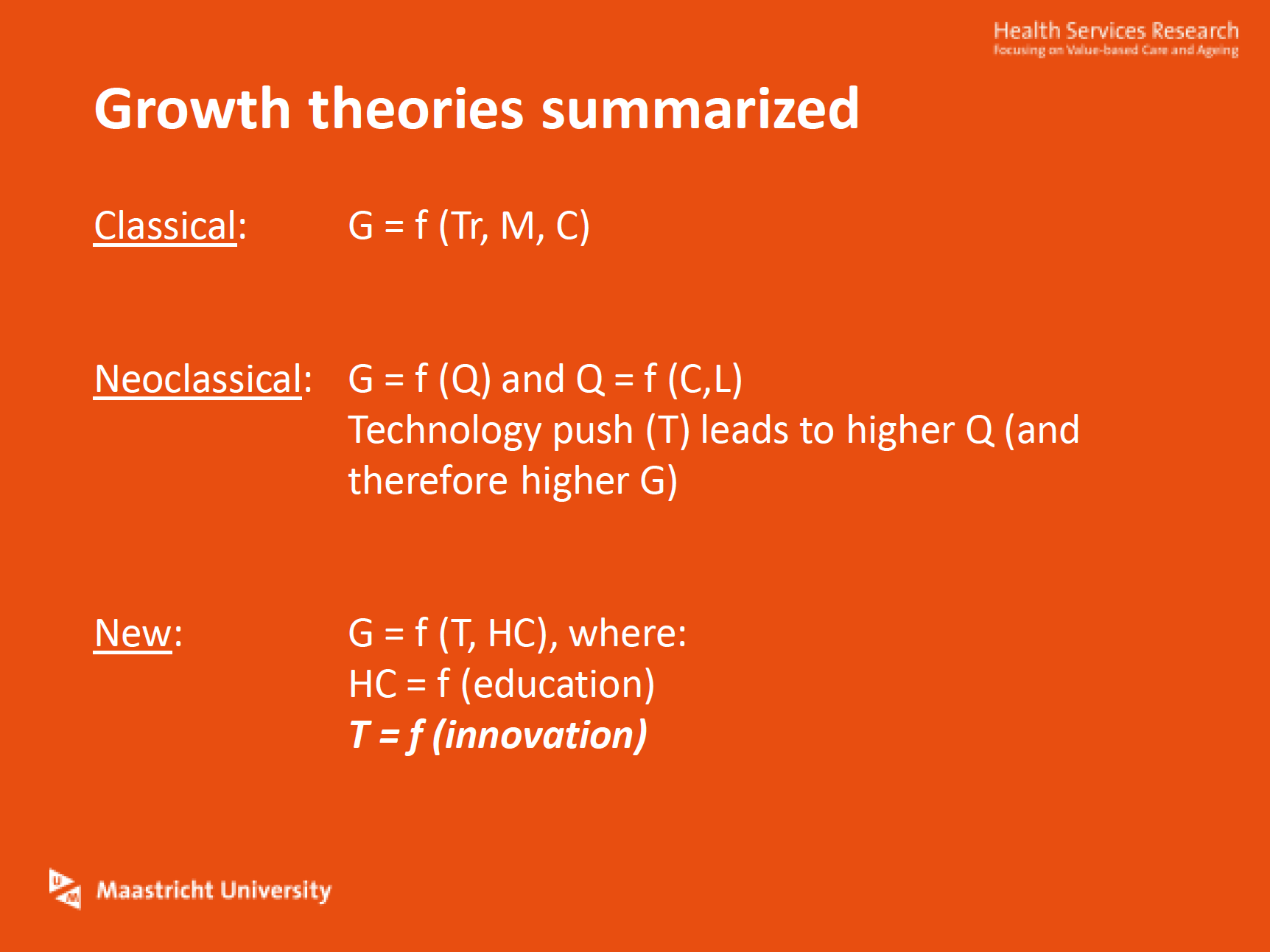
2) Growth is explained by modeling the innovation process inside the economic model. - 28How can the growth theories be summarized, using mathmatical equations/formulas?
- 29What is the definition of "Innovation Economics"?The study of application of innovations to induce economic growth.
- 30What are the five most important economic theories on innovation, according to Antonelli (2009)?1) Classical economic approach.
2) Schumpeterian economic approach.
3) Arrovian economic approach.
4) Evolutionary economic approach.
5) Institutional economic approach. - 31What are the central assumptions behind the "Classical Economic Approach", according to Smith and Marx?1) Demand-pull approach, which means the division of labour leads to specialization (i.e. learning) and innovation
2) Induced approach, which means technological change is induced by the changing costs of labour which lead to the substitution processes between labour and capital intensive technologies. - 32How can the "Classical Economic Approach" be represented as a mathmatical formula/equation?I = f (degree of specialization)
I = (degree of substitution between L & C)
I (Innovation), L (Labour), C (Capital) - 33What are the central assumptions behind the "Schumpeterian Economic Approach", according to Schumpeter?1) Entrepeneurship and corporations are the driving forces behind economic growth, while innovation is the competitive tool used to achieve the goal of earning a profit.
2) A firm innovates successfully and is rewarded with high profits and a monopoly position, which in turn encourages rivals to come up with better innovations in order to compete for a better market position (process of creative destruction). - 34How can the "Schumpeterian Economic Approach" be represented as a mathmatical formula/equation?I = f (competing entrepeneurs)
I = f (degree of monopolistic power)
I (Innovation) - 35What are the central assumptions behind the "Arrovian Economic Approach", according to Arrow (1921)?1) Knowledge is the necessary input/output factor used within the "process of creation" (i.e. invention).
2) New knowledge can increase the efficiency in the production of other goods.
3) Knowledge and learning processes have increasing returns, which drive the process of growth.
4) Markets fail in the allocation of resources for invention; hence, government policy towards invention and innovation are required (e.g. patent protection). - 36How can the "Arrovian Economic Approach" be represented as a mathmatical formula/equation?I = f (Knowledge)
I (Innovation) - 37What are the central assumptions behind the "Evolutionary Economic Approach", according to Nelson and Winter?1) The economy is an evolutionary system; it is shaped by the past (path dependency).
2) Most decisions are not taken on the basis of rationality, but on the basis of routines (habits)
3) As firms revise their routines, they undertake and search processes to find/develop new routines.
4) Technological changes occurs as businesses explore variations in routines and choose new routines.
5) The development of technological changes (innovations) require active government policies. - 38How can the "Evolutionary Economic Approach" be represented as a mathmatical formula/equation?I = f (routines)
I (Innovation) - 39What are the central assumptions behind the "Institutional Economic Approach", according to Dorward (2000)?1) Institutional arrangements (e.g. patents, copyright law, grants, public-private partnerships etc.) can play an important role in economic growth as they create certain incentives (e.g. to innovate).
2) Institutions are critical determinants of transaction costs and risks which need to be recognized in technology, screening, development and promotion. - 40How can the "Institutional Economic Approach" be represented as a mathmatical formula/equation?I = f (institutions)
I (Innovation) - 41What are the two perspectives that describe how societies organize resources in order to create, sustain and/or diffuse innovations and attain an expansion in their wealth?Different perspectives
1) Innovation are an independent variable which cause economic growth/effects
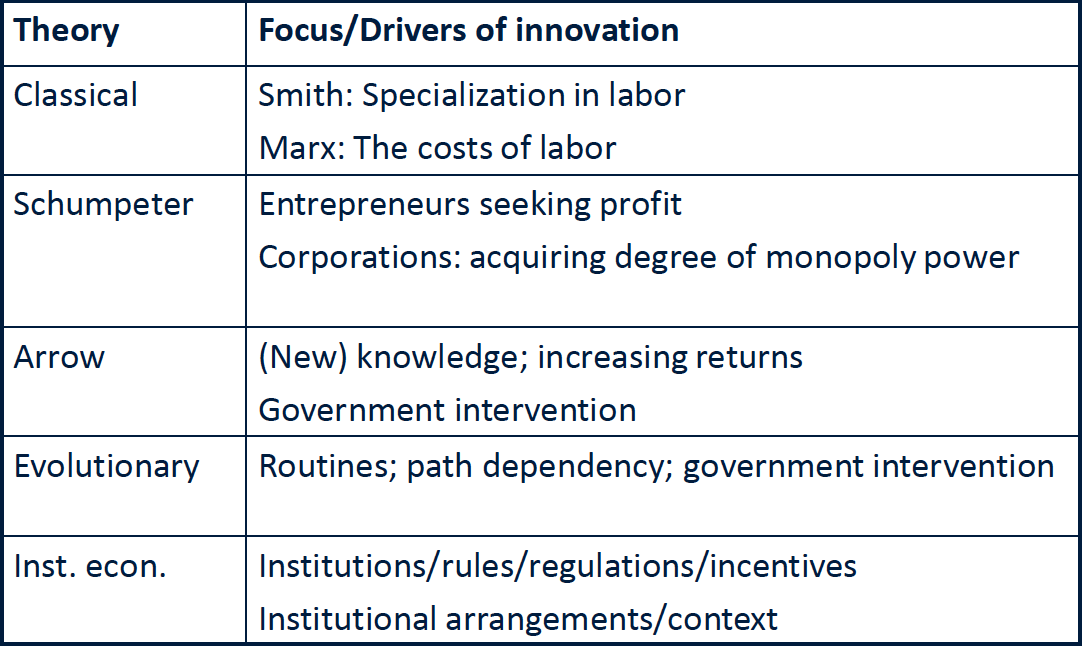
2) Innovations are a dependent variable which have economic causes - 42What are the incentives/drivers for each economic approach?
- 43What are the roles of the pharmaceutical industry?1) To develop and produce new medicines and vaccines.
2) To drive innovation in drugs.
3) Economic growth factor (worldwide). - 44What are the characteristics of the pharmaceutical market?1) Aggressive advertisement towards physicians and government bans for end of users.
2) Ethical/Prescription drugs require a legal medical prescription.
3) Consumer has limited knowledge of the efficacious substances. - 45What are some examples of government interventions with regards to the pharmaceutical market?1) Drug development regulations (clinical trial)
2) Entry barriers (without patent protection no innovation)
3) Drug price regulations
4) Ban on advertisement
5) Specific regulations for orphan drugs
6) Reimbursement/access (e.g. co-payment, generic drugs etc.) - 46What are the type of drugs available within the pharmaceutical market?1) Ethical (or prescription) drugs
2) OTC-drugs
3) Brand drugs
4) Generic drugs
5) Me-too drugs
6) Orphan drugs - 47What is the definition of an "Ethical Drug"?A prescription or ethical drug is a licensed medicine that is regulated by legislation to require a prescription before it can be obtained.
- 48What is the definition of an "OTC-Drug"?Over-the-counter (OTC) drugs are medicines that may be sold without a prescription, in contrast to prescription drugs.
- 49What is the definition of a "Brand Drug"?A drug which is produced and distributed with patent protection.
- 50What is the definition of a "Generic Drug"?A drug which is produced and distributed without patent protection.
- 51What is the definition of a "Me-too Drug"?A drug that is structurally very similar to already known drugs, with only minor differences.
- 52What is the definition of an "Orphan Drug"?A drug with is effective in the treatment of some rare disease.
- 53What are the stages of drug development?1) Preclinical studies (in vitro and animal testing)
2) Clinical studies (Phase I, II and III)
3) Market authorization and reimbursement
4) Pharmacoviligance (Phase IV) - 54What are the "four hurdles" to market access?1) Quality
2) Safety
3) Efficacy
4) Cost-effectiveness - 55What are the limitations of economic evaluations?1) Low Quality
2) Uncertainty
3) Poor understanding by authorities
4) Transferability and Generalizibility - 56What is the definition of a "Pharmacoeconomic Evaluation"?An analytical tool used with increasing frequency to assist decision making in the financing and management of pharmaceutical products in the healthcare system or national health insurance programs of an individual country.
- 57What are the three types of coverage decisions?1) Coverage with evidence development
2) Coverage only in research
3) Innovative risk-sharing agreements - 58What are the challenges with regards to the drug development process?1) High cost
2) Unequal access
3) Lack of transparency
4) What is value?
5) Budget impact vs cost-effectiveness
6) Uncertainty with regards to coverage decisions
7) Harmonization between reimbursement and regulatory approval - 59What does the approach of "Coverage with Evidence Development" entail?Coverage for promising technology for which the evidence is still uncertain, in order to achieve earlier adoption of promising technologies.
- 60What does the approach of "Innovative Risk-Sharing Agreements" entail?The process by which two or more parties agree to share the risks associated with achieving a certain outcome, on the condition that the outcome is as good as promised (on a population level). Else, the company pays back the 'loan investment'
- 61What is the definition of an "Organization", according to Hall (1994)?An organization is a decision-making unit engaged in production.
- 62What is the definition of an "Organization", according to Daft et al. (2014)?A social entity which is goal directed, is designed as a deliberate structured and coordinated activity system, and is linked to the environment.
- 63What is the definition of "Vertical Integration", according to Laugesen and France (2014)?Vertical integration is the process of absorption of different product functions in a single organization. A firm will vertically integrate different stages of the production function under one roof.
- 64What are some examples of "backwards Vertical Integration"?1) Hospital acquiring a physician practice.
2) Insurers acquiring healthcare providers.
3) Pharmaceutical companies acquiring biotech startups. - 65What are some examples of "forward Vertical Integration"?1) Hospitals acquiring long-term care facilities.
2) Long-term care facilities aquiring hospices - 66Why do companies choose to integrate vertically, according to Besanko et al. (2007)?1) Poor coordination in the value chain
2) Danger of leakage of private information
3) High transaction costs - 67What is the definition of "Horizontal Integration", according to Laugesen and France (2014)?Horizontal integration occurs when a firm producing a given product expands by acquiring other firms producing broadly the same product or firms producing the same services.
- 68What are some examples of "Horizontal Integration"?1) Two hospitals merging
2) Two local GP practices merging
3) Two long-term care facilities merging
4) A merger between two health care insurers who are active in the same market - 69Why do companies choose to integrate horizontally, according to Postema & Roos (2015)?1) Economies of scale and scope
2) Strategy considerations (market structure)
3) Third-party pressures - 70What is the definition of a "Transaction Cost"?Costs that are related to the processes involved in completing a transaction for input or outputs between individuals, companies, or units within the same company that are not included in
the unit price (e.g. the cost of running the economic system). - 71Where do "Transaction Costs" stem from, according to Coase & Williamson?1) Relation-specific assets
- location specific assets
- physical asset
- human assets
- dedicated assets
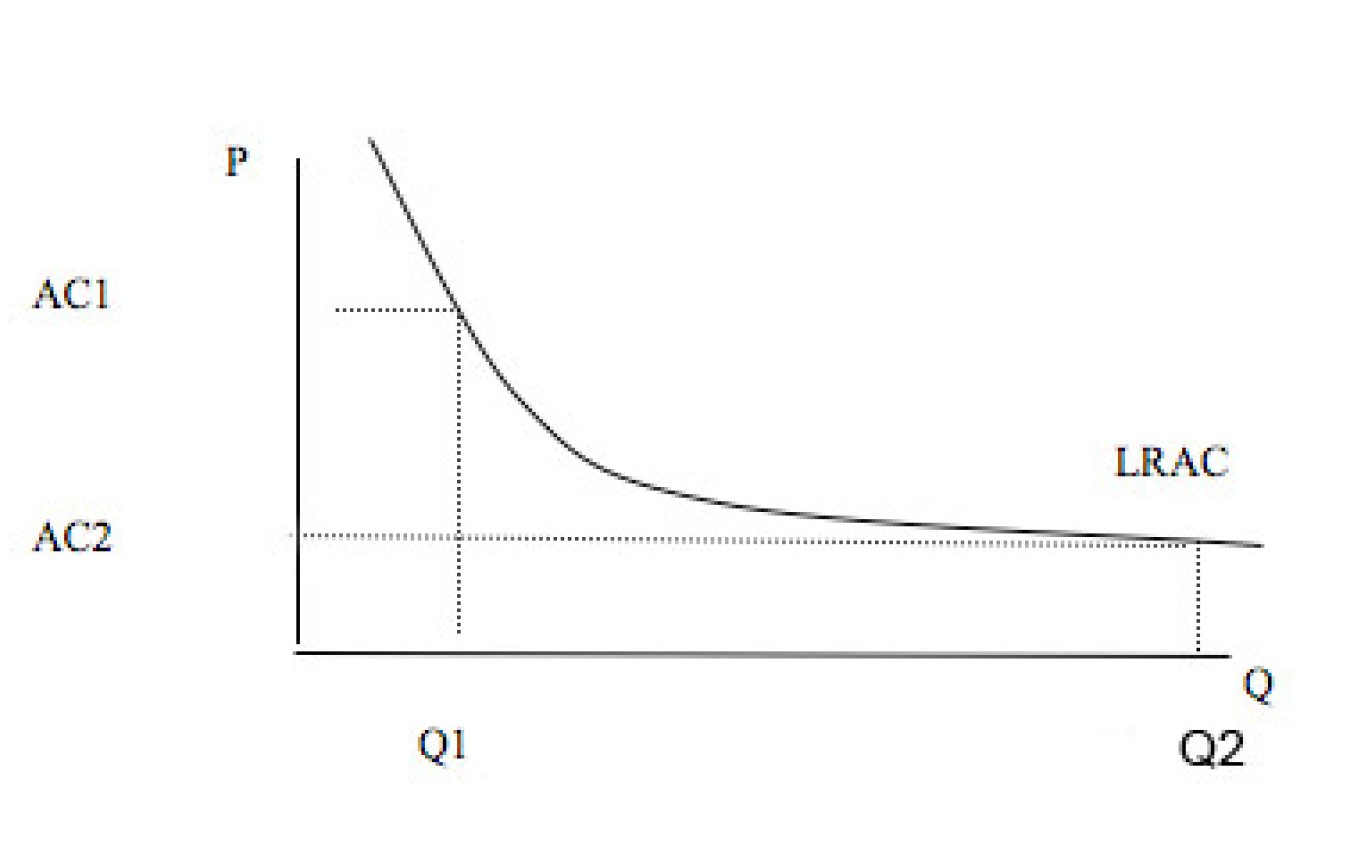
2) Hold-up problems (quasi rents) - 72When does an "Economy of Scale" apply to a firm?It applies when a firm enjoys lower average costs as the quantity of an output increases.
- 73What are some of the factors that can play a role in the "Economies of Scale"?1) Indivisibilities (spreading fixed costs)
2) Specialization (division of labour)
3) Inventories
4) The cube-square rule
5) Complementarities - 74When does an "Economy of Scope" apply to a firm?It applies when a firm enjoys lower total costs when it produces two types of outputs than when it produces only one of the two types of outputs.

- 75What is the aim of an "Health Technology Assessment"?1) To inform decision makers.
2) To improve the quality of care by promoting an appropriate and rational use of health technologies.
3) To facilitate planning for the introduction and diffusion of new technologies. - 76What is the aim of an "Economic evaluation"?1) It provides a framework for identifying and comparing the costs and benefits of different options.
2) It informs decision-makers about healthcare allocation. - 77What is the importance of health economic evaluations?1) It can lead to an increased attention to issues of cost and efficiency.
2) It can lead to an increased use of economic data in decisions about reimbursement or pricing of health technologies.
3) It can lead to a formal use of economic data (e.g. drug reimbursement).
4) It can be used to calculate the cost-effectiveness of a new innovation and support its case to gain market access. - 78What is the definition of an "Economic Evaluation"?An economic evaluation is a comparative analysis between two or more health technologies in terms of costs and effects.
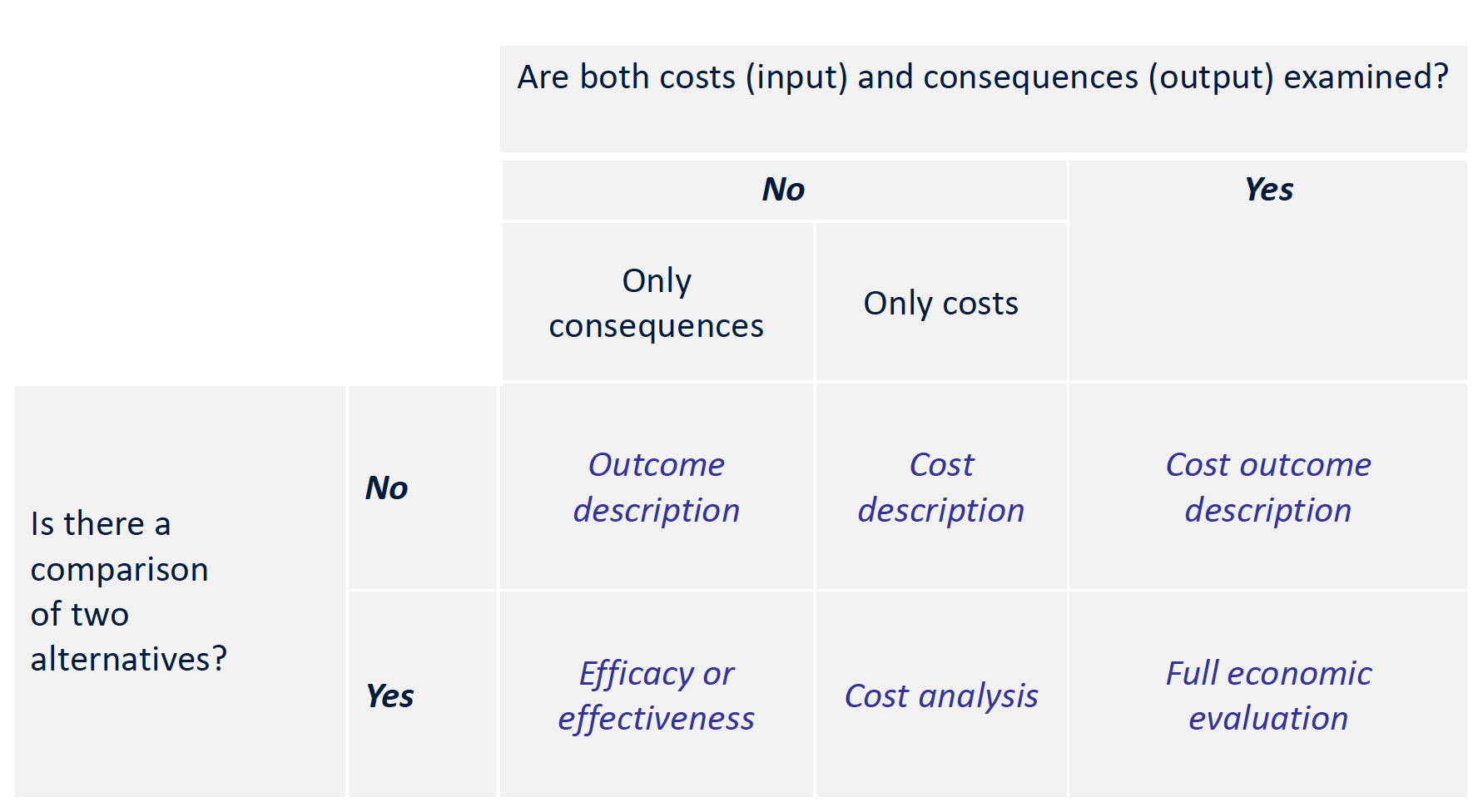
- 79What factors determine whether to use a "Partial Economic Evaluation" vs a "Full Economic Evaluation"?
- 80What are the four types of full economic evaluations?
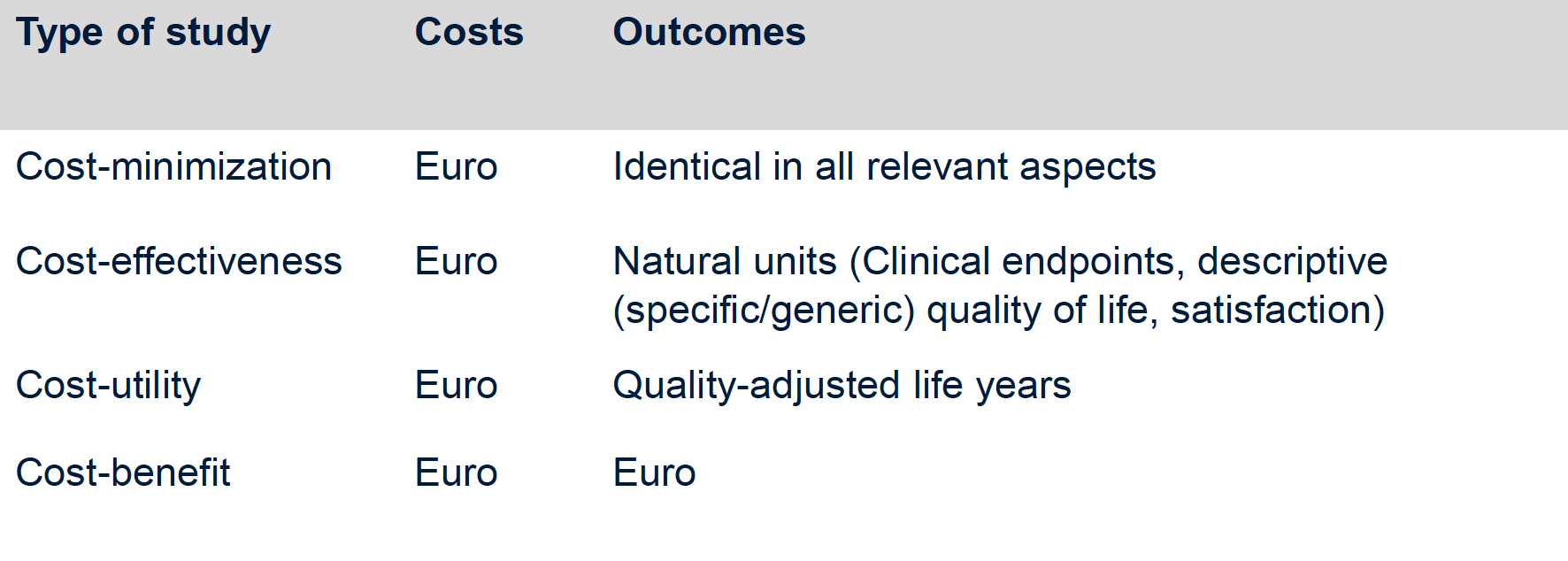
- 81What is the definition of a "QALY"?Quality-Adjusted Life Year
- 82What is the purpose with regards to the use of a QALY as a unit of measurement?A QALY represents a generic measure of disease burden, which includes the quantity and quality of life.
- 83What is the definition of a "Cost-illness study"?It is a study that estimates and evaluates the healthcare costs (direct costs) and production losses (indirect costs) of a particular disease or risk factor.
- 84What is the definition of an "ICER"? What does is represent?The ICER or Incremental Cost-Effectiveness Ratio represents the additional costs per unit of effect from the comperator treatment.
- 85What other factors need to be considered alongside "Cost-Effectiveness"?1) Lack of, or inadequacy of, alternative treatments
2) Seriousness of the condition
3) Overall financial implications for the government (e.g. budget impact analysis)
4) Equity objectives - 86What are the advantages of a "Trial-Based Economic Evaluation"?1) High validity; costs and effects are in the same population
2) Early opportunity to produce cost-effectiveness results
3) Access to individual patient data - 87What are the disadvantages of a "Trial-Based Economic Evaluation"?1) Truncated time horizon
2) Limited comparators
3) Restricted generalizability to different setting or countries
4) Failure to incorporate all relevant evidence - 88What are the advantages of a "Model-Based Economic Evaluation"?1) Comparison of all feasible interventions.
2) Exploration of the full range of clinical possibilities.
3) For a range of patient subgroups.
4) Systematic combination of evidence from a variety of resources.
5) Extended results from clinical trial. - 89What are the disadvantages of a "Model-Based Economic Evaluation"?1) Lack of transparency
2) Quality of data and model
3) Limitations of model
4) Parameter uncertainty
5) Indirect comparisons - 90What is the "Markov Model"?Patient progress through health states over time and at each cycle the transition probabilities change.
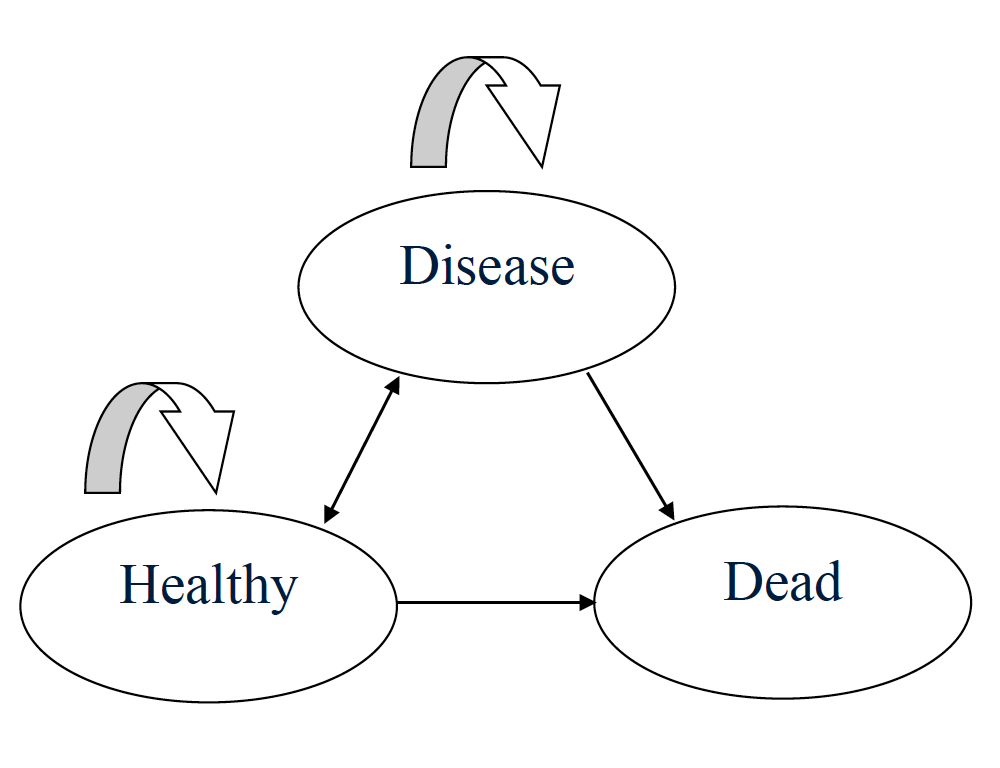
- 91What are the steps of the Markov model?1) Health states
2) Initial transitions
3) Cycle length and number of cycles
4) Transition probabilities
5) Costs and outcomes
6) Results and sensitivity analysis - 92What factors determine the uncertainty of an economic evaluation? How can this be addressed?1) Structural uncertainty
2) Parameter uncertainty
3) Heterogeneity
All the uncertainties can be addressed by using a one way sensitivity analysis. - 93What is the definition of "Implementation"?It means carrying out or executing the innovation in real practice.
- 94What factors influence the implementation process of a innovation?1) Costs and benefits of the new intervention.
2) Degree to which the desired action already takes place. - 95What are barriers that hinder the implementation of a new innovation?1) Absence of of personal contact between researchers and policy makers.
2) Lack of timeliness/relevance of the economic evaluation.
3) Mutual mistrust (incl perceived political naivety vs perceived scientific naivety)
4) Power and budget struggles
5) Poor quality of research
6) Political instability or high-turn over of policy making staff - 96What are the top 5 most frequently cited "Barriers and Facilitators"?
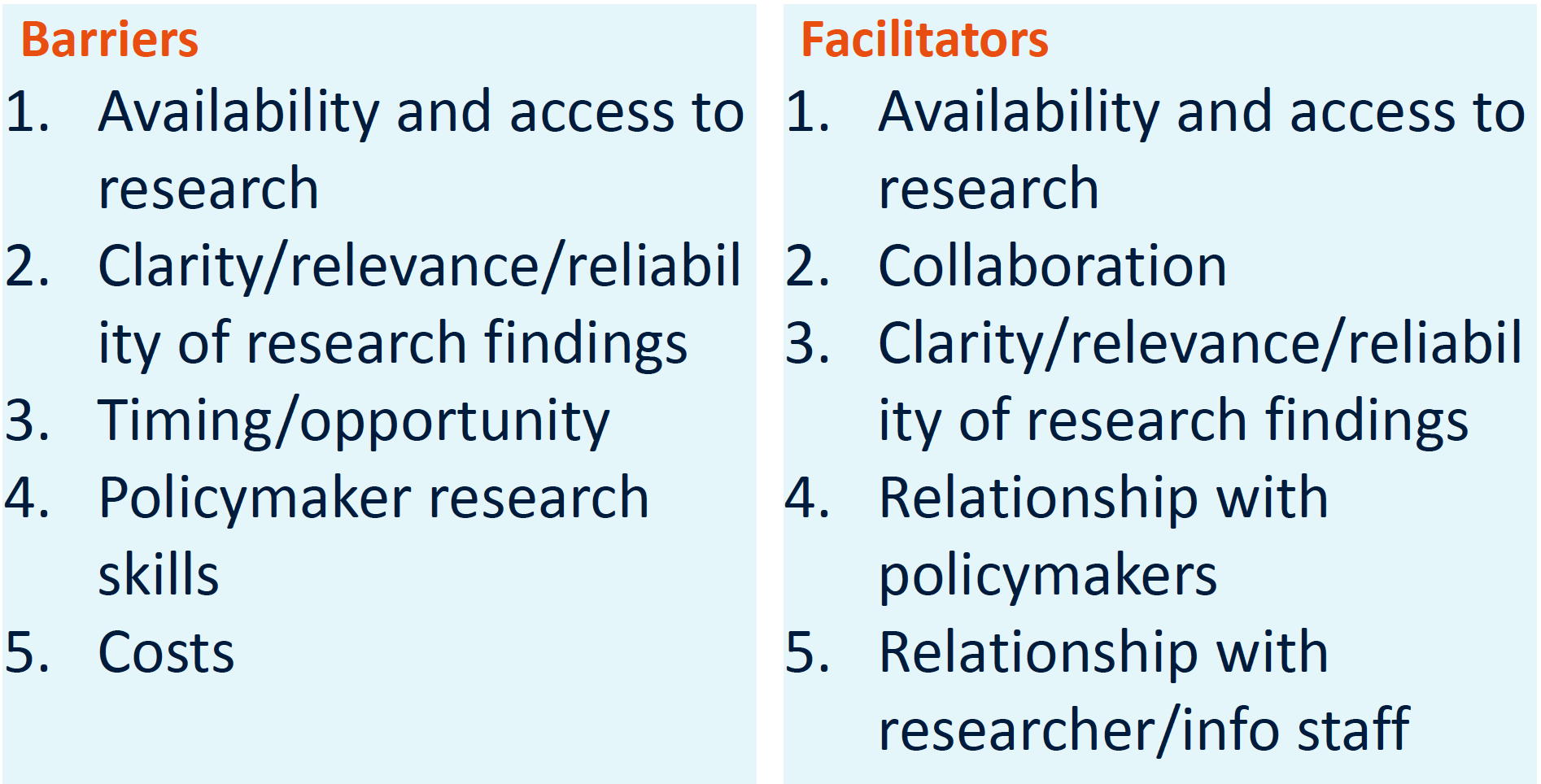
- 97Which four important methods can be used to bridge the gap between research and policy making?1) Teach policy makers how research is done and developed
2) Use independent organizations for research to increase credibility
3) Using real life trials and present these results and focus on the applicability
4) An agency with authority should examine the cost effectiveness of new interventions - 98Which other methods can also be used to bridge the gap between research and policy making?1) Knowledge brokers
2) Mini-HTA
3) Stakeholders involvement and more research into the underlying factors
4) Using other analysis - 99What is the definition of "Generalizability", according to Knies et al. (2008)?The extent to which the results of a study can be generalized to the population from which the sample was drawn.
- 100What is the definition of "Transferability", according to Knies et al. (2008)?The extent to which results of a study, as it applies to a particular setting, hold true for a different population or setting.
- 101What are the five limiting factors of transferability, according to Goeree (2007)?1) Patient characteristics
2) Disease characteristics
3) Provider characteristics
4) Health care system characteristics
5) Methodological characteristics - 102What are the steps with regards to diagnosing transferability?1) Assess the general knock-out criteria.
2) Assess the specific knock-out criteria.
3) Estimate the relevance of a specific knock-out criteria.
4) Estimate the relevance between 2 countries relating to these specific knock-out criteria.
5) Estimate the effect on the ICER of the decision country. - 103When and how can the transferability be increased?1) Design Stage
2) Analysis Stage
3) Reporting Stage - 104How can the difference in countries with regards to transferability of quality of life be explained, according to Goeree (2007)1) Individual differences in patients due to different health status
2) Country specific characteristics
3) Methodological differences, how to measure health related Quality of Life - 105How can the EQ-5D tool be used to measure the utility of a patient?The EQ-5D tool uses the following methods
1) Time trade off
2) Visual Analogue Scale
Informações
- Descrição
- Flashcards used for Economics course at Maastricht University (FHML).
- Criado por
- Noor Shoukri
- Visualizações
- 56
- Tags
- Avaliação