
Flashcards
International Strategic MGMT_Part1
Flashcards do conjunto (198)
- 1The three Levels of ManagementNormative Management
Strategic Management
Operational Management - 2Normative ManagementDas normative Management ist die Unternehmungsleitung und sie bestimmt die Ziele, welche man erreichen möchte.
Principles, Norms and Policies. - 3When a company defines its goals and purpose, it is defining structures, measures and behavior on _____Normative level
- 4Strategic ManagementDas strategische Management überlegt sich wie man die vorgegebenen Ziele von dem normativen Management erreichen kann. Sie geben eine gewisse Route für das Ziel an. Das heisst sie teilt zum Beispiel den verschiedenen Abteilung eine Aufgabe zu.
Identification, build-up, exploitation of strategic success potentials - 5Operational ManagementDas operative Management ist für die Umsetzung des Zieles verantwortlich. Es ist wie die ausführende Macht von dem normativen und dem strategischen Management.
Realisation of normative and strategic goals and implementation of the corresponding programs. day to day business - 6Vertical IntegrationVertical integration is an arrangement in which the supply chain of a company is owned by that company. Vertical integration and expansion is desired because it secures the supplies needed by the firm to produce its product and the market needed to sell the product. However, it can become undesirable when its actions become anti-competitive and impede free competition in an open marketplace.
- 7Horizontal IntegrationHorizontal integration is the process of a company increasing production of goods or services at the same part of the supply chain. A company may do this via internal expansion, acquisition or merger. The process can lead to monopoly if a company captures the vast majority of the market for that product or service.
Horizontal integration contrasts with vertical integration, where companies integrate multiple stages of production of a small number of production units. - 8Levels of Strategy
- 9A strategic positioning decision strives to match:internal core competences and environmental opportunities, knowledge about external conditions and internal resources
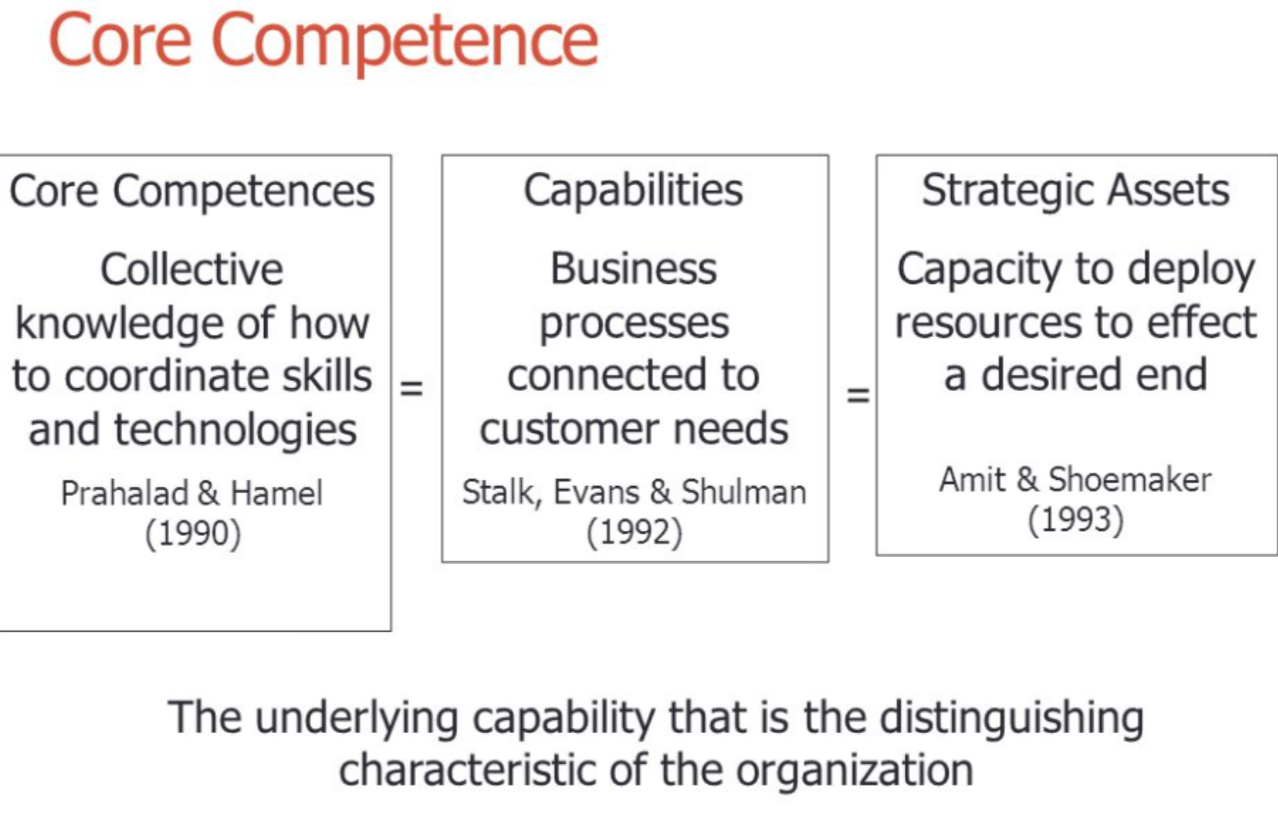
- 10Combine the focus of strategic analysis to right level of the 4 strategies: 1. Core competence: which level? 2. Design of a value chain activity for competitive advantage? 3. Cooperation? 4. Competitive positioning and advantage?1. Corporate Level
2. Functional
3. Network
4. Business - 11Achieving synergies between businesses is main task on .. which strategic level?corporate & network strategy level
- 12____ are the two basic strategies for creating value and attaining a competitive advantage in an industryCost leadership and differentiation
(in Business Strategy Level, focus on competitive strategy) - 13A _____ is a special outlook, skill, capability, or technology that runs through the firm's operations, weaving together all value activities into an integrated value chain.core competency
- 14What strategic actions has Rivella implemented in order to change the diminishing profits in its home market? Name three strategic actions.Internationalization
Product innovation
Diversification in other product categories - 15Core of business strategy: Strategic positioning inside out (unique competencies) and outside in (industry attractiveness) w1,p.41Unique Competencies Industry :
Michael Porter’s Value Chain model
Attractiveness:
Michael Porter’s Five Forces (Supplier power, threat of substitutes, customer power, Threat of new entrants, market competitors) - 16Michael Porter’s Value Chain: Value-Chain analysis helps to understand the potential and performance of resources and capabilities, thereby calcifying cost structures and value creation. Explain the value chain with primary and supportive activities. ISM Reader page 66
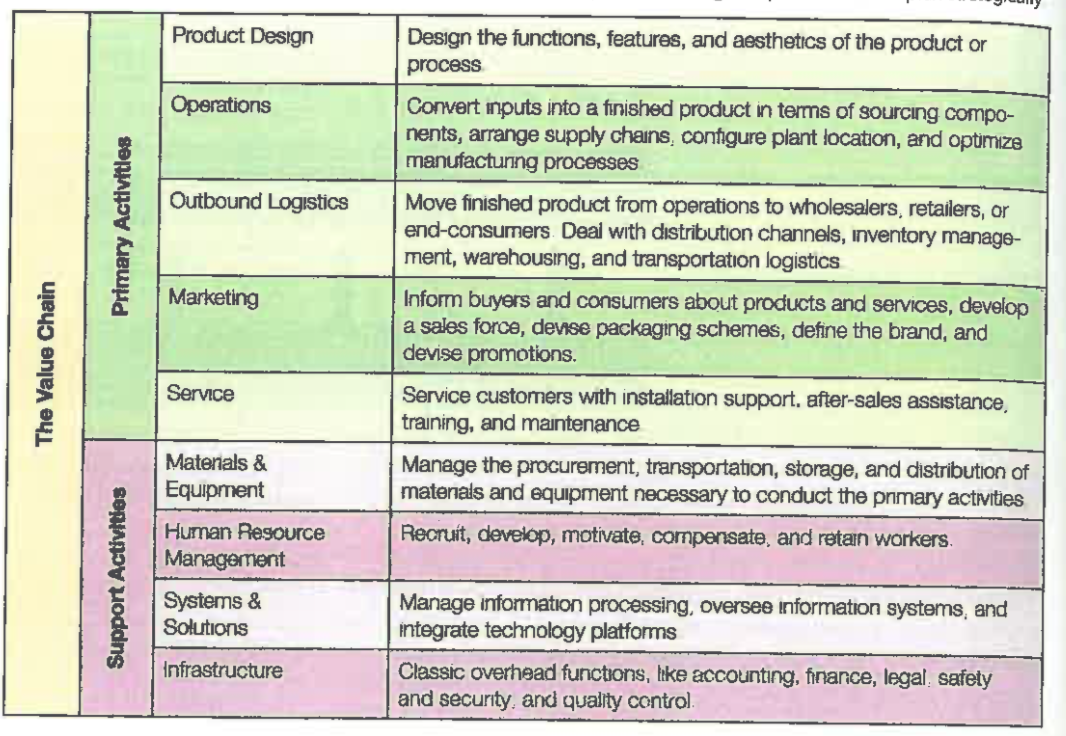
- 17The Product / Market Matrix by Igor Ansoff explain the 4 strategies.1. new market, existing product: Market development strategy
2. new market, new product: Diversification strategy
3. existing market, new product: product development strategy
4. existing market, existing product: Market penetration strategy - 18The way a company creates value and firm performance through strategic integration of cross-border business activities. what's that?a definition of International Strategic Management
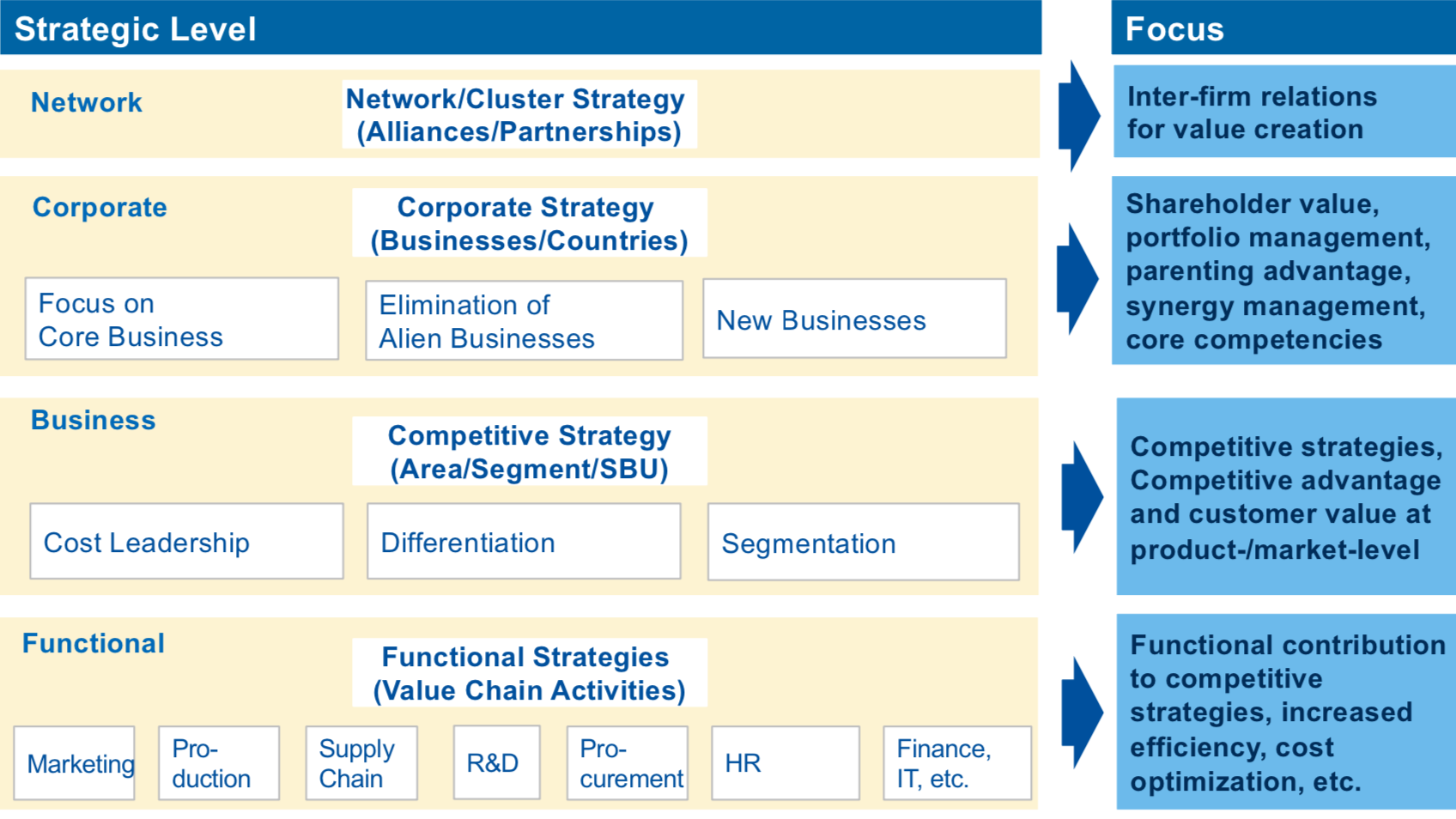
- 19Levels of Strategy explain the focus of Network strategic levelNetwork/Cluster Strategy (Alliances/Partnerships)
Focus: Inter-firm relations for value creation - 20Levels of Strategy explain the focus of Corporate strategic levelCorporate Strategy (Businesses/Countries)
1. Core Business
2. Elimination of Alien Businesses
3. New Businesses
Focus:
Shareholder value
portfolio management
parenting advantage
synergy management
core competencies - 21Levels of Strategy explain the focus of Business Strategic levelCompetitive Strategy (Area/Segment/SBU: strategic business unit)
1. Cost Leadership
2. Differentiation
3. Segmentation
Focus:
Competitive strategies
Competitive advantage
customer value at product-/market-level - 22Levels of Strategy explain the focus of Functional Strategic LevelFunctional Strategies (Value Chain Activities)
1. Marketing
2. Production
3. Supply Chain
4. R&D
5. Procurement
6. HR
7. Finance, IT, etc.
Focus:
Functional contribution to competitive strategies
increased efficiency
cost optimization - 23Mercantilism16./17. century
Countries should
simultaneously encourage exports and discourage imports - 24Absolute Advantage by Adam Smith18. century
Countries should
specialize in the production of goods for which they have an absolute advantage and trade for others - 25Comparative Advantage by David Ricardo18./19. century
Nations benefit by
producing those goods in which they have a comparative advantage and then trade them to acquire supplies of all goods.
According to the theory, was simply because a country could produce a product at lesser opportunity costs (lower price) due to having a natural resource or favourable climate. This trade theory was not concerned with network effects or economies of scale. - 26Factor Proportion Theory by Heckscher & Ohlin20. century
Countries tend to
specialize in and export products that are intensive in the factors with which they are abundantly supplied.
If two countries differ by their relative endowment of machines and
labor, the country that has relatively more machines will export goods that use machine as input. The other country will export goods that mainly use labor as input. (eg. Milkproducts in China and Switzerland) - 27New Trade Theory by Paul Krugman20. century
Countries should trade in all goods and services, even if these are direct substitutes. This will mean choice to consumers and scales to producers. NTT explains why countries that are trade partners are trading similar goods and services. Countries may import goods to compete with products in the home country. This will promote domestic competition from imports and improve productivity/innovation and thus, exports. - 28New New Trade Theory by Marc Melitz21. century
Firms are heterogenous and some firms will exports goods while other produce only for the domestic market. - 29Difference FPT (Factor Proportion Theory) by Heckscher & Ohlin and Comparative Advantage by Dave RicardoFPT: 1.Endowments or resources
2. not necessarily specialization
Ricardo: 1. Productivity
2. Full specialization - 30Classical country-based trade theories name 41. Mercantilism
2. Absolute Advantage
3. comparative advantage
4. Heckscher-Ohlin FPT - 31modern firm-base trade theories name 41. country similarity
2. product life cycle
3. Global strategic rivalry
4. porter's national competitive advantage - 32Theory of Competitive Advantage of Nations (CAN) by Porter called the Diamond modelCompetitive national advantage was found to be attributable to four
factors and two moderators which mutually reinforce each other
F1 Factor endowments
F2 Demand conditions
F3 Related and supporting industries
F4 Firm strategy, structure and intensity of rivalry
M1 Government
M2 Chance - 33Porter's Diamond Model 1. Factor: the Factor ConditionsBasic factors:
- Natural resources
-climate
-Geographic location
Advanced factors:
-Communication
-Skilled labor
-Technology & Research, Education
=Ricardo: comparative advantage theory
Heckscher& Ohlin: factor endowments theory - 34Porter's Diamond Model 2. Factor: Demand ConditionsDemand conditions:
The nature of home demand for domestic products/services.
1. Size of the home market
2. Sophistication of consumers
The more demanding the domestic consumers, the higher the pressure on firms to constantly innovate
=> New Trade Theory - 35Porter's Diamond Model 3. Factor: Related and Supporting IndustriesThe presence of supplier and related industries within a nation that are internationally competitive provides benefits such as innovation, upgrading, information flow, and shared technology development which create advantages in downstream industries. = Clusters!!
- 36Porter's Diamond Model 4. Factor: Firm Strategy, Structure and RivalryFirm strategy, structure and the intensity of rivalry: the conditions in the nation governing how companies are created, organized, and managed and the nature of domestic rivalry.
1. industries’ sources of competitive advantage
2. the more rivalry, the higher the competition
3. Intense domestic rivalry improves the worldwide
competitiveness of domestic firms - 37Porter's Diamond Model Two Moderators: Government and ChanceBoth government policies and chance influence all factors of the diamond model.
Government should act as a Catalyst and Challenger. support for industries can be direct or indirect.
Chance accounts for the fact that not all successful industries conform to the predictions of the basic model - 38First-mover advantage, explain this conditionCompanies should invest substantial financial resources in building first-mover advantages.
It is the advantage that a company has when it is the first to introduce a new product, service, or technology, and so does not have competition from other companies. - 39Competitive advantage of nations (CAN) model by Porter 1. who exports? 2. who produces? 3. where to invest? 4. Free trade promotion?1. Countries should be exporting products from industries where all four components of the diamond are favorable, while importing where the components are not favorable
2. Production activities should be dispersed to countries where they can be performed most efficiently
3. Companies should invest substantial financial resources in building first-mover advantages
4. Promoting free trade is in the best interests of the home country (but not necessarily an individual firm - 40Case - The Old-New Trade Theory - Krugman Introduction into the research agenda of Paul Krugman. He focuses on aggregated trade flows and patterns of countries. what was the impact?His theories had a transformational impact on the field of international trade and how we think today about trade patterns.
- 41What is the relevance of “monopolistic markets”?Monopolistic markets are linked to increasing returns to scale. With increasing returns it makes economically sense to have only one producer of a certain good.
- 42What is the relevance of “similar-similar trade“?Classical trade theory was focuses on North-South trade, eg. very different goods were exchange. Researcher observed that more and more trade was occurring between similar countries (North-North) and similar products. Specialization in narrower ranges of machinery and intermediate products will permit the exploitation of economies of scale.
- 43What is meant by “increasing returns on trade”?Increasing returns to scale on trade refers to the specialization of production of a certain variety of a good. One country (or firm) should produce all of the respective good to make use of the increasing returns to scale, eg. the average costs decline with the cumulative output.
This implies that countries would engage in trade of the same product but different varieties, e.g, France exports cars to Germany and Germany exports cars to France, but of different varieties (brands and types). - 44What is meant by “increasing returns on geography”? 1. explain the home market effect 2. why is this effect self-enforcing?1. Certain industries or production facilities will and should be concentrated in one geographical region. The location depends strongly on the market size for product/variety. A greater market size in conjunction with trade costs fosters the location of the corresponding production facilities. Krugman refers to this as home market effect.
2. Thinking one step further this implies that clusters naturally arises from this home market effect, many companies are founded/exists because the local demand for a variety/product is strong. With increasing returns to scale this effect is self-enforcing. - 45What is competitiveness of a country. Name some competitiveness dimensionsSize (Population)
Number of firms (Direct measure)
Innovativeness (Patents or new firms)
Strengt of the currency (PPP)
Account surplus: Export > Import - 46Why and How do Firms gain from being in a Cluster?Knowledge Spillovers
Skilled labor pooling
Improved use of intermediate inputs
Easy communication
Fast transportation of inputs
Access to specific public goods
Local subsidies
Reputation / Marketing
Greater competition and forces to innovate - 47explain a MNE firms Vision Mission (strategy starts with both. Togehter combined they represent an MNE's definition of purpose, values, goals and direction.Vision is the idealization of what an MNE firm wants to be (the ultimate goal). it's a future-oriented declaration of its purpose and aspirations. it communicates to stakeholders.
a Mission complements a vision.vision statement inspires people to dream, mission statement inspires to action. it communicates general approach. Specifies objectives - 48Name 7 company stakeholdersemployees
stockholders
governments
partners
suppliers
customers
society - 49...... is the measure of a firm's capability of selling what it makes for more than the costs incurred in making it.::VALUE::
MNE's create value by developing a compelling value proposition (why should customer buy)
-cost leadership strategy
-differentiation strategy
-or integrated cost leadership/differentiation like Zara or Lexus. (Threat to be caught in the middle.) - 50Factors that influence the configuration of a value-chain include: name 7- business environment
-digitization
-economies of scale
-innovation context
-logistics
-resource costs
-robotics - 51Legal definition of a corporationA corporation is an institution that is granted a charter recognizing it as a separate legal entity having its own privileges, and liabilities distinct from those of its members.
Core characteristics:
Legal personality, Limited liability, Transferable shares, Centralized management, Shared ownership by contributors of capital. - 52Business Systems describe what? w3, p5Business System describe particular ways of organizing, controlling, and
directing companies that evolve in different contexts.
-They reflect replication of successful patterns of business behavior.
-Support by one or several core governments is crucial
=>changes in business system are only made cause of perception of institutional failure or external pressure - 53The term "Business System" may be applied at levels. explain the 5 layers and its levels.
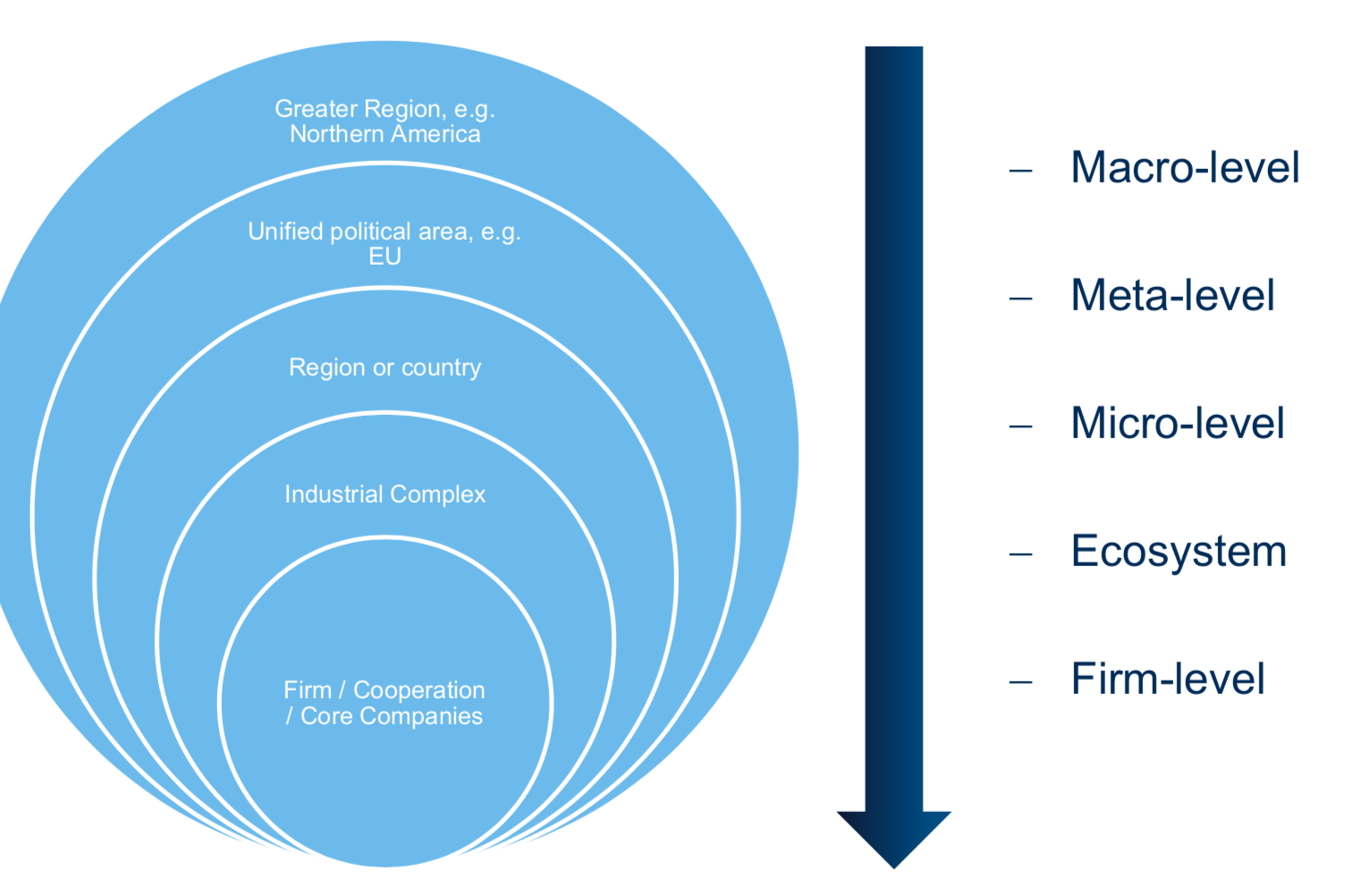
- 54name 2 example countries which use the "Anglo-Saxon" Business system.USA, UK
Focus on Shareholders
in Financial Markets.
Information Disclosure is high - 55name 4 countries which use a "Communitarian" Business SystemJapan, Germany, France, Italy
Focus on Stakeholders:
Employees, suppliers, government, community ("society")
Information Disclosure is limited - 56name 4 countries which use "Emerging" Business systemsIndonesia, Phillippines, Thailand, China
Focus on family owners
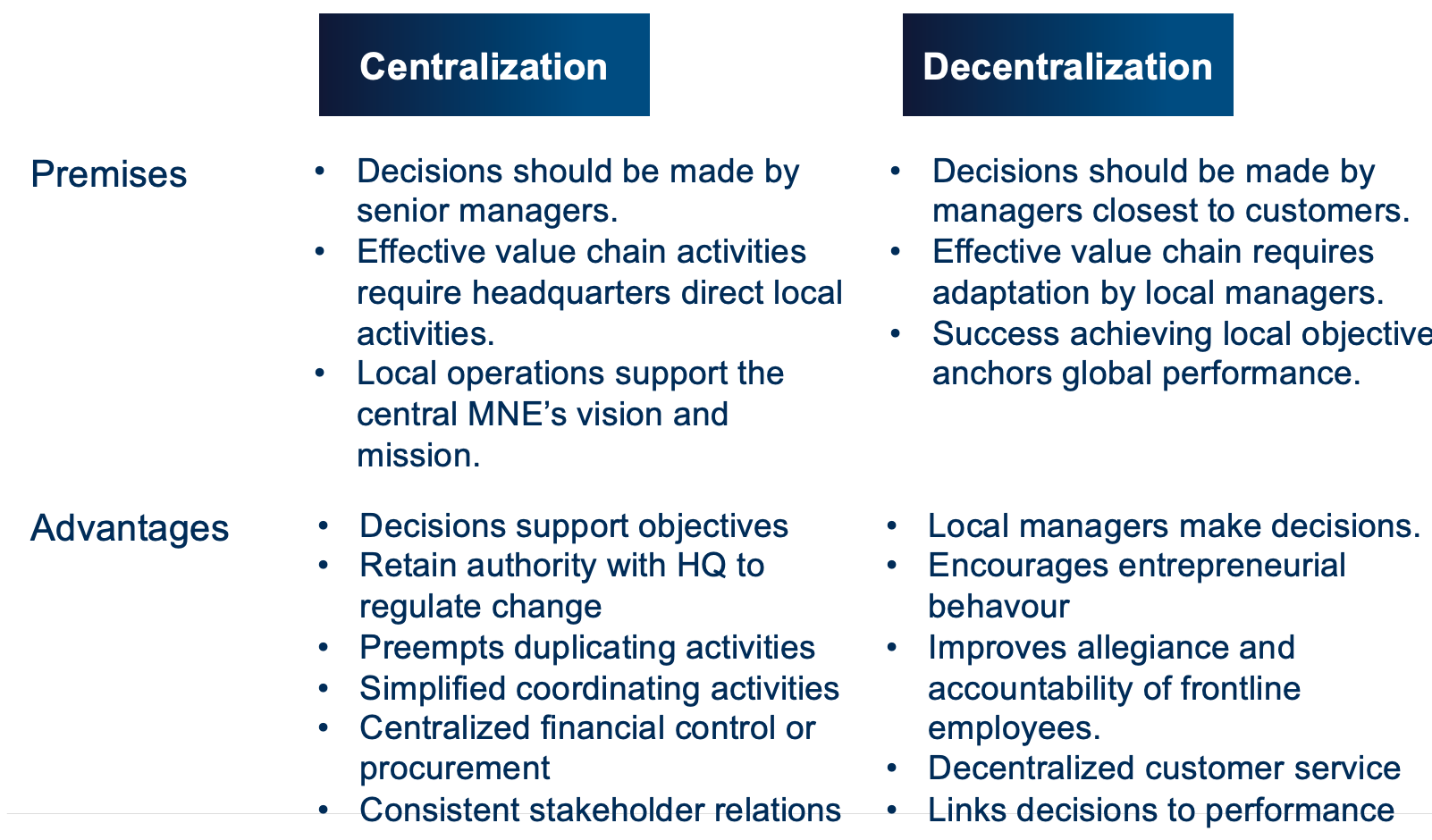
government ministries
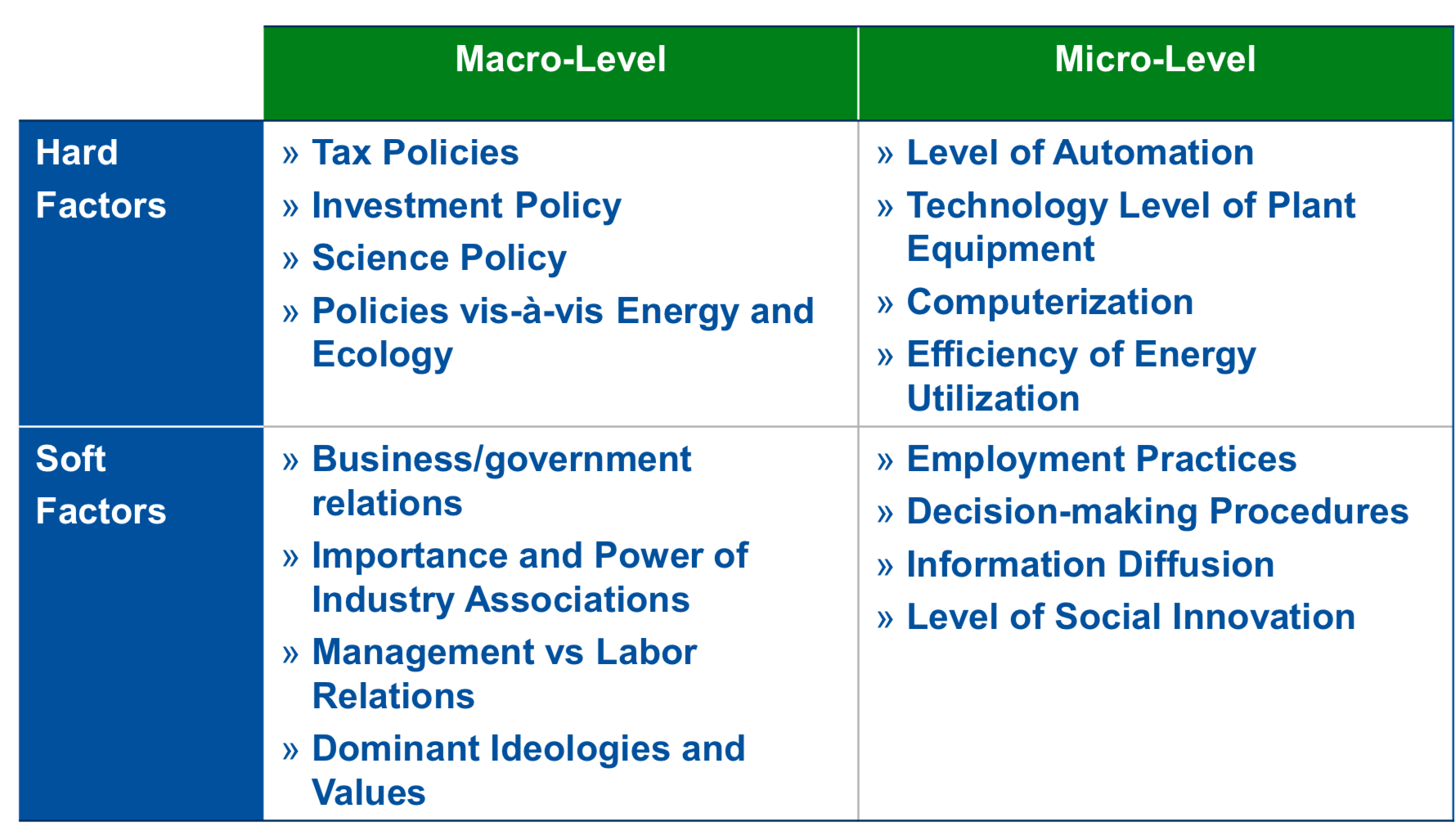
lack of disclosure and transparency - 57Analytical Framework: Business Systems Characteristics Differences in Business Systems manifest themselves in 3 areas..
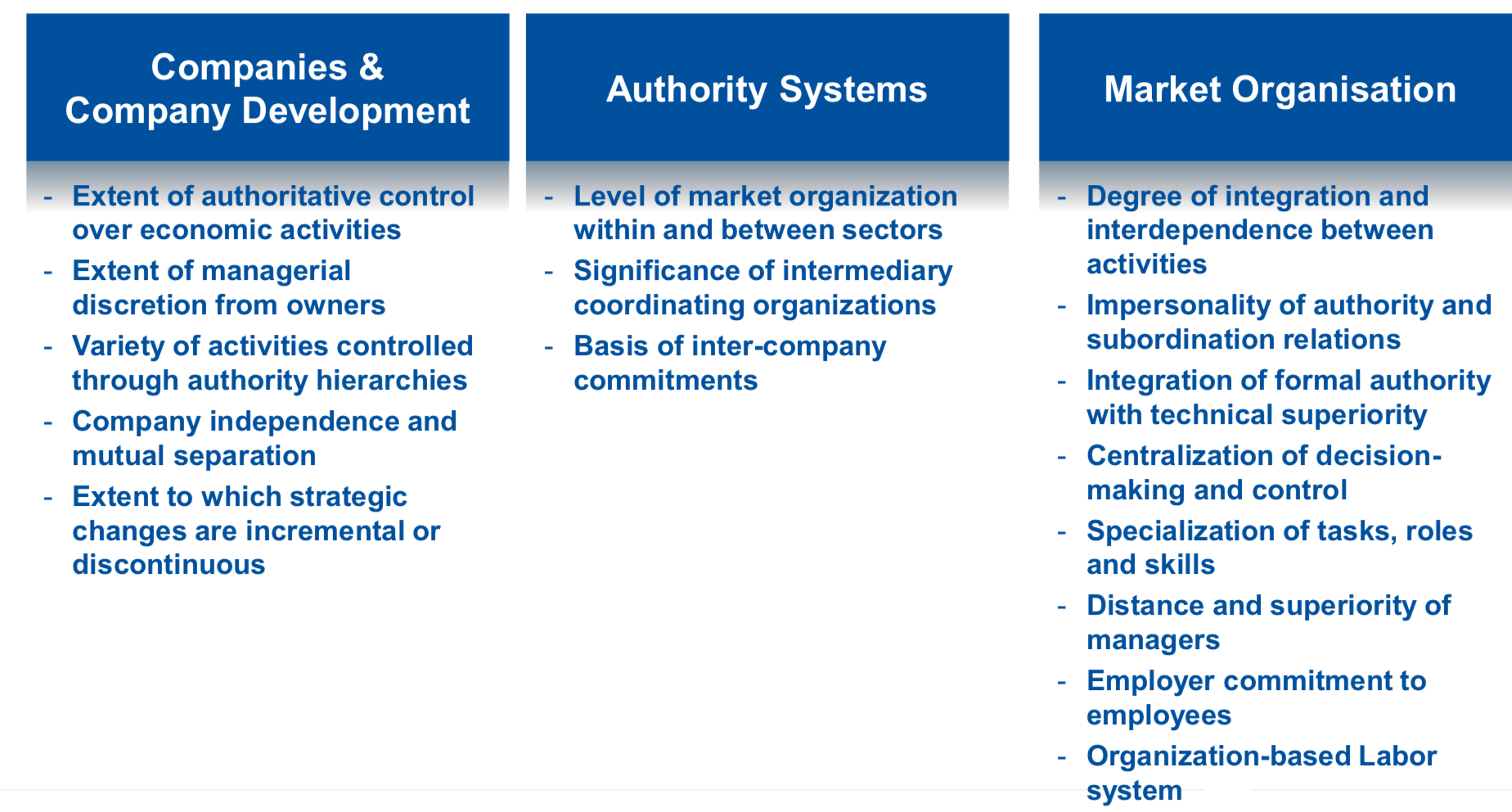
- 58Framework for Business System Analysis explain the 4 fields (hard&soft factors within macroµ level)
- 59What is a core company? what kind of problems do they control?In capitalist production, companies are faced with a number
of control problems like
labour process
supply process
distribution
core production technologies
access to finance.
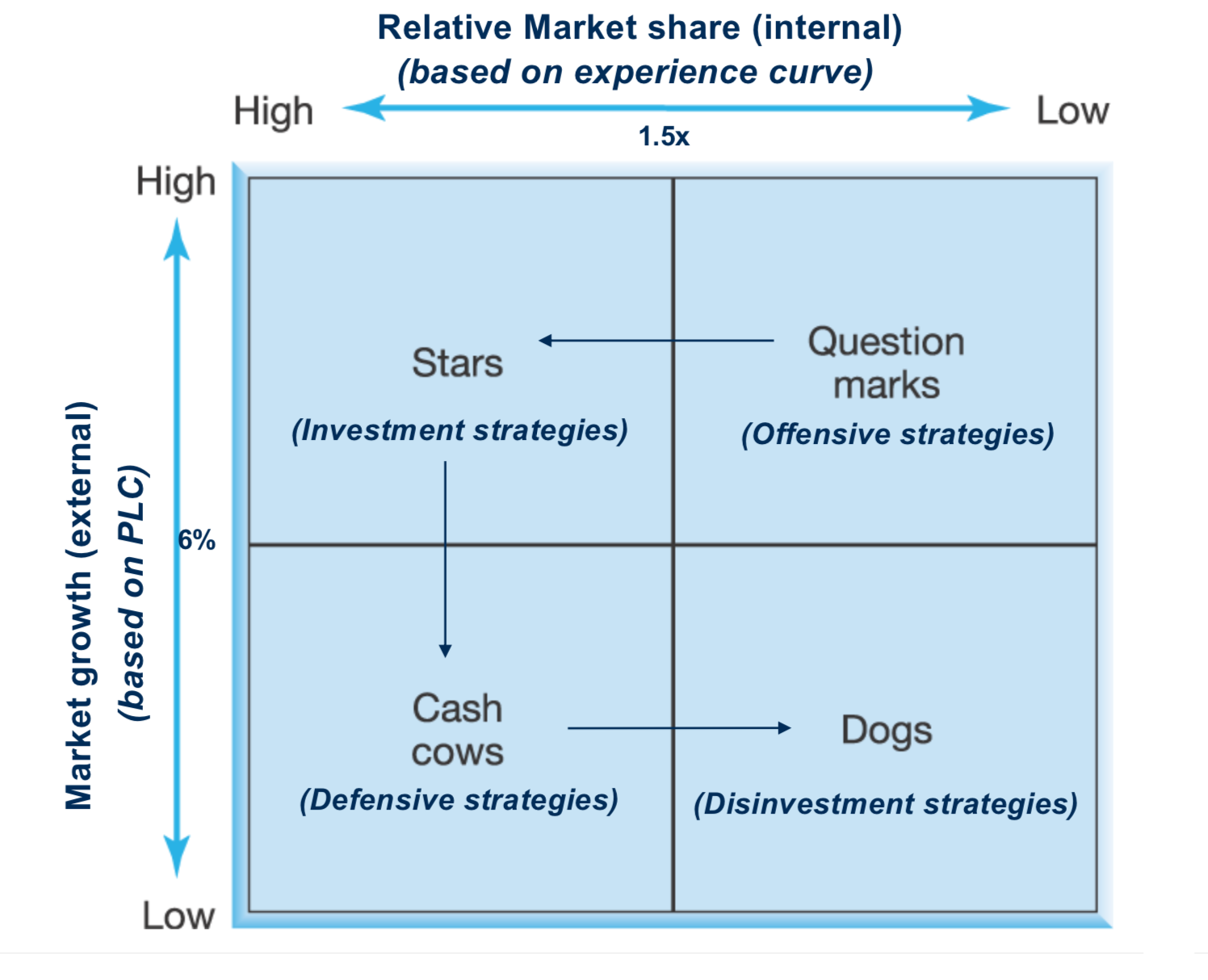
Companies who have gained dominating control over these processes are called core companies. - 60Market share/Market growth matrix: The BCG-Matrix
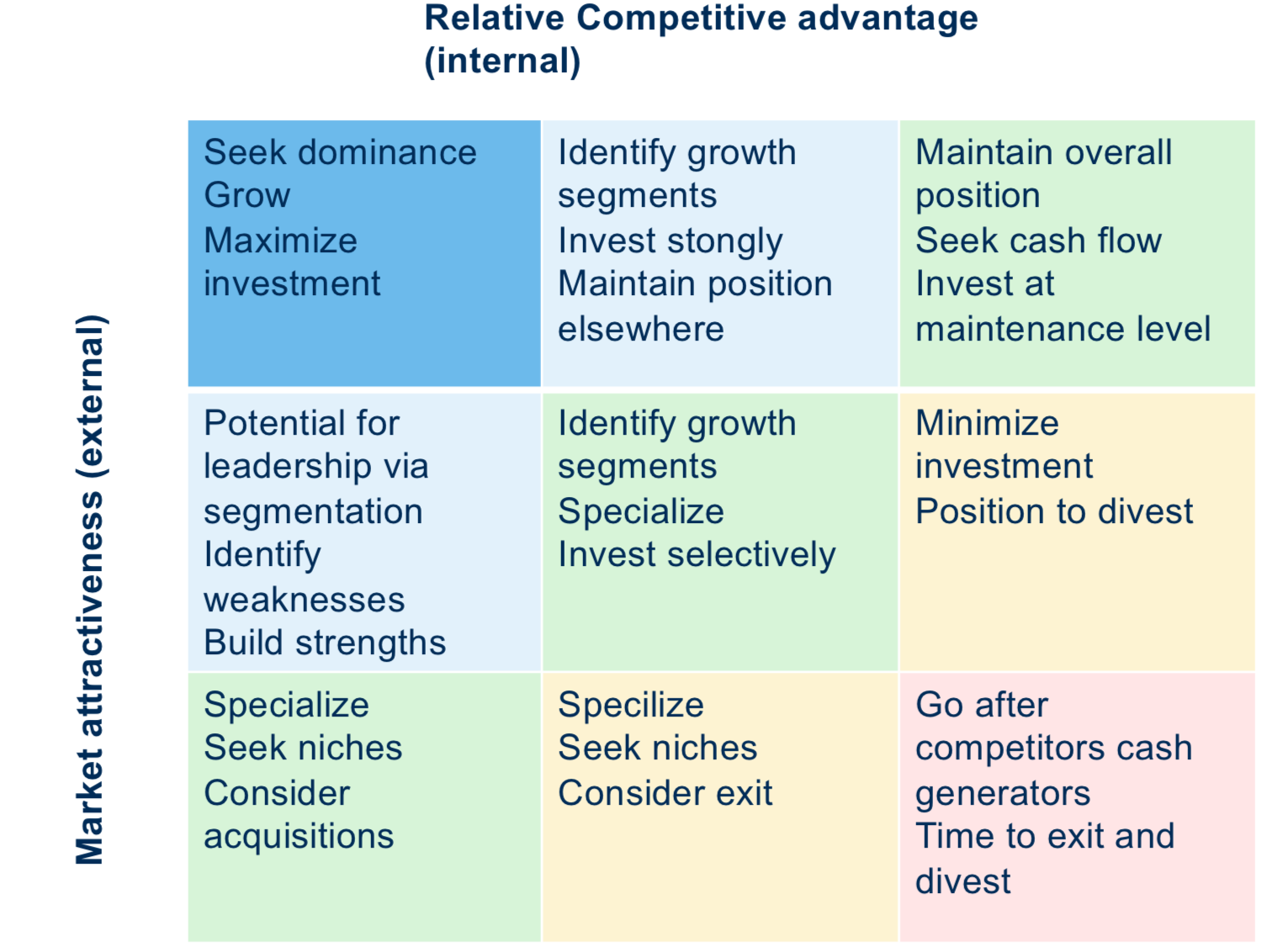
- 61Market attractiveness/Competitive advantage matrix: The (GE) McKinsey Matrix 2
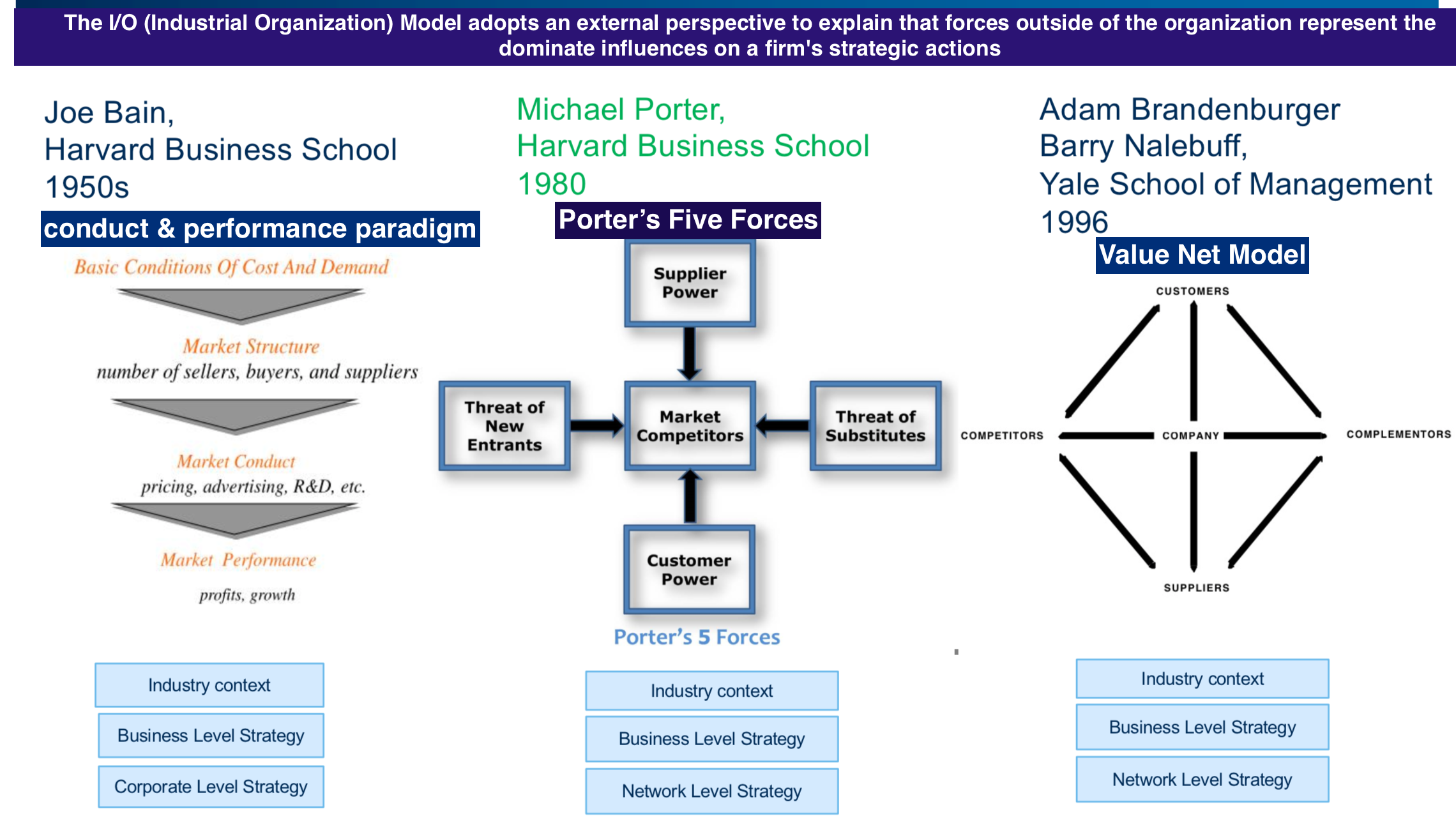
- 62Industry attractiveness (IO) Industrial Organization
- 63Unique competencies Competitive Cost & Customer Analysis The Porter’s Company Value Chain (1985) explain the 2 context and 2 strategy level w4,p20Organizational & International context
Business & Network Level strategy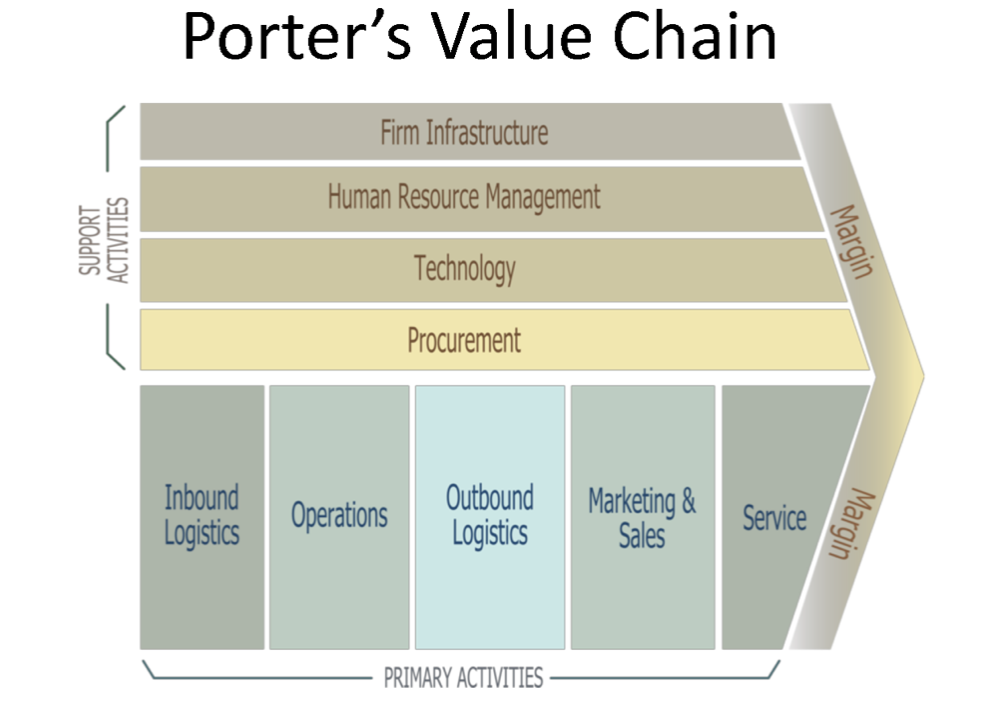
- 64Unique competencies Competitive Cost Analysis The McKinsey Business System (Industry Value Chain) (1970s) explain the 3 context and 3 strategy level w4,p20Industry, Organizational & International context
Business, Corporate & Network Level Strategy - 65Unique competencies Edith E. Penrose (1959) University of Baltimore 1959 «The Theory of the Growth of the Firm»«A firm is a bundle of productive resources with different firms possessing different bundles of these resources».
Organizational Context
Corporate & Network Level Strategy - 66Unique competencies Birger Wernerfeld, MIT Sloan School of Management (1984) «The Resource-based View of the Firm»«A resource can be thought of as a strength or weakness of a given firm or any semi-permanent advantages (examples: machine capacity, customer loyalty, production experience, technological leads etc.)»
Organizational Context
Corporate & Network Level Strategy - 67Unique competencies C. K. Prahalad, Gary Hamel University of Michigan Harvard Business School (1990) Core Competence
- 68Unique competencies D. Teece, G. Pisano & A. Shuen University of Michigan Harvard Business School (1997) Dynamic capabilityDynamic capability is «the firm’s ability to integrate, build, and reconfigure internal and external competencies to address rapidly changing environments.»
Organizational context
Corporate & Network Level Strategy - 69Sustainable competitive advantage in international context is based on...efficiency, flexibility and learning
Managers should aim to develop, at one and the same time, global scale in efficiency, multinational flexibility, and the ability to develop innovations and leverage knowledge on a worldwide basis. - 70WHAT IS BLUE OCEAN?The idea behind it is the referral to the vast marketing options that occurs when an unknown industry or innovation occurs. The authors define blue oceans as markets associated with high potential profits. Overall, blue ocean markets have several characteristics that innovators and entrepreneurs love. A pure blue ocean market has no competitors. A blue ocean market business leader has first-mover advantages, cost advantages in marketing with no competition, the ability to set prices without competitive constraints, and the flexibility to take its offering in various directions.
- 71Red Ocean strategy Red oceans are all the industries in existence today.Companies try to outperform their rivals to grab a greater share of existing demand. As the market space gets crowded, profits and growth are reduced. Products become commodities, leading to cutthroat or ‘bloody’ competition.
-with its strategic choice of differentiation OR low cost - 72Blue Ocean Strategy Blue oceans denote all the industries not in existence today – the unknown market space, untainted by competition.In blue oceans, demand is created rather than fought over. There is ample opportunity for growth that is both profitable and rapid.
In blue oceans, competition is irrelevant because the rules of the game are waiting to be set. A blue ocean is an analogy to describe the wider, deeper potential to be found in unexplored market space. A blue ocean is vast, deep, and powerful in terms of profitable growth.
-Align the whole system of a firm’s activities with its strategic choice of differentiation AND low cost - 73The Four Actions Framework to create a Blue Ocean1. Raise: which factors should be raised well above industry standards?
2. Eliminate
3. Reduce: well below industry standards
4. Create: factors which the industry never offered
= a New Value Curve - 74Cost reduction and local responsiveness are driven by different variables » Pressures for global integration and cost reductions are greatest when: name 41. industries produce commodity products (universal need) so price is the main competitive weapon
2. major competitors based in low cost locations
3. persistent capacity and price pressures
4. consumer are powerful and there are low switching costs
Products: sugar, flights, credit cards, computers, gasoline - 75Cost reduction and local responsiveness are driven by different variables » Pressures for local responsiveness arise from: name 41. differences in consumer taste and preferences
2. differences in traditional practices and infrastructure
3. differences in distribution channels
4. host-government demands
Products: adapters, asianburger, trains - 76Four archetypes of international corporate-level strategy
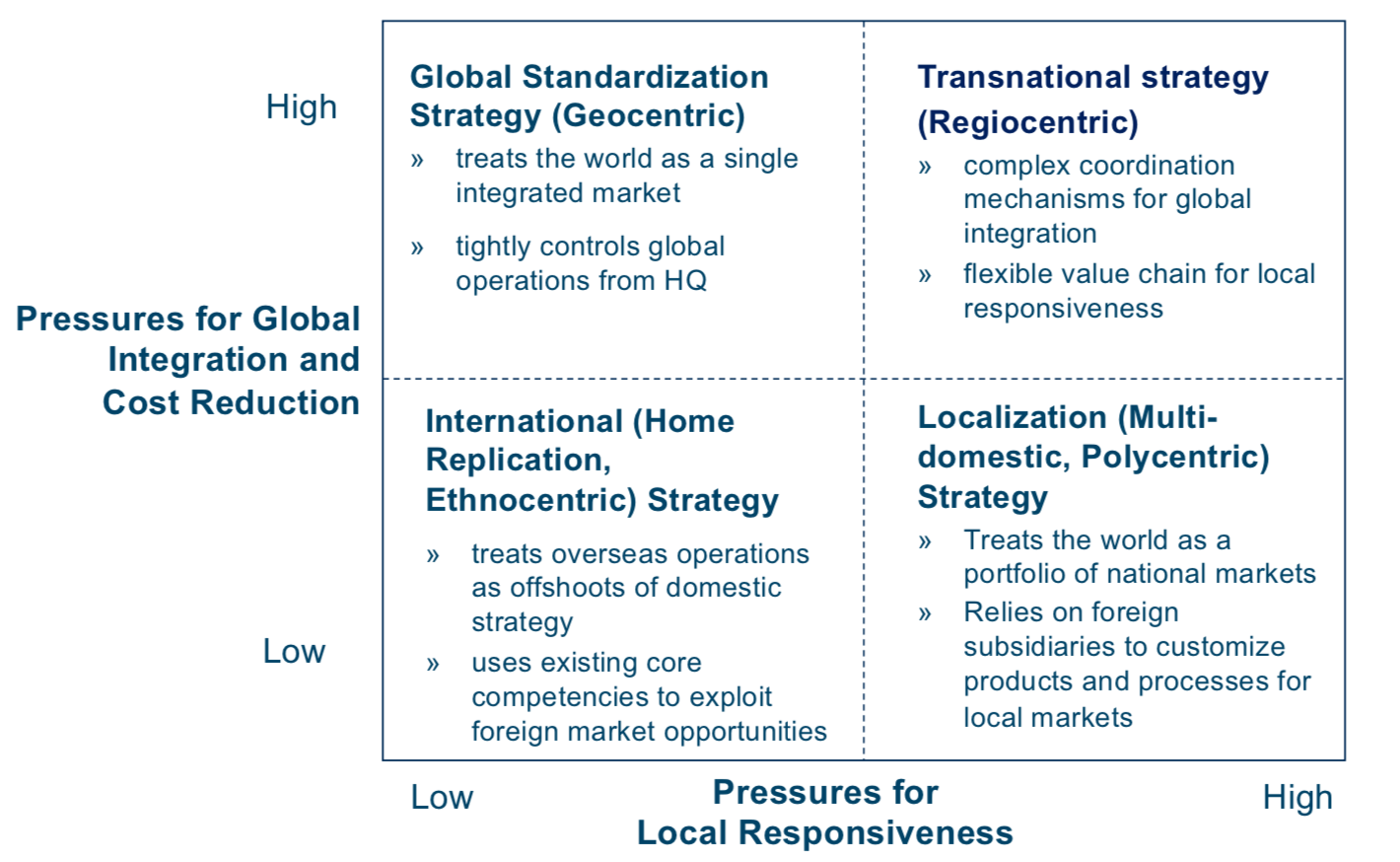
- 77» Traditional MNC Cultural Orientation low Responsiveness / low Cost Pressure Ethnocentric means?focus on values, processes and resources of the domestic company and replicate.
- 78» Traditional MNC Cultural Orientation high responsiveness / low cost pressure Polycentric means?focus on values and interests of the local culture in the served markets
- 79» Traditional MNC Cultural Orientation low responsiveness / high cost pressure Geocentric means?focus on global values and universal needs
- 80» Traditional MNC Cultural Orientation high responsiveness / high cost pressure Regiocentric means?Focus on integration in geographic markets and building an global network of operations.
- 81The characteristics of a multi-domestic strategy are..1. Individual value chain in every market
2. independence of business units
3. different local markets with cultural, legal-political, economic specifics - 82The term ________ refers to a global company that thrives on seeking unique ideas and insights from locations around the world and then leveraging that knowledge in international markets.Transnational
strategy (Regiocentric)
» complex coordination mechanisms for global integration
» flexible value chain for local responsiveness - 83Citibank decides to open a call center in Mumbai, India because a detailed analysis of the country-specific advantages suggests that India is the optimal place for responding to customers' calls. Citibank is exploiting ________ by running a call center in India.location economies
Countries have different cultural, economic, legal and natural dimensions. These differences have direct effects on the cost of production of many goods. Companies go around the globe to find and operate under the most optimum settings for their goods. Production of the goods under the most optimum settings can give added advantage in cost of productions over their competitors. This is known as Location Economies. - 84Which industry tend to push to which international strategy archetype: Private BankingTransnational strategy
- 85Which industry tend to push to which international strategy archetype: AccommodationMultidomestic strategy
- 86Which industry tend to push to which international strategy archetype: Power SupplyGlobal Standardization strategy
- 87Which industry tend to push to which international strategy archetype: MicroprocessorsGlobal Standardization strategy
- 88Preston Electronics is an MNE with facilities located in Taiwan, Singapore, and Germany. Preston gives its local operations the authority to adapt value activities to prevailing local economic, political, legal, and cultural conditions. Preston is most likely using aNein ________ strategy.Localization
- 89Firms that compete in the global marketplace typically face the asymmetric forces of pressures for ________ and ________.global integration; local responsiveness
- 90Zara creates, produces, and distributes most of its products from its headquarters in Spain. Zara is most likely using a ________ configurationconcentrated
- 91discrete series of steps taken to move a product from conception to end-users what kind does this sentence describe?A company's value chain is best described as the ________.
- 92How to approach a case study task on International Strategy?1. Analyze the competitive advantage of the company
2. Analyze the pressures for standardization and cost reduction and the pressures for local responsiveness.
3. Identify the archetype (s) of international strategy the company seem to apply.
4. Identify the organizational structure best suited to the strategy chosen. - 93Expandig globally allows for rise of profitability and profit growth. how? w5, p.101. expanding the market: Superior product without international competition
2. Location economies: Clearvision, optimal location
3. experience effects: economies of scope & scale
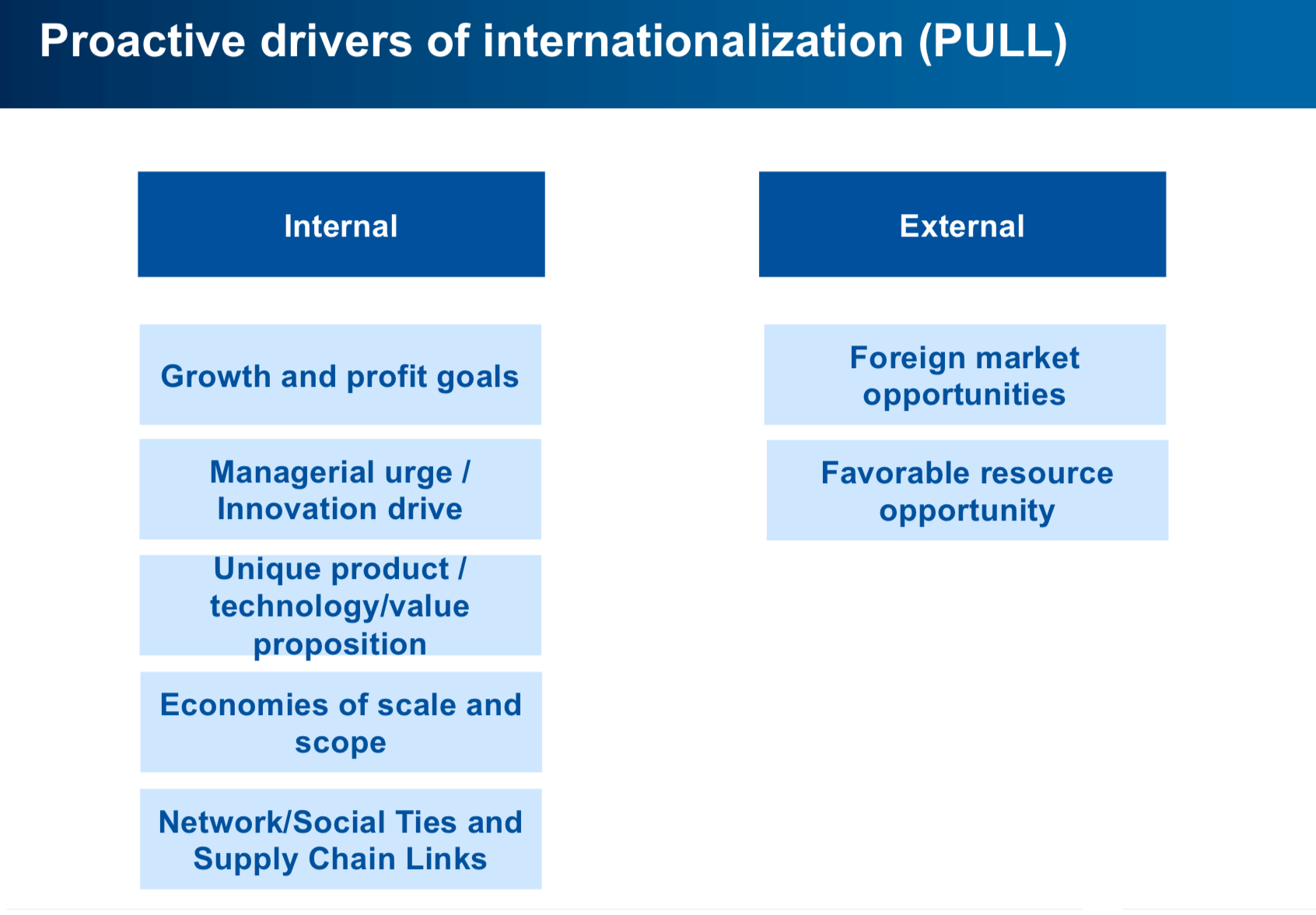
4. subsidiary skills: Competence development and transfer from subsidiary abroad to head office and in the global web (McDonald’s, Zara) - 94Internationalization as a decision influenced by a combination of drivers, barriers and risks. what are the pull drivers?
- 95Internationalization as a decision influenced by a combination of drivers, barriers and risks. what are the push drivers?
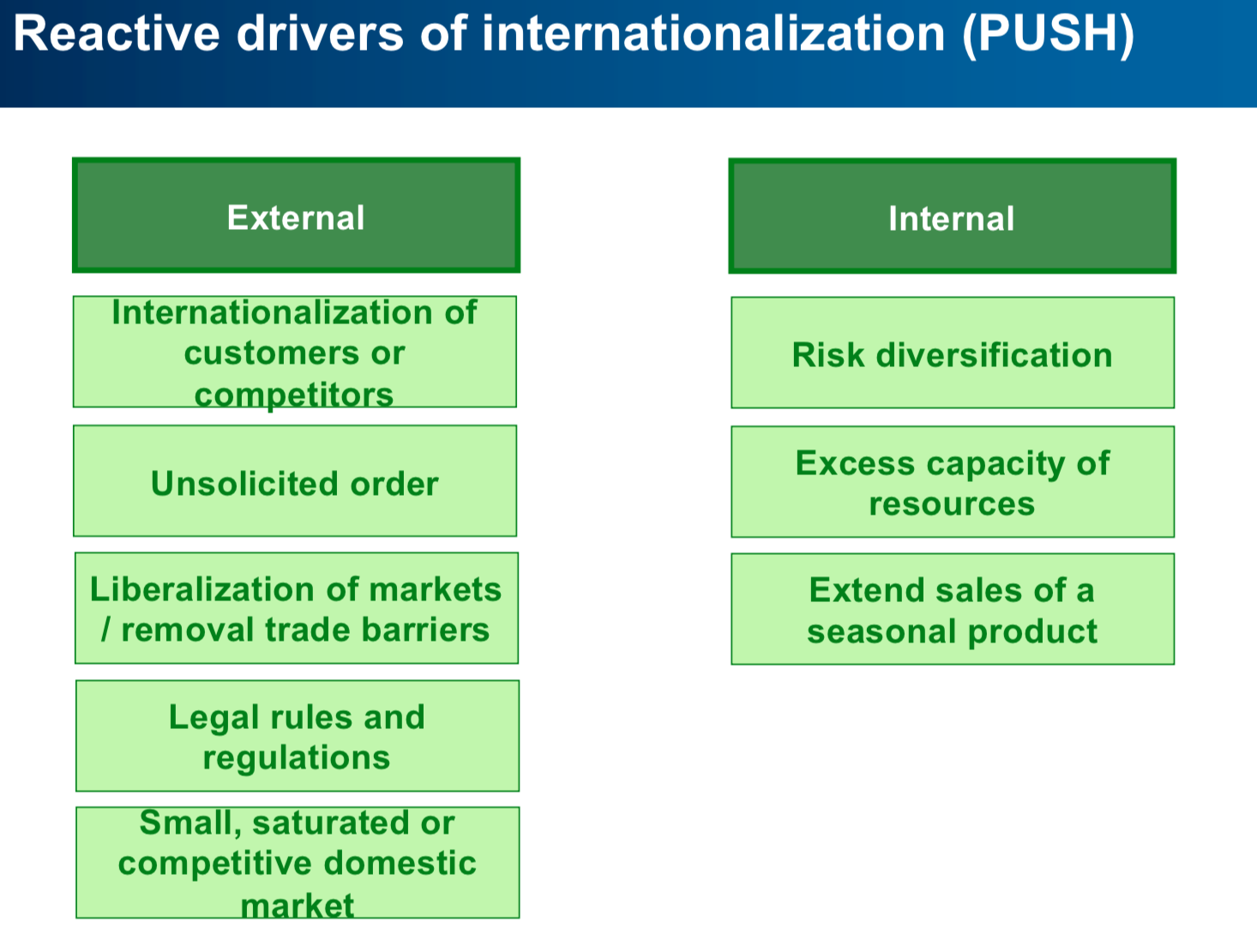
- 96Unsolicited order what's that?example of Stadler Rail.
Unsolicited business proposals are sent to clients who haven’t requested them. They are submitted on the proposer’s own initiative
(Push driver for internationalization) - 97Barriers of Internationalization name 31. Lack of knowledge about foreign markets
2. Lack of ressources
3. Lack of networks - 98Risks of Internationalization name 41. (Geo-)Political risks
2. Labour disputes and consumer boycotts
3. Financial and fiscal risks (foreign exchange rate)
4. Legal risks - 99Reasons for internationalization of Swiss SME (in 2016) name the 4 main reasons.1. Demand form forging customers (54.4%)
2. Limited potential in domestic market (41.7%)
3. Use of existing network (29.1%)
4. High market opportunities due to innovative products (28.2%) - 100Obstacles in the internationalization process of Swiss SME (in 2016) name 41. Price of own products & services (37.9%)
2. Existing laws and regulations abroad (21.2%)
3. Costs of Internationalization (19%)
4. Available time of senior management (14.8%) - 101The relationship DoI and performance W5, p.44
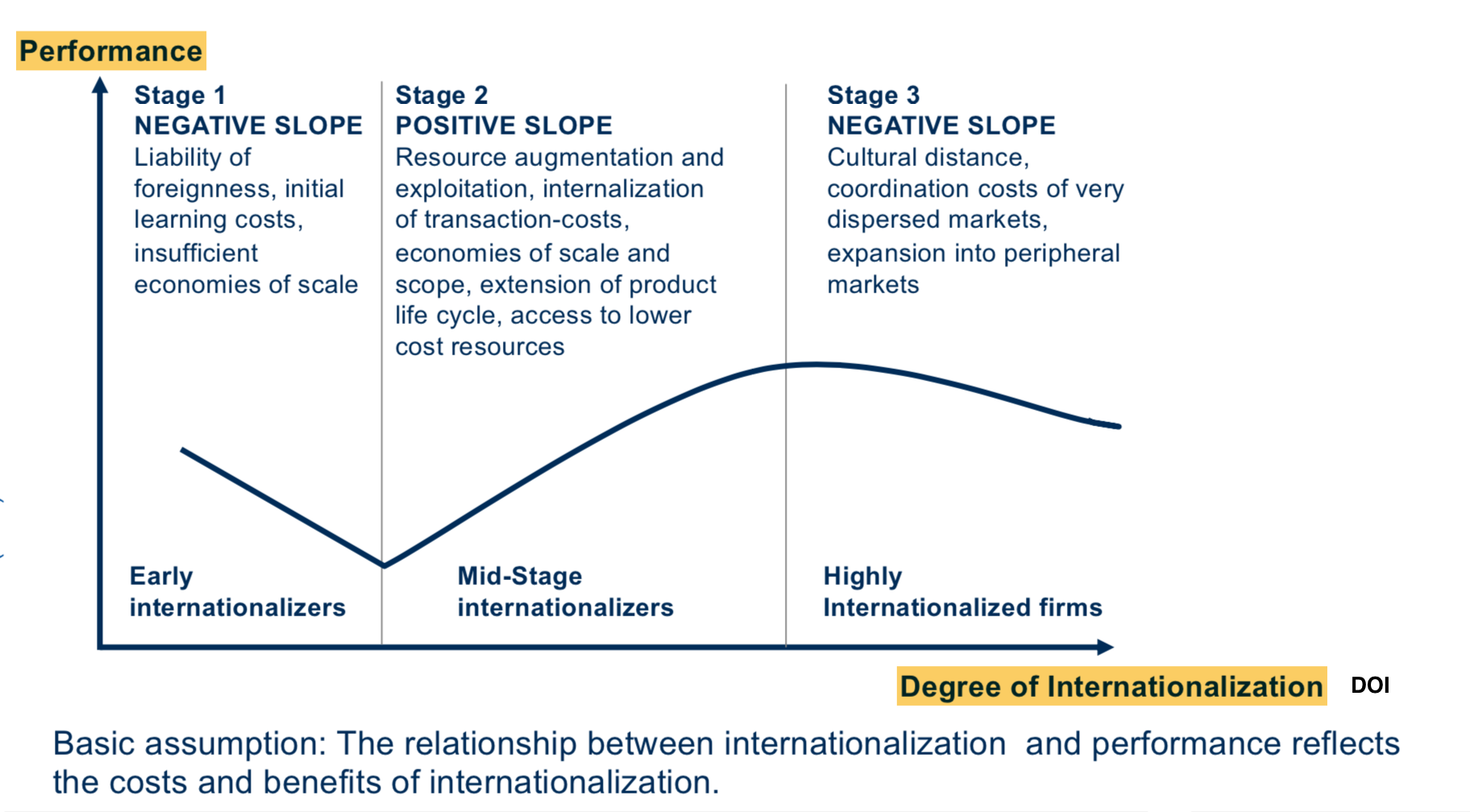
- 102Different DoI-Performance-Links draw the shape lines for Germany, US and Japan
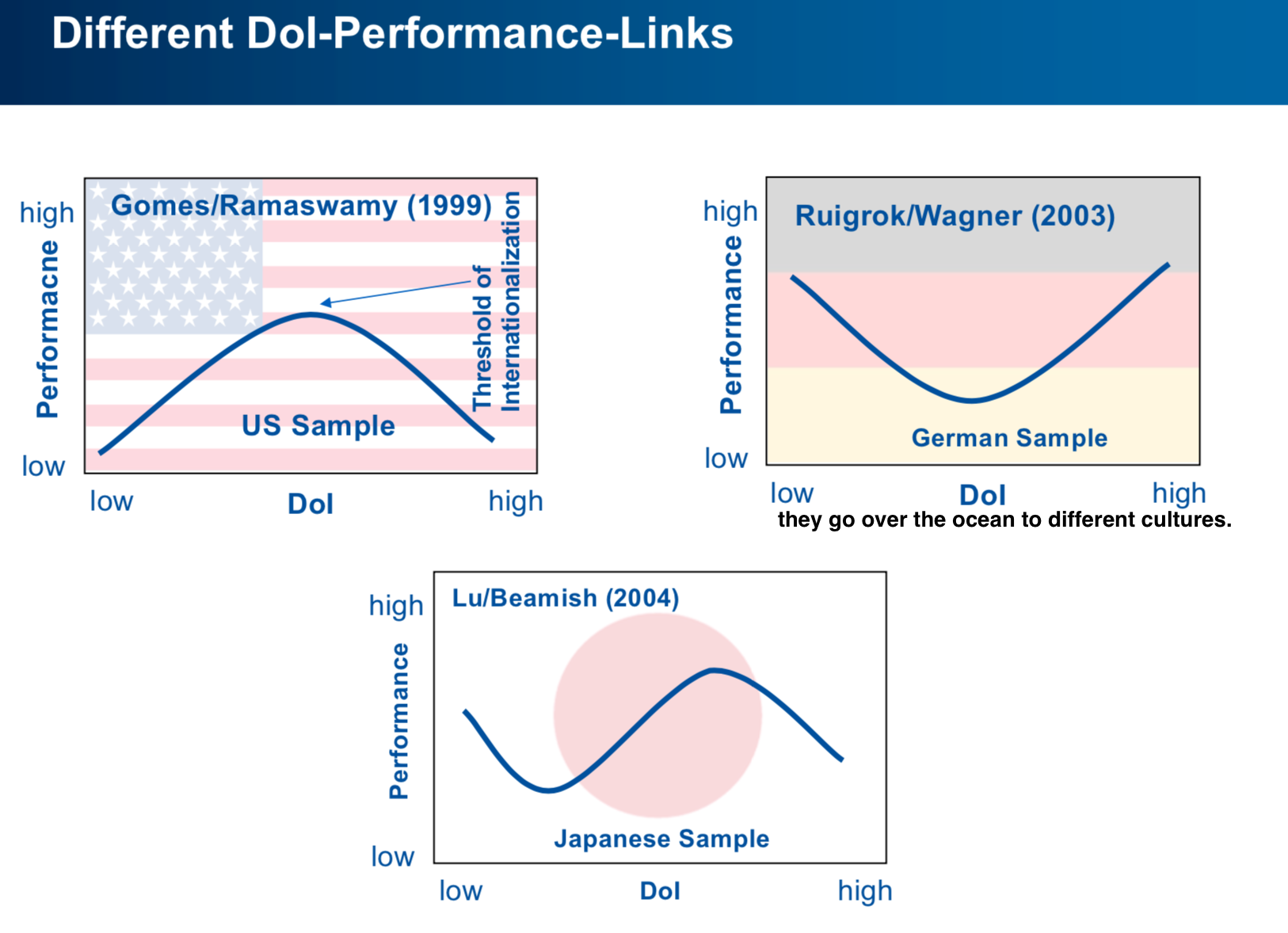
- 103DoI-Performance link for Swiss companiesExpected form
- S-Curve «on its back» or inverted S-
Curve
- Justification
- Swiss firms from all three large language
areas have a culturally and geographically close large market nearby (D/F/I)
- The small home market forces Swiss firms to expand abroad relatively early in their development - 104Summary: The relationship between DoI and performance of USA, Germany and Switzerland
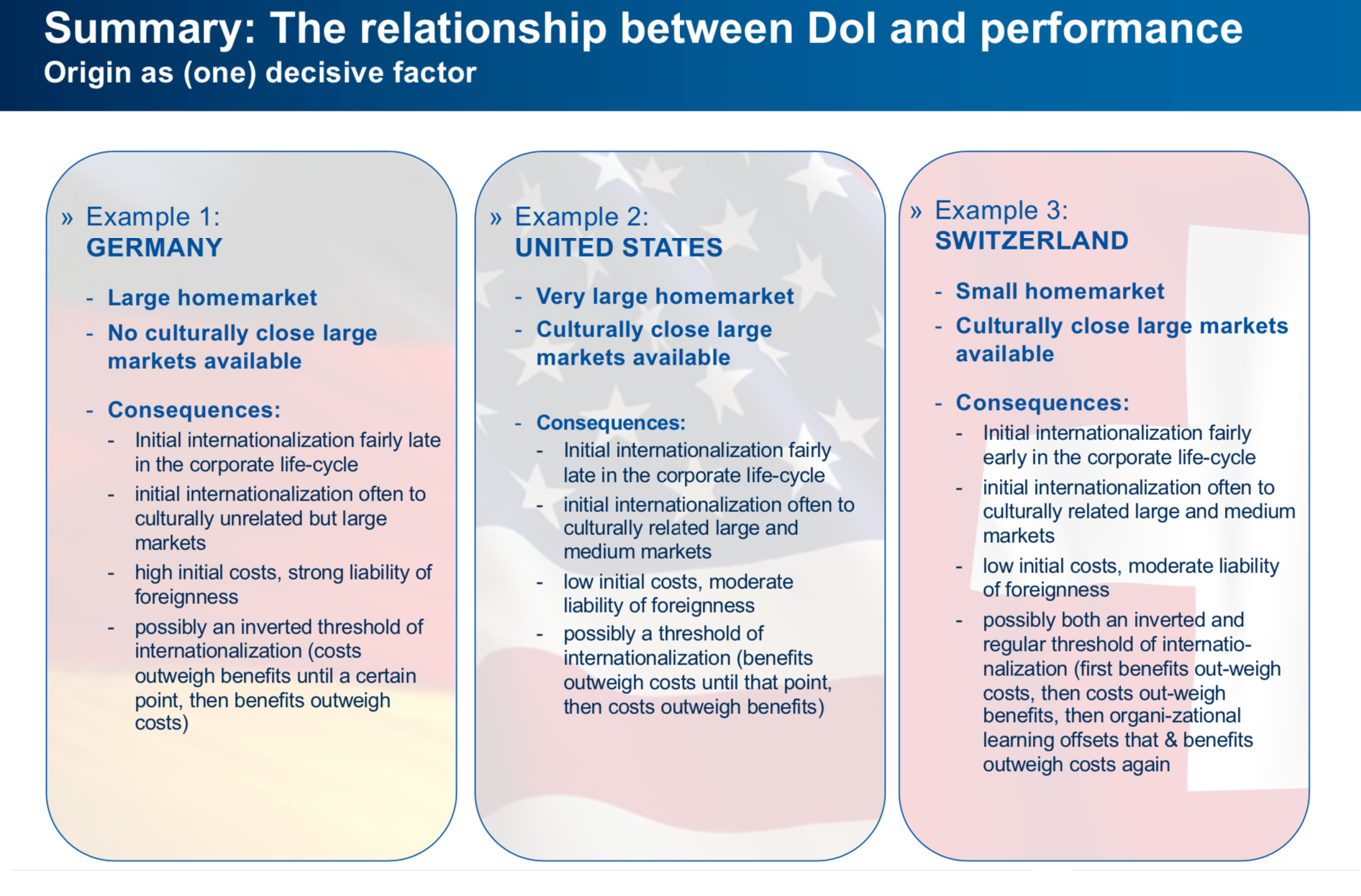
- 105Internationalization of customers & competitors Unsolicited orders and foreign market opportunities are all examples for push or pull drivers of internationalization?Reactive drivers of internationalization (external PUSH)
- 106Legal Rules Liberalization of Markets and Removal of Trade Barriers are all examples for push or pull drivers of internationalization?Reactive drivers of internationalization (external PUSH)
- 107Growth and profit goals, economies of scale and scope Unique product (technology/value proposition) are all examples for push or pull drivers of internationalization?Proactive drivers of internationalization (internal PULL)
- 108Foreign market opportunities Favorable Ressource Opportunity are all examples for push or pull drivers of internationalization?Proactive drivers of internationalization (external PULL)
- 109Theories and models of internationalization explain Transaction cost theories of Internationalization (FDI)Firms internationalize to minimize transaction costs.
1. International Product Life Cycle
2. Exchange Rates on Imperfect Capital Markets
3. Internalization Theory (own facilities abroad)
4. Eclectic paradigm - 110Theories and models of internationalization explain Vernon's International Product Life-Cycle (PLC) w6, p.12
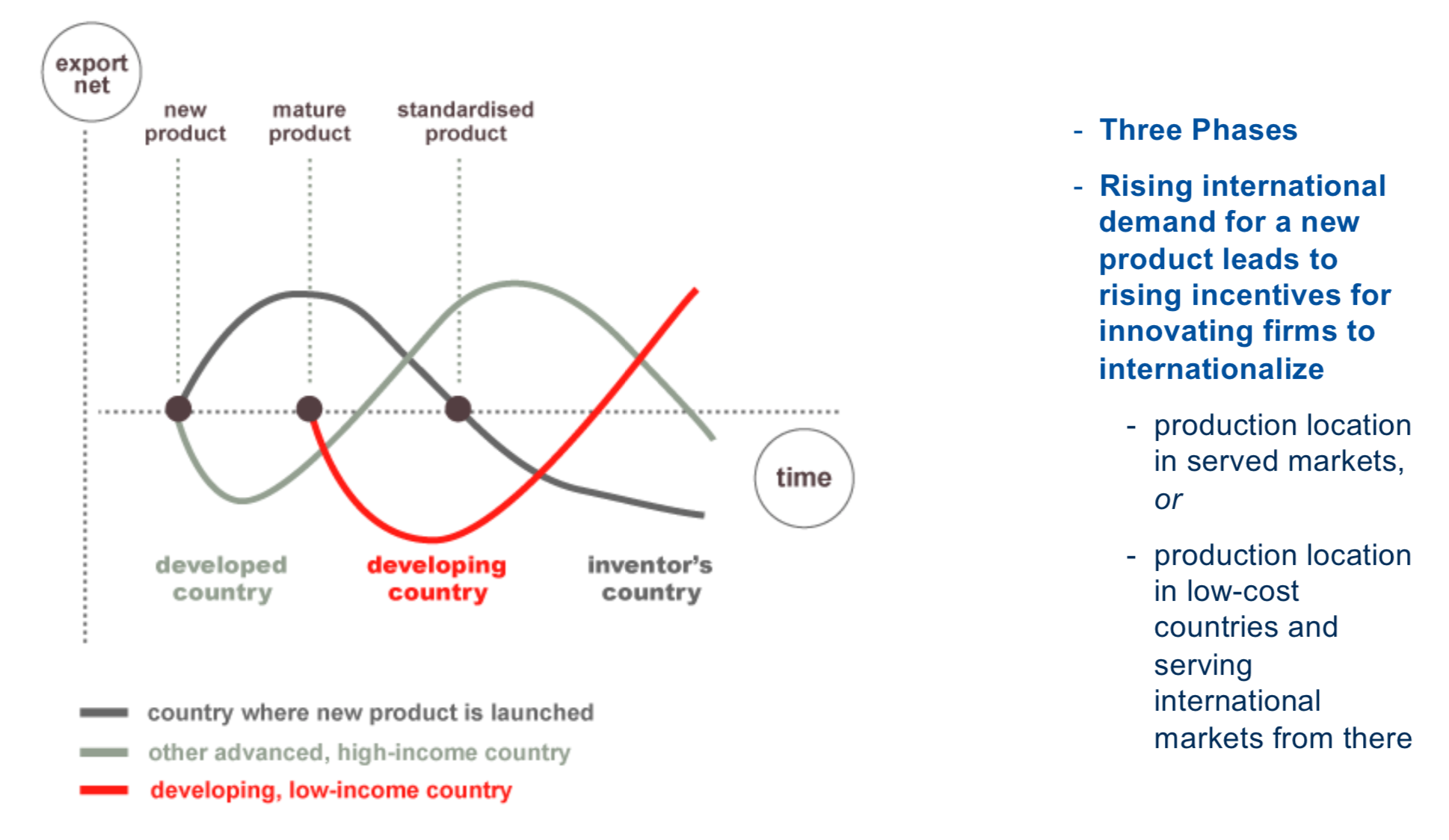
- 111Theories and models of internationalization explain OLI (Eclectic Paradigm) w6,p15Firms internationalize to make use of three specific groups of competitive advantages: 1. ownership- specific (O)
-patents, trade marks,
- technology innovations
- economies of large size:
scale, scope, access to
financial capital
2. location-specific (L)
-low factor prices,
- technology access,
- market conditions etc.
- see «Competitiveness of
nations» (CAN)
3. internalization-specific (I)
- Full control remains with the
MNE
- WOS is preferable to other
entry modes because of transaction cost, uncertainty and control over the distribution channel.
=>because of transaction costs theory - 112The higher the O:: The higher the L:: The higher the I::1. The higher the O the more the firm will prefer to use them itself rather than to rent them.
2. L are the key factor for which country will become a host of the international activity.
3. The higher the I the more the company will engage in international production. - 113Theories and models of internationalization explain The Stages (Uppsala) Model: Gradual processThe goal of internationalization is to minimize risk while maximizing learning and growth. the stages are:
0) domestic operation
1) little exports in geographically close markets, not too risky
2) regular exports, also into more distant markets, with more resources (with agents)
3) exports via sales offices abroad
4) production abroad.
Firms choose markets in order of decreasing
psychic/cultural distance. Decision criterion for next steps: trade-off between growth and risk - 114Explain brief the 5 Uppsala Model: Internationalization as a step-by-step process1. Domestic Focus
2. Pre-export stage (irregular export, management tests feasibility for internationalisation)
3. experimental Involvement (regular export, management becomes favorable for internationalization)
4. Active involvement (sales office in foreign market, management dedicates substantial time & money)
5. committed involvement (FDI and M&A, management makes internationalization as key part of the firm’s profit-making and value- chain activities) - 115Theories and models of internationalization explain The Network Approach to internationalizationInternationalization occurs opportunistically based on networks and relationships within the firms (customers, suppliers, personal networks of managers, etc.); internal internationalization (FDI, M&A) occurs only if there are no cooperation opportunities.
=>network is not step by step but more the connection between all participants - 116Theories and models of internationalization explain Born Globals: Factors influencing early internationalizationSome firms do not internationalize consciously but are highly internationalized from the start.
1. Entrepreneur Characteristics (personality, qualifications, experience)
2. Industry characteristics (5 forces, eg. a Software)
3. Globalization effect (ICT, transportation, consumer needs)
4. Networks (Personal & Organizational) - 117Theories and models of internationalization what is the The Springboard ModelDescribes the aggressive internationalization by emerging markets MNE into developed markets.
- 118The Springboard Model explain 1. motivation 2.reasons to spring 3. unique activities 4. challenges
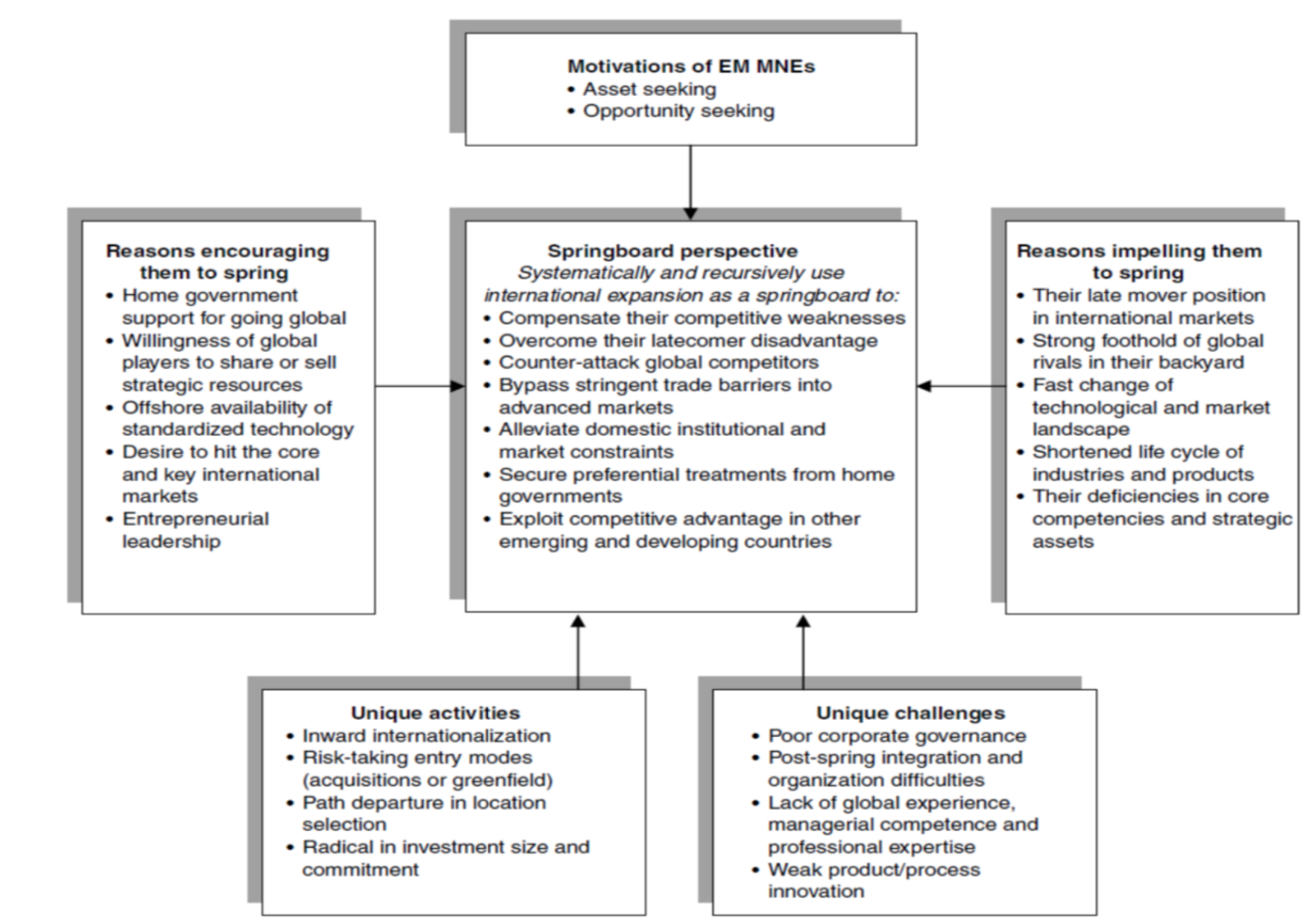
- 119Factors influencing the internationalization process
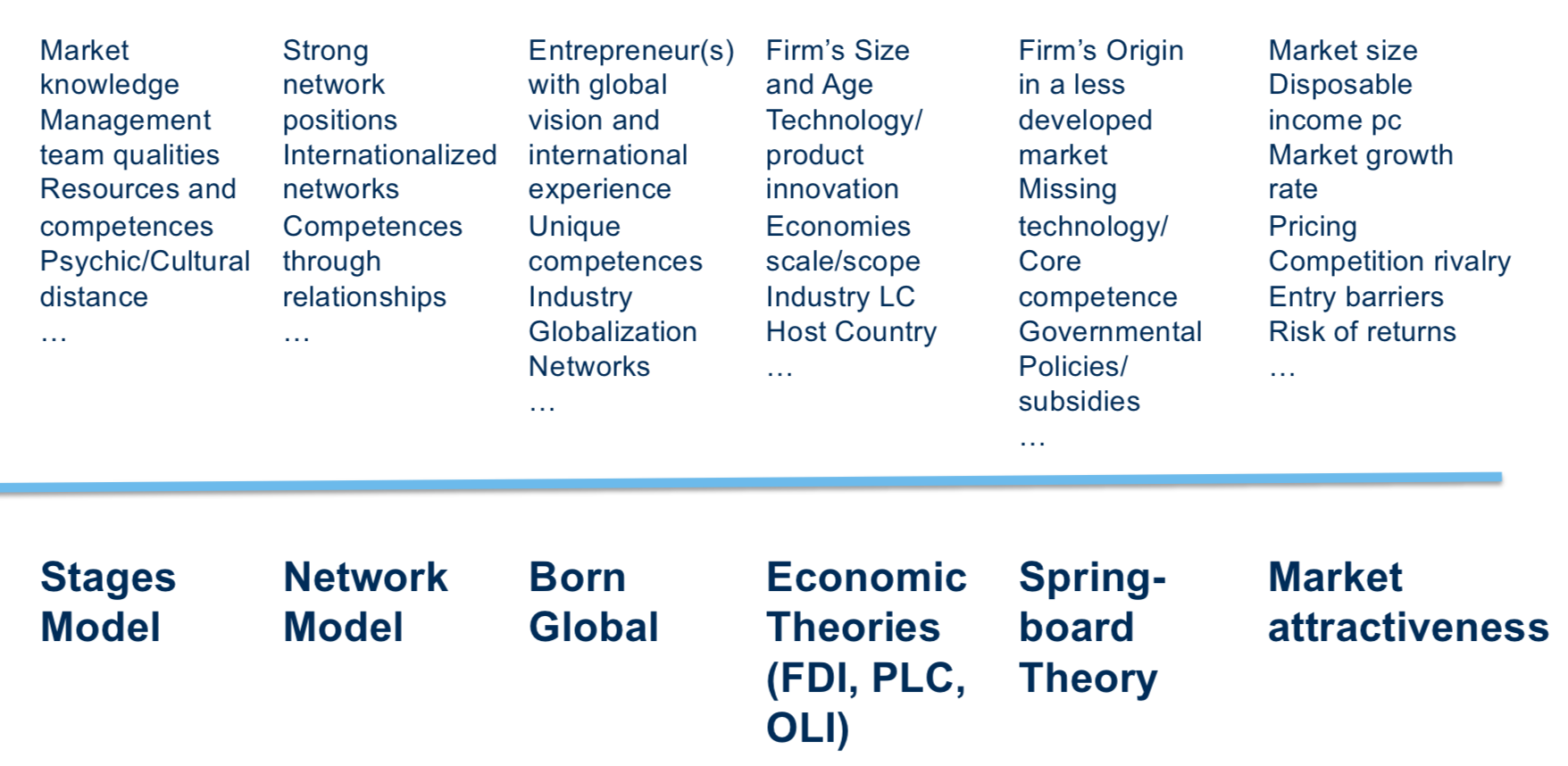
- 120name 6 foreign market entry modes1. Exporting
3. Licensing
4. Franchising
5. Joint Ventures
6. Strategic Alliances
7. Wholly owned subsidiary(FDI) (Greenfield) - 121explain Export 1. options 2. pro/condirect vs. indirect (with intermediary eg. sales agent)
pro:
no cost of establishing manufacture
helps achieve experience curve
con:
no low-cost location
high transport cost
tariff barriers
market intermediary can be risky - 122explain Licensing pro and consa licensor grants the rights to intangible property to the licensee for a specified time period, and in return, receives a royalty fee from the licensee (f.i. patents, inventions, formulas, processes, designs, copyrights, trademarks)
pro:
avoid development costs
good for in political volatile markets
no barriers to invest
capitalize on applications of own intellectual property without developing those applications itself
con:
no tight control
coordination
know-how theft risk - 123explain Franchising pro/consa franchising agreement allows an independent entrepreneur or organization, called the franchisee, to operate a business under the name of another, called the franchisor, in return for a fee (long-term committment)
pro:
-it avoids the costs and risks of opening up a foreign market
-quickly build global presence
-avoid tariffs and restrictions on foreign investment
con:
- inhibits the firm's ability to take profits out of one country to support competitive attacks in another
- geographic distance of the firm from franchisees can make it difficult to detect poor quality and thus brand and reputation damage
-risk of creating a future competitor - 124explain Joint Ventures pro/conA firm that is jointly owned by two or more otherwise independent firms (most joint ventures are 50:50 partnerships)
pro:
-benefit from a local partner's knowledge of local conditions, culture, language, political systems, and business systems
-costs and risks of opening a foreign market are shared
-satisfy political considerations for market entry
con:
-giving control of its technology to its partner risk
-not have tight control to realize experience curve or location economies
-conflicts for control if goals and objectives differ or change over time - 125explain M&A pro/conpro:
-less time consuming and quicker to execute, immediate grab of market share when acquiring established company
-less risky compare to greenfield, bank on existing goodwill of the acquired company
con:
- complex task involving bankers, lawyers, M&A specialists
- restrictions on foreign acquisitions in host countries
-risk to overpay for the asset
-clash of cultures
-Integrating the operations of both companies take much longer or doesn’t happen
- risk of inadequate pre-acquisition screening - 126explain Strategic Alliances pro/cona cooperative agreement between potential or actual competitors (from different countries). Joint ventures or short-term contractual agreements about cooperation on a particular task.
Key success factors:
- Partner selection.
- Alliance Structure.
- Managing the relational capital in spite intercultural differences.
pro:
- Facilitate foreign market entry
- Share fixed costs/risks of developing new products
- Combine complementary skills and assets that no company can develop on their own.
- Help to establish technological standards for the industry.
con:
- Give competitors a low-cost route to new technology and markets.
- Can generate short-term profits, but in the long-run “hollow out”
partners, leaving them with no competitive advantage.
- Study: 2/3 of alliances run into serious managerial and financial
troubles within two years of their formation. - 127explain Wholly owned subsidiary (FDI) pro/conthe firm owns 100% of stock (f.i. set up a new operation (Greenfield venture) or acquire an established firm).
pro:
- reduce risk of losing control over core competencies (technological advantage)
- give tight control over operations in different countries that is necessary for engaging in global strategic coordination
- realize location and experience curve economies
con:
- Most costly entry strategy: the firm bears the full cost and risk of setting up overseas operations
- Slower to establish
- Preemption by more aggressive global competitor and losing potential market share - 128Timing of entry First-mover advantage pro/conpro:
-establish a strong brand name
-build sales volume in that country and ride down the experience curve ahead of rivals
-gain cost advantage
con:
-pioneering costs (business failure due to ignorance, promoting, education) - 129Selecting an Entry Mode name all modes and explain advantages/disadvantages
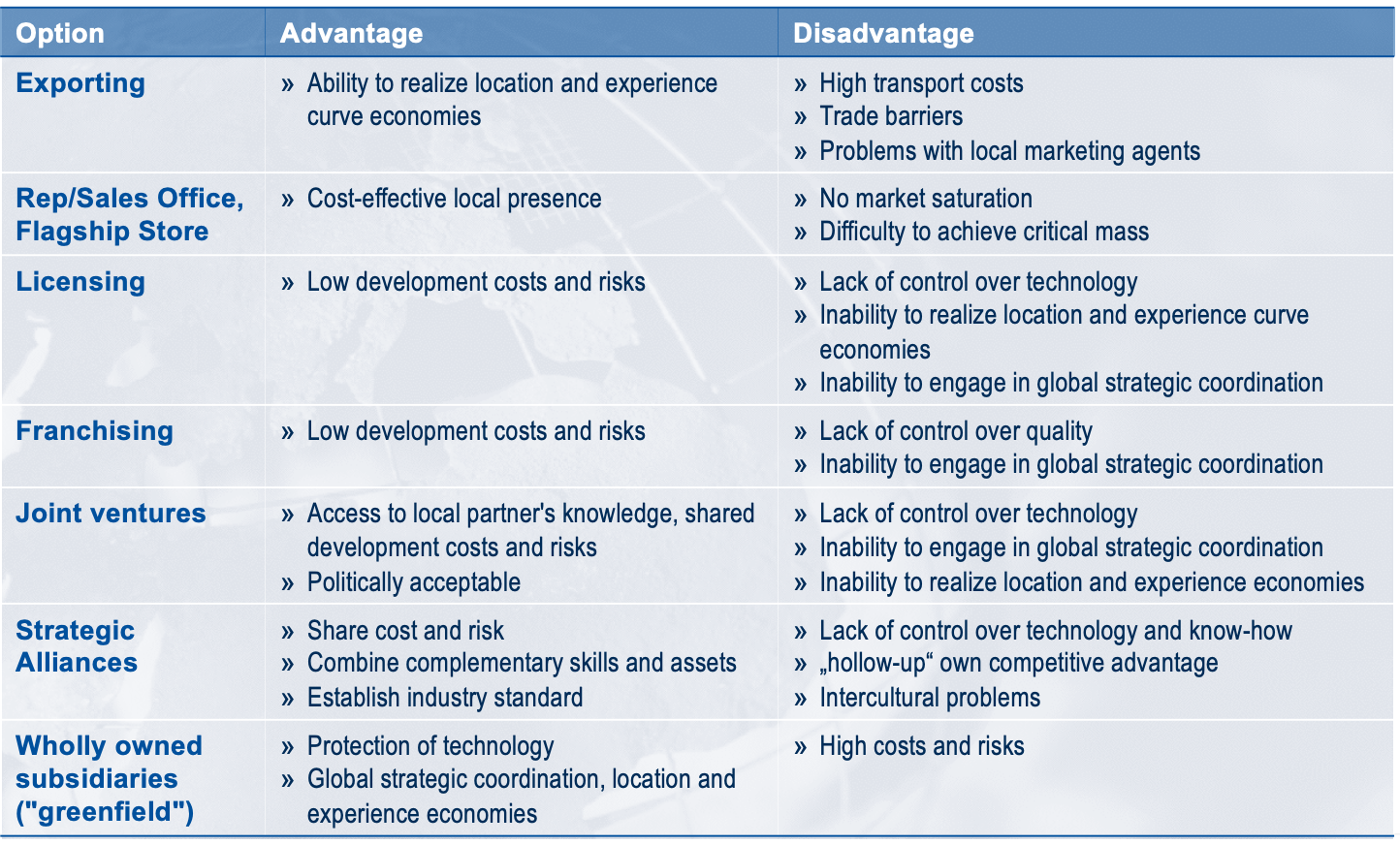
- 130Core competence and entry mode -technological know-how -management know-how state the different approachtech know-how as core competence:
-NO licensing, joint venture (losing control over technology)
-wholly owned subsidiary
management know-how as core comp.:
-losing control not that great risk (Starbucks, mcDonald's)
-valuable asset is brand name - 131FDI Acquisition pro/conacquisitions are
+quick to execute
+preempt competitors
+less risky by buying healthy company
-overpay/too optimistic (hubris hypothesis)
-culture clash
-different cultures, hard to combine business - 132FDI Greenfield venture pro/con+easier to build than to change firm culture
+greater long-term returns than acquisition
-expensive
-slow to establish
-huge risk (however less risk for unpleasant surprise than aquisition) - 133FDI choose Greenfield venture or Acquisition?Acquisition:
-Where already well-established enterprises
-when global competitors are also interested
(Greenfield would be too slow)
Greenfield venture:
-no incumbent competitors yet
-if the competitive advantage of the firm is based on the transfer of organizationally embedded competencies - 134Classification of foreign market entry strategies
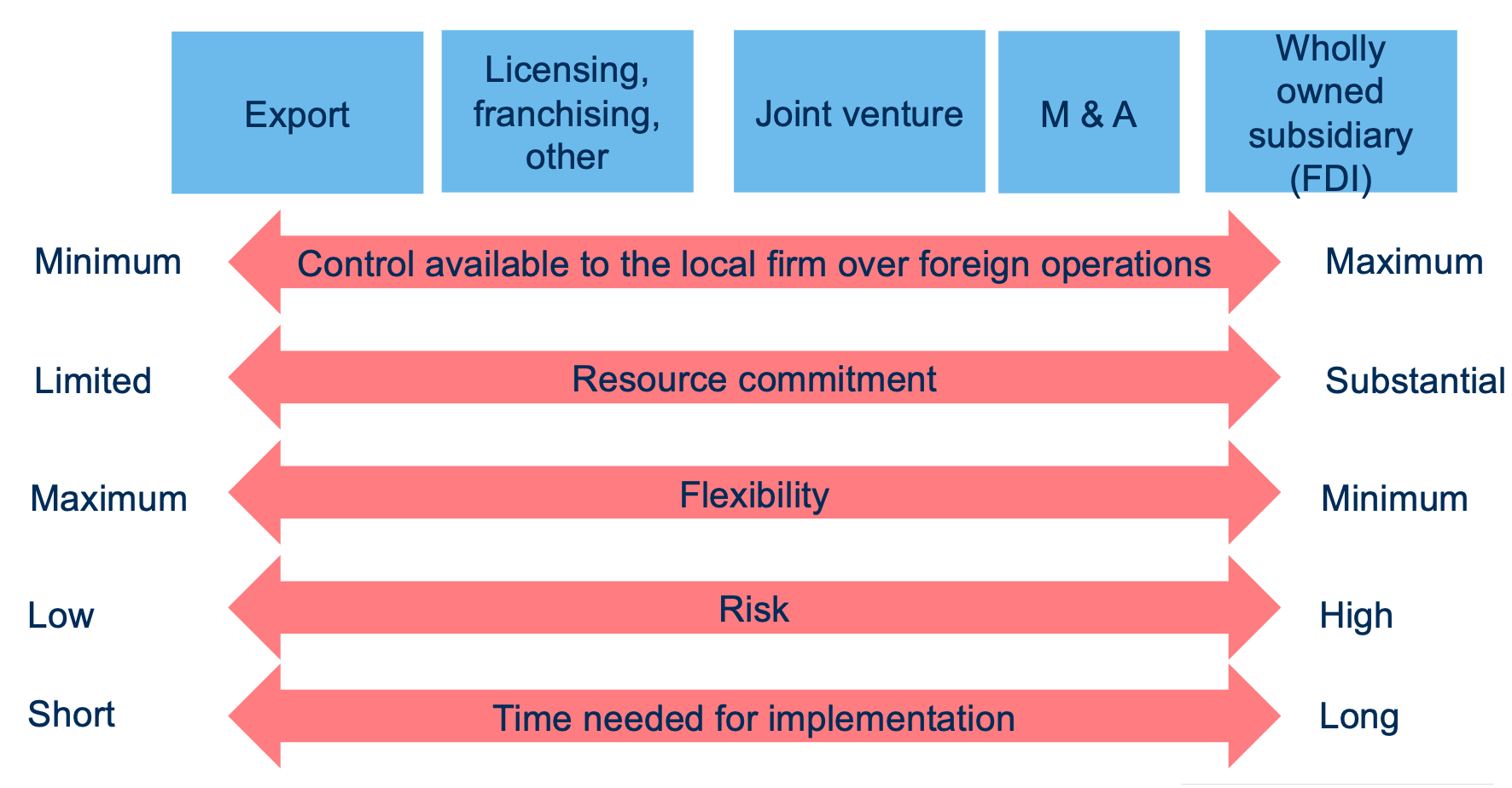
- 135Which transaction refers to the sale of goods/services produced by a company based in one country to customers that reside in a different one?exporting
- 136Companies are likely to export products abroad in all of the following situations: name 31. when their average cost per unit of home country production declines substantially by increasing output.
2. when they are new to international business.
3. when they aim to increase degree of market diversification - 137Name 3 examples of property rights that may be licensed to one company from anotherpatents
copyrights
trademarks - 138a company's location should be flexible enough to?respond to new opportunities and withdraw form less profitable ones.
- 139what is the most likely reason that firms avoid aggressively seeking export opportunities?Firms are reluctant to adjust their established business practices.
- 140explain Internationalization advantagethe benefits of retaining a core competency within a company and purposefully threading that core competency through the value chain.
- 141Explain the primary reason for technology licensing to take place while a product is still in the development stage:ensure that a product launches in various countries at about the same time.
- 142If a company that wants to acquire knowledge most likely use .... as a method for expansion.an acquisition
- 143The basic risk management process in five steps are?1. Define risks: Risk types
2. Assess and quantify risks: Probability / Impact Matrix
3. Determine risk response (mitigation) strategies
4. Implement control and communication
5. Monitor and update risks - 144The four major risks categories are?
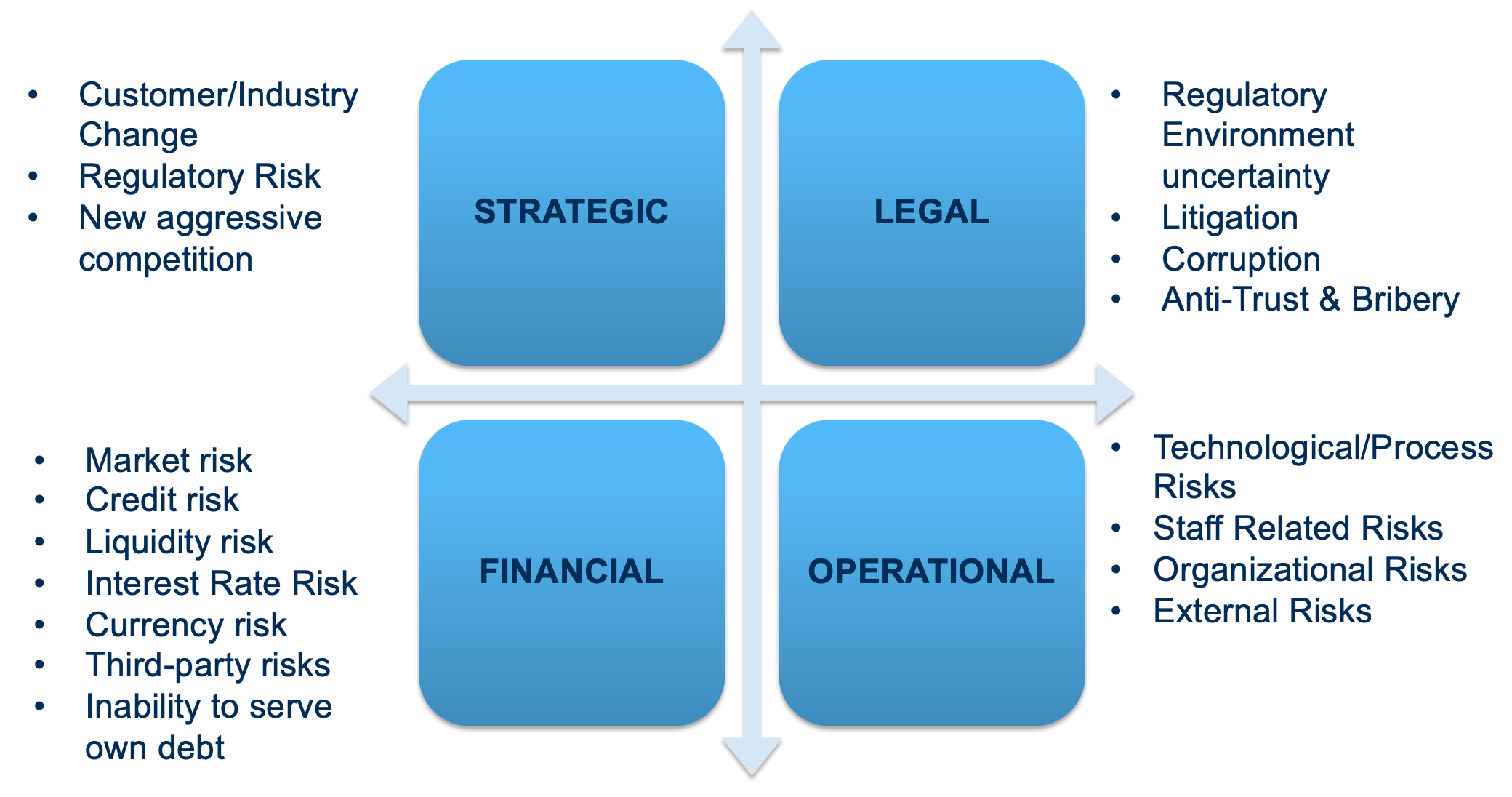
- 145Basic risk typologies: Three-layered framework1. General Environmental Risks (Pestel-R)
2. Industry-specific risks
3. Company- specific Risks (Marketing, Finances, Personnel, Management Processes, Infrastructure, IT, Projects) - 146General environmental risks: PESTEL-R is a simple framework that helps you systematically identify potential risks in the business environment. Review the 5Risk Areas
Political
Economic
Social/Cultural
Technological
Ecological
Legal
Define then the Risk Factors and specific risks for each - 147Industry-specific risks: The industry value chain and its business economics provide a framework for analysis of the industry-specific risk drivers. the 5-forces are?Risk Areas:
Suppliers
Consumers/ Clients
Competition/ Rivalry
Substitutes
New entrants - 148Company-specific risks: The major business functions and/or company value chain elements offer a possible risk areas framework. There are 9 internal risk areasRisk Areas:
Products
Finance
Personnel
Management
Processes
Infrastructure
Marketing
Legal
IT - 149Risk assessment matrix what are the x and y axis?Impact (y)
Probability (x) - 150The global risk landscape 2018 (according to WEF) the 4 major risks are? w8,p.251. Extreme weather events
2. Natural disasters
3. failure of climate-change mitigation and adaption
4. Cyberattacks and Water crises - 151Risks, crises and corporate actions w8, p26
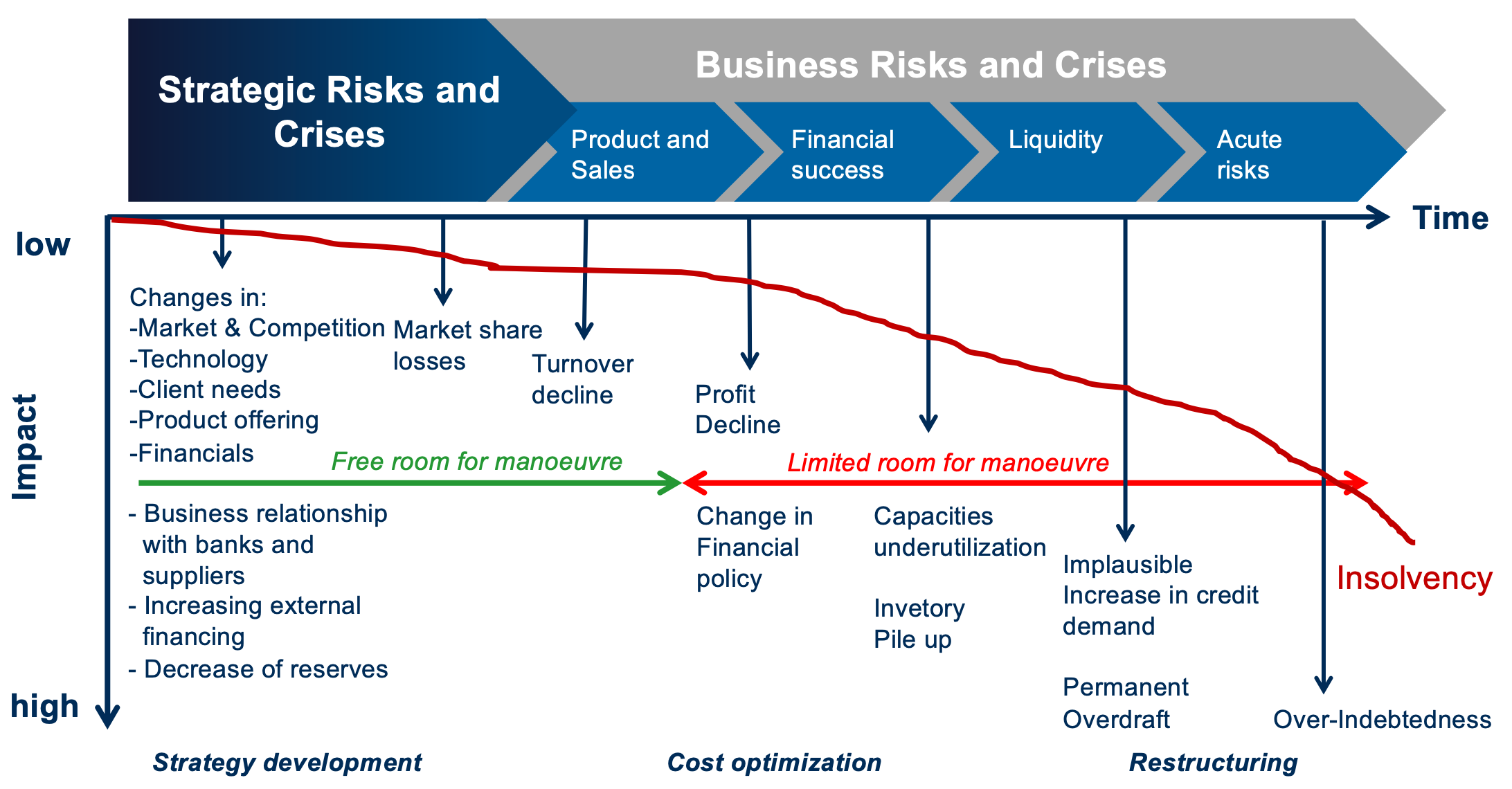
- 152Risk assessment and corresponding risk response strategiesHigh Impact, High Probability: High Risk
=>Mitigate & Control
High Impact, low Probability: Medium risk =>Share
Low Impact, High Probability: Medium risk
=>Control
Low impact, Low probability: Low risk
=> accept - 153Financial responses to uncertainties and risks-Hedging Techniques (always involves two transactions)
1. Forward (Futures) Hedging (forward contracts which must be executed).
2. Option Hedging (forward contracts which can be executed but which are burdened with an "insurance premium" – the option price).
-Non-Hedging Techniques
Invoicing in relevant foreign currency. - 154Strategic responses to uncertainties and risks. name 6 Mitigation StrategiesAvoidance (market exit)
Reduction & Control
Risk transfer & Cooperation (insurance)
Imitation
Flexibility
Acceptance (building up reserves) - 155Five success factors for internationalization through digitalization
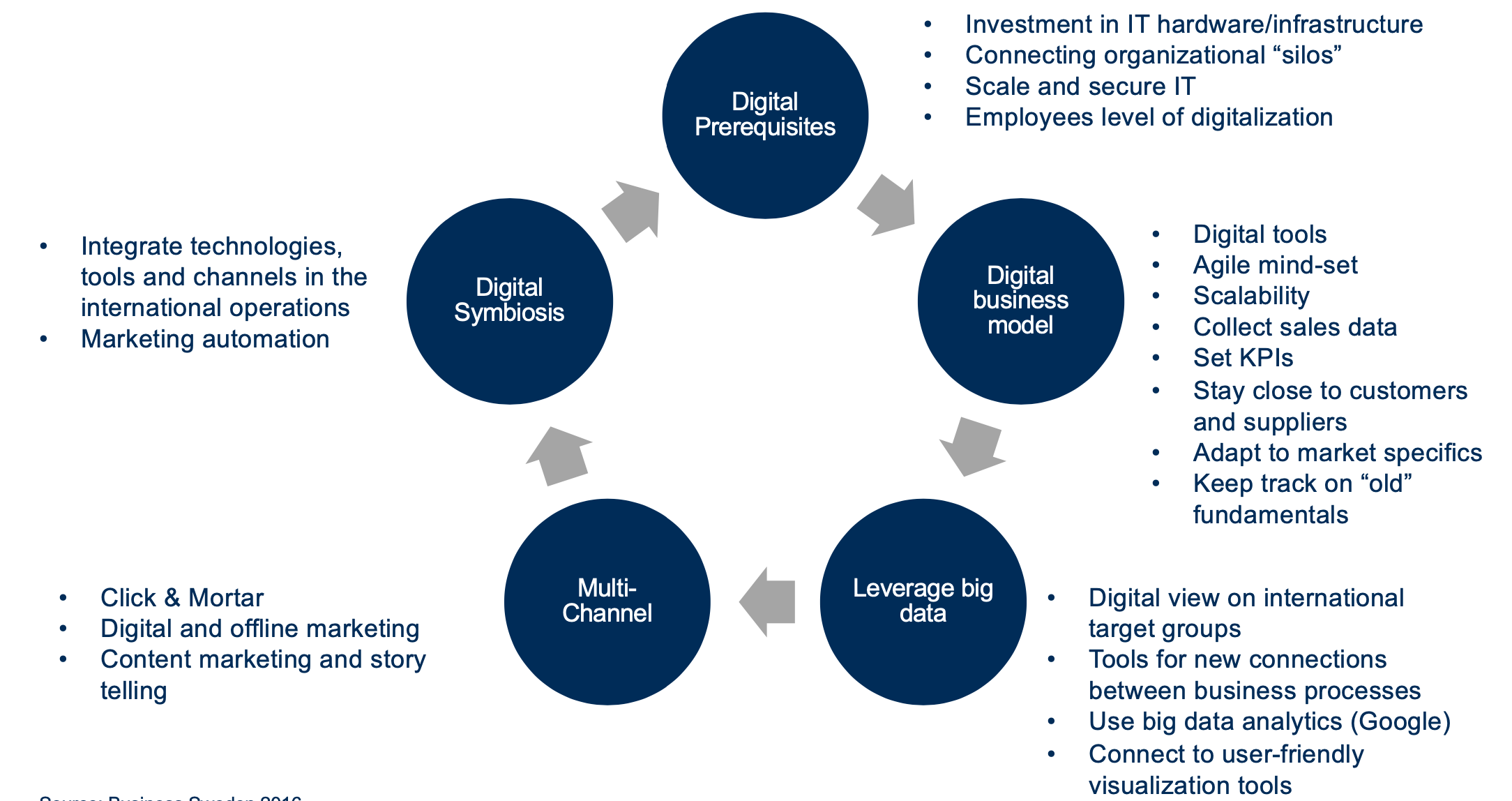
- 156Visionary leadership: Four major traits1. International mind-set and cosmopolitan values
2. strategic vision
3. Willingness to invest in human assets
4. Willingness to commit resources - 157Global coordination explain: Coordination by Standardization- Procedures, processes, employee manuals, strategic decision-making
- Enhances efficiency (Suitable for home-replication and global strategy) - 158Global coordination explain: Coordination by Plan- Plans set success factors, specify expectations, assign accountability, formalize deadlines; regulate how units accept, adopt, and adjust tactics.
- Enhances effectiveness - 159Global coordination explain: Coordination by Mutual Adjustment- Relies on social networking outlooks and methods Cross-national, cross-functional and cross-business teams.
- Management rotation - 160In successful companies structure follows strategy.. Basic organizational choices: Differentiation When organizing for international business, management needs to consider the following three dimensions:1. Vertical differentiation
•Centralization •Decentralization
location of decision-making responsibilites
2. Horizontal differentiation
•International Division •Area Divisions
•Worldwide Product Divisions •Global Matrix
3. Integrating mechanisms
•Strategy and coordination •Formal and informal integration - 161Vertical differentiation: Premises and Advantages
- 162Archetypes of International Organization: ::International Division:: - foreign markets are to be exploited opportunistically - Foreign Sales / Total Sales is low -> start of the internationalization what are the pro&cons?Advantages
- easily integrated into existing structure
- Short communication channels, efficiency, low cost
- 'logical' first step for a successful domestic corporation
Disadvantages
-may be hard to coordinate (domestic managers may withhold resources, country managers second tier etc.)
- low synergies and isolation, difficult introduction of new products and transfer of core competencies - 163Archetypes of International Organization what is this one?Domestic with International Division
suitable for when firms initially expand abroad (all international activities in one division) was used initially by Walmart.
International (home replication) strategy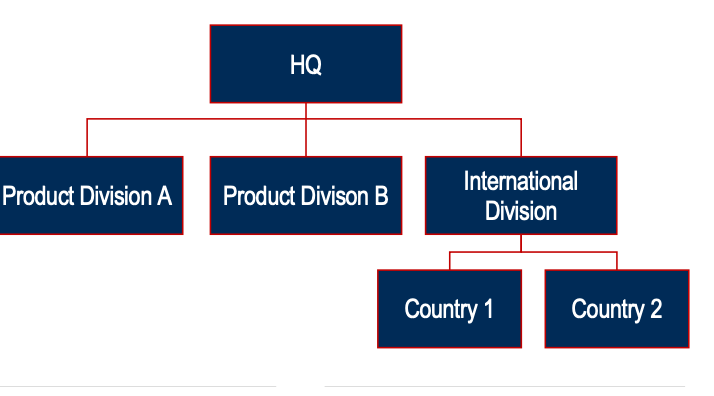
- 164Archetypes of International Organization what is this one?Global Area Divisions
low degree of diversification, domestic structure based on functions. each area is largely autonomous entity.
aka Nestlé
Localization (multi domestic) strategy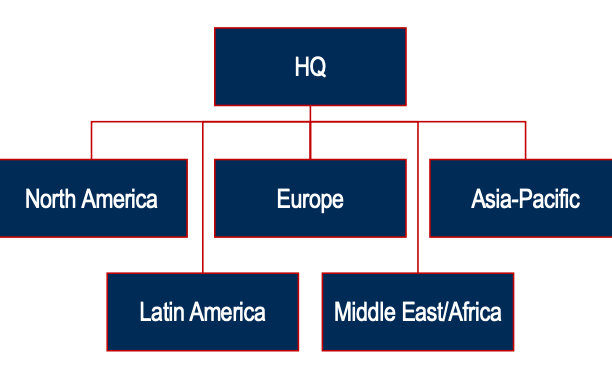
- 165Archetypes of International Organization: Geographic (global) area structure - foreign markets are to be exploited systematically - regional markets differ strongly from each other - advantages are achieved regional or local - high grade of internationalization what are the pro&cons?Advantages
- suited to multi-domestic strategies
- make rapid strategic and operational decisions that depend upon local tastes and regulations, lowest coordination needed.
Disadvantages
- large overhead
- duplication of activities
- maybe hard to coordinate information flows - 166Archetypes of International Organization what is this one?Global Functional Divisions
aka Glencore, bp, Le Parfait, Maggi, Mövenpick
Global strategy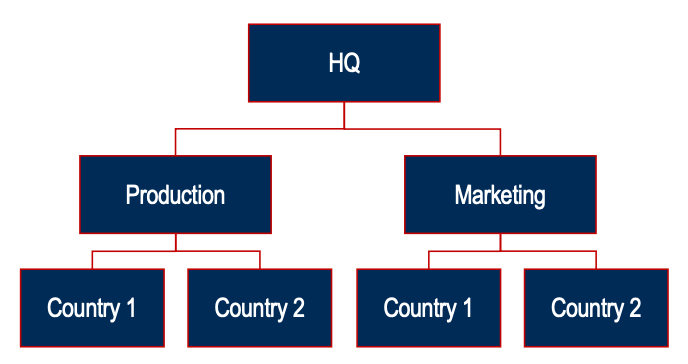
- 167Archetypes of International Organization: ::(Worldwide) functional structure:: - Competitive advantages in the global functions - competitive pressures push for a global strategy what are the pro&cons?Advantages
- maximize scale economies in the function
- little duplication of facilities
- structure allows for tight, centralized control (local responsiveness)
- Low level of local functional adaptation
Disadvantages
- slow information processing
- slow reaction to changing environments
- Local subsidiaries in more than one function -> risk of informal structures - 168Archetypes of International Organization what is this one?Global Product Divisions
each division is a self-contained, largely autonomous entity
aka Logitech, Apple, Nespresso
Global strategy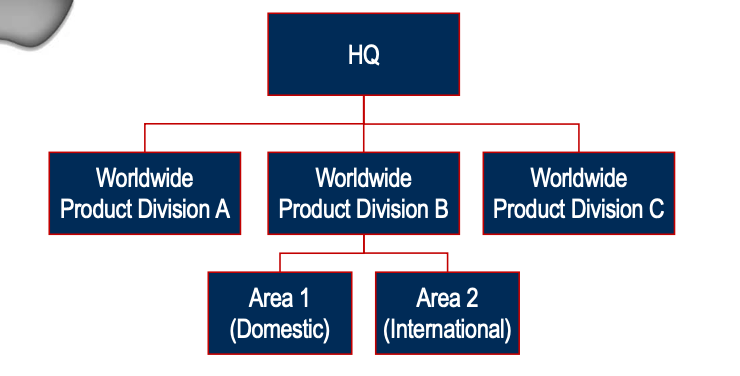
- 169Archetypes of International Organization: ::(Worldwide) product structure:: − Advantage in global product categories or groups − pressures for local responsiveness are comparatively low what are the pro&cons?Advantages
− economies of scale can be reaped at a global level
− easier to coordinate (because both domestic and foreign managers report to the same person) that's good for core competencies
− easier to spin off product ranges
− allows each major product line to focus on the specific needs of its
customers (experience curve economies)
Disadvantages
− harder to be locally responsive
− maybe hard to coordinate information
flows between geographic regions
− duplication of facilities and personnel
within each division - 170Archetypes of International Organization: ::Global matrix structure:: - Transnational strategy - Coordination of product divisions and regional structures needed what are the pro&cons?Advantages
− "Best of both worlds": Advantages of both area and product based primary structures
−Intensive discussion and better decisions quality
− More efficient highly specialized employees
− Teamorganization
Disadvantages
− Highest coordination need.
−Ego wars between managers leads to delayed decision
making through upward referral of decisions
−No unity of command (always two bosses to report to)
− Difficult accountability - 171Archetypes of International Organization what is this one?Global Matrix
Horizontal differentiation proceeds along two dimensions: product division and geographic area
aka Philips & Unilever
Transnational strategy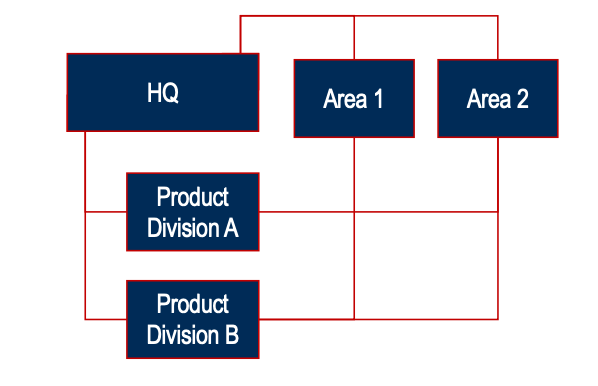
- 172Structure reflects strategy for success which strategy has Pressures for Global Integration and Cost Reduction? which strategy has Pressures for Local Responsiveness?
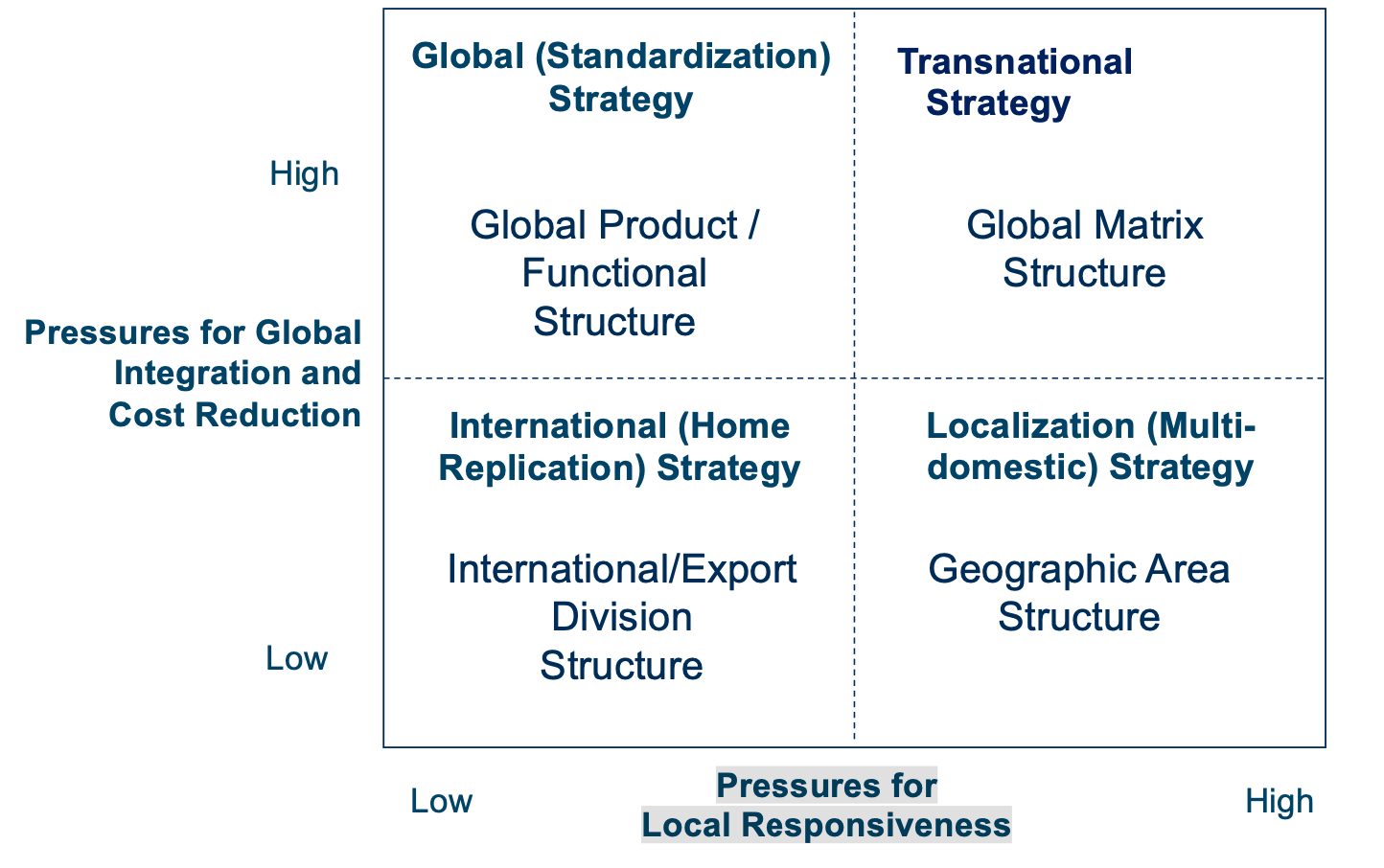
- 173What is the organizational architecture that international business use to manage and direct their global operations?The totality of a firm's organization formal, structure, control system and incentives, processes, culture and people.
ism reader p.291 - 174what does organizational structure mean? name three things1. Formal division of the organization into subunits (product division, national operation & function)
2. location of decision-making responsibilities (centralized or decentralized)
3. establishment of integrating mechanisms to coordinate the activities of subunits - 175Knowledge network great strength of it? ism reader p. 305indirect link between managers. can be used as a non bureaucratic conduit for knowledge flows within a multinational enterprise. helps for complex matrix structure.
However, not sufficient to achieve coordination. - 176Types of control system name 4 ism reader p. 307-Personal Controls (with subordinates, most widely used in small firms)
-Bureaucratic control (system, rules & procedures) for MNE its the budget and capital spending rules
-Output control (setting goals for subunits, performance metrics)
-Cultural control (employees buy-in the norms and values of the firm). they control their own behavior. if this culture is strong, need of other control systems get reduced. - 177—Synthesis of strategy, structure, and control systems
explain difference between localization, international, global standardization and transnational.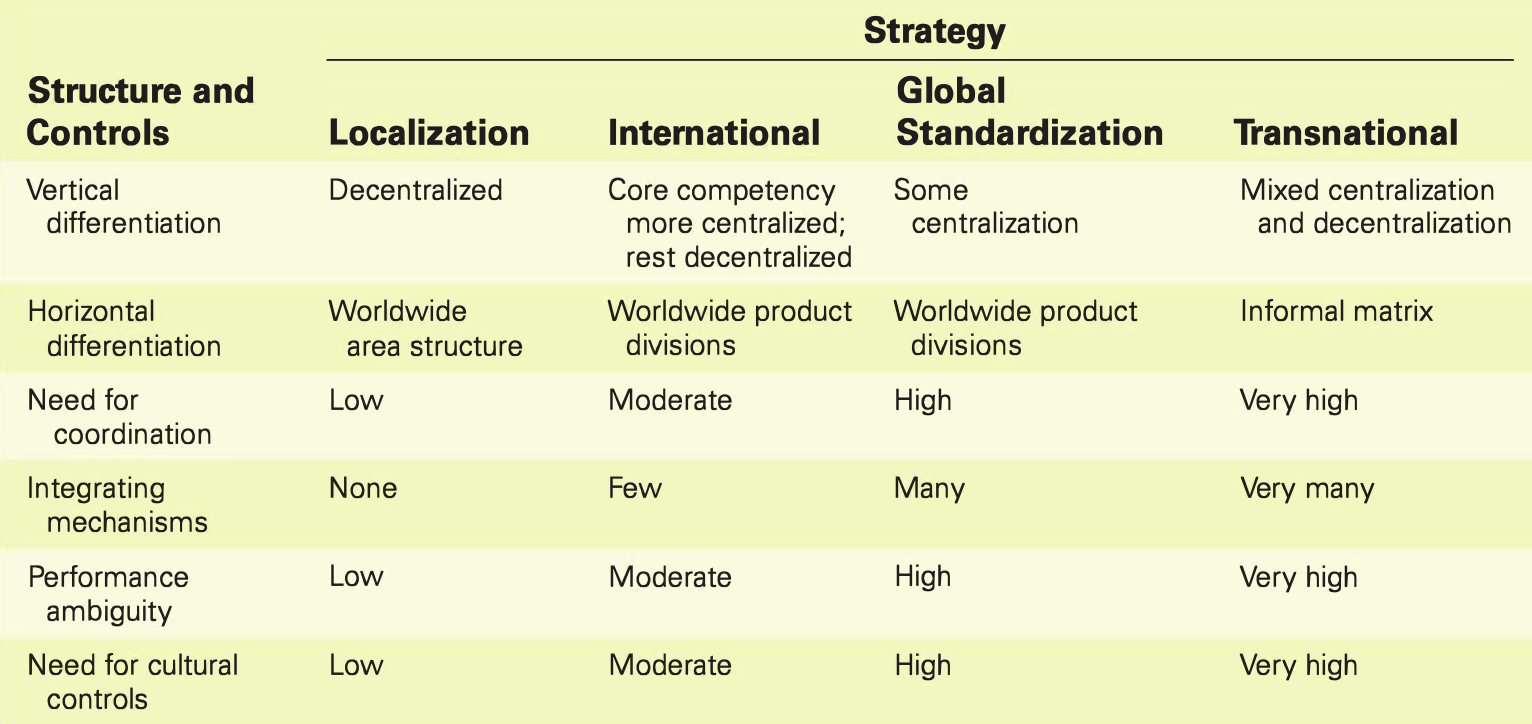
- 178Localization strategy: explain Structure and controls-focus on local responsiveness
-operating decisions decentralized, self-contained country subsidiaries.
-no high need of integrating mechanisms
-relying on output and bureaucratic control
-incentives with performance metrics at country level - 179International strategy: explain Structure and control-create value by transferring core competencies to foreign subsidiaries.
-output and bureaucratic control
-incentives that are focuses on performance - 180Global Standardization strategy: explain Structure and Control-focus on the realization of location and experience curve economies.
-may operate with a worldwide division structure
-array of formal and informal integrating mechanisms
-output, bureaucratic, strong organization culture that can facilitate cooperation and coordination - 181Transnational Strategy: Explain structure and control-focus on global learning, local responsiveness, experience curve economies
-maybe use matrix type structures (both product divisions and geographic area have significant influence)
-core competence transfer makes pressure for centralizing operating decisions
-locally responsiveness makes pressure for decentralizing
-formal and informal integrating mechanisms high
-incentives that promote cooperation between subunits - 182Organizational inertia name 4 reasons why organizations are difficult to change ism reader p. 319-existing distribution of power and influence within an organization
- existing culture (norms & values)
-senior managers decide appropriate business model/paradigm
-Institutional constraints by for example national regulations - 183Specifying the Value Chain Explain primary activities:Product Design: function, features of the product/process.
Operations: inputs into a finished product. (sourcing components, arrange supply chain, optimize manufacturing process)
Outbound Logistics: move finished product
Marketing: define brand, sales force, promotion.
Service: installation support, after-sale, training and maintenance - 184Specifying the Value Chain Explain secondary activities:Materials & Equipment: everything necessary to conduct the primary activities
HR: recruit, develop, motivate, compensate
System & Solutions: information processing and technology platforms
Infrastructure: accounting, finance, legal, safety & security, quality - 185Domestic Marketing explain 1. Orientation 2. Product planning 3. marketing mix decisions w12, p.161. Domestic Focus (Ethnocentric)
2. Product development for home country customers
3. made at headquarters - 186Export Marketing explain 1. Orientation 2. Product planning 3. marketing mix decisions w12, p.161. Country choice export (Ethnocentric)
2. Product development determined primarily by the needs of the home country customers
3. Made at headquarters - 187International Marketing explain 1. Orientation 2. Product planning 3. marketing mix decisions w12, p.161. see picture
(Polycentric)
2. Local product development based on local needs
3. made in each country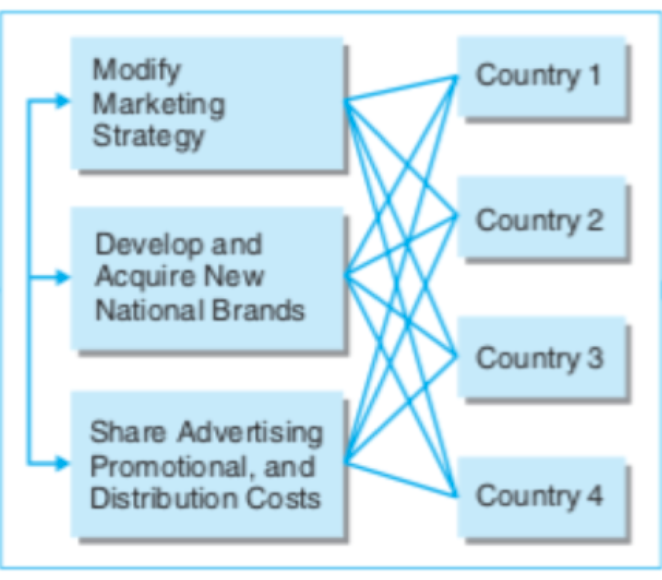
- 188Multinational Marketing explain 1. Orientation 2. Product planning 3. marketing mix decisions w12, p.171. see picture
(Regiocentric)
2. Standardize within region, but not across
Made regionally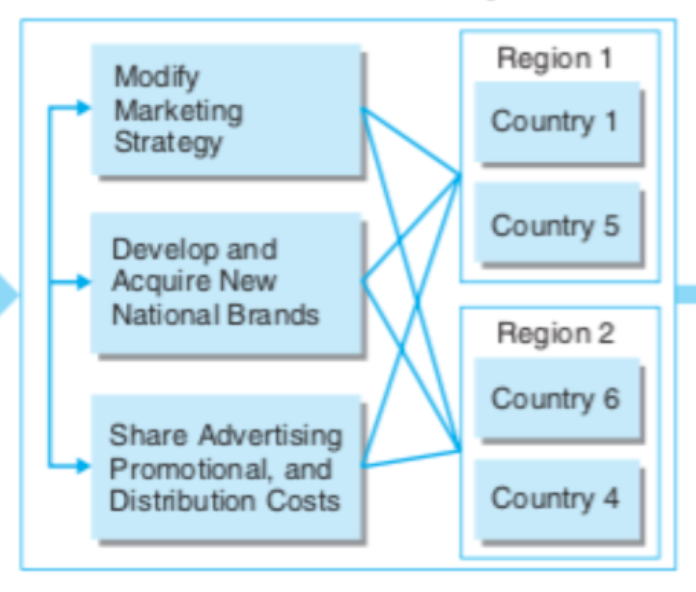
- 189Global Marketing explain 1. Orientation 2. Product planning 3. marketing mix decisions w12, p.171. Coordiante Marketing Mix across countries and regions
-integrate sourcing and production with marketing
-allocate resources to achieve portfolio balance and growth
(Geocentric)
2. Global product, with local variations
3. made jointly with mutual consulation - 190Two main segmenting approaches1. Aggregate Segmentations (country as segments aka Nestle)
2. Disaggregate Consumer segmentation (as UBS) - 191What is the aim of: Segmenting and targeting on the international marketsOptimal product-market fit (Positioning)
- 192Consumer culture brand positioning explain 1. Global 2. Foreign 3. local1. brand as a symbol of a given global consumer culture (nike)
2. a brand mystique around a specific foreign culture (e.g Swiss watches, French perfume, Canadian maple sirup
3. global brand, that is portrayed as an intrinsic part of the local culture - 193Brand internationalization name the 4
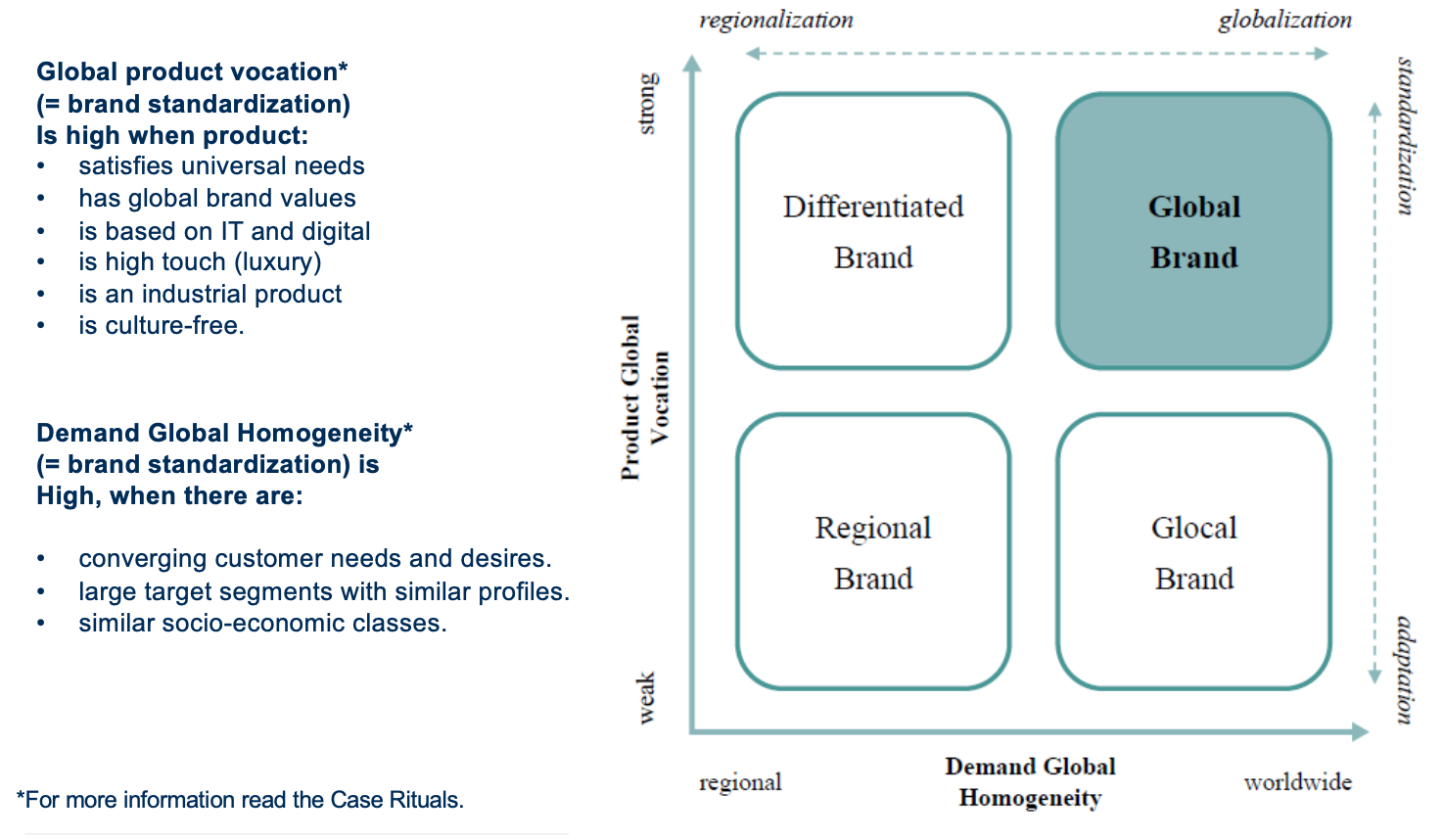
- 194International Marketing implementation: Product strategy important decisions
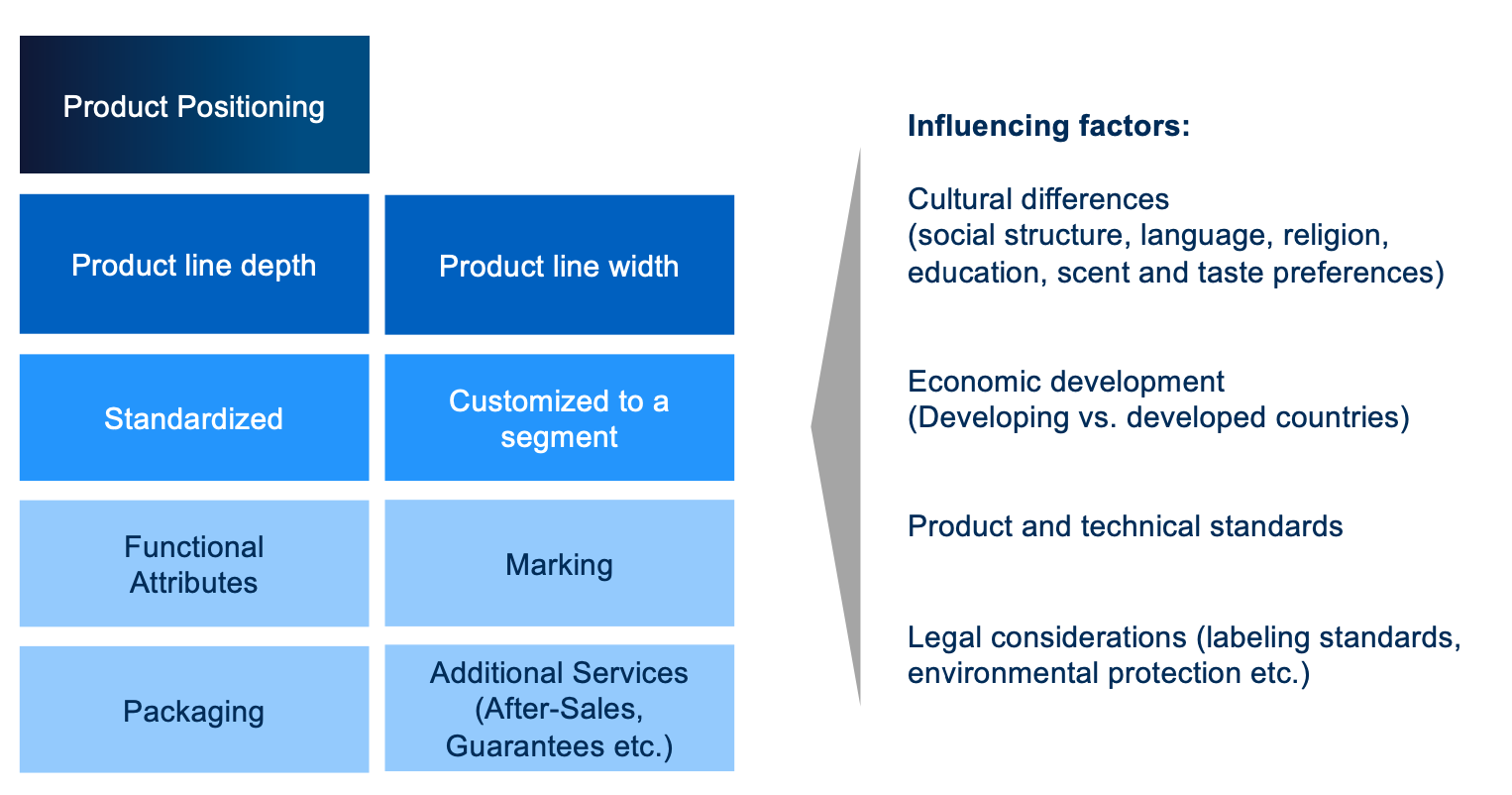
- 195International Marketing implementation: Pricing strategy name the 3Pricing discrimination: Different countries different price
Strategic pricing: predatory pricing, multipoint pricing, experience curve pricing
Governmental regulation: Antidumping policies, competition policies - 196International Marketing implementation: Pricing strategy what are the three Strategic pricing?• Predatory pricing: use low prices to drive weaker competitors from the national market
• Multipoint pricing: two or more MNE compete against each other in two or more countries (aggressive pricing in one market can elicit a rival response in another).
• Experience curve pricing: low or no price globally to build sales volume rapidly by taking large losses initially. - 197International Marketing implementation: Communication channels Personal channels like One-to-one, mouth-to-mouth, guerrilla and viral, influencers, own webpage, blog ,social media better when:• Industrial products
• Complex products
• Short distribution channels
• Few media vaialable - 198International Marketing implementation: Communication channels are Influenced by?• Product type
• Consumer sophistication
• Channel length
• Media availability
• Culture
Informações
- Descrição
- Wirtschaftswissenschaft FlashCards sobre International Strategic MGMT_Part1, criado por Nora Mahrer em 27-09-2019.
- Criado por
- Nora Mahrer
- Visualizações
- 303
- Avaliação