
Quiz
Development of Postural Control & Reactions
This quiz has question types that open in the usual player.
Questions in this quiz (36)
1Developmental milestones are physical/behavioral signs of development or maturation.
- ATrue
- BFalse
2Developmental milestones are used for all of the following EXCEPT:
- ATo assist with a diagnosis
- BGuide intervention planning
- CTo determine what school the child will go to
- DTrack developmental trends
3Which of the following are limitations with the milestone concept?
- ASome of it may have to deal with anxiety levels of the child's parents
- BIt does not account for "differences"
- CThere is considerable variability in the way a child learns developmental skills
- DThe 50% percentile does not determine if a child is outside the expected range
4[blank_start]Movement[blank_end] is the act of moving (ex: crawling)
[blank_start]Posture[blank_end] is the core strength, tone, and stability that helps the way one positions their body
Both help to achieve a motor task/goal- AMovement
- BPosture
- CMovement
- DPosture
5Postural stability provides foundation for simple and complex movements.
- ATrue
- BFalse
6Which of the following are the two theories strictly associated with the development of movement?
- AHierarchical
- BOrganismic
- CSystems View
- DContextual
7When movement occurs as the nervous system matures: [blank_start]hierarchical[blank_end]
When movement emerges from an interaction between the nervous system, body, environment, and the task: [blank_start]systems view[blank_end]
[blank_start]In hierarchical[blank_end]:
- reflexes are distinct from voluntary movement and must be suppressed/inhibited
- reflexes reappear if there is CNS damage or if needed to support certain activities
[blank_start]In Systems Approach[blank_end]:
- [blank_start]Nonlinear[blank_end] --> multiple interacting subsystems including: body build characteristics,
musculoskeletal, arousal, sensory, perceptual interacting with immediate environment
- [blank_start]Behavior[blank_end] as emergent; no central pattern generator; even reflexes are not hardwired but the result of the convergence of multiple systems- Ahierarchical
- Bsystems view
- CIn hierarchical
- DIn Systems Approach
- ENonlinear
- FLinear
- GBehavior
- HReflex
8Which is not a characteristic of the stepping reflex?
- Afeet touches a surface and then stepping movements occur
- Bseen in newborns - 4 month olds
- Creemerges during 5-6 months
- Da baby must learn how to crawl first
9If there is a loss of a stepping reflex, how would they present themselves in the two theories?
increase in weight in legs, but infant can still demonstrate reflex in water --> [blank_start]dynamic system[blank_end]
maturation of higher brain centers/nervous system --> [blank_start]hierarchial[blank_end]- Adynamic system
- Bhierarchical
- Cdynamic system
- Dhierarchical
10Culture does not have an impact on early motor development and reflexes.
- ATrue
- BFalse
11How are posture and movement related?
- Ain order to move we have to have stability
- Bboth require tone
- Cboth require strength
- Dall answers are correct
12Which of the following are the theoretical basis of the spatiotemporal adaptation theory? (check all that apply).
- AReflexes and reactions integrate into postural control.
- BWith increasing competence with purposeful movement supports the development of cognitive and social skills.
- CPostural control provides foundation for functional skill.
- DAdaptation occurs through developmental and purposeful sequence of activity.
- ENone of these answers are correct.
13Does the spatiotemporal theory place emphasis on sensory-motor-sensory relationship?
- Ayes
- Bno
14According to the spatiotemporal adaptation theory, if a child cannot complete a task such as walking, they will:
- ACry and become upset
- BRevert back to lower level skills such as crawling to help them achieve their goal
- CNot finish the goal/task
- DSeek help from someone
15What are the four components of the spatiotemporal adaptation theory?
- Amovement, posture, environment, social participation
- Bsocial participation, movement, adaptation, spiraling continuum
- Crest, sleep, play, work
- Dmovement, environment, adaptation, spiraling continuum
16[blank_start]Movement[blank_end]: primitive to efficient; environmental challenges support development of complex thinking and acting; both intrinsically and extrinsically motivated
[blank_start]Spiraling Continuum[blank_end]: Environmental stimulation/challenges cause “spatiotemporal stress” versus “distress”
[blank_start]Adaptation[blank_end]: process of expanding child’s repertoire of movements and activities
[blank_start]Environment[blank_end]: Child, others, objects, supporting surface, gravitational and 3 dimensional space- AMovement
- BEnvironment
- CAdaptation
- DSpiraling Continuum
- EMovement
- FEnvironment
- GAdaptation
- HSpiraling Continuum
- IMovement
- JEnvironment
- KAdaptation
- LSpiraling Continuum
- MMovement
- NEnvironment
- OAdaptation
- PSpiraling Continuum
17These are the environmental components of spatiotemporal adaptation:
[blank_start]Holding Function[blank_end]: supports/embeds the infant
[blank_start]Challenge[blank_end]: helps child reach higher levels of potential
[blank_start]Interactive[blank_end]: promotes back-and-forth between self and environment
[blank_start]Facilitating[blank_end]: provides source of stimulation- motivation to move- AHolding Function
- BChallenge
- CInteractive
- DFacilitating
18Which of the following are characteristics of the spiraling continuum?
- APreviously acquired patterns are called forward to adapt to the challenge or new experience
- BPreviously acquired patterns are used to meet the environmental demand with success eliminating the stressful situation
- CProcess of expanding child’s repertoire of movements and activities
- DChild, others, objects, supporting surface, gravitational and 3 dimensional space
- EWith maturation of CNS, higher level functions emerge
19How is the spiraling continuum process stalled in children with disabilities?
- AIt doesn't affect children with disabilities
- BIt causes distress, which alters equilibrium and prevents higher levels of learning to emerge
- CIt stalls briefly but then returns to normal
20What are lower level strategies used during a normal course of development?
- Aprone extension
- Bwalking
- Crunning
- Dearly sitting
21Check all of the following that represent the spatiotemporal adaptation theory.
- Asensorimotor approach to developing motor skills
- Bdevelopmental and purposeful sequences mature as a result of the child's experiences with the environment
- Cintegration of previously acquired movements with the new environmental demands being an ongoing process
- Dnone of these represent the spatiotemporal theory
22Stress is the alteration of equilibrium in a child that causes them to make an adjustment within an environment to return to equilibrium.
- ATrue
- BFalse
23[blank_start]Muscle tone[blank_end]- gives muscle rigidity; (enough tension on muscle for weight shift with enough give for quick changes in movement)
[blank_start]Postural tone[blank_end]-adds to muscle tone in extensor muscles that work against gravity
[blank_start]Postural fixation[blank_end]- acts to maintain joint position against internal or external force; obtained by joint co-contraction of antagonist muscles around the joints
Postural strategies distribute postural tone where needed to [blank_start]hold positions[blank_end] and/or for [blank_start]redistributing tone[blank_end] in anticipation of or during changes in position- AMuscle tone
- BPostural tone
- CPostural fixation
- Dhold positions
- Eredistributing tone
24Posture is the movement of body segments at any given time.
- ATrue
- BFalse
25Rank the following movement components from least complex (lowest level) to most complex (highest level):
[blank_start]1[blank_end] - Physiological Flexion
[blank_start]4[blank_end] - Lateral Flexion & Rotation
[blank_start]3[blank_end] - Flexion (against gravity)
[blank_start]2[blank_end] - Extension (against gravity)- A1
- B4
- C3
- D2
26Which of the following are primitive reflexes?
- AProtective Equilibrium
- BTonic
- CPhasic
- DRighting
27Rank the following postural control/movement patterns from 1-4 in the order that they develop:
Unilateral weight shift/movement -- [blank_start]3[blank_end]
Bilateral weight shift/movement -- [blank_start]2[blank_end]
Weight bearing -- [blank_start]1[blank_end]
Contralateral weight shift/movement -- [blank_start]4[blank_end]- A1
- B2
- C3
- D4
- E1
- F2
- G3
- H4
- I1
- J2
- K3
- L4
- M1
- N2
- O3
- P4
28Which of the following are phasic reflexes?
- Arooting
- Ball are examples of phasic reflexes
- Cbabinski
- Dstepping
29Phasic reflexes activate muscles/groups through full range/mobility but do not have a weight bearing function.
- ATrue
- BFalse
30Which of the phasic reflexes is associated with hypersensitivity, stimulus bound effect, sensory overload, and anxiety if it persists in the older child?
- ABabinski

- BMoro
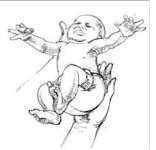
- CGrasping
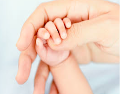
- DPlantar

- ABabinski
31Which is not a characteristic of the development of antigravity movement?
- ACOG shifts
- BBilateral weight shifting
- Ctalking
- DIncreased independence in extremity movement
32Which of the following define tonic reflexes? (check all that apply)
- AUsually postures assumed in response to the position of the head and trunk in space or in relation to each other
- BMuscle tone is distributed in specific postural patterns, causing cessation of movement or fixation
- CMost frequently offset the body’s midline and its proximal joints
- DUsually produce observable movement in response to touch, pressure, movement of body, sight or sound
33Which type of reflex is this?
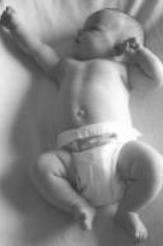
- APhasic
- BTonic
34Check all that apply to rotational righting.
- ANot present at birth
- BMove the midline of the body into alignment with the center of gravity
- CActivate muscles causing head and trunk to rotate around the central axis of the body
- DUnilateral weight shifting becomes evident
- EBody on body; neck on body
- FLandau & Optical Righting
35Which is not a characteristic of optical righting?
- AStimulus: visual input
- BReaction: orientation of head position
- CPersists through life
- DOnset in utero
36Research has shown that full-term infants sleeping non-prone have delays in motor milestones and lower scores on developmental screening measures than infants who slept prone.
- ATrue
- BFalse
Information
- Description
- Human Development Quiz on Development of Postural Control & Reactions, created by marissa rivera on 01/10/2017.
- Author
- marissa rivera
- Language
- English
- Views
- 219
- Tags
- Rating
- 5.0 out of 5 · 1 rating Rate this quiz