
Quiz
6
Create a free account to finish this quiz
Save your progress and see your final score.
Already have an account? Sign in
Questions in this quiz (97)
1The PEAR DB functions can be accessed using DB::<function_name>.
- ATrue
- BFalse
2The string argument of the function for connecting to a database is of the format <DBMS software>://<user account>:<password>@<database server>
- ATrue
- BFalse
3The PEAR DB functon for connecting to a database is called DB::linkto database('string').
- ATrue
- BFalse
4The DBMS software in <DBMS software>://<user account>:<password>@<database server> stands for the particular DBMS software package being connected to: for example mysqli for versions of MySQL starting with version 4.1.2
- ATrue
- BFalse
5The PEAR DB function DB::is Error can be used to determine whether any database access operation was successful or not.
- ATrue
- BFalse
6In PHP, an _____ array provides pairs of key=>value elements; the value of an element is referenced through its key and all key values in a particular array must be unique.
- ANumeric
- BValue
- CString
- DAssociative
7Multi-line PHP comments start with // and end with #.
- ATrue
- BFalse
8PHP written in C and usually comes installed with Unix: for other operating systems, the PHP interpreter can be downloaded from http://www.php.net
- ATrue
- BFalse
9The PHP start tag is <?php and end the tag is ?>.
- ATrue
- BFalse
10Web pages, where part of the information is extracted from databases or other data source, are called dynamic Web pages
- ATrue
- BFalse
11In PHP, a ____ array associates a numeric index with each element in the array
- ANumeric
- BAssosiative
- CVariable
- DString
12PHP variable names start with a $ sign and can include characters, numbers, and the underscore character
- ATrue
- BFalse
13Interpolating variables occurs only within single-quoted strings.
- ATrue
- BFalse
14PHP programs are executed on the client.
- ATrue
- BFalse
15The auto-global predefined PHP variable $_POST is an array that holds all the values entered through form parameters.
- ATrue
- BFalse
16The JDBC _____ libraries are called java.sql.*
- AMethod
- BFunction
- CClass
17JDBC does not distinguish between queries that return single tuples and those that return multiple tuples.
- ATrue
- BFalse
18What are the advantages and disadvantages of the embedded SQL approach.
- AThe main advantage is the query text is part of the source code can be checked for syntax errors and validated against the database schema at compile time. The program is quite readable. Since queries are known in advance, the choice of program variables to hold query results is simple.
- BThe main advantage is flexibility in generating queries at runtime. Also, the library of function calls approach is able to call multiple data program.
- CThe main disadvantage is the query text is part of the source code can be checked for syntax errors and validated against the database schema at compile time. The program is quite readable. Since queries are known in advance, the choice of program variables to hold query results is simple.
- DDisadvantage are more complex programming, inability to do checking at compile time, and concerns about SQL runtime errors.
- EDisadvantage are the loss of flexibility in changing the query the query at runtime and that all changes to queries must be recompiled.
19The use of function calls is a more dynamic approach for database programming than embedded SQL.
- ATrue
- BFalse
20A _____ object is similar to a cursor in embedded SQL and an iterator in SQLJ.
- AProcedure
- BFunction call
- CResult Set
21_____ is the part of the SQL standard that specifies how to write persistent stored modules.
- ASQL/PSM
- BXML
- CSQLJ
- DResultSet
22Database stored procedures (aka persistent stored modules) are stored and executed by the DBMS at the database server.
- ATrue
- BFalse
23Discuss advantages and diadvantages to the library of function calls approach
- ADisadvantage are the loss of flexibility in changing the query at runtime and that all changes to queries must be recompiled.
- BThe main advantage is flexibility in generating queries at runtime. Also, the library of function calls approach is able to call multiple data program.
- CThe main advantage is flexibility in generating queries at compile time. Also, the library of function calls approach is able to call multiple single program.
- DDisadvantages are more complex programming, inability to do checking at compile time, and concerns about SQL runtime errors.
- EThe main advantage is the query text is part of source code and can be checked for syntax errors and validated against the data. The program is quite readable.
24It is necessary to have a binding between the data types of the programming language and the attribute data types in the data model
- ATrue
- BFalse
25In SQLJ, embedded SQL commands are preceded by #sql.
- ATrue
- BFalse
26One advantage of using an SQLJ translator is that it is not necessary to install drivers such as a JDBC driver.
- ATrue
- BFalse
27In XML _____ defines the set of commands (names) that can be used
- ANamespace
- BValid
- CDocument
- DInvalid
28Describe the three main approaches for database programming.
- AUsing a library of database functions. This approach provides what is known as an application programming interface (API) for accessing a database from applications programs.
- BUsing a library of database methods. This approach provides what is known as an application programming interface (API) for accessing a database from applications programs
- CEmbedded SQL. Embeding database commands in a general-purpose programming language. A preprocessor extracts the embedded SQL from the source code and replaces it with function calls to DBMS-generated code.
- DEmbedded SQL. Embeding database commands in a specific-purpose programming language. A preprocessor can not extract code, but function calls to be extracted to DBMS-generated code.
- EDesigning a new database programming language.
- FEmbedded SQL. Embeding database commands in a specific-purpose programming language. A preprocessor extracts the embedded SQL from the source code and replaces it with function calls to DBMS-generating code
29In XML schema, the tag _____ is used to specify primary keys.
- Axs:element
- Bxsd:key
- Cpsd:schema
- Dxs:sequence
30A * following an element name means the element can be repeated zero or one times (an optional, single-valued, nonrepeating elements)
- ATrue
- BFalse
31If an XML document is well-formed and follows a particular schema, it is _____
- ANamespace
- BKeys
- CInvalid
- DValid
32The XML schema, it is possible to specify constraints that correspond to unique and primary key constraints in a relational database, as well as foreign keys constraints
- ATrue
- BFalse
33An element that does not have *, +, or ? following the element name means the element must appear exactly once in the document (a required, single-valued, non-repeating element).
- ATrue
- BFalse
34A ? following an element name means that element can be repeated zero or more times in the document (an optional, mult-valued, repeating element).
- ATrue
- BFalse
35The basic object in XML is the XML document, which is structured using types and iterators.
- ATrue
- BFalse
36How does a well-formed XML document look like?
- AIt is syntactically correct: a non-single root element with every element including a matching pair of start/end tags within the start-end of the parent element
- BIt must finish with an XML declaration to indicate the version of XML.
- CIt is syntactically correct: a single root element with every element including a matching pair of start/end tags within the start-end tags of the parent element
- DIt is syntactically correct: a single root element with every element except a matching pair of start/end tags within the start-end tags of the parent elements
- EIt must start with an XML declaration to indicate the version of XML
37Struct type constructors include the set (T), list (T), bag(T), array(T), and dictionary (K,T) type constructors.
- ATrue
- BFalse
38Three major differences between the relational and object database design.
- AIn ODB design a binary relationship can be declared in one direction or both. If attributes are included in both directions, there is a potential problem with redundancy.
- BIn ODB design a binary relationship can be declared in one direction or both. If attributes are included in both directions, there is no any problem
- CIn an ODB, operations must be defined early since they are part of the classes specifications. In RDBs, operations may not be defined until implementation
- DIn RDB inheritance is built into the model; ODBs do not have built-in constructs for inheritance.
- EIn an RDB, operations must be defined early since they are part of the class specifications. In an ODB, operations may not be defined until implementation
- FIn ODB inheritance is built into the model; RDBs do not have built-in constructs for inheritance.
39The typical mechanisms for making an object an object persistent are naming and reachability.
- ATrue
- BFalse
40The main property required of an OID is that it be immutable (should not change).
- ATrue
- BFalse
41_____ inheritance occurs when a subtype inherits only some of the functions of a supertype.
- AGeneralization
- BComplete incapsulation
- CConditional
- DSelective
42In operator overloading (or polymorphism), an operation name may refer to several distinct implementations, depending on the type of object it is applied to.
- ATrue
- BFalse
43In ______ all operations that can be applied to an object must be predefined.
- AHalf encapsulation
- BComplete incapsulation
- CObject identifier
- DFeedback loop
44The implementation of an operation is called its signature.
- ATrue
- BFalse
45A subtype is used when a new type is needed that is similar but not identical to an already defined type.
- ATrue
- BFalse
46The dictionary constructor creates a collection of two tupes (K,V) where the value of a key K can be used to retrieve the can be used to retrieve the corresponding value V.
- ATrue
- BFalse
47An ODMS provides a unique identity to each independent object in the database via a unique, system-generated ____.
- ALiterals
- BIndirect pointer
- CConstructor
- DObject identifier (OID)
48An object typically has three components: state, timing, and behavior
- ATrue
- BFalse
49The 80-20 rule suggests that 80% of the workload is presented by 20% of the most frequently used transactions, which govem the physical database design.
- ATrue
- BFalse
50The phases (or activities) of the life cycle are not strictly in sequence; ______ are common among and within the phases of the life cycle.
- AOne-shot
- BRequirements collection
- CFeedback loop
- DView integration
51In the _____ approach to schema design, a scheme is designed for each user group or application based phase, these schemas are merged into a global conceptual schema.
- ARequirements analysis
- BFeedback loops
- CFeasibility analysis
- DOne-shot
- EView integration
52A large database typically has large transaction volumes and rates, is used in service sector industries, and runs 24/7
- ATrue
- BFalse
53Many organizations use data dictionary systems (information repositories) to manage meta-data, i.e., data that describes the database structure, constraints, applications, authorizations, users, and so forth.
- ATrue
- BFalse
54What are the three goals of database design?
- ASatisfy the information content requirements of the generalised users and applications.
- BSupport result
- CSupport processing requirements and any performance objectives.
- DProvide a natural and easy-to-understand structuring of the information.
- ESatisfy the information content requirements ofthe specified users and applications.
- FProvide a comlicated structuring of the information.
55_______ involves interacting with potential users and user groups to identify their particular problems and needs.
- Aview-integration
- Brequirements collection and analysis
- Cfeasibility analysis
- Done-shot
- Efeedback loop
56A transaction processing system can be characterized as one with several dozen gigabytes of data and a schema with more than 30 or 40 distinct entity types
- ATrue
- BFalse
57Identify the three criteria to guide the choice of physical database design options
- ASpace utisilation
- BAvailability of vendor services
- CTransaction throughput
- DResponse time
- EFamiliarity of personnel with the system
58Identify the three factors to consider in choosing one DBMS over another
- ASpace utilization
- BOrganization-wide adoption of a certain philosophy (data model, vendor, methodology, tools)
- CAvailability of vendor services
- DTransaction throughput
- EResponse time
- FFamiliarity of personnel with the system
59_____ is concerned with analyzing potential application areas, identifying the economics of information gathering and dissemination, performing preiliminary cost-benefit studies, determining the complexity of data and processes, and setting up priorities among applications.
- AFeasibility analysis
- BRequirements collection and analysis
- CView integration
- DOne-shot
- EFeedback loops
60The initial requirements can be expected to be formal, complete, consistent, and correct.
- ATrue
- BFalse
61In the ______ schema design approach, the requirements from the different stakeholders are merged into a single set of requirements before the schema design begins
- ARequirements collection
- BFeedback loop
- CCentralized (or one-shot)
- DRequirements analysis
62What two things does minimizing redundancy imply?
- AReducing the need for multiple updates to maintain consistency across multiple copies of the same information.
- BReducing the redundant information in tuples.
- CMaking sure the semantics of the attributes is clear in the schema
- DMinimizing redundant storage of the same information
- EDisallowing the possibility of generating spurious tuples
63Third normal form (3NF): R is 2NF and all non-prime attributes are transitively dependent on the primary key.
- ATrue
- BFalse
64First normal from (1NF): the domain of an attribute must include only atomic (simple, indivisible, scalar) values and the value of any attribute in a tuple must be a single value from the domain of that attribute.
- ATrue
- BFalse
65Second normal form (2NF): R is 1NF and every non-prime attribute A in R is fully functionally dependent on the primary key of R
- ATrue
- BFalse
66What are four informal guidelines that may be used to measure the quality of a relation schema design?
- AReducing the need for multiple updates to maintain consistency across multiple copies of the same information.
- BDisallowing the possibility of generating spurious tuples.
- CReducing the redundant information in tuples
- DReducing the NULL values in tuples
- EMaking sure the semantics of the attributes is clear in the schema
- FMinimizing redundant storage of the same information
67Normalization of data can be considered a process of analyzing the given relation schemas based on their functional dependencies and primary keys to achieve closure on the domain space
- ATrue
- BFalse
68отметьте true
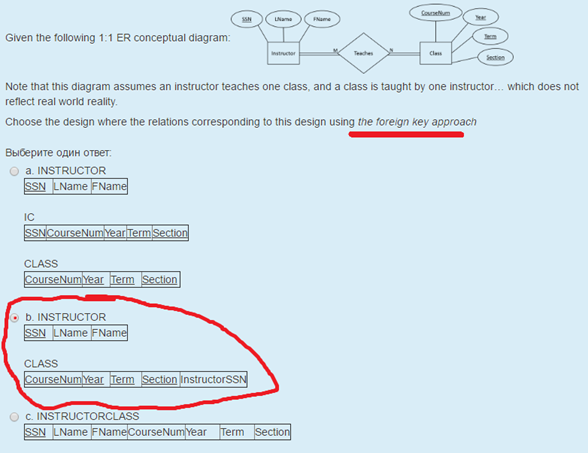
- ATrue
- BFalse
69When mapping a binary M:N relationship type R, create a new relation S to represent R, including as foreign key attributes in S the primary keys of the relations that are the perticipating entity types (their combination in S is the composite primary key of S).
- ATrue
- BFalse
70Отметьте true
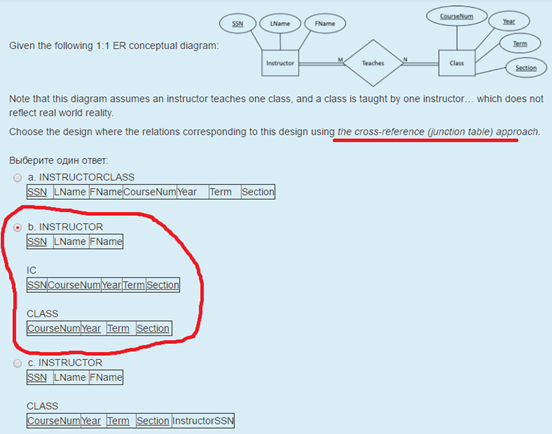
- ATrue
- BFalse
71Отметьте true
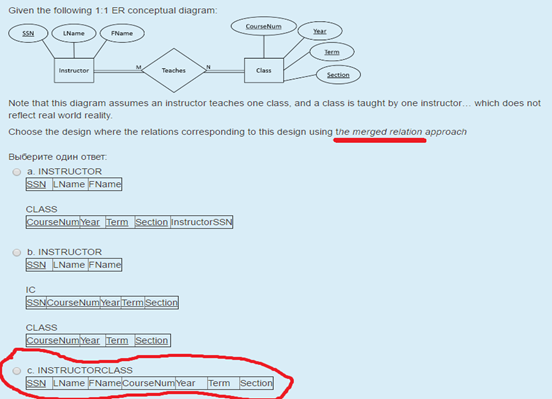
- ATrue
- BFalse
72The symbol σ (sigma) is used to denote the SELECT operator in the relational algebra
- ATrue
- BFalse
73A EQUIJOIN uses any of the comparison operators =, <, ≤, >, ≥, or ≠.
- ATrue
- BFalse
74The symbol π (pi) is used to denote the PROJECT operation in the relational algebra.
- ATrue
- BFalse
75A THETA JOIN uses the comparison operator =
- ATrue
- BFalse
76SQL is both a data definition language (DDL) and a data manipulation language (DML).
- ATrue
- BFalse
77A key uniquely identifies a tuple in a relation.
- ATrue
- BFalse
78When the DELETE operation violates a contraint, the deletion must be rejected.
- ATrue
- BFalse
79Semantic integrity constarint may be enforced using mechanisms called triggers and assertions.
- ATrue
- BFalse
80If a multi-table query refers to two or more attributes with the same name, we must qualify the attribute name with the table name, e.g., TABLE.Attribute, to prevent ambiguity.
- ATrue
- BFalse
81A relation schema may only have one key.
- ATrue
- BFalse
82Tuples in a relation are ordered.
- ATrue
- BFalse
83The DELETE operation can violate referential integrity.
- ATrue
- BFalse
84The INSERT operation can violate domain constraints, key constraints, entity integrity, or referential integrity.
- ATrue
- BFalse
85The theortical basis of the relation data model is set theory and first-order predicate logic.
- ATrue
- BFalse
86Attributes that represent the same real-world concept must have identical names in different relations.
- ATrue
- BFalse
87When the INSERT operation violates a constraint, the default option is to reject the insertion.
- ATrue
- BFalse
88Attributes must have unique domains.
- ATrue
- BFalse
89NULL values may mean value unknown, value exits but is not available, attribute does not apply to this tuple (value undefined).
- ATrue
- BFalse
90All tuples in a relation must be distinct.
- ATrue
- BFalse
91отметьте true
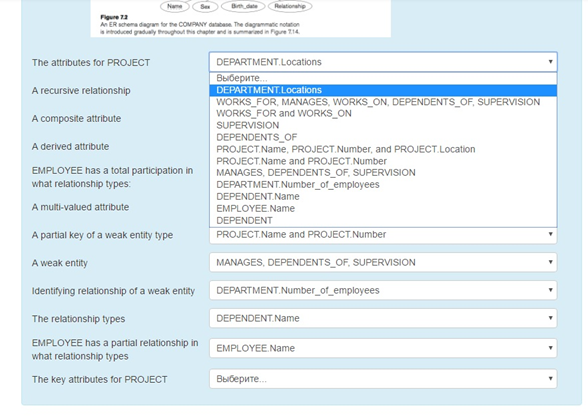
- ATrue
- BFalse
92First phase of database design and implementation process:
- ARequirements collection and analysis
- BConceptual database design
- CChoice of DBMS
- DData model mapping
- EPhysical database design
- FDatabase system implementation and tuning
93Second phase of database design and implementation process:
- ARequirements collection and analysis
- BConceptual database design
- CChoice of DBMS
- DData model mapping
- EPhysical database design
- FDatabase system implementation and tuning
94Third phase of database design and implementation process:
- ARequirements collection and analysis
- BConceptual database design
- CChoice of DBMS
- DData model mapping
- EPhysical database design
- FDatabase system implementation and tuning
95Fourth phase of database design and implementation process:
- ARequirements collection and analysis
- BConceptual database design
- CChoice of DBMS
- DData model mapping
- EPhysical database design
- FDatabase system implementation and tuning
96Fifth phase of database design and implementation process:
- ARequirements collection and analysis
- BConceptual database design
- CChoice of DBMS
- DData model mapping
- EPhysical database design
- FDatabase system implementation and tuning
97Sixth phase of database design and implementation process:
- ARequirements collection and analysis
- BConceptual database design
- CChoice of DBMS
- DData model mapping
- EPhysical database design
- FDatabase system implementation and tuning
Information
- Description
- Quiz on 6, created by eldar khasen on 16/12/2017.
- Author
- eldar khasen
- Language
- English
- Views
- 47
- Rating
- No ratings yet Rate this quiz