
Quiz
Unit 7 Ecology
Create a free account to finish this quiz
Save your progress and see your final score.
Already have an account? Sign in
Questions in this quiz (65)
1The following food web shows the flow of energy between organisms in an ecosystem. More producers are introduced into the ecosystem. How will this introduction likely affect the other organisms in the ecosystem?

- AThe additional producers may not affect the other organisms because there is plenty of room in the ecosystem for plants.
- BThe number of organisms may decrease because the producers will require more energy, which they will receive from the other organisms.
- CThe additional producers may decrease the number of herbivores because they may outcompete the herbivores for energy from the omnivores.
- DThe number of organisms may increase because plants provide energy to primary consumers, which then transfer energy to the carnivores.
2In one forest ecosystem, coyotes and bobcats are carnivores, while white-tailed deer and rabbits are herbivores. Which of these describes the flow of energy in this ecosystem?
- AFrom plants to deer, from deer to coyotes
- BFrom rabbits to deer, from deer to coyotes
- CFrom plants to rabbits, from rabbits to deer
- DFrom bobcats to rabbits, from rabbits to plants
3Organisms that consume wastes to obtain the nutrients they need to survive are classified as:
- Adecomposers
- Bherbivores
- Cpredators
- Dproducers
4Hailey studied a salt march ecosystem. She made the following list of some of the organisms that live in a salt marsh:
1. Hawks: top predators
2. Sparrows: insectivores
3. Grasshoppers: herbivores
4. Cordgrass: primary producer
Using the information provided, which food chain is the most probable path of energy in this ecosystem?- ACordgrass --> Grasshopper --> Sparrow --> Hawk
- BCordgrass --> Hawk --> Grasshopper --> Sparrow
- CHawk --> Cordgrass --> Grasshopper --> Sparrow
- DHawk --> Sparrow --> Grasshopper --> Cordgrass
5The following shows a food chain in a garden environment.
Sun --> Grass --> Grasshopper --> Bird
Which statement describes the energy transfer in this food chain?- AThe energy from the bird is transferred back to the grasshopper.
- BThe grass passes all of the energy it receives from the sun to the grasshopper.
- COnly a small amount of the energy the bird receives from the grasshopper is used by the bird.
- DMore energy is transferred from the grass to the grasshopper than from the grasshopper to the bird.
6The following diagram shows a food web for a large lake. The number of trout in the lake decreased due to overfishing by humans. Which statement describes the impact of this change on the other organisms in the food web?

- AThe number of forage fish will decrease since they will have fewer trout upon which to prey.
- BThe number of plankton will increase since fewer organisms will be getting energy from them.
- CThe eagles will lose a source of energy and need to get energy from gulls, forage fish, and snapping turtles.
- DThe snapping turtles will lose a source of energy and will need to get energy from gulls, eagles, and waterfowl.
7The following diagram shows a food web for a Mississippi forest ecosystem. A virus reduces the number of rabbits in the ecosystem. Which statement describes the impact of the reduction on other organisms in the ecosystem?

- AThe leafy weeds population will increase due to reduced feeding pressure from reduced numbers of rabbits.
- BThe bobcat population will increase due to the reduced number of animals that prey upon the bobcats.
- CThe loss of the rabbit population will cause the bobcat population to change its diet to include blackberry.
- DThe loss of the rabbit population will cause the white-tail deer population to decrease since its main source of energy is gone.
8Some people created a water pond on their property. The following diagram shows the food web for this pond. The owners of the property sprayed insecticide that destroyed the mosquito eggs. How will this affect the flow of energy in the food web?

- AWithout mosquitoes available as a food source, less energy will be available to the frogs.
- BWithout mosquitoes available as a food source, less energy will be available to the phytoplankton.
- CWithout competition from mosquitoes, more energy will be available to the frogs.
- DWithout competition from mosquitoes, other insects will move into the pond area to prey upon the frogs.
9A grassland community is pictured below. Grasses are considered:

- Asecondary consumers
- Bprimary consumers
- Cdecomposers
- Dproducers
10In the food web below, which of the following organisms feeds on the largest variety of different producers?

- Abutterfly

- Bfield mouse

- Cgrasshopper

- Ddragonfly

- Abutterfly
11Which organism in this food chain is a producer?

- Afish
- Bgrass
- Chawk
- Dgrasshopper
12Baleen Whales eat zooplankton, a herbivore, by taking in a large amount of water into their mouth. These whales use special structures in their mouth to separate zooplankton from the water. Because Baleen Whales eat zooplankton, they are classified as ___.

- Acarnivores
- Bherbivores
- Comnivores
- Dproducers
13Which of these is a food web based on the relationships described below?

- A

- B

- C

- D

- A
14The following diagram shows a food web for a Mississippi forest floor. How would the disappearance of dead leaves from the forest floor affect spiders?

- ATheir population would decrease because they would have fewer dead leaves to eat.
- BTheir population would increase because they do not depend directly on dead leaves for energy.
- CTheir population would increase because they could eat more centipedes that do not eat dead leaves either.
- DTheir population would decrease because they eat animals that depend on dead leaves for energy.
15The diagram below shows a food chain. What do the arrows in the diagram represent?

- Aflow of energy
- Blife cycle stages
- Cone community replacing another
- Drenewable resource depletion
16If more mice were added to the region, there would be more food for all but which of the following organisms?

- Afoxes
- Beagles
- Cfrogs
- Dsnakes
17If for some reason the grasshopper population was drastically reduced, which organism in the food web would be most adversely affected?
- Agrasses
- Bfrogs
- Cfoxes
- Dmice
18Which organisms in the food web are herbivores?
- Arabbits, grasshoppers, mice, squirrels
- Bgrasses, wildflowers, seeds
- Crabbits, foxes, grasses
- Dfoxes, eagles, frogs, snakes
19This food web MOST likely represents organisms in which biome?
- Adesert
- Brain forest
- Ctundra
- Dgrassland
20According to the food web, frogs would be classified as:
- Aherbivores
- Bcarnivores
- Cproducers
- Ddecomposers
21If all the frogs disappeared from the region, the species that would benefit MOST would be:
- Asnakes
- Bgrasshoppers
- Ceagles
- Dmice
22How would a population of small freshwater fish be impacted if the algae population on which they feed where to decrease due to disease?
- AThe freshwater fish population would increase.
- BThe freshwater fish population would decrease.
- CThe freshwater fish population would not be impacted.
- DThe freshwater fish population would increase then decrease.
23Which organisms in the food web below compete for the same food source in this environment?

- Agrasshoppers and snakes
- Bhawks and frogs
- Cfrogs and snakes
- Ddecomposers and grasses
24What does an energy pyramid show?
- Aa series of events by which one organism eats another
- Bthe amount of energy that moves from one feeding level to another in a food web
- Cmany overlapping food chains
- Dthe different food groups and the daily requirements
25The following diagram shows an energy pyramid for an area within an ocean ecosystem. How is the shape of the pyramid related to energy flow within the ecosystem?

- AMost energy is concentrated at the highest trophic level.
- BEnergy is equally distributed among the organisms in each trophic level.
- COnly a small amount of energy from one trophic level is available to organisms at the next, highest level.
- DOnly a small amount of energy is available to organisms in ocean ecosystems.
26About 10% of the energy at one trophic level is passed to the next level. What usually happens to the energy that is not passed to the next trophic level or used to carry out life processes?
- AIt is given off as heat.
- BIt is stored as vitamins.
- CIt is used in reproduction.
- DIt is used in protein synthesis.
27The following diagram shows an energy pyramid for a wetland in Mississippi. Which conclusion is supported by this diagram?

- ARiver otters are tertiary consumers and have the least energy available to them.
- BCrayfish are secondary consumers and have the most energy available to them.
- CZooplankton are secondary producers and have the most energy available to them.
- DPhytoplankton are primary producers and have the least energy available to them.
28How does the amount of energy available at one level of an energy pyramid compare to the amount of energy available at the next level up?
- Ait is 90 times smaller
- Bit is 10 times greater
- Cit is 10 times smaller
- Dit is the same
29Why are there usually few organisms at the top of an energy pyramid?
- Ahumans hunt for organisms at this level
- BSo much energy is lost from one level to the next that the energy available can only support a few
- Conly so many will fit in a pyramid drawing
- Dorganisms at the top are larger and require more living space
30If producers receive 1,000 kcal of energy through photosynthesis from the sun, what would the primary consumers in the energy pyramid receive?

- A100 kcal
- B10 kcal
- C1 kcal
- D0.1 kcal
31If the snakes then ate all of the mice in this ecosystem, what would the secondary consumers in the energy pyramid receive?
- A100 kcal
- B10 kcal
- C1 kcal
- D0.1 kcal
32If the hawks then ate all of the snakes in this ecosystem, what would the tertiary consumers in the energy pyramid receive?
- A100 kcal
- B10 kcal
- C1 kcal
- D0.1 kcal
33Laura is studying a species of fish around an ocean reef ecosystem. She lists the following observations:
1. Males have brightly colored scales to attract the females for mating
2. Females are brown without brightly colored scales
3. The fish species normally has few predators
4. Within a few months, a species of carnivores enters the reef system area
5. These carnivores prey upon the colorful fish
Laura measured the population size of the fish species a year after the introduction of the predators. She found that there were fewer males, but overall the population size was similar to before the predators arrived.
Which of these adaptations is preventing the extinction of this fish species?- AThe female fish can change their appearance to display bright colors.
- BBoth the males and females can lay their eggs in the cracks found in the reef.
- CThe female fish can produce offspring through sexual and asexual reproduction.
- DBoth the males and females can change their diet to include more types of prey.
34Jesse is studying the red mangrove trees in a coastline environment. The following illustration shows the structure of a red mangrove. Jesse's data indicates that the salt content in the water of this coastline is increasing. Which of the following adaptations allows the red mangrove to survive in this coastline environment?

- AFlowers that attract insects for pollination, causing genetic variation in offspring
- BLarge leaves that allow for oxygen and gas exchange from the air instead of the sand
- CRoots with a filtration system that allows water to enter but keeps out the larger salt molecules
- DRoots that prop the tree above the sand, giving it support so it can withstand the force of ocean tides
35Base your answers to questions next two questions on the diagram below and on your knowledge of science. The diagram shows a plant that carries out photosynthesis.
Which table describes adaptations that allow organisms to survive in a desert environment?
- A

- B

- C

- D

- A
36A light-colored insect lives on trees in a forest. The bark of the trees appeared white because of light-colored lichen that also lived on the tree. Disease destroyed the lichen. The tree bark is now dark colored. How will this environmental change affect the number of light-colored insects?
- AThe number of insects will decrease because, with the lichen gone, the insects will have no other source of food.
- BThe number of insects will decrease because predators will see the light-colored insects on the dark bark more easily.
- CThe number of insects will increase because, with the lichen gone, the insects will no longer have to compete with the lichen for space.
- DThe number of insects will increase because the insect predators that also eat the diseased lichen will become ill and decrease in number.
37Naturally occurring variations within a species are mainly the result of mutations and
- Asexual reproduction
- Bdynamic equilibrium
- Ccamouflage
- Dmetabolism
38Which table shows adaptations that allow organisms to survive in a marshy wetland environment?
- A

- B

- C

- D

- A
39Base your answers of the following two questions on the diagram below and on your knowledge of science. The diagram shows how modern types of flowers developed from early types of flowers over the last 75 million years.
What is the most likely reason why these early flowers gradually changed to many different types of flowers over time?
- AThe flowers’ traits were genetically engineered.
- BThe environments of the flowers stayed the same.
- CThe genetic material of the flowers stayed the same.
- DThe flowers adapted to environmental conditions.
40Which process is represented in this diagram?
- Aevolution
- Bnatural selection
- Cecological succession
- Dspeciation
41The earliest land plants did not have flowers. However, around 70 million years ago, flowering plants became the dominant plant type in many habitats.Which type of organism would benefit directly from the increase in flowering plants?
- Aaquatic mammals, which are able to use the plants for shelter
- Banaerobic bacteria, which can thrive in low oxygen environments
- Ccarnivorous reptiles, which are able to hunt for food among the plants
- Dpollinating insects, which consume nectar and pollen as a food source
42Ospreys are a type of bird that nests near a body of water. These birds have adapted to hunt the fish living in the water of the environment. Which adaptations have allowed ospreys to survive in their environment?
- AShort wings for gliding over water
Long legs for reaching into the water
Hollow, lightweight bones that allow for flying - BLarge eyes that provide keen vision
Webbed feet for quick movement in water
Pivotal head that allows for quick view in all directions - CThick, oily feathers for water resistance
Strong feet and sharp claws for grasping fish
Strong, muscular legs for carrying the fish back to land - DStraight, sharply pointed beak for grasping prey
Large ears for hearing movements of fish in water
Long, sleek feathers that allow for diving into water
- AShort wings for gliding over water
43The chart show some characteristics of four habitats.
In which habitat would a black bear most likely be found?
- AQ
- BR
- CS
- DT
44Crassulacean acid metabolism (CAM) isa type of photosynthesis. A plant using CAM takes in carbon dioxide (CO2) at nighttime, when it is cooler. The plant changes the CO2 into an acid. During the daytime, the plant changes the acid into carbohydrates, without losing water to the warm air.
In which environment are such plants best adapted for survival?- ALow-altitude, because the air pressure is greater closer to sea level.
- BDesert, because plants living in the desert have little water available
- CAquatic, because plants living in water need more carbohydrates to avoid drowning
- DHigh-altitude, because the night air is cooler in alpine zones of mountains
45Dunia and Shane are studying the cold, snowy taiga biome for a science assignment. They learn that many of the trees in the taiga forests have long, thin needles that remain on the trees all year long. The following table shows Shane’s beliefs about why needles allow trees to survive in the taiga.
Which explanations should Dunia include in their final paper?
- A1 and 2
- B1, 3, and 4
- C2, 3, and 4
- D3 and 4
46Which of the following is an inherited structural trait/adaptation in African clawed frogs?

- AThe location of wave detectors on the frogs
- BThe location of the frogs in a pond
- CThe number of insects eaten by the frogs in an hour
- DThe number of times the frogs look for insects in an hour
47Certain species of whiptail lizards have only female individuals and no males. These lizards reproduce asexually.
What is one disadvantage of asexual reproduction for the lizards?
- AA new population can be established by a single individual in a relatively short period of time.
- BAll the members of a population are genetically very similar and less able to survive environmental changes.
- CThey are smaller than lizards that reproduce sexually.
- DThey are more likely to develop a variety of tail lengths.
48All of the characteristics listed below are useful for gathering food EXCEPT:

- Acolorful feathers
- Bnarrow beak
- Csmall body
- Dstrong wings
49The picture below shows four varieties of the same species of grass that grow in a prairie ecosystem. Which variety has the best chance of surviving a long period of dry weather?

- AVariety 1
- BVariety 2
- CVariety 3
- DVariety 4
50For rabbits, having long hair is an advantage over having short hair in environments with:
- Ahigh levels of rain
- Ba large number of competitors
- Cfew predators
- Dlow temperatures
51Some mesquite trees have deeper roots than any other plant in the desert. How are deep roots an adaptation for survival in the desert?

- ADeep roots can protect the tree from predators.
- BDeep roots encounter cooler conditions far below the desert surface.
- CDeep roots can extend great distances to reach water.
- DDeep roots interact with beneficial bacteria below the surface.
52An organism is born with a genetic abnormality not present in any of its ancestors. This abnormality is most likely the result of:
- Acirculation
- Bcompetition
- Crespiration
- Dmutation
53Cacti grow slowly compared to most other plants. The fact that cacti keep their stomata closed for much of the day can help explain this growth characteristic.
Which of these best explains the advantage of keeping stomata closed during the day?
- AIt limits water loss through transpiration.
- BIt conserves oxygen produced in photosynthesis.
- CIt recycles carbon dioxide within plant systems.
- DIt protects plant tissues from predators.
54Some plants have adaptations designed to keep herbivores from eating them. Which of the following is NOT an example of this type of adaptation?
- Athorns
- Bchemical with an unpleasant odor
- Cchemical skin irritant
- Dsugary berries
55The Couch’s Spadefoot lives in Texas and has the characteristics listed below. The Couch’s Spadefoot is adapted to a certain type of environment.
Characteristics of the Couch's Spadefoot:
1. Their pupils are vertical slits
2. Adults have mottled brown backs and light-colored bellies
3. Their eggs and tadpoles develop quickly in temporary ponds that form after rain
4. Adults live in holes they dig using special "spades" on their rear feet
5. Adults eat insects and spiders
Which of these resources is most likely scarce in this environment?
- Asoil
- Bsunlight
- Cwater
- Doxygen
56The cactus is a common plant in deserts in North America. Examine the diagram showing an adaptation that is found on many species of cacti.

- AThe adaptation provides a place for birds to perch while eating the cactus’ flowers.
- BThe adaptation prevents animals from being able to eat the cactus.
- CThe adaptation mimics stick insects and gives them a place to hide and not get eaten.
- DThe adaptation is able to trap water, so the cactus does not need water from the soil.
57What kind of adaptation would you NOT expect to find in an animal that stalks, kills, and eats other animals?
- Abrightly colored skin that warns of its presence
- Bability to make little or no noise when walking
- Ca fur color that blends in with the environment
- Dsharp teeth and claws
58How does natural selection lead to evolution?
- AOverpopulation provides food for stronger members of the species.
- BHelpful traits accumulate among surviving members of the species.
- CEnvironmental changes kill weaker members of the species.
- DStronger offspring kill weaker members of the species.
59When the environment changes more quickly than a species can adapt, the species may become:
- Aextinct
- Bdominant
- Coverpopulated
- Ddiverse
60Pesticides and fertilizers can help farmers to produce more crops. However, overuse of these chemicals can result in:
- Aecological succession
- Bmaterial recycling
- Cselective breeding
- Denvironmental pollution
61A species of dark green-colored butterflies live on trees in a forest. The bark of the trees appears dark green because of the moss that also lives on the trees. Disease destroyed the moss. The tree bark is now white-colored due to a white-colored lichen that is now living on the trees. How will this environmental change affect the number of green-colored butterflies?
- AThe number of butterflies will decrease because, with the green moss gone, the butterflies will have no other source of food.
- BThe number of butterflies will decrease because predators will see the green-colored butterflies on the white-colored bark more easily.
- CThe number of butterflies will increase because, with the moss gone, the butterflies will no longer have to compete with the moss for space.
- DThe number of butterflies will increase because the butterfly predators that also eat the diseased moss will become ill and decrease in number.
62According to the information below, which of these is responsible for the decrease in the black-footed ferret population?

- ACompetition with prairie dogs for resources
- BReduced numbers of prairie dogs
- CDevelopment of managed wildlife areas
- DActivity of research institutes
63The diagram below shows a sequence of environmental changes in an area over a long period of time. Which statement best describes the changes shown in the diagram?

- AOver time, one natural area is replaced by another.
- BOver time, the number of fish increases.
- CThe environment goes through seasonal changes.
- DPrecipitation follows cloud formation.
64During a storm, several butterfly-eating birds were blown to a distant island. The island, which previously had no birds, was filled with butterflies of all colors. One year later, all the butterflies are dark green and brown. Which of the following is the most likely explanation for the change in the butterfly population?
- ANatural Selection favored the dark green and brown butterflies.
- BPrimates like to eat all other butterflies.
- CGradualism is selecting against red, yellow, and blue butterflies.
- DA genetic mutation led to punctuated equilibrium.
65The graph below shows the percent of seeds from two plant species that sprout when grown in water containing different amounts of salt. Which of the following best summarizes the effect of saltwater on these plant species?
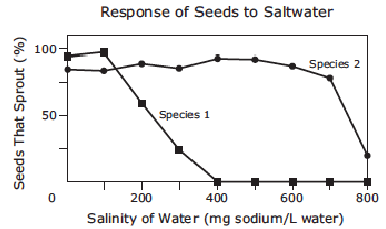
- ASpecies 1 can sprout only in freshwater, and Species 2 can sprout only in salt water.
- BBoth species can sprout in freshwater and saltwater, but Species 2 can sprout in higher salt concentration than Species 1.
- CBoth species need salt in their water, but Species 2 needs more salt than Species 1.
- DSpecies 1 can sprout only in water with a low salt concentration, but Species 2 is not affected by the salt concentration.
Information
- Description
- Quiz on Unit 7 Ecology, created by Kimberly Mancuso on 07/02/2018.
- Author
- Kimberly Mancuso
- Language
- English
- Views
- 651
- Tags
- Rating
- No ratings yet Rate this quiz