
15107524
Description

Quiz by Matthew Coulson, updated more than 1 year ago

|
Created by Matthew Coulson
about 8 years ago
|
|
Question 1
Question
Many patients that appear to have had a stroke haven't actually had a stroke, rather one of the 'stroke mimic' conditions which present similarly to a stroke. Which of the below 'stroke mimic' conditions is by far the most prevalent?
Answer
-
Seizure
-
Sepsis
-
Vestibular Dysfunction
-
Dementia
Question 2
Question
The [blank_start]Rosier[blank_end] score is the scoring system used to diagnose Stroke.
Answer
-
Rosier
Question 3
Question
The most severe type of stroke is diagnosed once a patient shows the following symptoms:
Hemiplegia involving at least two of face, arm and leg
Homonymous Hemianopia
Cortical signs such as Dysphasia
What is this syndrome called?
Answer
-
Total Anterior Circulation Syndrome (TACS)
-
Total Posterior Circulation Syndrome (TPCS)
-
Total Internal Carotid Syndrome (TICS)
-
Partial Anterior Circulation Syndrome (PACS)
Question 4
Question
Infarcts that occur in the deeper parts of the brain such as the basal ganglia and thalamus cause a condition called ...
Answer
-
Lacunar Syndrome
-
Partial Anterior Circulation Syndrome
-
Total Anterior Circulation Syndrome
Question 5
Question
Which type of stroke causes the following:
- Cranial nerve palsies
- Bilateral motor and/or sensory deficits
- Conjugate eye movement disorders
- Homonymous hemianopia
Answer
-
Total Anterior Circulation Syndrome
-
Lacunar Syndrome
-
Posterior Circulation Syndrome
-
Partial Anterior Circulation Syndrome
Question 6
Question
The [blank_start]right side of the brain[blank_end] controls creativity, music & artistic awareness
The [blank_start]left side of the brain[blank_end] controls spoken language, reasoning and number skills
Answer
-
left side of the brain
-
right side of the brain
-
right side of the brain
-
left side of the brain
Question 7
Question
Atrial fibrillation typically causes which type of stroke?
Answer
-
Atheroembolic
-
Cardioembolic
Question 8
Question
What is the most common cause of haemorrhagic stroke?
Answer
-
Aneurysm
-
Uncontrolled Hypertension
-
Tumour
-
Amyloid Angiopathy
Question 9
Question
If a Stroke patient presents within [blank_start]4.5 hours[blank_end] of the start of the stroke and a haemorrhagic cause has been excluded, they should be thrombolysed using [blank_start]Alteplase[blank_end].
Answer
-
4.5 hours
-
1 hour
-
90 minutes
-
Alteplase
-
Streptokinase
-
tPa
Question 10
Question
All people presenting with acute stroke who have had a diagnosis of primary intracerebral haemorrhage excluded by brain imaging should, as soon as possible but certainly within 24 hours, be given
Answer
-
Aspirin 300mg
-
Clopidogrel 300mg
-
Ticagrelor 180mg
Question 11
Question
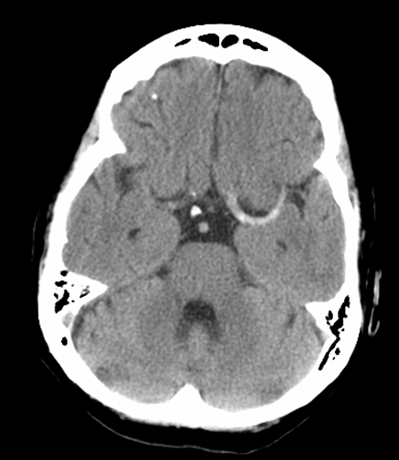
The CT scan shows the earliest sign of an infarct of which artery?
Answer
-
Internal Carotid
-
Anterior Cerebral Artery
-
Middle Cerebral Artery
-
Posterior Cerebral Artery
-
Posterior Communicating Artery
Question 12
Question
Cardioembolic Strokes are caused by [blank_start]red[blank_end] thrombi which are [blank_start]fibrin[blank_end] dependant and thus should be treated with [blank_start]anticoagulants[blank_end] such as [blank_start]Heparin[blank_end]
Atheroembolic Strokes are caused by [blank_start]white[blank_end] thrombi which are [blank_start]platelet[blank_end] dependant and should thus be treated by [blank_start]antiplatelets[blank_end] such as [blank_start]Aspirin[blank_end]
Answer
-
red
-
white
-
fibrin
-
platelet
-
anticoagulants
-
antiplatelets
-
Heparin
-
Aspirin
-
tPA
-
white
-
red
-
platelet
-
fibrin
-
antiplatelets
-
anticoagulants
-
Aspirin
-
Heparin
-
Warfarin
Want to create your own Quizzes for free with GoConqr? Learn more.