
Quiz
The Endocrine System
This quiz has question types that open in the usual player.
Questions in this quiz (35)
1Endocrine cells/glands secrete hormones directly into the blood to be carried towards target tissues.
- ATrue
- BFalse
2What is a neuroendocrine cell?
- AA cell that receives synaptic signals from other neurons and produce action potentials causing hormones to be secreted into capillaries
- BCells that release hormones into the bloodstream when acted upon by other hormones
- CCells that disintegrate entirely in order to release their hormone into the blood
- DCells that release hormones that act directly on the nervous system
3Fill in the blanks below to define the different types of chemical signalling.
[blank_start]Autocrine[blank_end] - cells release hormones which act on themselves
Signalling across [blank_start]gap junctions[blank_end] - cells release hormones which travel through the cytosol to a neighbouring cell
[blank_start]Paracrine[blank_end] - cells release hormones which act on different neighbouring cells
[blank_start]Endocrine[blank_end] - cells release hormones which target distant target cells via the bloodstream
[blank_start]Neuroendocrine[blank_end] - cells are stimulated by synaptic signals causing the production of an action potential leading to the release of hormones into the bloodstream- AAutocrine
- Bgap junctions
- CParacrine
- DEndocrine
- ENeuroendocrine
4Peptide hormones are synthesised first as large preprohormones. They are then cleaved by proteolytic enzymes which forms prohormones.
- ATrue
- BFalse
5How are prohormones released from the cell?
- AExocytosis stimulated by increase in cytosolic Ca2+
- BCan diffuse across cell membranes
- CVia transport proteins
- DExocytosis stimulated by an increase in cytosolic K+
6Prohormones are protein bound in the bloodstream.
- ATrue
- BFalse
7What gives a hormone a longer half life?
- ABeing protein-bound in circulation
- BBeing unbound in circulation
8Check the types of hormones that are released by neurosecretory cells.
- AProteins
- BSteroids
- CCatecholamines
- DThyroid hormones
9Check the types of hormones that are released by epithelial tissues.
- ASteroids
- BThyroid hormones
- CCatecholamines
- DProteins
10Steroid hormones are stored in glands.
- ATrue
- BFalse
11Check the true statements about steroid hormones.
- ADerived from cholesterol
- BSynthesised in mitochondria and SER
- CSynthesised in mitochondria and RER
- DSynthesised in golgi
- EStored in glands
- FCan diffuse across plasma membranes
- GProtein bound in circulation
- HShort half life
12Which amino acid are amine hormones commonly derived from?
- ATyrosine
- BThreonine
- CArginine
- DCysteine
- EGlutamine
- FMethionine
13Thyroid hormones and catecholamines can both cross the cell membrane.
- ATrue
- BFalse
14Thyroid hormones are stored in the thyroid gland bound to what substance?
- AThyroglobulin
- BThyroprotein
- CThyrolipid
- DCollagen
15Catecholamine hormones are unbound in circulation meaning they have a short half life.
- ATrue
- BFalse
16Thyroid hormones are protein bound in circulation.
- ATrue
- BFalse
17Eicosanoids are local chemical messengers - they act with autocrine/[blank_start]paracrine[blank_end] activity. They are derived from [blank_start]arachidonic acid[blank_end] found in plasma membrane phospholipids. One example of an eicosanoid is the [blank_start]prostaglandins[blank_end] which promote inflammation, support ovulation and inhibit gastric secretions.
- Aparacrine
- Barachidonic acid
- Cprostaglandins
18Which hormones have intracellular receptors in the cytoplasm or nucleus and act upon cells by altering gene transcription? Check all that apply.
- ASteroids
- BThyroid hormones
- CPeptides/proteins
- DCatecholamines
- EGlycoproteins
19What facilitates the binding of a steroid receptor to DNA?
- ADimerisation with another steroid-receptor complex
- BConformational shape change of the binding site
- CInteraction with transcription factors
- Da-subunit activation
20Fill in the blanks below to give a brief overview of the mechanism of lipid-insoluble hormones.
1. The hormone binds to the [blank_start]extracellular[blank_end] domain of a receptor.
2. The receptor undergoes a [blank_start]conformational shape change.[blank_end]
3. This triggers a signalling cascade via a [blank_start]second messenger[blank_end] mechanism to give the final response.- Aextracellular
- Bconformational shape change.
- Csecond messenger
21Fill in the blanks below to describe the development of the pituitary gland.
1. The embryonic [blank_start]hypothalamus[blank_end] and roof of [blank_start]mouth[blank_end] develop outgrowths towards one another.
2. These evaginations fuse to form one structure, however they maintain their differing composition and function due to their differing [blank_start]embryological[blank_end] origins.
3. The [blank_start]sella turcica[blank_end] develops inferior to the gland.- Ahypothalamus
- Bmouth
- Cembryological
- Dsella turcica
22The posterior pituitary lobe develops from neuroectoderm of the hypothalamus and the anterior pituitary lobe develops from the roof of the mouth.
- ATrue
- BFalse
23Label this image to show the anatomy of the pituitary gland.
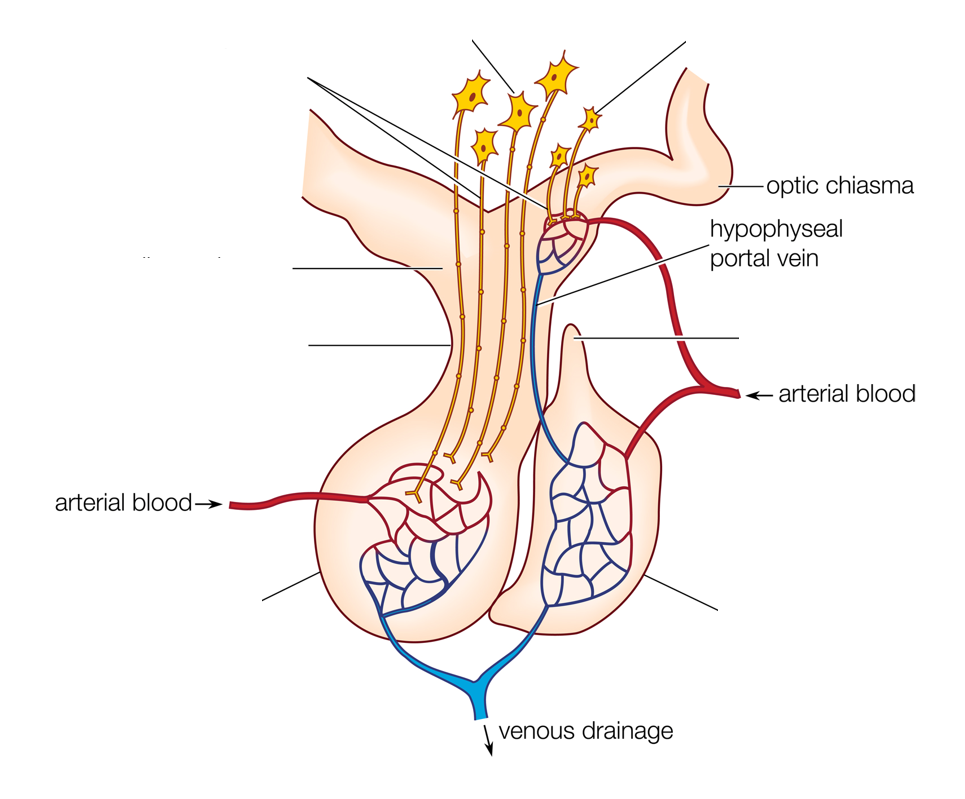
- ANeuroendocrine cells
- BParaventricular nucleus
- CSupraoptic nucleus
- DPars tuberalis
- EPars distalis
- FPosterior lobe
- GAnterior lobe
- HPars nervosa
- IInfundibulum
- JMedian eminence
24In which lobe of the pituitary gland are the hormones synthesised in the cell bodies of the nuclei, transported down axons, stored in nerve terminals and released into the blood upon stimulation?
- APosterior (neurohypophysis)
- BAnterior (adenohypophysis)
25What hormones does the posterior pituitary gland secrete?
- AOxytocin
- BADH
- CLH and FSH
- DACTH
- EProlactin
26What is the action of anti-diuretic hormone (ADH)?
- AReduces water resorption in the kidney
- BIncreases water resorption in the kidney
- CIncreases blood pH
- DIncreases GFR
27Which hormone increases uterine contractions during birth and milk ejection during suckling in a positive feedback mechanism?
- AOxytocin
- BACTH
- CLH
- DFSH
28In which lobe of the pituitary gland will the hormones be released from hypothalamic nuclei into portal blood vessels at the median eminence to be transported down into the pars distalis and out of the lobe in the blood?
- APosterior (neurohypophysis)
- BAnterior (adenohypophysis)
29Which blood vessel supplies the median eminence and stalk of the pituitary gland?
- ASuperior hypophyseal artery
- BInferior hypophyseal artery
- CHypophyseal portal artery
- DInfundibular artery
30What does the inferior hypophyseal artery supply? Check all that apply
- APosterior lobe directly
- BAnterior lobe via short portal vessels
- CInfundibulum and median eminence
- DHypothalamus
- EThyroid gland
31Fill in the blanks below to describe the endocrine cell types of the anterior pituitary gland.
G[blank_start]onadotroph[blank_end] cells secrete l[blank_start]uteinising[blank_end] hormone and f[blank_start]ollicle stimulating[blank_end] hormone.
C[blank_start]orticotroph[blank_end] cells secrete a[blank_start]drenocorticotrophic[blank_end] hormone and [blank_start]melanocyte[blank_end] stimulating hormone.
S[blank_start]omatotroph[blank_end] cells secrete somatotrophin, also known as g[blank_start]rowth[blank_end] hormone.
T[blank_start]hyrotroph[blank_end] cells secrete [blank_start]thyroid[blank_end] stimulating hormone.
All of the hormones mentioned above are trophic to other specific endocrine glands.
L[blank_start]actotroph[blank_end] cells secrete [blank_start]prolactin[blank_end], which does not affect any downstream hormones.- Aonadotroph
- Buteinising
- Collicle stimulating
- Dorticotroph
- Edrenocorticotrophic
- Fmelanocyte
- Gomatotroph
- Hrowth
- Ihyrotroph
- Jthyroid
- Kactotroph
- Lprolactin
32The only way of controlling the release of hormones from the anterior pituitary is by negative feedback.
- ATrue
- BFalse
33Fill in the blanks below to describe the secretion of hypothalamic hypophysiotrophic hormones on the anterior pituitary gland.
The hypothalamic hypophysiotrophic hormones are released into the [blank_start]pituitary portal[blank_end] system from nerve terminals in the [blank_start]median eminence[blank_end] of the hypothalamus. They then travel through the portal system and out of the lobe.- Apituitary portal
- Bmedian eminence
34Fill in the blanks below to describe a negative feedback mechanism affecting the anterior pituitary gland.
1. Low temperature stimulates the [blank_start]hypothalamus[blank_end] in the brain
2. Hypothalamic cell bodies release [blank_start]thyrotropin releasing[blank_end] hormone (TSR) into the [blank_start]pituitary portal system[blank_end]
3. TSR activates the [blank_start]thyrotroph[blank_end] cells in the anterior pituitary to secrete [blank_start]thyroid stimulating[blank_end] hormone (TSH)
4. TSH stimulates the [blank_start]thyroid[blank_end] glane to secrete T3 and T4 which [blank_start]increase[blank_end] body temperature
5. High concentrations of these enzymes triggers the hypothalamus to slow the mechanism- Ahypothalamus
- Bthyrotropin releasing
- Cpituitary portal system
- Dthyrotroph
- Ethyroid stimulating
- Fincrease
- Gthyroid
35The hypothalamic hypophysiotrophic hormones stimulate the release of specific hormones from the anterior pituitary.
- ATrue
- BFalse
Information
- Description
- University Functional Anatomy and Embryology Quiz on The Endocrine System, created by Charlotte Jakes on 15/12/2019.
- Author
- Charlotte Jakes
- Language
- English
- Views
- 36
- Tags
- Rating
- No ratings yet Rate this quiz