
Quiz
Midterm test continued
This quiz has question types that open in the usual player.
Questions in this quiz (116)
1What is the backlighting of a monitor measured by?
- Acd/m2
- BMHz
- CGHz
- Ddecibels
2Select the connectors for video/monitors.
- AVGA
- BDVI-I & DVI-D
- CHDMI
- DDisplayPort
- EThunderbolt
- FAll of the above.
3Video card installation problems:
When you power up the computer and there's a black screen or an error message when Windows start, you should check...- Aif the onboard video ports are disabled in BIOS/UEFI
- Bthe motherboard
- Cthe PSU
- Dthe GPU
4Video card installation problems:
When you power up the computer and there are beeps the problem is...- Athe BIOS/UEFI can't detect the video card or slot
- Bthe video card is bad
- Cthe PSU
- Dthe version of Windows the computer is running
5[blank_start]Artifacts[blank_end] happen when the video controller is out of sync with the refresh of the monitor screen.
- AArtifacts
- BScreen tearing
- CPixel disortion
- DRefresh fail
6Artifacts are commonly caused by an overheating GPU.
- ATrue
- BFalse
7If the LCD panel of a laptop has a black screen but the power light is on, the video subsystem might be the problem.
- ATrue
- BFalse
8If the external monitor of a laptop works but the LDC won't, the LCD panel assembly is the problem and you should replace the [blank_start]invertor[blank_end].
- Ainvertor
- Bscreen
- Cthe whole laptop
- Dkeyboard chassis
9[blank_start]PAN[blank_end] (personal area network) is a used for personal devices such as cell phones and laptops that communicate at close range. This type of network uses USB or lightning connection and Bluetooth or Wi-Fi.
- APAN
10[blank_start]LAN[blank_end] (local area network) is used for small local areas such as homes and offices or a small group of buildings.
- ALAN
11[blank_start]WMN[blank_end] (wireless mesh network) is used for many wireless devices that communicate directly with each other rather than through a single central device.
- AWMN
12[blank_start]MAN[blank_end] (metropolitan area network) covers multiple buildings in a large area such as a large campus or a downtown area. It is used with LTE or ethernet with fiber-optic cabling.
- AMAN
13[blank_start]WAN[blank_end] (wide area network) is used for large geographical areas made up of smaller networks such as the internet. It can use DSL, cable internet, satellite, cellular WAN, and fiber optic.
- AWAN
14Before connecting to the internet, a device or network first connects to an internet service provider like Xfinity.
- ATrue
- BFalse
15[blank_start]Bandwidth[blank_end] is the theoretical number of bits that can be transmitted over a network connection at one time.
- ABandwidth
- BData throughput
- CLatency
16[blank_start]Data throughput[blank_end] is the average of the actual speed of the network.
- AData throughput
- BBandwidth
- CLatency
17Latency is the network transmission delay that causes faster network performance.
- ATrue
- BFalse
18The speed of DSL is [blank_start]22[blank_end] - [blank_start]70[blank_end] Mbps.
- A22
- B50
- C20
- D70
- E22
- F50
19[blank_start]Cable[blank_end] uses existing TV cable lines and [blank_start]DSL[blank_end] uses ordinary copper phone lines and unused voice frequencies.
- ACable
- BDSL
- CDSL
- DCable
20You can't use the same phone line for voice and DSL at the same time.
- ATrue
- BFalse
21[blank_start]Cable[blank_end] shares TV cable infrastructure with neighbors so service may become degraded. [blank_start]DSL[blank_end] uses dedicated phone lines so you have to filter phone line static. You need a filter on every phone jack except the DSL modem one.
- ACable
- BDSL
22Dedicated lines using fiber-optic speeds are up to [blank_start]43[blank_end] TBps.
- A43
- B50
- C25
- D10
23Fiber optic is a dedicated point-to-point connection with no line sharing.
- ATrue
- BFalse
24TV, internet data, and voice communication all share the broadband fiber-optic cable.
- ATrue
- BFalse
25Satellite provides high-speed internet connection in remote areas (even airplanes).
- ATrue
- BFalse
26A disadvantage of satellite is...
- AIt requires line-of-site wireless connectivity and latency occurs when uploading.
- BIt requires filtering because of static.
- CIt shares infrastructure with neighbors so service may become degraded.
27The two types of cellular technologies are [blank_start]GSM[blank_end] and [blank_start]CDMA[blank_end].
- AGSM
- BWAN
- CWiFi
- DWAP
- ECDMA
- FCDMA
- GGSM
- HWAN
- ILAN
28LTE is not expected to replace GSM and CDMA.
- ATrue
- BFalse
29[blank_start]VPN[blank_end] protects data by encrypting it, called tunneling.
- AVPN
30A dial-up connection uses an [blank_start]RJ-11[blank_end] connector.
- ARJ-11
- BRJ-45
- CRJ-50
- DEthernet
31An IP address is assigned to a network connection when the connection is first made.
- ATrue
- BFalse
32Which of these is an IPv4 address?
- A192.168.100.4
- B2001:0db8:85a3:0000:0000:8a2e:0370:7334
- C1010110100001
- D30-65-EC-6F-C4-58
33Which of these is an IPv6 address?
- A2001:0db8:85a3:0000:0000:8a2e:0370:7334
- B30-65-EC-6F-C4-58
- C01001011010101
- D196.22.199.4
34IPv4 addresses are [blank_start]32[blank_end]-bits with 4 decimal numbers called octets and only have periods and numbers. IPv6 is [blank_start]128[blank_end]-bits with 8 hexadecimal numbers with colons.
- A32
- B128
35[blank_start]TCP/IP[blank_end] is an IP set of rules for IP addressing and protocol-set of rules computers must follow in order to communicate.
- ATCP/IP
- BTCP
- CIP
36255.255.255.0 is a [blank_start]subnet mask[blank_end].
- Asubnet mask
- BIPv4 address
- CIPv6 address
- Ddefault gateway
37A host is any device on a network that requests or servers up data or services to other devices.
- ATrue
- BFalse
38A default gateway is usually a router. When a computer sends a message to a computer on a different network, it sends the message to the default gateway.
- ATrue
- BFalse
39[blank_start]Name resolution[blank_end] is finding the IP address for a computer name.
- AName resolution
- BIP lookup
- CChkdsk
- DQOS
40The IP address, subnet mask, default gateway, and DNS server addresses all can be manually assigned to a computer's network connection. This is known as [blank_start]static[blank_end] IP address.
- Astatic
41When the IP address, subnet mask, default gateway, and DNS server addresses are requested from a server on the network when a computer first connects, it is known as [blank_start]dynamic[blank_end] IP address.
- Adynamic
42[blank_start]DHCP[blank_end] is the server that assigns the address from a pool of addresses it maintains.
- ADHCP
- BWAP
- CLAN
- DSOHO
43DHCP client is a computer or device that is requesting address information from the DHCP server aka leasing the IP address.
- ATrue
- BFalse
44Fill in the blanks for the TCP/IP Model for Network Communication.
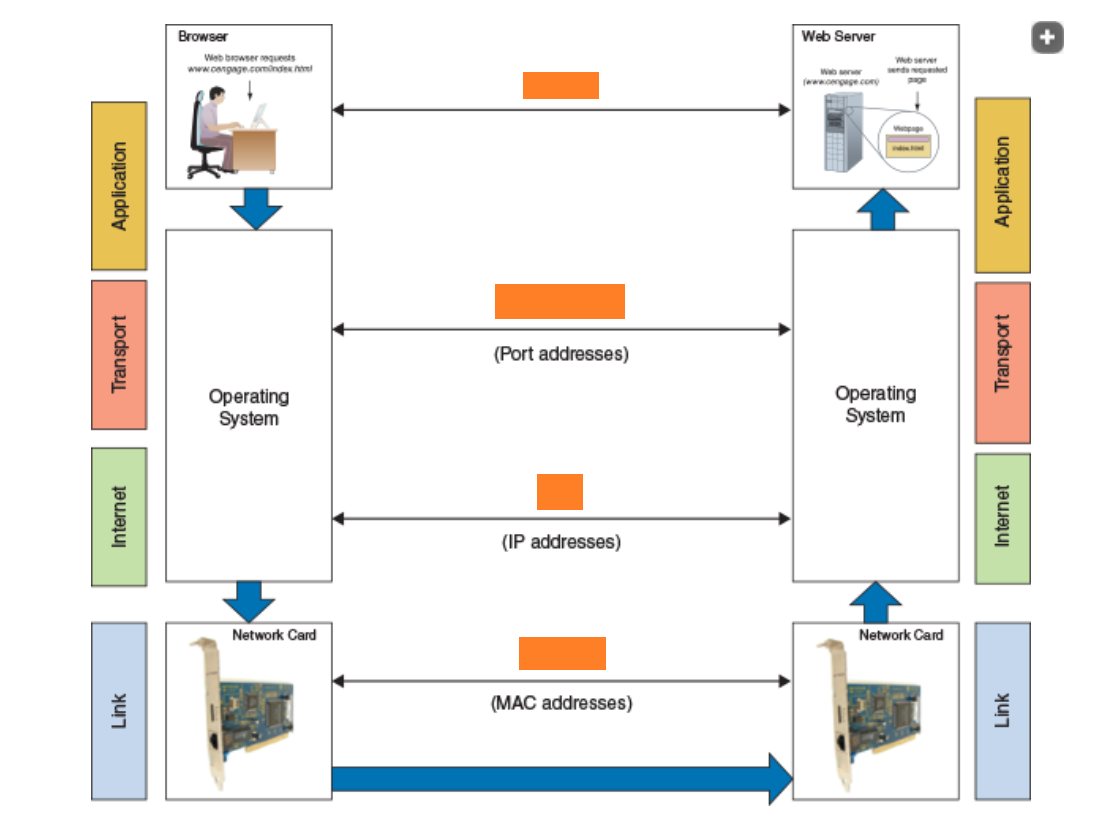
- AEthernet
- BIP
- CTCP/IP
- DHTTP
45Fill in the blanks for the TCP/IP layers.
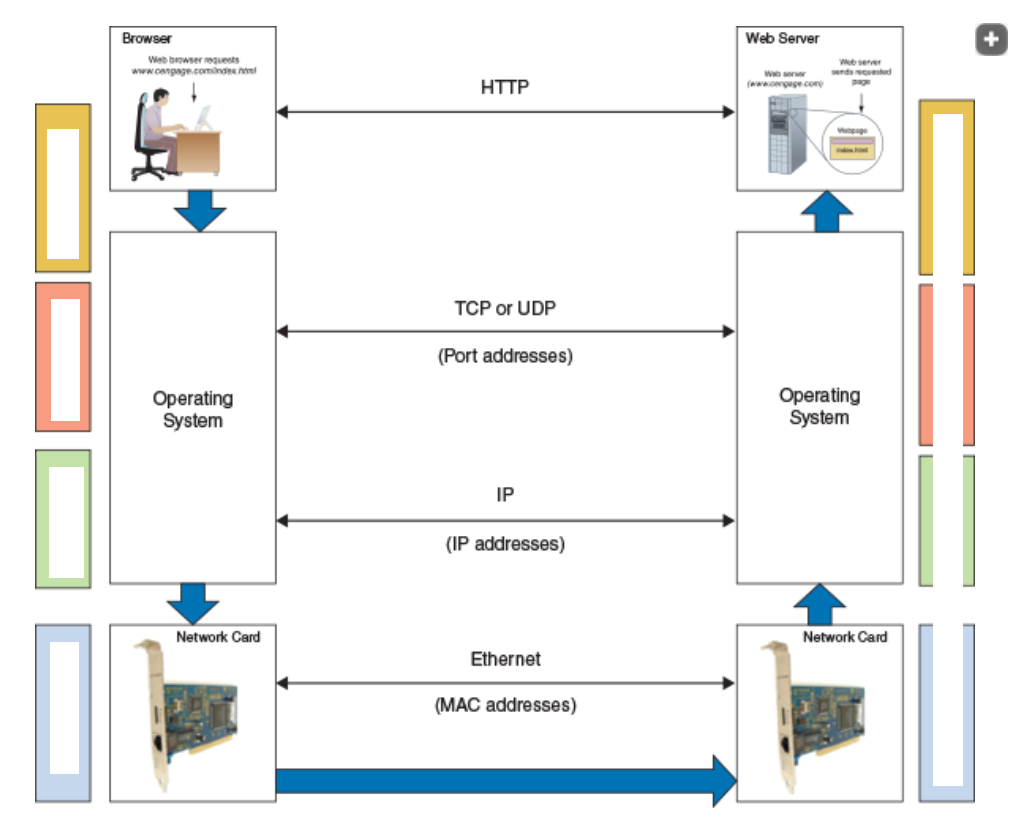
- ALink layer
- BInternet layer
- CTransport layer
- DApplication layer
46A(n) [blank_start]intranet[blank_end] is any private network that uses TCP/IP protocols. A large enterprise might support an intranet that is made up of several local networks.
- Aintranet
- Btelnet
- Cinternet protocol
- DMAC
47IP (Internet Protocol) is the primary TCP/IP protocol, used by the Internet layer, that is responsible for getting a message to a destination host.
- ATrue
- BFalse
48The [blank_start]Link[blank_end] Layer is the physical network, including the hardware and its firmware for every device connected to the network. A computer’s network interface card (NIC) is part of this physical network.
- ALink
49In the [blank_start]Application[blank_end] Layer, when a browser client makes a request to a web server, the browser passes the request to the OS. The OS formats the message using the appropriate application protocol (for example, HTTP, FTP, Telnet, DNS, and SSH).
- AApplication
50The [blank_start]Transport[blank_end] Layer adds information to the message to address the correct server application. Depending on the type of application, the protocol TCP (Transmission Control Protocol) or UDP (User Datagram Protocol) adds the port assigned to the server application.
- ATransport
51The [blank_start]Internet[blank_end] Layer is responsible for getting the message to the destination computer or host on the local network, an intranet, or the Internet. The primary protocol used at this layer is IP (Internet Protocol).
- AInternet
52IP at the Internet layer is responsible to make sure the message gets from one network to the next until it reaches its destination network (see Figure 8-4) and destination computer on that network.
- ATrue
- BFalse
53 On the destination computer, its NIC receives the message, strips off Ethernet or Wi-Fi information at the [blank_start]Link layer[blank_end], and passes the message up to the Internet layer. The [blank_start]Internet layer[blank_end] strips off IP address information and passes the message up to the Transport layer. The [blank_start]Transport layer[blank_end] strips off TCP or UDP information and passes the message to the correct port and on to the Application layer. The [blank_start]Application layer[blank_end] passes the message to the web server application.
- AInternet layer
- BTransport layer
- CApplication layer
- DLink layer
54What is a protocol data unit (PDU)?
- AA message on a TCP/IP network. A PDU might be called a packet or frame, depending on the complexity of the PDU.
- BEvery device on a network (for example, computers, printers, smart thermostats, refrigerators, and smartphones) connects to the network by way of its PDU and MAC address.
- CThe primary protocol used at the Internet layer is PDU, which uses a 32-bit and/or 128-bit IP address to identify each host. (Other Internet layer protocols include EIGRP, OSPF, BGP, and ICMP.)
55The largest possible 8-bit number is 11111111, which is equal to 255 in decimal, so the largest possible IPv4 address in decimal is [blank_start]255.255.255.255[blank_end].
- A255.255.255.255
- B111.111.111.111
- C200.200.200.200
- D999.999.999.999
56IPv4 created about six billion potential IP addresses.
- ATrue
- BFalse
57Reserved IP addresses include:
- A127.0.0.1
- B0.0.0.0
- C255.255.255.255
- D111.111.111.111
- E256.256.256.256
58[blank_start]127.0.0.1[blank_end] indicates your own computer and is called the loopback address.
- A127.0.0.1
- B255.255.255.255
- C0.0.0.0
59[blank_start]255.255.255.255[blank_end] is used for broadcasting messages by TCP/IP background processes to communicate with all devices on a network at the same time or without needing specific recipient information, such as when a device uses DHCP to send out a request to any host that might be running a DHCP server to get an IP address.
- A255.255.255.255
- B100.100.100.100
- C0.0.0.0
- D127.0.0.1
60What is it called when a message is sent over a local network to all devices on the network? The message does not contain recipient information.
- ABroadcast messages
- BLocal reciever
- CNetwork ping
- DLoopback
61The [blank_start]first[blank_end] part of an IP address identifies the network, and the [blank_start]last[blank_end] part identifies the host.
- Afirst
- Blast
62For example, the range of IP addresses assigned to a local network might be 192.168.80.1-100. The first three octets (192.168.80) identify the [blank_start]network[blank_end] and the last octet (1 through 100) identifies each [blank_start]host[blank_end].
- Anetwork
- Bhost
63How does it know how many bits in its IP address identify its network? That’s the job of the [blank_start]subnet mask[blank_end].
- Asubnet mask
- BTCP/IP
- Cnetwork layer
- DDNS
64The computer compares the first 24 bits of the destination IP address to its own first 24 bits. If they match, it directs the message to the computer on its local network. If they don’t match, it sends the message to its default gateway.
- ATrue
- BFalse
65Sometimes an IP address and subnet mask are written using a shorthand notation like 15.50.212.59/20, where the /20 means that the first 20 bits in the IP address identify the network.
- ATrue
- BFalse
66IEEE recommends that the following IP addresses be used for private networks:
[blank_start]10[blank_end].0.0.0 through [blank_start]10[blank_end].255.255.255
172.[blank_start]16[blank_end].0.0 through 172.[blank_start]31[blank_end].255.255
[blank_start]192.168[blank_end].0.0 through [blank_start]192.168[blank_end].255.255- A10
- B11
- C12
- D32
- E10
- F11
- G12
- H32
- I16
- J10
- K32
- L15
- M31
- N32
- O72
- P50
- Q192.168
- R255.255
- S0.0
- T10.0
- U192.168
- V0.0
- W10.0
- X255.255
67IP addresses available to the Internet are called [blank_start]public[blank_end] IP addresses.
- Apublic
68[blank_start]NAT[blank_end] (Network Address Translation) is a technique designed to conserve the number of public IP addresses needed by a network. A router stands between a private network and the Internet. It substitutes the private IP addresses used by computers on the private network with its own public IP address when these computers need access to the Internet.
- ANAT
- BLAN
- CQOS
- DWAN
69For a SOHO router, expect that NAT is disabled by default.
- ATrue
- BFalse
70For IPv6 addresses, if blocks contain all zeroes, they can be written as double colons (::). To avoid confusion, only one set of double colons is used in an IPv6 address. The IP address above can be written two ways:
2001::B80:0000:0000:D3:9C5A:CC
2001:0000:B80::D3:9C5A:CC- ATrue
- BFalse
71Fill in the blanks for different casting types.
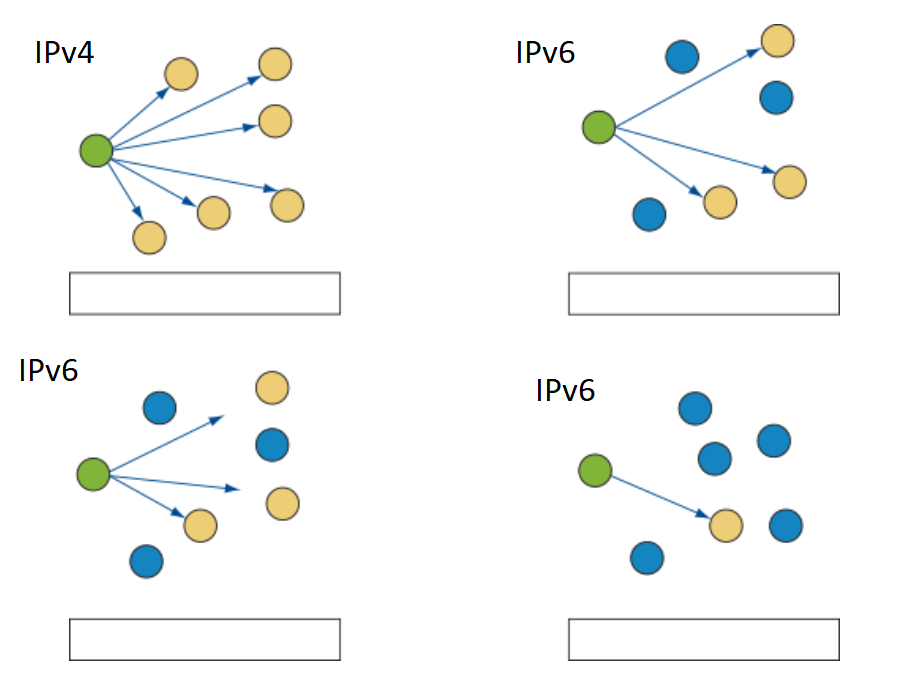
- ABroadcasting
- BMulticasting
- CUnicasting
- DAnycasting
72A link In TCP/IP[blank_start]v6[blank_end] is a local area network or wide area network bounded by routers. It is also called a local link.
- Av6
- Bv4
- Cv2
- Dv1
- Ev3
73A node is any device that connects to the network, such as a computer, printer, or router.
- ATrue
- BFalse
74IPv6 uses subnetting but doesn’t need a subnet mask because the subnet ID is part of the IPv6 address. The subnet ID is the 16 bits following the first 48 bits of the address.
- ATrue
- BFalse
75A [blank_start]multicast[blank_end] address is used to deliver messages to all nodes in a targeted, multicast group, such as when video is streaming from a server to multiple nodes on a network.
An [blank_start]anycast[blank_end] address is used by routers and can identify multiple destinations; a message is delivered only to the closest destination.- Amulticast
- Banycast
- Cunicast
- Dbroadcast
76What are the three types of unicast addresses?
- Alink local addresses
- Bunique local addresses
- Cglobal addresses
- Dpublic addresses
- Eprivate addresses
77These local addresses are similar to IPv4 APIPA addresses in that they are assigned to the computer by itself as opposed to coming from a DHCPv6 server, and are not guaranteed to be unique on the network. Most link local addresses begin with what?
- AFE80::/64
- BFF00::/8
- C2000::/3
- D0::0
78Very few networks solely use IPv6. Tunneling is used to allow IPv6 messages to traverse IPv4 networks. A tunnel works by encapsulating an IPv6 message inside an IPv4 message.
- ATrue
- BFalse
79private IP addresses In TCP/IP version 4, an IP address used on a private network that is [blank_start]isolated from[blank_end] the Internet.
- Aisolated from
- Bon
80IPv6 uses subnetting but doesn’t need a subnet mask because the subnet ID is part of the IPv6 address.
- ATrue
- BFalse
81IPv6 addressing is designed so that a computer can self-configure its own link local IP address, which is similar to how IPv4 uses an Automatic Private IP Address (APIPA).
- ATrue
- BFalse
82A [blank_start]fully qualified domain name[blank_end] (FQDN) identifies a computer and the network to which it belongs.
- Afully qualified domain name
- Bdomain name
- Clink
83On the Internet, a fully qualified domain name must be associated with an IP address before the computer can be found.
- ATrue
- BFalse
84[blank_start]Domain Name Servers (DNS)[blank_end] maintain a directory of domain names and translate them to Internet Protocol (IP) addresses.
- ADomain Name Servers (DNS)
- BIPv4
- CMAC address
- DNIC
85When Windows queries the DNS server for a name resolution, it is called the DNS [blank_start]client[blank_end].
- Aclient
- Bquery
- Csearch
- Dresolution
86[blank_start]TCP[blank_end] (Transmission Control Protocol) guarantees message delivery. It makes a connection, sends the data, checks whether the data is received, and resends it if it is not.
- ATCP
87[blank_start]Connection-oriented[blank_end] protocol In networking, a TCP/IP protocol that confirms a good connection has been made before transmitting data to the other end, verifies that data was received, and resends data if it was not received.
[blank_start]Connectionless[blank_end] protocol a TCP/IP protocol such as UDP that works at the OSI Transport layer and does not guarantee delivery by first connecting and checking where data is received.- AConnection-oriented
- BConnectionless
88UDP is used for broadcasting, such as streaming live video or sound over the web, where guaranteed delivery is as important as fast transmission.
- ATrue
- BFalse
89 A [blank_start]hub[blank_end] is just a pass-through and distribution point for every device connected to it, without regard for what kind of data is passing through and where the data might be going. Hubs are outdated technology, having been replaced by switches.
- Ahub
- Bswitch
90A [blank_start]switch[blank_end] is smarter and more efficient than a hub because it keeps a table of all the MAC addresses for devices connected to it. When the switch receives a message, it searches its MAC address table for the destination MAC address of the message and sends the message only to the interface for the device using this MAC address
- Aswitch
- Bhub
91An [blank_start]unmanaged[blank_end] switch requires no setup or configuration other than connecting network cables to its ports. It does not require an IP address and is appropriate for SOHO networks.
A [blank_start]managed[blank_end] switch has firmware that can be configured to monitor and manage network traffic. It’s appropriate for larger networks and can be used to manage QoS for prioritizing network traffic and to control speeds for specific ports.- Aunmanaged
- Bmanaged
92[blank_start]virtual LANs (VLANs)[blank_end] A subnet of a larger network created to reduce network traffic. Managed switches are commonly used to set up VLANs.
- AVLAN
- BLAN
- CWAP
- DWAN
93Which topology means that nodes are connected to one or more centralized devices, which are connected to each other (see Figure 8-16). A centralized device can be a switch or a hub.
- Astar bus
- Bsnowflake
- Cweb
- Dwebbed
94An Ethernet cable should not exceed [blank_start]100[blank_end] meters (about 328 feet) in length.
- A100
- B150
- C200
- D50
95The wireless access point can be
- Abridge
- Bdedicated device
- Chotspot
- DLTE
96A networking device that stands between two segments of a network and manages traffic between them.
- Abridge
- Brouter
- CWAP
- DNPC
97If your wireless access point does not reach the entire area you need to cover, you can add _________ which amplifies and retransmits the signal to a wider coverage area.
- Arepeater
- Bextender
- Cethernet
- Dbridge
98The difference between a repeater and an extender is that a [blank_start]repeater[blank_end] rebroadcasts the signal using a new network name, whereas an [blank_start]extender[blank_end] keeps the original network name.
- Arepeater
- Bextender
- Cextender
- Drepeater
99A telltale sign that the network’s DNS server is malfunctioning is when you can reach a website by its IP address, but not by its FQDN.
- ATrue
- BFalse
100 A [blank_start]proxy server[blank_end] is a computer that intercepts requests that a client, such as a browser, makes of another server, such as a web server. It substitutes its own IP address for the request using NAT protocols.
- Aproxy server
- BVPN
- Cfirewall
101A protocol that collects event information about network devices, such as errors, failures, and users logging in or out, and sends the information to a Syslog server.
- ASyslog
- BAuthentication server
- CEvent log
- DLogger
102A firewall that combines firewall software with anti-malware software and other software that protects resources on a network.
- Anext-generation firewall (NGFW)
- BVPN
- CFirewall
- DHypervisor
103A computer, security appliance, network appliance, or Internet appliance that stands between the Internet and a private network. It runs a firewall, anti-malware software, and other software to protect the network
- AUnified Threat Management (UTM)
- BFirewall
- CVPN
- DHypervisor
104[blank_start]unshielded twisted-pair (UTP)[blank_end] cable Twisted-pair networking cable commonly used on LANs that is less expensive than STP cable and does not contain shielding to prevent electromagnetic interference.
[blank_start]shielded twisted-pair (STP)[blank_end] cable A cable that is made of one or more twisted pairs of wires and is surrounded by a metal shield.- Aunshielded twisted-pair (UTP)
- Bshielded twisted-pair (STP)
105Which twisted pair categories reduce crosstalk?
- ACAT5e
- BCAT6
- CCAT5
- DCAT6e
106What is plenum?
- Aareas between floors of a building
- Barea in vents
- Carea in walls
- Darea outside
107Fiber-optic cable comes in two types:
- Asingle-mode (thin, difficult to connect, expensive, and best performing)
- Bmultimode (most popular)
- Csingle-plex (thin, difficult to connect, expensive, and best performing)
- Dmulti-plex (most popular)
108If you need network access to a remote location in a building where network cabling and Wi-Fi cannot reach, you have another option:
- APoE (power over ethernet)
- BEoP (ethernet over power)
- CWiFi
- DNetwork Sharing
109Powerline adapters dont have to be plugged directly into a wall outlet.
- ATrue
- BFalse
110If you have the opposite problem of needing to get power where your network cabling has gone, you can use [blank_start]Power over Ethernet (PoE)[blank_end], a feature that might be available on high-end wired network adapters to allow power to be transmitted over Ethernet cable. Using this feature, you can place a wireless access point, webcam, IP phone, or other device that needs power in a position in a building where you don’t have an electrical outlet. The Ethernet cable to the device provides both power and data transmissions.
- APower over Ethernet (PoE)
- BEthernet over Power (EoP)
111A device that adds power to an Ethernet cable so the cable can provide power to a device.
- APoE injector
- BEoP injector
- CSwtich
- DHub
112A [blank_start]loopback plug[blank_end] can be used to test a network cable or port. Another way to use a loopback plug is to find out which port on a switch in an electrical closet matches up with a wall jack.
A [blank_start]cable tester[blank_end] is used to determine if a cable is good or to find out what type it is if the cable is not labeled. You can also use a cable tester to locate the ends of a network cable in a building.
A [blank_start]network multimeter[blank_end] is a multifunctional tool that can test cables, ports, and network adapters. When you connect it to your network, it can also detect the Ethernet speed, duplex status, default router on the network, lengths of cables, voltage levels of PoE, and other network statistics and details.
A [blank_start]Wi-Fi analyzer[blank_end] is software that can find Wi-Fi networks, determine signal strengths, help optimize Wi-Fi signal settings, and help identify Wi-Fi security threats.
A [blank_start]toner probe[blank_end], is a two-part kit that is used to find cables in the walls of a building.
A [blank_start]cable stripper[blank_end] is used to build your own network cable or repair a cable.
A [blank_start]crimper[blank_end] is used to attach a terminator or connector to the end of a cable.- Aloopback plug
- Bcable tester
- Cnetwork multimeter
- DWi-Fi analyzer
- Etoner probe
- Fcable stripper
- Gcrimper
113A [blank_start]crossover[blank_end] cable used to connect two like devices such as a hub to a hub or a computer to a computer (to make the simplest network of all).
An [blank_start]straight-through[blank_end] cable is an ethernet cable used to connect a computer to a switch or other network device.- Acrossover
- Bstraight-through
114[blank_start]T568A[blank_end] has green 1 and 2 wires and orange 3 and 6 wires. [blank_start]T568B[blank_end] has orange 1 and 2 wires and green 3 and 6 wires.
- AT568A
- BT568B
115First ping an IP address, such as Google’s DNS server: ping 8.8.8.8
Then ping a domain name: ping google.com
If both pings work, then you can conclude that DNS works. If an IP address works but the domain name does not work, the problem lies with DNS.- ATrue
- BFalse
116If Wifi network is not found you can manually connect to it.
- ATrue
- BFalse
Information
- Description
- Information Technology Quiz on Midterm test continued, created by Ari Gu on 24/02/2020.
- Author
- Ari Gu
- Language
- English
- Views
- 9
- Tags
- Rating
- No ratings yet Rate this quiz