
Quiz
HL Chemistry IB Revision
This quiz has question types that open in the usual player.
Questions in this quiz (80)
1Check all reasons why the theoretical yield may not be accurate.
- ALoss of reactant/product
- BImpurities in reactants
- CToo much reactant added
- DIncomplete reaction
- EReaction is in equilibrium
2The Ideal Gas Laws
As pressure increases, volume [blank_start]decreases[blank_end] --> [blank_start]more[blank_end] collisions, less empty space
As temperature increases, volume [blank_start]increases[blank_end] --> [blank_start]more[blank_end] kinetic energy, particles move further
As temperature increases, pressure [blank_start]increases[blank_end] --> [blank_start]more[blank_end] kinetic energy, more collisions- Amore
- Bmore
- Cmore
- Ddecreases
- Eincreases
- Fincreases
3A real gas behaves most like an ideal gas at [blank_start]low[blank_end] pressure and [blank_start]high[blank_end] temperature because the particles are widely spaced, and are almost negligible volume.
A real gas behaves least like an ideal gas at [blank_start]high[blank_end] pressure and [blank_start]low[blank_end] temperature because the particles are close together and take up more volume - volume is [blank_start]greater[blank_end] than expected - and have stronger attractive forces - pressure is [blank_start]lower[blank_end] than expected.- Alow
- Bhigh
- Chigh
- Dlow
- Egreater
- Flower
4Relative atomic mass is the average mass of all the different isotopes of an atom
- ATrue
- BFalse
5Which color of visible light has the shortest wavelength and therefore the most energy?
- ARed
- BYellow
- CBlue
6Electromagnetic waves all travel at the same speed
- ATrue
- BFalse
7What is the speed of light?
[blank_start]3[blank_end].00 x 10^[blank_start]8[blank_end] m/s- A3
- B5
- C2
- D4
- E9
- F7
- G8
8When is an emission spectrum produced?
- AWhen an atom moves from a higher to a lower energy level
- BWhen an atom moves from a lower to a higher energy level
9What is the difference between a line spectrum and a continuous spectrum?
- ALine spectrum = discrete
Continuous spectrum = continuous energy levels - BLine spectrum = continuous
Continuous spectrum = discrete energy levels - CLine spectrum = shows energy changes
Continuous spectrum = does not show energy that atoms have absorbed
- ALine spectrum = discrete
10Which series is produced when electrons fall to the 2nd energy level, producing visible light?
- APaschen
- BLyman
- CBalmer
11Which series is produced when electrons fall from an excited state to the ground state, producing UV light?
- ALyman
- BBalmer
- CPaschen
12What is the transition that corresponds to ionization of an electron?
- A∞ --> 1
- B2--> ∞
- Coutermost level --> ∞
- D1 --> ∞
13What type of radiation is produced when the electron falls to the third energy level (n=3) in the Pachen series?
- AUV
- BInfrared
- CVisible light
14The energy in a photon of light emitted is equal to the energy change in an atom when an electron falls from an excited state.
- ATrue
- BFalse
15In an atomic orbital, what % chance is there of finding the electron?
- A85%
- B75%
- C100%
- D90%
16What is the correct order of electron orbitals/how many electrons does each contain?
[blank_start]s[blank_end] = 2
p = [blank_start]6[blank_end]
[blank_start]d[blank_end] = 10
f = 14- As
- Bp
- Cf
- D6
- E4
- F10
- G8
- Hd
- Ia
- Jb
17Which two elements below have 4s1 followed by a 3d orbital?
- AManganese and Sulfur
- BChromium and Copper
- CCopper and Sulfur
- DManganese and Chromium
18Effective nuclear charge is = number of [blank_start]protons[blank_end] - shielding [blank_start]electrons[blank_end]
- Aprotons
- Bneutrons
- Celectrons
- Dprotons
19Effective nuclear charge...
- Aincreases along a period, no change down a group
- Bincreases along a period, increases down a group
- Cdecreases along a period, no change down a group
- Ddecreases along a period, increases down a group
20Atomic radius...
- Adecreases across a period, increases along a group
- Bdecreases across a period, decreases along a group
- Cincreases across a period, decreases along a group
- Dincreases across a period, increases along a group
21For ionic radius...
- AIons in Groups 1-14 are smaller than their parent atoms, and ions in Groups 1-14 are larger than their parent atoms.
- BIons in Groups 1-14 are smaller than their parent atoms, and ions in Groups 1-14 are smaller than their parent atoms.
- CIons in Groups 1-14 are larger than their parent atoms, and ions in Groups 1-14 are larger than their parent atoms.
- DIons in Groups 1-14 are larger than their parent atoms, and ions in Groups 1-14 are smaller than their parent atoms.
22Ionization energies...
- Aincrease across a period and decrease down a group
- Bdecrease across a period and decrease down a group
- Cincrease across a period and increase down a group
- Ddecrease across a period and increase down a group
23"A measure of the ability of an atom to attract electrons in a covalent bond." This is...
- Aelectron affinity
- Bionization energy
- Celectronegativity
- Datomic radius
24Electron affinity of an atom is...
- Athe energy change that occurs when one mole of electrons is added to one mole of gaseous atoms
- Bthe enthalpy change that occurs when one mole of electrons is added to one mole of gaseous atoms
- Cthe energy change that occurs when an electron is added an atom
25Al2O3 is basic
- ATrue
- BFalse
26Check the properties of an ionic compound.
- AHigh melting point
- BLow melting point
- CHigh boiling point
- DLow boiling point
- E(generally) soluble in polar solvents
- F(generally) soluble in non-polar solvents
- GLow volatility
- HDo not conduct in solid state but conduct when molten or in aqueous solution
- IBrittle
27Which molecules commonly have an incomplete octet?
- ABeCl2
- BBF3
- CAl2O3
- DC2H6
- ENaOH
28Species with 2 electron domains are...
- Abent/v-shaped
- Btetrahedral shape
- Clinear
29Species with three electron domains and no lone pairs are:
- Atrigonal pyramidal
- Bbent/v-shaped
- Ctriangular planar
30Species with three electron domains and one lone pair are:
- Atriangular planar
- Bbent/v-shaped
- Ctrigonal pyramidal
31Name the molecular geometry.
Species with 4 electron domains and no lone pairs: [blank_start]tetrahedral[blank_end]
Species with 4 electron domains and one lone pair: [blank_start]trigonal pyramidal[blank_end]
Species with 4 electron domains and two lone pairs: [blank_start]bent/v-shaped[blank_end]- Atetrahedral
- Btrigonal pyramidal
- Cbent, v-shaped, bent/v-shaped
32Which allotropes of carbon are sp2 hybridized?
- Afullerene C60
- Bdiamond
- Cgraphite
- Dgraphene
33In Silicon Dioxide (SiO2), each silicon is bonded to x oxygens, and each oxygen is bonded to y silicons.
- Ax = 4
y = 2 - Bx = 2
y = 1 - Cx = 2
y = 4
- Ax = 4
34Dipole-dipole attraction occurs between [blank_start]permanent[blank_end] dipoles.
- Apermanent
- Btemporary
- Cinstantaneous
- Dinduced
35Hydrogen bonds occur when a hydrogen is bonded to an atom of:
- AFluorine
- BOxygen
- CNitrogen
- DCarbon
- EChlorine
36In a polar solvent, solubility of polar covalent molecules increases as the polarity increases
- ATrue
- BFalse
37Key terms to include in a definition of metallic bonding?
- AA lattice of positive ions
- Bin a sea of delocalised electrons
- Cstrong forces of attraction
- Dionic bonds between metals
38What are alloys?
- Asolid solutions
- Bmixtures
- Ccompounds
39Which atoms will form expanded octets?
- APeriod 1
- BPeriod 2
- CPeriod 3 or below
40Species with five electron domains have triangular bipyramidal electron domain geometry with bond angles at 90°, 120° and 180°.
However, their molecular geometry is different when there are lone pairs. Which ones are correct?- AAll bonded: triangular pyramidal
- BAll bonded: triangular bipyramidal
- C4 bonded, 1 lone pair: see-saw
90°, 117°, 180° - D4 bonded, 1 lone pair: bent/v-shaped
117° - E3 bonded, 2 lone pairs: T-shaped
- F3 bonded, 2 lone pairs: bent/v-shaped
- G2 bonded, 3 lone pairs: linear
- H2 bonded, 3 lone pairs: bent/v-shaped
41What is the electron domain geometry shape of a species with 6 electron domains?
- Aoctahedral
- Btetrahedral
- Chexahedral
42Ozone absorbs damaging UV-B and UV-C in the ozone layer. The wavelengths of light it absorbs (for dissociation into free radicals) is below (nm)
- A330
in the range of 200 to 315nm - B242
- C400
- A330
43An sp2 hybridized atom has 3 sp2 hybrid orbitals and 1 unhybridized s orbital
- ATrue
- BFalse
44sp hybrid orbitals form when an atom is triple bonded.
- ATrue
- BFalse
45Enthalpy (H) is a measure of the amount of [blank_start]heat[blank_end] energy in a substance, stored in teh [blank_start]bonds[blank_end] and [blank_start]intermolecular forces[blank_end]
- Aheat
- Bbonds, intermolecular forces
- Cintermolecular forces, bonds
46Standard Enthalpy Change of Combustion: enthalpy change for the [blank_start]complete[blank_end] combustion of [blank_start]one mole[blank_end] of a substance in [blank_start]excess oxygen[blank_end] under [blank_start]standard[blank_end] conditions
- Acomplete
- Bone mole
- Cexcess oxygen
- Dstandard
47The standard state of a substance is the [blank_start]pure[blank_end] form of the substance under [blank_start]standard[blank_end] conditions
- Apure
- Bstandard
48The unit of enthalpy is given in:
- AJ
- BkJ
- Ccal
- D°C
49When we do mc∆t, what do we assume?
- Ano heat loss from the system
- Ball heat goes from reaction to water
- Cthe solution is dilute
V(solvent) = V(water) - Dwater has a density of 1.00g cm-3
50Hess's law: the [blank_start]enthalpy[blank_end] change for any chemical reaction is [blank_start]independent[blank_end] of the route, provided the starting conditions and final conditions, and reactants and products, are the [blank_start]same[blank_end].
- Aenthalpy
- Bindependent
- Csame
51Standard enthalpy change of formation: the enthalpy change that occurs when [blank_start]one mole[blank_end] of a substance is formed from [blank_start]its elements[blank_end] in their [blank_start]standard[blank_end] states under [blank_start]standard[blank_end] conditions.
- Aone mole
- Bits elements
- Cstandard
- Dstandard
52bond enthalpy: energy needed to break [blank_start]one mole[blank_end] of bonds in [blank_start]gaseous[blank_end] molecules under [blank_start]standard[blank_end] conditions
- Aone mole
- Bstandard
- Cgaseous
53[blank_start]one mole[blank_end] of [blank_start]photons[blank_end] are needed to break one mole of bonds.
- Aphotons
- Bone mole
54first ionization energy corresponds to energy needed to form a [blank_start]positive[blank_end] ion
first electron affinity corresponds to energy needed to form a [blank_start]negative[blank_end] ion- Apositive
- Bnegatively charged
- Cpositively charged
- Dnegative
55lattice enthalpy is the enthalpy change that occurs when [blank_start]one mole[blank_end] of a [blank_start]solid[blank_end] ionic compound is separated into [blank_start]gaseous ions[blank_end] under [blank_start]standard[blank_end] conditions
- Asolid
- Bgaseous ions
- Cstandard
- Done mole
56The Born-Haber Cycle takes these steps
1. Enthalpy of [blank_start]atomization[blank_end] of reactants (normally just one as the other is gaseous already)
+ 2. Enthalpy of [blank_start]breaking[blank_end] bonds (of the other reactant which will probably be a diatomic molecule so x 0.5)
+ 3. Enthalpy of [blank_start]ionization[blank_end] of the cation (may need to go to 2nd)
+ 4. Enthalpy of [blank_start]affinity[blank_end] of the anion (may need to go to 2nd and normally -ve)
- 5. Enthalpy of formation of the products- Aatomization
- Blattice
- Cbreaking
- Dmaking
- Eionization
- Fseparation
- Gelectron affinity
- Hsublimation
57As ion radius increases, lattice enthalpy [blank_start]decreases[blank_end].
As ion charge increases, lattice enthalpy [blank_start]increases[blank_end].- Adecreases
- Bincreases
58Enthalpy change of solution: the enthalpy change when [blank_start]one mole[blank_end] of a [blank_start]solute[blank_end] is dissolved in a solvent to [blank_start]infinite[blank_end] dilution under [blank_start]standard[blank_end] conditions.
- Aone mole
- Binfinite
- Cstandard
- Dsolute
59Entropy is the distribution of available energy among the particles. An ordered state has a low entropy as there is low energy distribution. A disordered state has high entropy as there is a high degree of disorder.
What letter represents entropy?- AS
- BE
- CQ
- DM
60All states (except a perfect solid at 0°K) have positive entropy values.
- ATrue
- BFalse
61What is the correct order of the equation for ∆S(reaction)?
- AS(products) - S(reactants)
- BS(reactants) - S(products)
- CS(bonds formed) - S(bonds broken)
- DS(bonds broken) - S(bonds formed)
62What unit is ∆S (surroundings) in?
- AJ K-1 mol -1
- BJK mol -1
- CK mol J-1
- DJ-1 K-1 mol-1
63Well well well, its Gibbs Free Energy. I still don't know what that thing is, something to do with how much of the energy is able to do "useful" work. What is useful? What isn't?
All I know is that Gibbs Free Energy is useful because it can tell us whether or not a reaction is spontaneous, and whether or not it is possible. The definition of Gibbs is ∆G = ∆H - T∆S.
For a reaction to be spontaneous, Gibbs must be:- Anegative
- Bpositive
64What are some ways we can measure rate of reaction?
- AChange in volume of gas produced against time
- BChange in mass against time
- CChange in transmission of light: colorimetry
- DTitration, using quenching
- EConductivity changes (if ions change)
- FEndpoint reactions: timing until a certain point is reached
65Activation energy is the [blank_start]minimum[blank_end] value of [blank_start]kinetic energy[blank_end] which [blank_start]particles[blank_end] must have before they are able to react.
- Akinetic energy
- Bparticles
- Cminimum
66A catalyst modifies the collision geometry of the particles so they are more likely to react.
- ATrue
- BFalse
67Label the graph below showing the graphs for different orders of reaction.
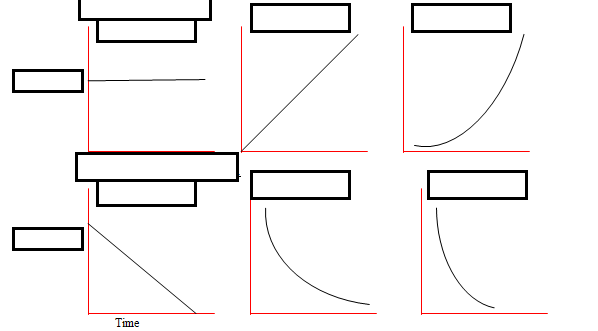
- Arate vs time graph
- Bconcentration vs time graph
- Crate
- Dtemperature
- E1st order
- F2nd order
- G2 order
- H1 order
- Izero-order
- Jorder 0
- Kconcentration vs time
- Lrate vs time
- M0 order
- Nconcentration of reactant A
- Omass of reactant A
- Pfirst-order
- Qthird-order
- Rsecond-order
- S3rd order
68The rate determining step is the fastest step in the reaction.
- ATrue
- BFalse
69With a 10°C increase in temperature, there is always a doubling of rate of reaction.
- ATrue
- BFalse
70The value of A, the Arrhenius constant, indicates:
- Athe frequency of collisions and the probability they have proper orientations
- Bthe frequency of collisions
- Cthe probability the collisions have proper orientations
- Dthe activation energy of a reactant
71In a state of equilibrium, there is no [blank_start]net[blank_end] change in [blank_start]concentration[blank_end] of products and reactants in a closed system of dynamic [blank_start]forward[blank_end] and [blank_start]backward[blank_end] reactions
- Aconcentration
- Bnet
- Cforward
- Dbackward
72Which change in the system affects the Kc of the equilibrium?
- AChange in concentration of any reactant/product
- BChange in pressure/volume
- CChange in temperature
- DAddition of catalyst
73Le Chatelier's Principle: A system at equilibrium when subjected to a [blank_start]change[blank_end] will respond in such a way as to [blank_start]minimise[blank_end] the [blank_start]effect[blank_end] of the [blank_start]change[blank_end].
- Achange
- Bminimise
- Cchange
- Deffect
74Oh no, its Gibbs again. I knew he'd come back. This time he has made his way into equilibrium. Let's see... Gibbs says, a system has the highest possible value of entropy when free energy is at a minimum. THis is equilbrium.
Gibbs, I have no idea what that means, but all I have to know is the following true things:- AIf ∆G is large negative, there are more products at equilibrium
- BIf ∆G is large positive, there are more reactants at equilibrium
- CIf ∆G = zero, the concentrations are exactly the same.
- DIf ∆G is large negative, there are more reactants at equilibrium
- EIf ∆G is large positive, there are more products at equilibrium
75The equilibrium constant is the ratio of the rate constants of the forwards and backwards reactions.
- ATrue
- BFalse
76A Bronsted-Lowry acid is a proton (H+) acceptor
- ATrue
- BFalse
77Al2O3 (Aluminium Oxide) is amphiprotic.
- ATrue
- BFalse
78Salt: the [blank_start]ionic[blank_end] compound formed when the [blank_start]hydrogen[blank_end] of an acid is replaced by a [blank_start]metal[blank_end] or other [blank_start]positive[blank_end] ion
- Aionic
- Bhydrogen
- Cmetal
- Dpositive
79Enthalpy of neutralisation: enthalpy change that occurs when an [blank_start]acid[blank_end] and a [blank_start]base[blank_end] react to form [blank_start]1 mole[blank_end] of water. it is always [blank_start]exo[blank_end]thermic.
- Aacid
- Bbase
- C1 mole, one mole
- Dexo
80pH + pOH = 14.00 at 298K
- ATrue
- BFalse
Information
- Description
- Year 12 Chemistry Quiz on HL Chemistry IB Revision, created by Hazel S on 24/04/2017.
- Author
- Hazel S
- Language
- English
- Views
- 11
- Tags
- Rating
- No ratings yet Rate this quiz