
9132553
Description

Quiz by Aidar Darmesh, updated more than 1 year ago

|
Created by Aidar Darmesh
over 8 years ago
|
|
Question 1
Answer
-
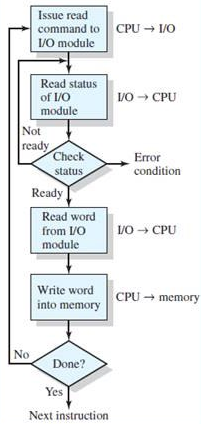
Manual memory access
-
Direct memory access (DMA)
-
Interrupt-driven I/O
-
Programmed I/O
Question 2
Question
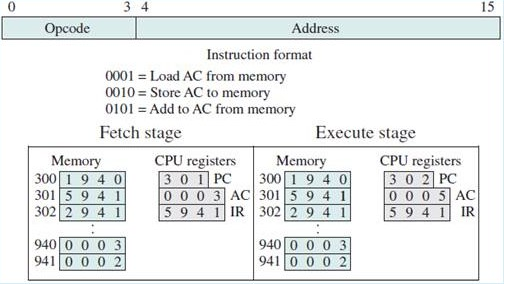
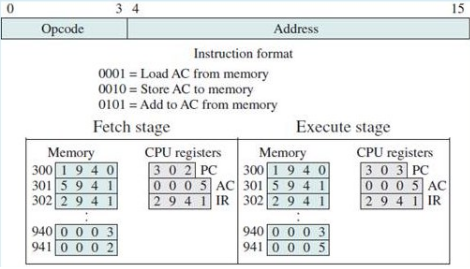
The figure below illustrates a partial program execution. What is the address of the instruction that is being executed?
Image:
Screenshot 18 (image/png)
Answer
-
941
-
302
-
940
-
301
Question 3
Question
Which of the following element of a computer system stores data and programs
Answer
-
Main memory
-
System bus
-
Processor
-
I/O modules
Question 4
Question
The figure below illustrates a partial program execution. Instruction in the IR will:
Image:
Screenshot 18 (image/png)
Answer
-
Store content of AC to the memory
-
Add 2 to the memory location from AC
-
Store 5 to AC from the memory
-
Add 3 to the memory location from AC
Question 5
Question
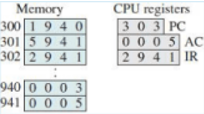
Choose the micro-instructions that reflect instruction execution stage shown in the figure below
Image:
Screenshot 19 (image/png)
Answer
-
PC -> MAR 303 M -> MBR 2941 MBR -> IR 2941
-
IR -> MAR 303 M -> MBR 0005 MBR -> M 0005
-
IR -> MAR 941 AC -> MBR 0005 MBR -> M 0005
-
IR -> MAR 2941 AC -> MBR 0005 MBR -> M 0005
Question 6
Answer
-
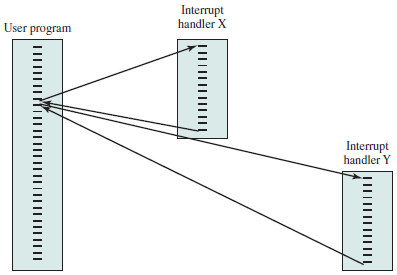
Parallel interrupt processing
-
Parent-child interrupt processing
-
Sequential interrupt processing
-
Nested interrupt processing
Question 7
Question
When an I/O device completes an I/O operation, the device issues an interrupt signal to the processor and then:
Answer
-
The processor stops execution of the current instruction without finishing it and responds to the interrupt
-
The processor loads the program counter with the entry location of the interrupt-handling routine
-
The processor saves information needed to resume the current program at the point if interrupt
-
The processor finishes execution of the current instruction before responding to the interrupt
Question 8
Question
Complete the relationship concerning the memory systems: greater capacity
Answer
-
lower capacity
-
slower access speed
-
greater cost per bit
-
faster access speed
Question 9
Question
Which register contains condition codes set by the processor hardware as the result of operations?
Answer
-
Program counter
-
Accumulator
-
Program status word
-
Stack pointer
Question 10
Question
Which of the following provides for communication among elements of a computer system?
Answer
-
main memory
-
system bus
-
processor
-
I/O modules
Question 11
Question
We have
Ts = average (system) access time
T1 = access time of M1 (cache)
T2 = access time of M2 (main memory)
T3 = access time of M3 (disk)
H1 = hit ratio, fraction of time reference is found i M1
H2 = hit ratio, fraction of time reference is found i M2
The average time to access an item, in case the item in main memory is:
Answer
-
Ts = H1*T1 + H2*T2 + (1-H2)*T3
-
Ts = H1*T1 + (1-H1)*(H1*T1 + H2*(T1 + T2) + (1 - H2)*(T2 + T3))
-
Ts = H1*T1 + (1-H1)*(T1+T2)
-
Ts = H1*T1 + (1-H1)*(H2*(T1 + T2) + (1 - H2)*(T1 + T2 + T3))
Question 12
Question
Control and status registers control the operation of the processor and the execution of programs
Answer
-
верно
-
неверно
Question 13
Question
This type of system was developed at MIT by a group known as Project MAC for the IBM 709 in 1961
Answer
-
Serial processing
-
Multiprogrammed batch system
-
Simple batch system
-
Time-sharing system
Question 14
Question
The concept of codes of operation (user mode, system mode) was introduced with
Answer
-
Time-sharing-system
-
Simple batch system
-
Multiprogrammed batch system
-
Serial processing
Question 15
Question
Short-term scheduler, or dispatcher, picks a process. Each process in the queue is given some time in turn. This strategy is called:
Answer
-
Round-robin technique
-
Prioritizing
-
Carousel technique
-
Merry-go-round technique
Question 16
Question
Central idea in this system was the use of piece of software known as the monitor:
Answer
-
Time-sharing-system
-
Simple batch system
-
Multiprogrammed batch system
-
Serial processing
Question 17
Question
‘More than one program attempts to make use of a shared resource at the same time’. This is
Answer
-
Failed mutual exclusion
-
Improper synchronization
-
Deadlocks
-
Nondeterminate program operation
Question 18
Question
The term was first used by the designers of Multics in 1960s:
Answer
-
Monitor
-
Process
-
Multiprogramming
-
Time sharing
Question 19
Question
Utilities are
Answer
-
Application program
-
System programs
-
Opcodes
-
Processor registers
Question 20
Question
“When program shares memory and their execution is interleaved by the processor, they may interfere with each other by overwriting common memory areas in unpredictable ways. The result of a particular program depend on the activities of other programs in shared systems”. This is:
Answer
-
Falled mutual exclusions
-
Deadlocks
-
Nondeterminate program operation
-
Improper syncronization
Question 21
Question
The state of a processor is defined by:
Answer
-
the activity just executed by the process
-
the current activity of the process
-
the final activity of the process
-
the activity to next be executed by the process
Question 22
Question
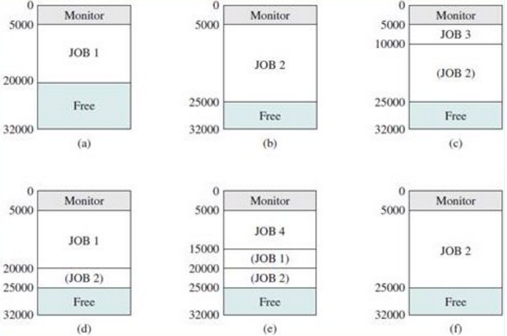
CTSS is illustrated in the figure. There are four interactive users with the following memory requirements:
JOB1:15000 words
JOB2: 20000 words
JOB3: 5000 words
JOB4: 10000 words
In (e) JOB4 is loaded. A portion of JOB1, written out to disk, is equal to
Image:
Screenshot 16 (image/png)
Answer
-
15000
-
10000
-
20000
-
5000
Question 23
Question
The hardware and software used in providing applications to a user can be viewed in:
Answer
-
classified fashion
-
layered fashion
-
sandwich fashion
-
leveled fashion
Question 24
Question
Suppose that a process is in “Blocked” state waiting for some I/O device. When the service is completed, it goes to the:
Answer
-
Suspended state
-
Terminated state
-
Ready state
-
Running state
Question 25
Question
CTSS is illustrated in the figure. There are four interactive users with the following memory requirements:
JOB1:15000 words
JOB2: 20000 words
JOB3: 5000 words
JOB4: 10000 words
In (f) JOB2 is loaded. A portion of JOB2, read in from disk, is equal to
Image:
Screenshot 16 (image/png)
Answer
-
15000
-
10000
-
20000
-
5000
Question 26
Question
We have
Ts = average (system) access time
T1 = access time of M1 (cache)
T2 = access time of M2 (main memory)
T3 = access time of M3 (disk)
H1 = hit ratio, fraction of time reference is found i M1
H2 = hit ratio, fraction of time reference is found i M2
The average time to access an item, in case the item in cache is:
Answer
-
Ts = H1*T1 + H2*T2 + (1-H2)*T3
-
Ts = H1*T1 + (1-H1)*(H1*T1 + H2*(T1 + T2) + (1 - H2)*(T2 + T3))
-
Ts = H1*T1
-
Ts = H1*T1 + (1-H1)*(H2*(T1 + T2) + (1 - H2)*(T1 + T2 + T3))
Question 27
Question
The figure below illustrates a partial program execution.
What is the address of the instruction that will be executed next?
Image:
Screenshot 21 (image/png)
Answer
-
940
-
303
-
941
-
302
Question 28
Question
The serial processing presented two main problems:
Answer
-
setup time
-
using a monitor
-
time slicing
-
multiprogramming
-
scheduling
Question 29
Question
The process index register:
Answer
-
contains the index into a process list of the process currently controlling the processor
-
define the region in memory occupied by the process
-
points to the next instruction in that process to be executed
-
contains the starting address of the region of memory occupied by the process
Question 30
Question
The concept of a batch operating system was developed to
Answer
-
Maximize processor utilization
-
Minimize response time
-
Support interactive mode
-
Minimize processor utilization
Question 31
Question
Batch operating system were used
Answer
-
From the late 1940s to the mid-1950s
-
From the mid-1950 to early 1960s
-
In early 1960s
Question 32
Question
“More than one programs hung up waiting for each other”. This is
Answer
-
Falled mutual exclusions
-
Deadlocks
-
Nondeterminate program operation
-
Improper synchronization
Question 33
Question
This contains the most frequently used functions in the OS:
Answer
-
Centre
-
Base
-
Root
-
Kernel
Question 34
Question
The end user views a computer system in terms of:
Answer
-
a set of machine instructions
-
utilities
-
a set of system programs
-
a set of applications
Question 35
Question
Which of the following is not the state of process?
Answer
-
new
-
waiting
-
terminated
-
ready
-
running
-
old
Question 36
Question
The fetched instruction is loaded into the
Answer
-
IR
-
Accumulator
-
Memory
-
PC
Question 37
Question
When the time required for the I/O operation will take much more time than executing a sequence of user instructions, it is:
Answer
-
Slow I/O wait
-
Long I/O wait
-
Fast I/O wait
-
Short I/O wait
Question 38
Question
The figure below illustrates a partial program execution.
What is the address of the instruction that is being executed?
Image:
Screenshot 21 (image/png)
Answer
-
303
-
940
-
941
-
302
Question 39
Question
The system handles multiple interactive jobs
Answer
-
Time-sharing system
-
Simple batch system
-
Serial processing
-
Multiprogrammed batch system
Question 40
Question
A system clock generates interrupts at a rate of approximately one every 0.2 seconds. At each clock interrupt, the OS regained control and could assign the processor to another user. This technique is known as
Answer
-
Time scheduling
-
Time sliding
-
Time slicing
-
Time allocating
Question 41
Question
Choose the storage management responsibility for “Programmers should be able to define programs modules, and to create, destroy, and alter the size of modules dynamically”:
Answer
-
Protection and access control
-
Long-term storage
-
Automatic allocation and management
-
Process isolation
-
Support of modular programming
Question 42
Question
‘Lost signals, duplicate signals received’. This is
Answer
-
Improper synchronization
-
Nondeterminate program operation
-
Deadlocks
-
Failed mutual exclusion
Want to create your own Quizzes for free with GoConqr? Learn more.