
Woolly Mammoth GE Project- Madelyn and Katelyn
Slides in this set (5)
-
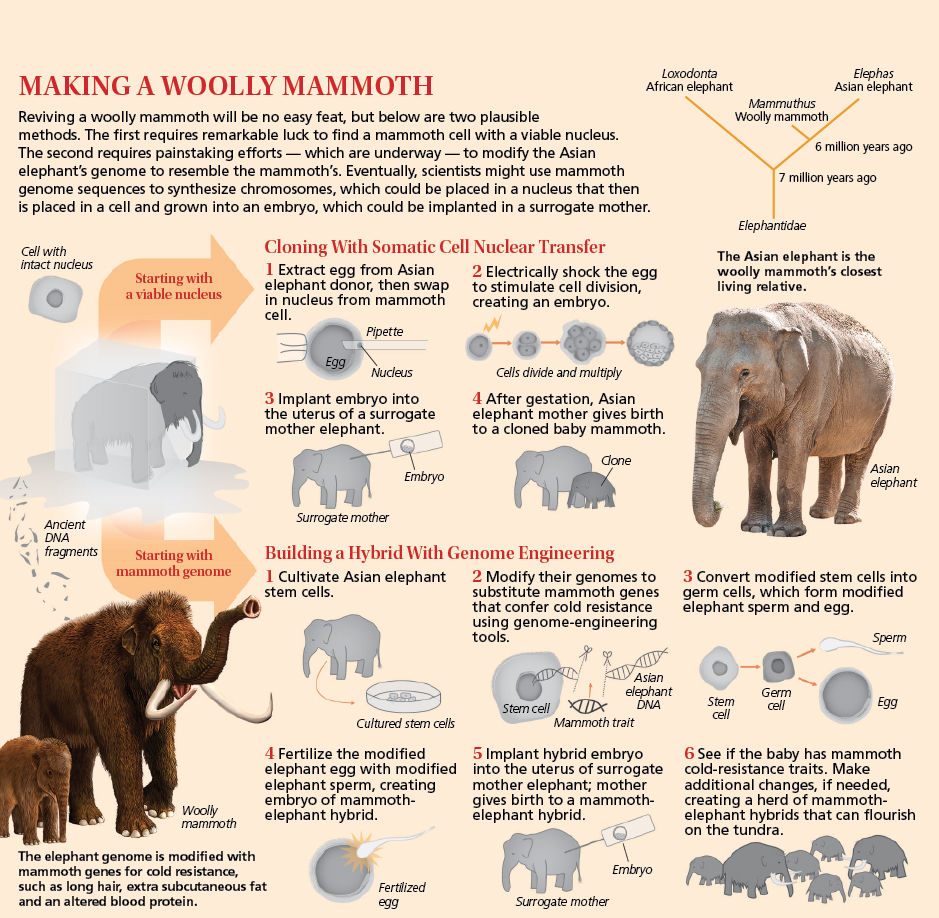
Methods of Cloning Woolly Mammoths
- Method 1/ Cloning with Somatic Nuclear Transfer:
- Before the process of cloning can even begin, the scientists must find a mammoth cell with a viable nucleus, which will be very hard considering mammoths have been dead for about 10,000 years. When, or if, a mammoth cell with a viable nucleus is found, the first method can begin.
- Step 1- Extract an egg from an Asian elephant, because they are the mammoths closest ancestors, and exchange the Asian elephants nucleus with the nucleus found in the mammoth cell with a pipette.
- Step 2- An electronic shock will be brought upon the cell containing the mammoths nucleus. This shock will stimulate cell division, eventually resulting in an embryo.
- Step 3- The embryo will be placed into a surrogate Asian elephant’s uterus, so it has a more natural environment to grow in, instead of in a lab.
- Step 4- Over time, the mammoth embryo will develop in the Asian elephants uterus. Eventually resulting in a cloned wooly mammoth.
- -Katelyn
- Method 2/ Building a Hybrid with Genome Engineering:
- This method is definitely the more complicated of the two. It is harder to understand without a background in biology and an understanding of genetics. Some of the materials that are used in this method are still undergoing experimenting and development.
- Step 1- In order for the scientist to start this cloning method, he or she must collect Asian elephant stem cells.
- Step 2- Using genome-engineering tools, in the stem cell, some of the Asian elephants DNA must be replaced by mammoth genes. The genes that need to be replaced by the mammoths are the genes that allow mammoth to sustain the cold environment that they live in.
- Step 3- This is where the stem cells come into play. The stem cells will be converted into germ cells, which will then form into modified elephant sperm and egg.
- Step 4- The created elephant egg cell should then be fertilized by the created elephant sperm cell, which will result in an embryo with a mix between a mammoth and an elephant.
- Step 5- Similar to the first method, implant the embryo into the uterus of the Asian elephant.
- Step 6- See if the mammoth-elephant hybrid has the same cold resistance that the woolly mammoth does. Adjust changes to the genome if needed.
- -Madelyn
-
-
Pros & Cons of Cloning Woolly Mammoths
- Pros
- 1. There is carbon trapped in the Siberian permafrost and if we were to clone wooly mammoths back into existence we would be slow the release of carbon into the air, slowing down the rate of global warming.
- "Prof Shapiro explains the soil is said to be colder where these herbivores have exposed it to Arctic air. 'There is a lot of carbon trapped in the Siberian permafrost and if these animals slow down that melting, we can slow the release of that carbon, potentially slowing the rate of global warming,' she says."
- -Katelyn
- 2. Bringing back the wooly mammoths could hold secrets that could impact our modern biology and medicine.
- "Species could carry retroviruses or pathogens when brought back to life."
- -Katelyn
- 3. Bringing back wooly mammoths can help recreate the steppe ecosystem more widely, and help recover damaged ecosystems.
- "The tundra and much of the taiga – the sometimes swampy coniferous forest of high northern latitudes – were once a grassland ecosystem known as the “mammoth steppe.” It was home to abundant grazing herds of antelope, deer, caribou, horses, bison, and Woolly Mammoths. At the end of the Pleistocene these herds vanished leading to an ecosystem conversion away from abundant grasses toward a more shrub dominated community."
- -Madelyn
- Cons
- 1. De extinction is often considered playing God because, technically, he didn’t create it. It is also raises controversy about rather or not it is fair to the animals and people see the cloning of animals as treating them as things rather than treating them as living creatures.
- "The public may also see cloning as an unnatural practice that treats animals more as things than creatures, he said."
- -Madelyn
-
Our Choice- Clone the Woolly Mammoths
- The side we choose to take was that wooly mammoths should be cloned and brought back. Wooly mammoths could really help the world advance and potentially save the world. By bringing back wooly mammoths you can slow down global warming and potentially even prevent it. By the wooly mammoths putting the kind of pressure on the ground that they do, it can slow down the carbon release from the Siberian permafrost. Wooly mammoths could also recreate the steppe ecosystem more widely. By bringing back wooly mammoths they can also help bring back damaged ecosystems. Wooly mammoths could also hold some medical and biological knowledge that we know nothing about until we create them. There are some negatives to cloning wooly mammoths, but if cloning them is what it takes to help prevent global warming happening so fast, we think we should clone wooly mammoths and bring them back to existence.
- -Madelyn and Katelyn
-
- (n.d.). Retrieved from https://www.avma.org/News/JAVMANews/Pages/070215b.aspx
- 5 Reasons to Bring Back Extinct Animals (And 5 Reasons Not To) - D-brief. (2013, April 04). Retrieved from http://blogs.discovermagazine.com/d-brief/2013/04/04/5-reasons-to-bring-back-extinct-animals-and-5-reasons-not-to/#.XLY6drdzznF
- Morse, F. (2015, June 11). Why scientists want to bring back woolly mammoths - BBC Newsbeat. Retrieved from http://www.bbc.co.uk/newsbeat/article/33062252/why-scientists-want-to-bring-back-woolly-mammoths
- Woolly Mammoth Revival. (2018, April 18). Retrieved from https://reviverestore.org/projects/woolly-mammoth/