
Required Practical 2
Slides in this set (10)
-
Equipment (Double slit experiment)
- Laser
- Double slit
- White screen
- Metre ruler
-
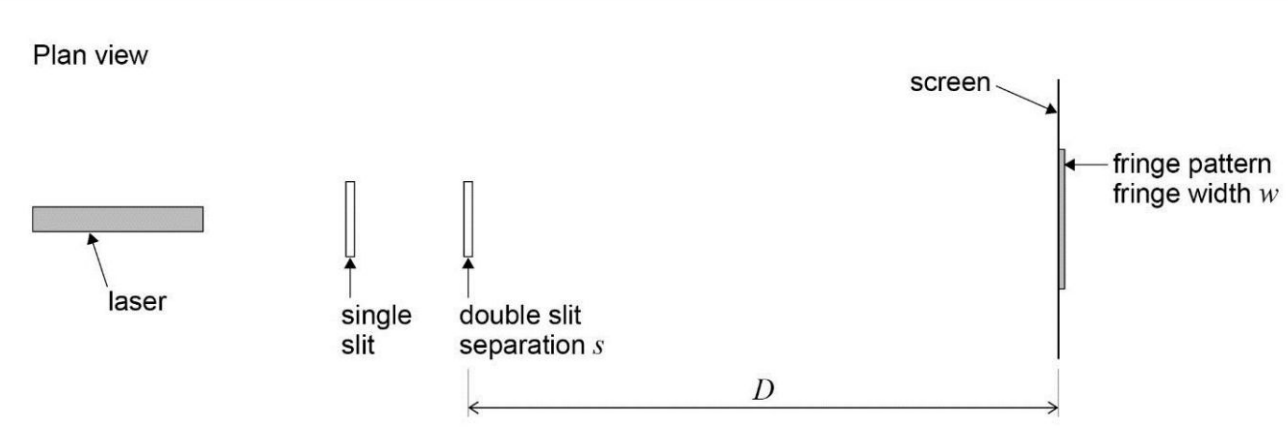
- Ensuring that the laboratory is partially darkened, set up the apparatus as shown in the diagram. The single slit might not be required if the laser beam is wide enough to illuminate both the slits of the double slit.
- Adjust the apparatus so that D is 0.500m, measured using the metre ruler.
- Measure across a large number of fringes using the ruler and divide by the number of fringe widths to find the fringe width w.
- Increase D by 0.100m and repeat this, increasing it by 0.100m each time up to 1.500m.
- Repeat the experiment twice more and find and record the mean w for each D.
- If it is not quoted on the double slit, the slit separation must be measured using a vernier calliper or a travelling microscope.
-
- Plot a graph of w against D and draw a line of best fit. The wavelength of the laser light will be the gradient multiplied by the slit separation.
- w = λD/s ⇒ λ = ws/D = Gs where G is the gradient.
-
- Shining a laser into someone’s eyes can be dangerous, so ensure that the lasers are pointed away from them.
-
- Make sure that the screen and double slit are aligned perfectly normal to the laser to avoid parallax error in the measurement of the fringe width. A set square can be used in conjunction with the ruler.
-
Equipment (Diffraction grating experiment)
- Laser
- Diffraction grating
- White screen
- Metre ruler
-
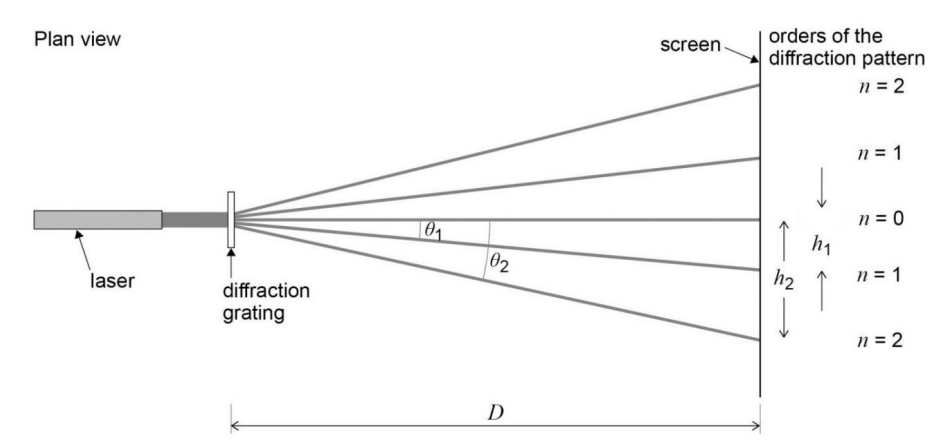
- Ensuring that the laboratory is partially darkened, set up the apparatus as shown in the diagram.
- Adjust the apparatus so that D is 1.000m, measured using the metre ruler.
- Measure the distances h1 and h2 on either side of the central maximum using the ruler and find the mean of each of them.
-
- Work out the slit separation by finding the reciprocal of the number of slits per metre quoted on the diffraction grating.
- Find θ1 and θ2 by using θn = arctan(hn/D)
- Find λ from both of these angles using λ=dsin(θ)/n and then calculate the mean.
-
- Shining a laser into someone’s eyes can be dangerous, so ensure that the lasers are pointed away from them.
-
- Make sure that the screen and double slit are aligned perfectly normal to the laser to avoid parallax error in the measurement of the fringe width. A set square can be used in conjunction with the ruler.
Information
- Description
- Investigation of interference effects to include the Young’s slit experiment and interference by a diffraction grating
- Created by
- Jodie Jacob
- Views
- 5
- Rating