FORM THE MONOMERS OF NUCLEIC ACIDS, DNA AND RNA
IN DNA THE NUCLEOTIDE PENTOSE SUGAR IS DEOXYRIBOSE
IN RNA THE NUCLEOTIDE PENTOSE SUGAR IS RIBOSE
THEY HELP REGULATE MANY METABOLIC PATHWAYS, FOR EXAMPLE BY ATP, ADP AND AMP
THEY MAY BE THE COMPONENTS OF MANT COENZYMES
Is a nucleic acid
Found in the nuclei of all eukaryotic cells, within the cytoplasm of prokaryotic cells and is also inside some types of viruses
It is the hereditary material and carries coded instructions used in the development and functioning of all known living organisms
DNA is one of the important macromolecules that make up the structure of living organisms, the others being proteins, carbohydrates and lipids
Slide 4
STRUCTURE OF DNA
DNA is a polymer as it is made up of many repeating monomeric units called nucleotides
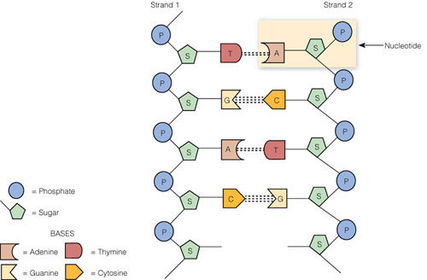
A molecule of DNA consists of two polynucleotide strands
The two strands run in opposite directions, described as anti-parallel
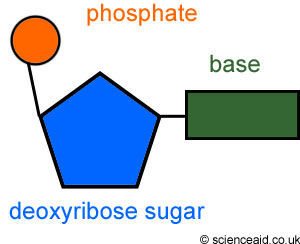
Each DNA nucleotide consists of a phosphate group, a five carbon sugar deoxyribose, and one of four nitrogenous bases; adenine, guanine, thymine or cytosine
The covalent bond between the sugar residue and the phosphate group in a nucleotide is also called a phosphodiester bond
These bonds are broken when polynucleotides break down and are formed when polynucleotides are synthesised
DNA molecules are long and so they can carry a lot of encoded genetic information
Slide 5
PURINES AND PYRIMIDINES
DNA consists of four types of nucleotide
In each nucleotide the phosphate and sugar groups are the same but the nitrogenous base differs
In DNA it may be either a purine - adenine or guanine - or a pyrimidine - thymine or cytosine
Slide 6
HYDROGEN BONDS
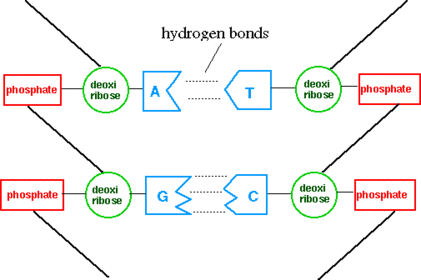
The two antiparallel DNA strands are joined to each other by hydrogen bonds between the nitrogenous bonds
Adenine pairs with thymine
Guanine pairs with cytosine
A purine pairs with a pyrimidine, giving equal size rungs on the DNA ladder
These can then twist, like twisting a rope ladder around an imaginary axis, into the double helix (coil), giving the molecule stability
Hydrogen bonds allow the molecule to unzip for transcription and replication
The DNA ladder is formed by the sugar-phosphate backbones of the antiparallel polynucleotide strands
The 'opposite directions' of the two strands refers to the direction that the third and fifth carbon molecules on the five carbon sugar, deoxyribose, are facing
The 5' end of the molecule is where the phosphate group is attached to the fifth carbon atom of the deoxyribose sugar
The 3' end is here the phosphate group is attached to the third carbon atom of the deoxyribose sugar
The rungs of the ladder consist of the complementary base pairs, joined by hydrogen bonds
The molecule is very stable, and the integrity of the coded information within the base sequences is protected
Eukaryotic cells:
The majority of DNA content, or the genome, is in the nucleus
Each large molecule of DNA is tightly wound around special histone proteins called chromosomes. Each chromosome is therefore 1 molecule of DNA
There is also a loop of DNA, without the histone proteins, inside mitochondria and chloroplasts
Prokaryotic cells:
DNA is in a loop and is within the cytoplasm, not enclosed in a nucleus
It is not wound around histone proteins
Is described as 'naked'
Slide 10
SELF-REPLICATING - DNA
DNA carries the coded instructions to make and maintain a particular organism
Every time a cell divides, the DNA has to be copied so that each new daughter cell receives the full set of instructions
Each molecule of DNA replicates
This replication takes place during interphase
In eukaryotes, this results in each chromosome having an identical copy of itself
At first they are joined together, at the centromere, forming two sister chromatids
The DNA within mitochondria and chloroplasts also replicates each time these organelles divide, which is just before the cell divides
Slide 11
SEMI-CONSERVATIVE REPLICATION
To make a new copy of itself, each DNA molecule;
unwinds - the double helix is untwisted, catalysed by a gyrase enzyme
unzips - hydrogen bonds between the nucleotide bases are broken, catalysed by DNA helicase, and results in two single strands of DNA with exposed nucleotide bases
Next;
free phosphorylated nucleotides are bonded to the exposed bases, following complementary base pairing rules
the enzyme DNA polymerase catalyses the addition of the new nucleotide bases to the single strands of DNA, it uses each single strand of unzipped DNA as a template
hydrolysis of the activated nucleotides, to release the extra phosphate groups, supplies the energy to make phosphodiester bonds between the sugar residue of one nucleotide and the phosphate group of the next nucleotide
Product;
two DNA molecules, identical to each other and the parent
Each of these molecules contains one old strand and one new strand - semi conservative replication
Slide 12
MUTATIONS
During DNA replication, errors may occur and the wrong nucleotide may be inserted
This could change the genetic code, and is an example of a point mutation
During the replication process there are enzymes that can proofread and edit out such incorrect nucleotides, reducing the rate that mutations are produced
However many genes have changes to their nucleotide sequence
Different version of a particular gene are called alleles or gene variants
Not all mutations are harmful
Slide 13
RNA
The sugar molecule in each nucleotide is ribose
The pyrimidine base uracil replaces thymine
The polynucleotide chain is usually single-stranded
The polynucleotide chain is shorter
There are 3 forms of RNA; messenger RNA (mRNA), transfer RNA (tRNA) and ribosomal RNA (rRNA)
Slide 14
GENES AND THE GENETIC CODE
On each chromosome there are specific lengths of DNA called genes. Each gene contains a code that determines the sequence of amino acids in a particular polypeptide of protein
Within each gene there is a sequence of DNA base triplets that determines the amino acid sequence, or primary structure, of a polypeptide
As long as this primary structure of a polypeptide is correct, it will then fold correctly and be held in its tertiary structure or shape, enabling it to carry out its function
Genes are inside the cell nucleus but proteins are made in the cytoplasm, at ribosomes
As the instructions inside the genes, on chromosomes, cannot pass out of the nucleus, a copy of each gene has to be transcribed into a length of mRNA
In this form, the sequence of bas triplets, now called codons, can pass out of the nucleus to the ribosome, ensuring that the coded instructions are translated and the protein is assembled correctly from amino acids
Slide 15
THE NATURE OF THE GENETIC CODE
The genetic code is near universal, because in almost all living organisms the same triplet of DNA bases codes for the same amino acid
The genetic code is described as degenerate, because, for all amino acids, except methionine and tryptophan, there is more than one base triplet. This may reduce the effect of point mutations, as a change in one base of the triplet could produce another base triplet that still codes for the same amino acid
The genetic code is also non-overlapping, and is read starting from a fixed point in groups of three bases. If a base is added or deleted then it causes a frame shift, as every base triplet after that, and hence every amino acid being coded for, is changed
Slide 16
TRANSCRIPTION
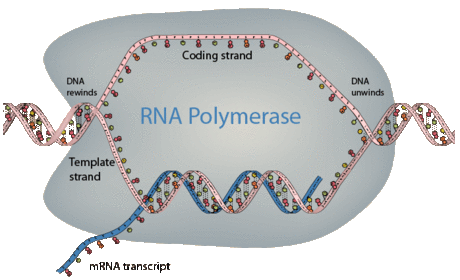
A gene unwinds and unzips
Hydrogen bonds between complementary nucleotide bases break
The enzyme RNA polymerase catalyses the formation of temporary hydrogen bonds between RNA nucleotides and their complimentary unpaired DNA bases
A bonds with T; C with G; G with C; and U with A, on one strand of the unwound DNA
This DNA strand is called a template strand
A length of RNA that is complementary to the template strand of the gene is produced. It is therefore a copy of the other DNA strand - the coding strand
The mRNA now passes out of the nucleus, through the nuclear envelope, and attaches to a ribosome
Ribosomes are made in the nucleolus, in two smaller sub units. These pass separately out of the nucleus through pores in the nuclear envelope, and then come together to form the ribosome. Ribosomes are made of ribosomal RNA and protein
Transfer RNA molecules are made in the nucleolus and pass out of the nucleus into the cytoplasm
They're single-stranded polynucleotides, but can twist into a hairpin shape
At one end is a trio of nucleotide bases that recognises and attaches to a specific amino acid
At the loop of the hairpin is another triplet of bases, called an anticodon, that is complementary to a specific codon of bases on the mRNA
Ribosomes catalyse the synthesis of polypeptides
Transfer RNA molecules bring the amino acids and find their place when the anticodon binds by temporary hydrogen bonds to the complementary codon on the mRNA molecule
As the ribosome moves along the length of mRNA, it reads the code, and when two amino acids are adjacent to each other a peptide bond forms between them
Energy, in the form of ATP, is needed for polypeptide synthesis
The amino acid sequence for the polypeptide is therefore ultimately determined by the sequence of triplets of nucleotide bases on the length of DNA - the gene
After the polypeptide has been assembled, the mRNA breaks down. Its component molecules can be recycled into new lengths of mRNA, with different codon sequences
The newly synthesised polypeptide is helped, by chaperone proteins in the cell, to fold correctly into its 3D shape or tertiary structure, in order to carry out its function