Transposons

Description

Accessory genome
Austin Davies
Slide Set by Austin Davies, updated more than 1 year ago
Austin Davies
Created by Austin Davies over 9 years ago
82
0

Resource summary

Slide 1

    TRANSPOSONS
    A transposon is a genetic element that can be translocated as a whole segment, between chromosomal, phage and plasmid DNA, in the absence of a complementary sequence in the host. Transposons are ubiquitous. Transposons induce a large fraction of spontaneous mutations and chromosomal rearrangements. Sometimes, transposons can encode antibiotic resistance, and so can confer this between species. 

Slide 2

    Insertion sequences 
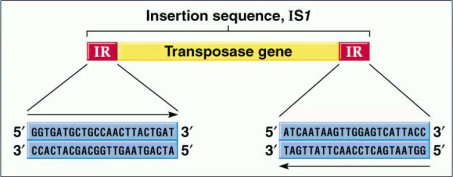
    Caption: : Insertion sequence schematic
    The most simple form of transposon. This sequence encodes only the protein needed for its own transposition - transposase. In E. coli, IS1 is present 4-19 times depending on the strain. The ends of all known IS elements show inverted terminal repeats, or ITRs of 20-50 base pairs. Note that the more widespread a transposon is throughout organisms, the lower the insertional bias it will exhibit. 

Slide 3

    Composite transposons
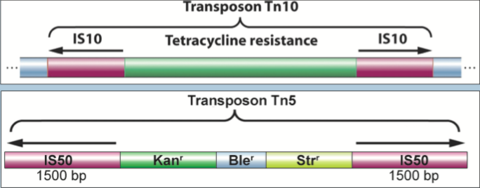
    A composite transposon consists of a central gene (e.g. antibiotic resistance), flanked by two identical IS elements. The IS elements provide transposase and ITR recognition elements (normally only one IS element transcriptionally active).
    Caption: : Composite transposon schematic

Slide 4

    Non composite transposons
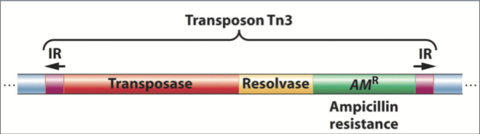
    Caption: : Non composite transposon schematic
    These are much like the composite transposons, however they do not contain flanking IS elements, however they are flanked by ITRs. These transposons encode genes from their own transposition and accessory function (AB resistance). Transposition requires 2 enzymes:  Transposase (like composite transposons)  Resolvase 

Slide 5

    Conjugative transposons 
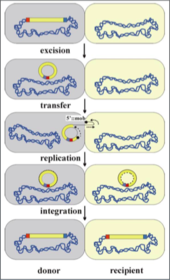
    Caption: : Schematic of conjugative transposon mode of action
    Sometimes called an ICE (integrated conjugative element), the conjugative transposon will excise its flanks and recombines them outside of the chromosome as a circular DNA. Mobility functions encoded on the plasmid enable it to conjugate itself from one cell to another, using rolling circle replication mechanism - however remember it can not replicate itself, so it must integrate back into the host chromosome to be replicated. 

Slide 6

    Mechanisms of transposition 
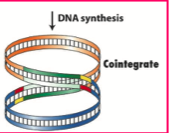
    Conservative/non replicative: A 'cut and paste' mechanism. The transposase creates dsDNA cuts in the donor, as well as staggered cuts in the recipient. This is non replicative, therefore donor DNA is lost or repaired. The product on the recipient strand is a scar (direct repeat of target DNA) either side of the transposon - this is a good indicator of transposon presence. IS and composite transposons. Replicative:A 'copy and paste' mechanism. The transposase makes two ssDNA cuts (one each strand) in the donor and staggered cuts in the target. A cointegrate is formed and resolvase is needed to resolve the structure. The product is again, a direct repeat either side of the transposon. Non composite transposons. 
    Caption: : Cointegrate schematic

Slide 7

    DNA rearrangements products
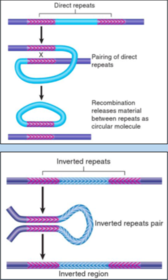
    Transposons are major contributors to genetic variation on the chromosome. This happens by:  Insertions - by transposition or homologous recombination (cut and paste introduces repeat scars which are mutations) Deletions - homologous recombination between 2 copies of a transposon, present in direct orientation  Inventions - homologous recombination between 2 copies of a transposon, present in inverted orientation 
Show full summary Hide full summary

Similar

IB Biology Topic 4 Genetics (SL)
R S
Proteins
Ifeoma Ezepue
DNA structure and replication
Ifeoma Ezepue
GCSE AQA Biology 1 Variation, Genetics & Reproduction
Lilac Potato
Biology 2b - Enzymes and Genetics
Evangeline Taylor
What are assessments and what do they measure?
mtyler12008
Genetics Vocabulary
aborsari
Science Revision - Year 10
Caitlin Kumala
DNA Replication
Laura Badger
GCSE AQA Biology 2 Genetics
Lilac Potato
OCR Chemistry - F322 - Module 2
jacob gray