Effector cells

Description

Lecture 23 - immunology
Austin Davies
Slide Set by Austin Davies, updated more than 1 year ago
Austin Davies
Created by Austin Davies over 9 years ago
8
0

Resource summary

Slide 1

    Effector B cells - Plasma 
    Secrete 10^6 antibodies per second. Require T help via cytokines for differentiation into plasma cells. The B cell gets activated by endocytosis an antigen bound BCR and presenting it on MHC II. CD4 T cell who previously encountered the same peptide on DC binds and secretes cytokines (IL-4) to activate as a signal 2. A B cell that binds antigen through BCR are 10,000x more effective at presenting antigenic peptide to T cell via MHC II.

Slide 2

    CTL kiss of death
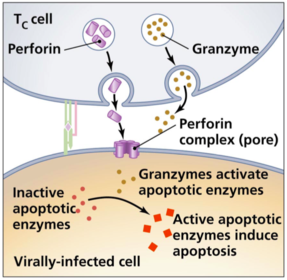
    CTLs do not simply lyse target cells. The mechanism is more the activation of apoptotic pathways in target cells. Virally infected cells presenting viral peptide on MHC I encounter antigen specific CTL, initiating CTL expression of weaponry.  Perforin - forms pore in cell membrane  Granzyme - enters cell via perforin pore; granzyme is a protease that targets signaling proteins - initiating apoptosis  CD95L (ligand) - binds CD95 on target cell, initiating apoptosis - activates enzymatic portion on target cell - this activates apoptotic enzymes. Note: apoptosis does not result in release of cell contents, the cell segregates and compartmentalises  itself into apoptotic bodies which are phagocytosed. 

Slide 3

    NK cells
    Detect altered MHC expression. Some viruses have a defence mechanism that disables MHC from binding TCR, preventing CTL action. However NK cells respond to 'missing self'. Lower or missing MHC expression triggers NK activation and killing of target cells.  The mechanism of operation relies on NK cells binding an activating receptor on the target cell membrane, triggering a killing response. However this response is neutralised by binding an inhibitory receptor to healthy MHC.

Slide 4

    Mast cells and hypersensitivity 
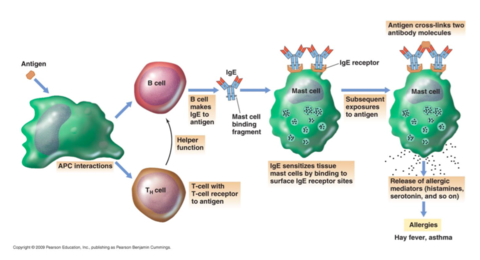
    Type 1 hypersensitivity induced as product of genetic components. Over low dose long duration exposure to antigen (POLLEN etc) B cells produce IgE specific to the allergen and that binds mast cell IgE receptors, two IgE molecules bind antigen and stimulate mast cells to release allergic mediators - histamines, providing allergic symptoms.This mechanism is used to target multicellular parasites, but gets confused with allergies. 

Slide 5

    Tolerance 
    Neonatal toleranceVery active in newborn, and in utero. A wave of regulatory T cells produced, these switch off other T cells, suppressing the immune system, protecting from autoimmunity. Central and peripheral tolerance is heightened also at this time. Central tolerance  B cells in the bone marrow tested against self antigen.  T cells in the thymus binding to self peptide on MHC Peripheral tolerance Lack of costimulation (signal 2) by no CD80 presentation  CTLA-4 is expressed on fully activated T cells, this outcompetes CD28 for CD80 and when bound, downregulates TC activation
Show full summary Hide full summary

Similar

Chapter 7 - The Blue Print of Life, from DNA to Protein
Dorothy B
Immune System
dsandoval
THE PROTIST MIND MAP
hasvinee
Infection and Disease
hannahcurle
HIV and the immune system
Beth Moore
Protein section 2
MrSujg
Microbiology MCQs 3rd Year Final- PMU
Med Student
Microbiology Test 1 2nd Year PMU
Med Student
Microbiology and Immunology
AchalaM
Horizontal gene transfer
Joe Wanford
Microbiology part 1
Lavinia Hayde