
Atomic structure and bonding
Slides in this set (3)
-
The atomic structure and bonding
- Introduction:
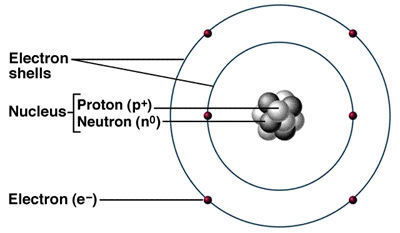
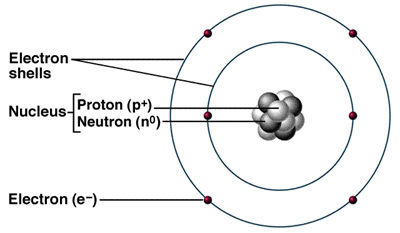
- The atomic structure has electrons, protons, and neutrons. They are particles which one of them have a positive, negative and no charge. The middle is the nucleus. Every element has a nucleus.
- There is two types of bonding called ionic bonding and covalent bonding. There are two bondings that have a different type of process in bonding.
- First, lets look at the atomic structure.
-
- Electrons
- Charge: e−
- Mass: 1/1896
- Protons
- Charge: +1
- Mass: 1
- Neutrons
- Charge: 0
- Mass: 1
-
Electrons, protons and neutrons
- Nucleus has positive charge due to the proton in the nucleus. Electrons move around the shells.
- The number of protons are the number of the atomic number.
- Atoms have no charge, so the number of protons are equal to the number of electrons.
- The numbers of neutrons are the number of mass number subtracted by the number of protons.
- Example:
- Chlorine
- Mass number: 35.45
- Atomic number: 17
- Protons = atomic number = 17
- Electrons = protons = 17
- Neutrons = mass number - atomic number = 18.45
Information
- Description
- Whole description in the atomic structure and bonding for IGCSE Edexcel.
- Created by
- Alex Steele
- Views
- 28
- Tags
- Rating