
Flashcards
Linguistics
Cards in this deck (41)
- 1Types of syllables- Open/closed
(no coda/coda)
- Light/heavy
(short vowel or syll. C. And no coda/long vowel or short vowel+coda)
-strong/weak
(vowel kept its quality/ weak vowel due to reduction, only in unstressed) - 2Syllables are made of... Which principle do they follow?- Onset
- Nucleus
- coda
Maximal onset principle - 3What is coarticulation? explain their types.- phonological process
- influence of articulation of neighbkuring sounds
- progressive assimilation, regressive assimilation, coalescence
- elision, compression, insertion - 4Classify vowels- mono /diphthongs
Monothongs: opening of mouth cavaty
Frontness/backness
Lip position
Diphthongs:
Closing diphthongs - /ei/ /ai/ /oi/
In falling diph.
Centring diphthongs
- /ee/ air /ie/ ear /ue/ tour
In stressed falling diph.
In unstressed rising diph. - 5Classify consonants- Voiced-lenis- weak/ voicless-fortis-strong
- *place of articulation*
.Bilabial (p, b, m)
.Dental (th)
.Labial-dental (f, v)
.Alveolar (t, d, s, z, l, n)
.Palato-alveolar (sh, tsh, djsch, jj)
.post-alveolar (r)
.palatel (j)
.velar (k, g, ng, w)
- *manner of articulation*
.plosives (p, b, t, d, k, g)
.nasals (n, m, ng)
.fricatives (f, v, s, z, sh, th)
.Africative (dsch, tsch)
.liguids (r, l)
.glides (w, j) - 6Phonetics and phonology + key termsPhonetics - production, physical properties, perceiption of sound system
.
Phonology- speakers knowledge of a lge system
.
Phoneme- speech sounds, smallest distinctive unit, symbolized with IPA (international phonrtic alphabet)
.
Phone- produced speech sounds
.
Allophones- two or more concrete forms of a phoneme
Silent l - walk
Cleal l- liberty
Dark l- milk
Voiceless l- fly
.
Morpheme- minimal unit of a writing system - 7Stress +stress rulesStress- higher, longer, louder and not reduced
Stress rules:
.Nouns and 3-syll adj.: first strong syll is stressed
.Verbs and 2-syll adj.: last strong syll is stressed
.suffixes may be stressed, uneffects stress, or moves stress to the last syll. of stem - 8Intonation can be divided into...Tonality- division of an utterance into chunks, called intonationphrases
.
Tonicity- highlight some words as important by accenting its stressed syll. (prehead-onset-head-*nucleus*-tail)
.
Tone- pitch movement (rise or fall) - 9Function of intonation + when falling/rising tones toFunction of intonation:
- express emotions
- grammatically division into clauses/ phrases
- focus on new information
- signals finality in conversations
Falling tones:
- finished statements
- commands/ orders
- wh questions
- greetings
Rising tones:
-leading on- parts of a sentence
- yes/no questions
- first parts of alternative questions
- adressing people - 10Morhpeme + allomorph-morpheme: smallest meaning bearing unit of lge
-allomorph: variant of a morpheme eg. Go, went for the lexical morpheme go - 11Basic types of morphemes-Free lexical morphemes: nouns, adj., lexical verbs
-free grammarical/functional morphemes: function words
- bound derivational morphemes: prefix, suffix
- bound inflectional morphemes: - s, - ed, - er, - est - 12Additional types of morphemes- Portmanteu morph: expresses more than one morpheme at a time, ran= {past} {run}
- suppletive morph: a portmanteu morph with a different root
Strong suppletion: good-better
Weak suppletion: buy-bought
- bound root: occurs only in combination with affixes, (ceive) receive, perceive
-unique morph: bound root only occuring with anpther free/bound morpheme: cranberry - 13Types of compounds- Endocentric: denotes 2nd element, milk chocolate
- exocentric: related features to head, paperback
-appositional: different descriptipn of same element, actor-manager
-copulative: denotes the sum of its elements, sleepwalk - 14Derivation + types-derivation: formation by addind affixes to base
-zero-derivation: two meanings of one word without changing it
- Shortening:
.clipping (omitting
part of the word blog(webblog)),
.blend (2 words merging (brunch)),
.acronym (AIDS pronounced as a word),
.alphabetism (pronounced as letters CNN) - 15Inflection in old english (nouns, verbs)- nouns: number, case, grammatical gender, strong/weak declension of nouns, strong/weak declension of adj.
-verbs: number person, tense, mood, non-finite forms - 16Reasons for English becoming an analytic language- loss of inflectional categories (grammatical gender, dative and accusative case, person)
- fixed word order
- alternative periphrastic constructions (of-genitive, more/most for adj. Gradiation, to-infinitve, would/should+V instead of subjunctive)
- regularisation of remaining inflection (plural -s, past - er, 3rd person - s) - 17Diachronic, Synchronic linguistics- Diachronic linguistics: study of lge through different periods of time
- synchronic linguistics: descriptive linguistics, study of lge at any point in time - 18English periods: old English + middle EnglishOld English (450-1100)
- germanic tribes settled on the british isles
- period of full inflection
Middle English (1100-1500)
- influence of Norman conquest 1066: French as lge of goverment, law, church, literature
-13th century conflict between King John of England and King Philipp of France - > English became generally spoken in upper class
- hundred years war: french lost its supremacy - > 14th century English as first lge
-reduced inflection - 19English Periods: Early Modern English+ Late modern EnglishEarly Modern English (1500-1700):
- reformation
- Renaissance
-colonial expansion
- end of first stage of Great vowelshift
Late Modern English (1700-1900):
- industrial revolution, capitalism
- Great Vowel Shift completed
- all scientific texts in English
- loss of inflection - 20Reasons for language change- language contact (latin, French, globalization English as lingua Franca)
-new means of communication (print, internet)
-new communicative requirements and goals (descriptions, instructions, education...) - 21Syntax categories of verbs and their sentence pattern- intransitive verb: S-V (She sleeps.)
-monotransitive verb: S-V-O (He wrote a letter.)
ditransitive verb: S-V-ind. O-dir. O (she gave him money.)
- complex transitive verb: S-V-O-O compl. (they consider him a hero.) , S-V-O- obgl. Adv. - 22Semantic Roles- Agent
- Patient (affected by action)
- Goal
- Source
- Recipient (profits from action)
- Time
- Place
- Instrument - 23Subclasses of multi-word verbs- phrasal verbs: V+ Adv/ Perp (particle) [grow up, hand in, put away] -- pronoun-O-Test --> hand it in (O after V)
- perpositional verbs: V+ Prep [rely on, look at] -- pronoun-O-Test --> rely on her (O after Prep)
((no Object? -> intransitive phrasal verb)
- phrasal-prepositional verbs: V+Adv/Prep+ Prep [get away with, let (sb.) in on] - 24finite/ non-finite clauses- finite clause: tensed predicate - finite verb (= first element of VP) expresses tense and shows Subject-Verb- agreement
- non-finite clause: tenseless predicate
-> participle clauses ([leaning on the bridge]...)
-> infinitve clauses (He wants [to see you]) - 25main + subordinate clauses and types- main clause: indipendent, always finite
- subordinate clauses: can have subordinate conjuction, can be finite or non-finite, has a syntactic function within
main clause+ subordinate clause= complex sentence
-> nominal clause:
object clause, noun clause ([Leaving one's home] is never easy), complement cl., noun complement cl.
-> adverbial clause: temporal, local, conditional, causal, final
-> relative clause: restrictive relative clause, non-restrictive rel. clause (with comma), sentential rel. clause ([WHICH!] comments on whole sentence) - 26structure of a verb phrase- lowest number of elements (main verb) -> max 5 (4 aux. + main verb)
strict sequence of aux: modal +base inf. -> perfect have +-ed part. -> progressive be + -ing part. -> passive be + -ed part.
- finite VP: first element is finite (indicates tense) - 27categories of auxiliary verbs- modal auxiliaries: can/could, may/might, must, shall/should, will/would
past forms don't express past reference
all non-finite
no 3rd pers. sing. present -s
- primary auxiliaries:
have (perfect), be (progressive, passive), do ("dummy" aux.) in questions, negations, emphasis, ellipic construction (Yes, I did.) [condition for do: absence of another aux. or the lexical verb be] - 28functions of language- referential function: transfer information
- emotive function: express feelings
- conative function: make sb. do smth.
- poetic function: entertainment
- interpersonal function: keep in touch with others
- metalinguistic function: talk about lge. - 29Types of sings- symbol (most words): arbitrary link between signifier and signified: black clothes for morning
- icons: similarity between signifier/signified: portrait
- index: signifier is closely associated with its signified: smoke as index for fire, here, now - 30Basic terms in semantics: language and concept"woman" in an uterrance
dentotes: extension: all women
refers to: the referent: one specific woman
evokes in brain: sense/intention: concept that is evoked +human, +female, +adult
together with: connotation: secondary meaning, associations - 31classical strucuralist model of semantics- necessary, sufficient, condition
husband: +human, +male, +married
problems: features not always binary, fuzzy concept - 32semantics: family resemblance, fuzzy concepts, protorypes and typicality scales- family resemblence: overlapping similarities, not connected words don't share features
-fuzzy concepts: boundraries fuzzy, no clear cup: cup vs. bowl
- prototypes and typicality scales: prototypes as best representatives of a category, not all members of a category have same status, assigned to a category through comparison with the prototype - 33Types of Meaning- lexical meaning: (table, run, un-) expressed by content words and derivational affixes, more concrete,
- 34Lexical Ambiguity- one form- more than one meaning
Polysemy: one word- two or more meanings (man, wing)
Homonymy: words identically spoken/ written form with unrelated meaning (race-race) - 35Mechanics of semantic change- derogation: adding of [-] semantic features
- melioration: adding [+] or loss of [-] semantic features
- generalisation: loss of semantic features -> larger extension
- specialisation: extension narrowed, semantic features added - 36Origin of English Vocabulary- native Germanic words (26% are from Germanic but took 50 % of core vocabulary)
- Loanwords:
Latin: cheese, dish, cat, buy -> continuous influence lge of science and church - climate, labour, scholastic
Old Norse words, celtic words
French words: 13th, 14th century: flood of French loanwords about: war, law, church, art, fashion,, hunting, replaced some native words
- most Loanwords in EModE: Latin (20k), French (6k), Greek (2k), German (300) - 37Varieties: language, dialect, variety, accent- language: often politcally and geographically defined
- dialect: typical connotations in common non-linguistic usage: derivation from "correct" standard lge, low status, no written form
- variety: homogenous speech pattern with large repertoire of elements and processes to function in all formal contexts of communication
-accent: describes pronunciation featrues - 38Varieties: dialect continuum- neighbouring dialects often differ only slightly -> distant dialects can be very different
- 39Varieties: general features of varietes (5)- codified in dictionionaries, grammars
- non-localized pronunciation
- minimal variation in form, maximal variation in function
- serving functions beyond the native speaker community
- instuttional purposes: government, education, science, media - 40Varieties: pidgin lge. vs. creole lge.pidgin lge: groups speaking diff lge --> birth of a new lge - simplified grammar
(no native speakers, restriced in context of use, not stable no indepentendt norms, not fully developed natural lge)
- creole lge: result of mixing of two lge.
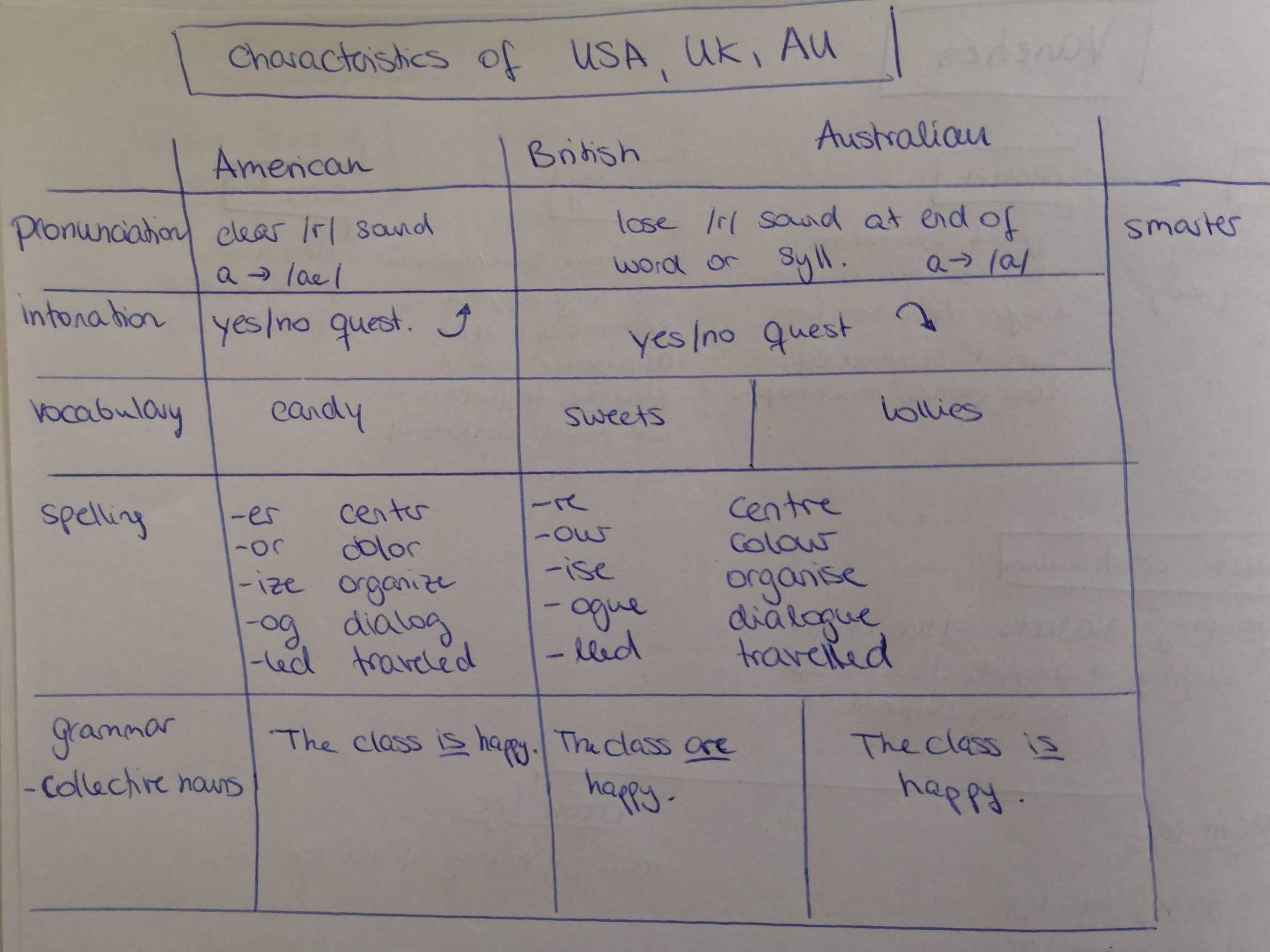
(native speakers, no restriction in context of use, stable and has independet norms, fully developed natural lge) - 41Varieties: Characteristics of USA; UK; AU