
Notizen
Eutrophication, Leaf Structure and Transport in Plants
Inhalt der Notizen (1)
Seite 1
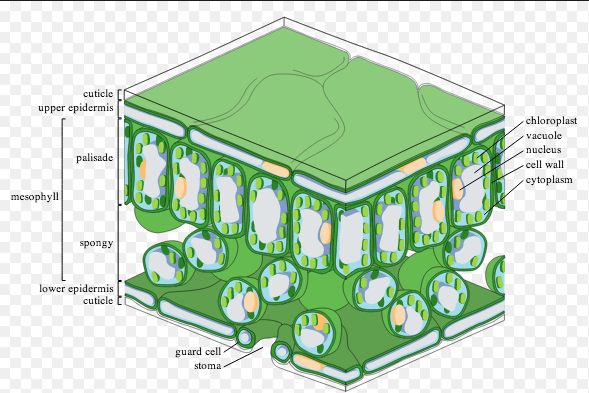
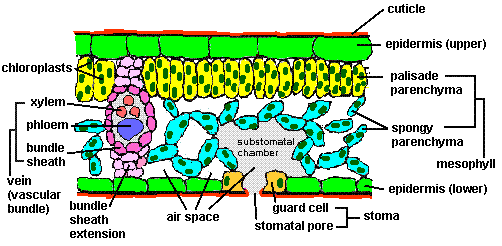
most respiration is carried out in the palisade cells
they are near the upper surface so they can absorb more light
if the stoma is open it is daytime and water is entering and leaving the cell
Structure
Function
Waxy Cuticle
This layer decreases water loss - is transparent so light can pass through
Upper Epidermis
Supports the leaf when the cells are turgid- Covered by waxy cuticle
Spongy Mesophyll Layer - Loosely-packed cells covered with a thin film of water allows diffusion of gases- Large air spaces
Vascular Bundle
Composed of xylem and phloem- provide transport and support
Lower epidermis
This layer has guard cells which control the opening and closing of stomata
Xylem - Cell walls thickened with lignin- Conducts water and mineral salts and gives mechanical support
Phloem
Transports sugars made during photosynthesis- Sieve plates separate adjacent cells
Palisade mesophyll
Cells are tightly-packed and contain many chloroplasts for maximum light absorption
Water and carbon dioxide need to from the soil intro the roots then to all parts of the plant (especially the leaves)
- transported in xylem vessels
- xylem vessels lose their cytoplasm and form long columns with walls thickened (and waterproofed) by lignin
Glucose is produced in the leaves and needs to be transported to non-photosynthetic parts
- transported by phloem
- columns but are living cells
W
Water travels by osmosis
Xylem is inside the veins and runs throughout the leaf
2. Water leaves the xylem and moves (by osmosis) from cell to cell
3. Some of it moves to cells for turgor or to be used in photosynthesis
4. 90% of water leaves via the stomata
5. Water evaporates in the air spaces of the spongy mesophyll and exits as a gas
Organic compounds are transported in the phloem = translocation
Sugar = Sucrose
Sucrose is moved from where it is produced or stored to where it will be utilized or stored
= moving sucrose from a source to a sink
Amino acids are also translocated to where they are needed
Use = making proteins
Treatment
Effect on rate
Explanation
No treatment
normal
normal
transpiration rate
Increased temperature
increased
Fast transpiration rate
In the dark
decreased
Slow transpiration rate
Increased humidity
decreased
Slow transpiration rate
Increased wind speed
increased
Fast transpiration rate
Removal of ½ of the leaves
decreased
½ times slower
Water is absorbed through the root hair cells
- low water potential in root hair cells compared with surrounding soil = osmosis
How does water move up the plant?
1. Root pressure: water enters root hairs by osmosis
2. Adhesion: Water molecules are attracted to the cellulose in the xylem vessels and move up them by capillary action
3. Transpiration pull: As water molecules evaporate off the spongy mesophyll and diffuse out of the stomata they 'pull' the water molecule behind them upwards
- downwards along a chain of water molecules in the cell = cohesion = sticking together and is caused by hydrogen bonds between water molecules
Leaf Structure 1. Upper Epidermis
No photosynthesis occurs because there are no chloroplasts
There is no transport of water and glucose
No gas exchange
2. Palisade Mesophyll
Photosynthesis occurs because there are lots of chloroplasts
No transport of water and glucose
No gas exchange
3. Spongy mesophyll
Photosynthesis occurs because there are chloroplasts
No transport of water and glucose
Gas exchange occurs
4. Lower Epidermis
No photosynthesis occurs
No transport of water and glucose
Gas exchange occurs
5. Xylem & Phloem
No photosynthesis occurs
There is transport of water and glucose
No gas exchange
6. Stomata
No photosynthesis
No transport of water and glucose
Only gas exchange occurs
7. Guard Cell
Only photosynthesis occurs
Eutrophication is the process by which a body of water becomes enriched in dissolved nutrients.
Excessive nutrients from fertilizers eg: nitrates and phosphateswashes from farmlands into rivers and streams.
This causes too much algae to grow.
The algae blocks sunlight from reaching aquatic plants below.
Aquatic plants die because they cannot photosynthesise.
Bacteria decompose the plants using up oxygen in the water - the B.O.D. (=Biological Oxygen Demand) of the water increases.
Aquatic animals die eg: fish due to lack of oxygen
Bacteria decompose these dead organisms using up even moreoxygen - the B.O.D. of the river rises even higher.
Ecosystem of the river is destroyed.
Water from the soil enters the plant through root hair cells. It then moves across the root cortex cells and into the xylem tubes. Water is then ‘pulled up’, the xylem vessels in the root and stem to replace the water that is lost at the leaves. The flow of water through the plant is called the transpiration stream. Mineral salts dissolved in the water also travel in this stream.
Xylem and phloem vessels together make the vascular bundle.
Xylem is made of dead, waterproof tubes. Lignin makes them waterproof. It’s specialised tissue in plants that transport waste and inorganic ions.
Xylem vessels contain no living material like cytoplasm. It helps their transport role because ir allows more water and minerals to be transported from the roots to the leaves.
Phloem is specialised tissue that transports the products of photosynthesis, mainly sucrose solution
Eutrophication
Leaf Structure
Plant Transport
Transpiration
Translocation
Informationen
- Beschreibung
- IGCSE Biology ( B2: Nutrition and Transport in Plants) Notiz am Eutrophication, Leaf Structure and Transport in Plants, erstellt von ShreyaDas am 25/03/2014.
- Erstellt von
- ShreyaDas
- Aufrufe
- 856
- Tags
- Bewertung