
Notizen
Sensory Channels in Marine Animals
Inhalt der Notizen (1)
Seite 1
Types of Information Available to Organisms
Light levels - decline with depth so visual information is decreased, light can be disrupted by complex habitats e.g. boulders and seaweed
Sound - propagates through water but there is lots of background noise
Water currents - could be a source, movement
Chemicals - diffuse well in water and persist
Electrical - sea water is highly conductive
What is Behaviour?
Behaviour is an interaction between an animal and its environment that involves decision making which stems from an animal's central nervous system, e.g. brain, ganglion etc.
The key feature is the use of information - e.g. moving to a refuge to avoid exposure is behaviour but a physiological response to heat is not
Decision making - information gathering, information processing and choosing an appropriate response to information.
Not all decision making will be conscious, e.g. reflexes count as behaviour
Visual Information
Predator Cues - cue is an an unintentional source of information. Anti-predator behaviour e.g. living in burrows, leaving to forage and mate, then returning when threatened by predator cues.
An example can be fiddler crabs. Very sensitive to movement, more so than shape - could use ping pong balls as predators and they would respond. Fiddler crabs have eyes on stalks and so have a doughnut (360) view of the world around it and don't see so well upwards. Respond more to indirect than direct attacks.
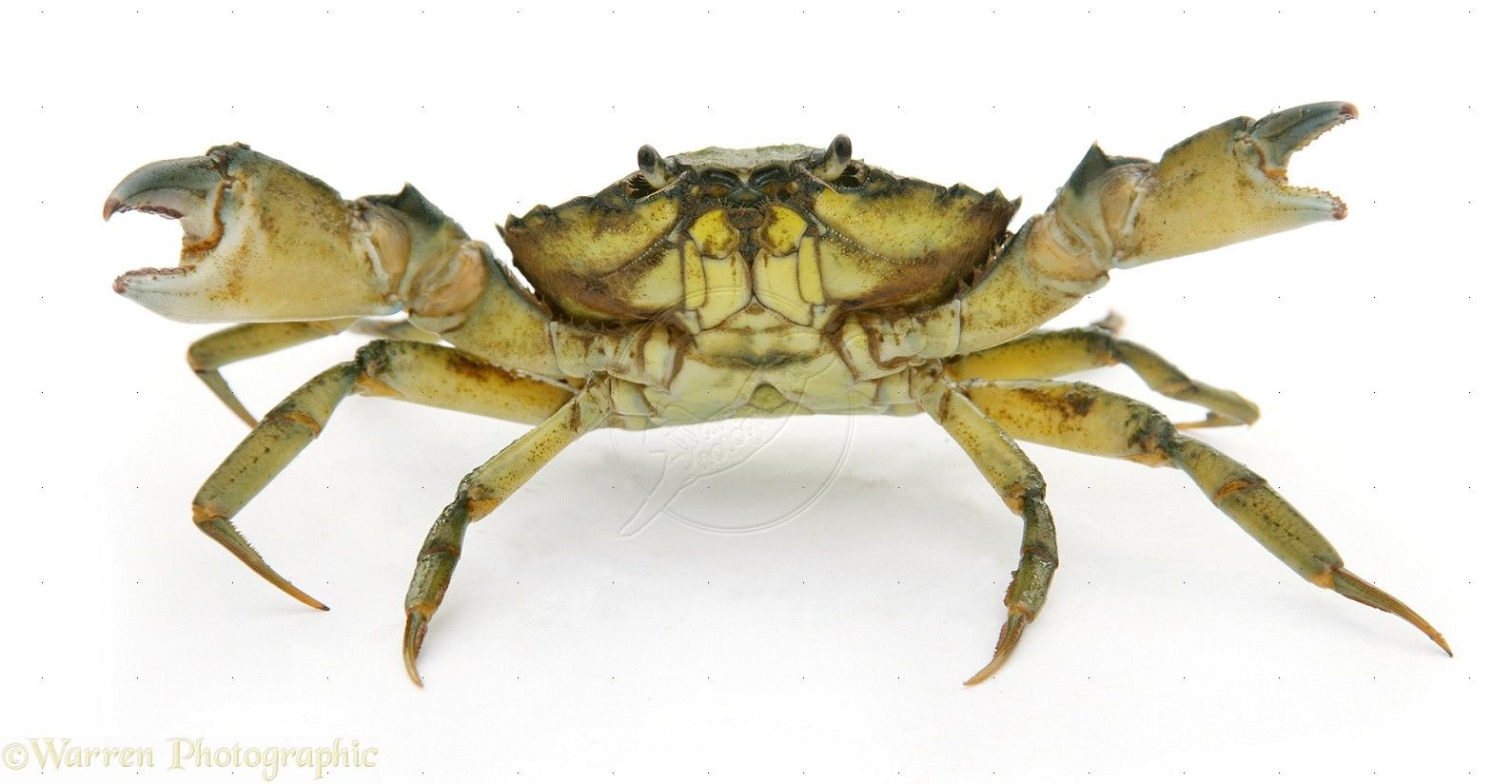
Signals - a behaviour that has evolved to convey information - an example would be a meral spread in Carcinus menas
Display - the activity used to produce the signal e.g. postural displays of aggression, mating displays
Tactile Information
Tactile information is very important in marine animals.
The sea is a very dynamic medium. Information on pressure changes is easily picked up (can be from movements of other animals, currents etc.)
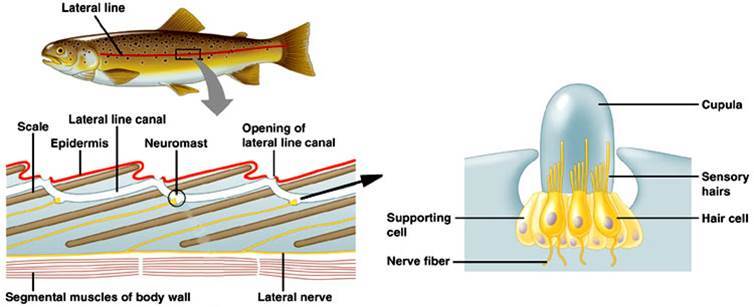
The lateral line in teleost and elasmobranch fishes is a good example. It can detect water currents and chemicals and is used to detect prey and avoid predators.
The lateral line is a canal under one layer of scales - opens to external environment - neuromast connected to lateral nerve - cupulla wobbles and triggers sensory hairs and sends message (neural) to lateral line.
The line we see is all the grooves leading to the lateral line canal
Chemical Information
Chemical information tends to travel slowly, is highly persistent and can be received in direct contact or to medium distance
In sand gobies it is found the the presence of chemical cues from predator cod affects feeding behaviour. Stomachs less full in presence of cod than in absence. Starved sand gobies take more risk in the presence of cos than fed ones do. Black gobies are more cautious as less camouflaged (Magnhagen, 1988).
Female crustaceans are only receptive to sperm when exoskeleton is soft. Males detect that a female is ready for mating when she releases a sex pheromone (UDP - uridine diphosphate - a very important chemical, crabs will guard a ball coated in it) and uses is as a cue to guard her. Pre-copula mate guarding is costly so timing and reading of these cues is important
Electrical Information
Passive Electroreception
Sharks and rays most sensitive to electric fields - system derived from lateral line but very highly modified
Muscle and nervous activity generates small electric fields which helps sharks locate prey because they detect electrical fields in other animals
Ampullae of Lorenzini located on sharks snout - thousands of tiny sensitive receptor organs
Also used for navigation - when a shark travels perpendicular to the earth's magnetic field it creates a difference in the current on the lateral line allowing sharks to know which way they are travelling. Stronger in East-West, weaker in North-South
Active Electroreception
Organ in tail - electrocyte generates weak electric field - disruption in field means someone else is present
General Behaviour
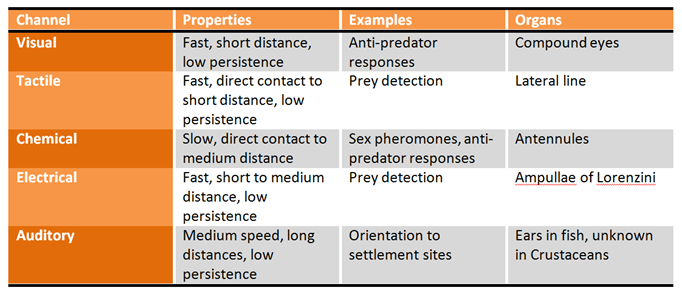
Visual & Tactile
Chemical & Electrical
Table
Informationen
- Beschreibung
- BSc Degree Marine Biology (217 - Ecology of Shallow Water Marine Habitats) Notiz am Sensory Channels in Marine Animals, erstellt von Madison Burt am 24/04/2014.
- Erstellt von
- Madison Burt
- Aufrufe
- 770
- Bewertung