
Quiz
Chapter 23 - The Transition Metals
Dieses Quiz enthält Fragetypen, die sich im gewohnten Player öffnen.
Fragen in diesem Quiz (21)
1Which of the following are typical properties of a Transition Metal element?
- AThey are found in the d-block of the Periodic Table.
- BThey are found to the right of the 'staircase' in the Periodic Table.
- CEach element can have a number of different oxidation states.
- DThey form brightly coloured compounds.
- EThey form mainly colourless or white compounds/solutions.
- FThey only conduct electricity when molten or in solution.
- GThey are able to form complex ions.
- HThey can often be used as catalysts.
2Which of the following is the correct electron configuration of Copper (Cu)?
- A[Ar] 3d10 4s1
- B[Ar] 3d9 4s2
- C[Ar] 3d8 4s3
- D[Ar] 4d9 4s2
- E[Ar] 4d10 4s1
3When ions are formed from transition metal elements, the 4s electrons are lost first.
- ARichtig
- BFalsch
4The formal definition of a transition element:
An [blank_start]element[blank_end] which forms at least one [blank_start]stable[blank_end] ion with a [blank_start]partially-filled[blank_end] [blank_start]d-shell[blank_end] of electrons.- Aelement
- Bstable
- Cpartially-filled
- Dd-shell
5Scandium and Zinc are both d-block and transition metal elements
- ARichtig
- BFalsch
6Match each definition to the correct term. Multiple labels may be required to complete each definition (some were too long).
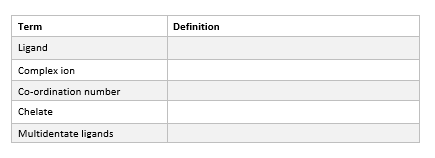
- AAn atom, ion or molecule that forms a
- Bco-ordinate bond with a transition metal
- Cion using a lone pair of electrons.
- DNumber of co-ordinate bonds to the TM
- EA TM ion surrounded by ligands.
- FA complex ion with polydentate ligands
- GA ligand which has multiple atoms with
- Hlone pairs of electrons which bond to
- Ithe TM ion, e.g. EDTA
7Only transition metals are able to form complexes.
- ARichtig
- BFalsch
8How would you classify the following ligands?
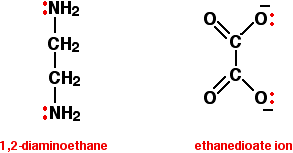
- Amonodentate
- Bunidentate
- Chexadentate
- Dbidentate
9What is the shape of this complex ion?
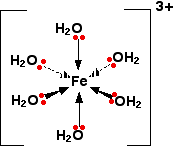
- Aoctahedral
- Bsquare planar
- Ctetrahedral
- Dlinear
10What is the shape of this complex ion?
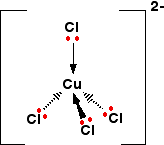
- Aoctahedral
- Btetrahedral
- Csquare planar
- Dlinear
11Complex ions with multidentate ligands are called [blank_start]chelates[blank_end]. Chelates can be used to effectively remove [blank_start]d-block[blank_end] metal ions from solution. If you add a hexadentate ligand such as [blank_start]EDTA[blank_end] to a solution of a transition metal salt, the EDTA will replace all six water [blank_start]ligands[blank_end] in the aqua ion, for example:
[Cu(H2O)6](2+) + EDTA(4-) --> [CuEDTA](2-) + 6H2O
In this equation, [blank_start]two[blank_end] species are replaced by [blank_start]seven[blank_end]. This increase in the number of particles causes a significant increase in [blank_start]entropy[blank_end] which drives the reaction to the right. for this reason chelate complexes with [blank_start]polydentate[blank_end] ligands are favoured over complexes with [blank_start]monodentate[blank_end] ligands. This is known as the chelate effect.- Achelates
- Bd-block
- CEDTA
- Dligands
- Etwo
- Fseven
- Gentropy
- Hpolydentate
- Imonodentate
12Optical isomerism occurs in transition metal complexes when there are two or more bidentate ligands.
- ARichtig
- BFalsch
13Geometric isomerism occurs in transition metal complexes which are octahedral or tetrahedral in shape.
- ARichtig
- BFalsch
14When the ligands bond with the transition metal ion, there is [blank_start]repulsion[blank_end] between the electrons in the ligands and the electrons in the d orbitals of the [blank_start]metal ion[blank_end]. That raises the energy of the d orbitals.
However, because of the way the d orbitals are arranged [blank_start]in space[blank_end], it doesn't raise all their energies by the same amount. Instead, it splits them into [blank_start]two groups[blank_end], one group of 2 orbitals with a slightly [blank_start]higher[blank_end] energy level than the other 3.
The size of the energy gap between them varies with the nature of the transition metal ion, its [blank_start]oxidation state[blank_end] (whether it is 3+ or 2+, for example), and the nature of the [blank_start]ligands[blank_end].
When [blank_start]white light[blank_end] is passed through a [blank_start]solution[blank_end] of this ion, some of the energy in the light is used to [blank_start]promote[blank_end] an electron from the lower set of orbitals into a space in the upper set. The amount of energy absorbed in order to promote this electron corresponds to a [blank_start]wavelength[blank_end] of the visible light. We therefore see a combination of the other colours in the spectrum, which often shows as the [blank_start]complementary[blank_end] colour of the one absorbed.- Arepulsion
- Bmetal ion
- Cin space
- Dtwo groups
- Ehigher
- Foxidation state
- Gligands
- Hsolution
- Ipromote
- Jwavelength
- Kwhite light
- Lcomplementary
15Why can transition metals form ions with variable oxidation states?
- AAs they can use both their 4s and 3d electrons in bonding.
- BAs they can form dative covalent (co-ordinate) bonds.
- CAs their electrons are delocalised within the lattice structure.
16Which two transition metals are found in the catalytic converters of modern cars?
- APlatinum
- BRhodium
- CIron
- DNickel
17A heterogenous catalyst is in the same phase as the reactants.
- ARichtig
- BFalsch
18What can be done to minimise the costs of using heterogenous catalysts?
- AIncrease the surface area - higher surface area = better efficiency.
- BSpread the catalyst onto an inert support medium, therefore increasing the surface-to-mass ratio so that a little goes a long way.
- CUse less catalyst but dot lumps of it across a surface.
- DIncrease the concentration of the reactants.
19Catalysts will eventually cease to work.
- ARichtig
- BFalsch
20When the catalyst is in the same phase as the reactant, an intermediate species is formed.
- ARichtig
- BFalsch
21What is autocatalysis?
- AWhen one of the products of the reaction catalyses the reaction.
- BWhen the reaction only begins on the addition of a catalyst.
- CWhen catalysts are used in cars.
Informationen
- Beschreibung
- A quiz based on the Transition Metal chemistry required for the new AQA A2 spec
- Autor
- Leah Firmstone
- Sprache
- English
- Aufrufe
- 641
- Verlauf
- Erstellt am 19 Mär 2018 · aktualisiert am 20 Mär 2018
- Schlagwörter
- Bewertung
- Noch keine Bewertungen Bewerte dieses Quiz