
Karteikarten
Proteins and Enzyme Action
Karten in diesem Stapel (26)
- 1Two types of ProteinsGlobular and Fibrous
- 2What are Globular proteins?Soluble proteins with specific 3D shape
e.g Hormones, Enzymes, Haemoglobin, Antibodies - 3What are Fibrous proteins?Strong, insoluble, flexible material
E.g Collagen and Keratin - 4Building Blocks for Proteins?Amino Acids
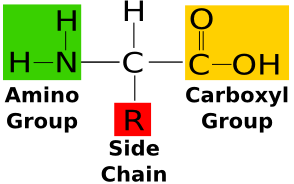
- 5Structure of Amino Acid?-Central Carbon
-Carboxyl (COOH) Group to right
-Amino Group to Left
-Hydrogen above
-R Group below - 6How do amino acids differ?The R group varies
- 7How do amino acids join together?Condensation reaction between Carboxyl group and amino group.
Peptide Bond - 8What does two amino acids form?Dipeptide
- 9Monomers of ProteinsAmino Acids
- 10What are Proteins made up of?One or more Polypeptides
- 11Define the Primary StructureSequence of amino acids - Polypeptide chain
- 12Define the Secondary structureHydrogen bonds between the amino acids form coils - alpha helix OR Beta pleated sheets
- 13Define the Tertiary structureThe coiled structures coil more due to hydrogen and ionic bonds between amino acids.
Disulphide bridges between Cystine amino acids
If the structure only have ONE polypeptide bond this is the final 3D structure - 14Define the Quaternary StructureSeveral different polypeptide chains bonded together
Final 3D structure for proteins made of more than one polypeptide chain ( Haemoglobin, Insulin, Collagen - 15Test for ProteinBiuret test
Add Sodiumhydroxide solution
Add Copper (II) Sulfate solution
Protein turns from blue to purple - 16Define an EnzymeAN biological Catalyst
Speed up the rate of reaction - lower activation energy - 17What makes a Enzyme specific?Specific active shape
Only complementary substrates can bind to it - 18Structure of Enzymes-Rough spherical shape due to tight folding of polypeptide chains.
-Soluble
-Roles in Metabolism or Synthesis of large molecules - 19Structure and role of Antibodies-Involved in Immune response
-Two light (short) polypeptide chains and two heavy (long) polypeptide chains
-Have variable regions - 20Structural Proteins-Physically Strong
-Consist of long polypeptide chains that lie parallel to each other w/ crosslinks between them
- Include Keratin (In hair and nails) and Collagen (connective tissue) - 21Lock and Key Model Vs Induced Fit ModelL+k - Active site shape is rigid, only exact complementary substrates can bind to form Enzyme-Substrate complexes
I F - Active site changes shape, substrate binds to act site, active site changes shape so the substrate fit exactly forming Enzyme-substrate complex - 22Affect of Substrate concentration on enzyme activity- Increase substrate concentration =
-Increase chance of successful collisions
-Increase chance of forming an enzyme substrate complex
-Increase rate of reaction
-Continues until all enzymes are satisfied - 23Affect of enzyme concentration on enzyme activityIncrease enzyme concentration =
-increase chance of successful collisions
-increase chance of forming an Enzyme- substrate complex
-increase R of R
-this continues until all substrates are used up + max. R of R - 24Affect of temp on enzymeTemp increases =
-increase R of R
-Kinetic energy increases
-Molecules move faster
-Increase chance of successful collisions and Enzyme-substrate complex
-caries until optimum
After Optimum =
-Decrease R of R
-Bonds in tertiary structure break
-Lose Active site
-enzyme denatured - 25Affect of pH on enzyme activityChange in pH away from optimum =
-Bonds in tertiary structure break
-Lose active site
-Denatured enzyme
- No Enzyme-Substrate complex - 26Competitive VS non-competitive inhibitors- C = - A substance with a similar shape to substrate w/ complementary shape to enzyme active shape
-Binds to active site, block it, prevent ES complexes forming
N-C = - Substance that binds to another site on the enzyme other then the active site, changing the active site shape
-
Informationen
- Beschreibung
- A level Biology Karteikarten am Proteins and Enzyme Action, erstellt von Charlotte Willis am 31/12/2017.
- Erstellt von
- Charlotte Willis
- Aufrufe
- 20
- Tags
- Bewertung