
Karteikarten
L8 - Motor systems 2
Karten in diesem Stapel (50)
- 1what is the function of the cerebellum in motor controlcontrol muscle tone and coordination in both conscious and unconscious movement
- 2what is the function of the basal ganglia in motor contrlintegration of sensory and motor info to aid with voluntary movement
- 3what disorders are associated with basal ganglia and motor dysfunctionparkinsons and huntingtons disease
- 4do the cerebellum and basal ganglia cause muscle contraction?no they alter other pathways to help coordinate movement
- 5explain the cerebellum's role in coordinating muscle movementrecives info about ongoing movement and makes any corrections needed to ensure movement is carried out properly
- 6how is the cerebellum involved in motor learninglearns patterns of movement so that they can be repeated or copied
e.g writing your name in a much larger font size than you normally do - 7what are the 3 anatomical components of the cerebellum- spino-cerebellum
- cerebro-cerebellum
- vestibulo-cerebellum - 8what is the function of the spino-cerebellumregulates axial muscle and posture
- 9what is the function of the vestibulo cerebellumcontrols balance and eye movement
- 10what is the function of teh cerebrocerebellumcompares intended movements with actual ones and sends compensatory intrsuctions
- 11where does the cerebrocerebellum send correctory impulses tothe primary motor cortex so that it can alter movement
- 12what is the main output cell from the cerebellumthe purkinjee cell
- 13what type of signals are sent by the purkinje cell to the cerebelar nuceiinhibitory impulses
- 14give 2 other cells which come from the cerebellum and enter the deep cerebellaer nucelimossy fibres and climbing fibres
- 15what does the DCN do with signals from the climbing and mossy fibrescompares their inputs
- 16what is the purpose of comparing the climbing and mossy fibres at the deeep cerebellar nucleicompares signals before and after cerebealler processing
(comparing expected to reality) - 17how does the rest of the brain aid in cerebellum activity comparisonrest of brain sends the "plan" of what was supposed to happen to the cerebellum
- 18what happens if the expected and reality are differentthe cerebellum adjusts outputs from the descending motor pathway
- 19how does the cerebellum act as a timerit makes sure that the sequence of motor activation is correct
- 20where is the basal ganglia locatedbelow the cortex
- 21what is the function of the basal gangliaintergration of sensory and motor information from the cortex
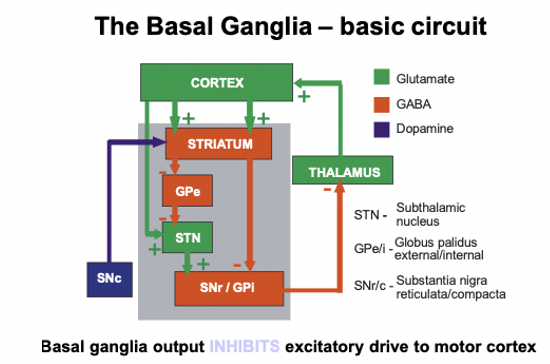
- 22give the pathway of information to and from the basal gangliafrom the cortex to the basal ganglia then back to cortex via the thalamus
- 23what is the basal ganglia's role in pre-motor activityprepares for movement
- 24what is the effect of the basal ganglia on the thalamus and what is the effect of the thalamus on the cortex?basal ganglia is inhibitory to the thalamus
thalamus is excitatory to the cortex - 25what needs to happen to the thalamus to initiate movement by the cortexthe inhibition from the basal ganglia needs to be removed
- 26give some structures which make up th ebasal gangliastraiatum
GPe
STN
SNr - 27what is the major excitatory NTM of the brainglutamate
- 28what is teh major inhibitory NTM of the brainGABA
- 29what is the effect of dopamine on the brainis modulatory
- 30is basal outflow excitatory or inhibitoryinhibitory to the thalamus
- 31give the flow of activity through the basal ganglia from the cortex to the thalamus- cortex stimulates striatum which has inhibitory effect either on SNr or on the inhibitor of the STN
- the STN excites the SNr
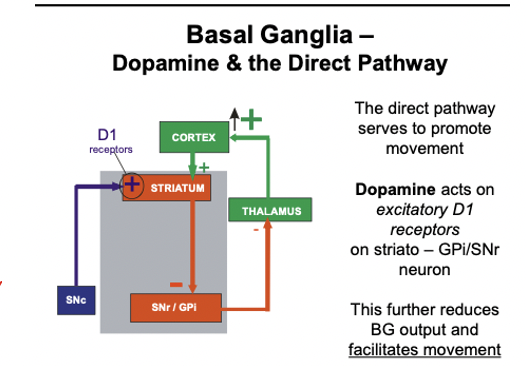
- so inputs can either excite or inhibit the inhibitor of thalamus - 32give the direct and indirect pathways through the basal ganglia- direct goes straight from striatum to SNr and GPi
- indirect goes through GPe and STN before hitting SNr and GPi - 33what does the direct and indirect pathways promote- direct promotes movement by inhibiting the inhibitor of the thalamus
- indirect inhibits the thalamus by activating its inhibitor - 34what 2 receptors do dopamine work onexcitatory D1 recepotrs on GPi and SNr
inhibitory D2 receptors - 35what is the effect of dopamine on movementfacilitates smooth movement by inhibiting the GPi or the STN depending on inputs
- 36how does dopamine activity cause smooth movementsuppresses unwanted movement
- 37give a hypokinetic and hyperkinetic disorder associated with the basal gangliahypokinetic = parkinsons (despite the shakes)
hyperkinetic = huntingtons - 38what causes parkinsons and huntingtonsdysregulation bewteen indirect and direct pathways of the basal ganglia
- 39why is parkinsons hypokineticthe person struggles to initiate movement
- 40describe the resting state and the movement of a parkinsons patienttremor
bradykinesia
rigidity
(harder to initiate minor movements) - 41what is the primary pathology of parkinsosnloss of dopamine regulation causing increased activity of the STN thus increasing inhibition of the thalamus
- 42how would parkinsons be treated- dopamine replacement drugs such as L-DOPA
- dopamine agonists
- drugs which reduce Dopamine breakdown - 43why is Parkinsons treatment poor and especially treatment using inhibitory of dopamine breakdown- doesnt treat the underlying degeneration
- inhibitors of breakdown assume there is any dopamine in first place - 44what is L-Dopa and why is it a bit meh- molecule which is metabolised into dopamine
- requires functioning DOPA decarboxynase
- dopamine is converted to NAD which increases SYM activity - 45how can surgery be used in parkinsonssurgical lesion of the STN to stop it from exciting the SNr
- 46give the symptoms of huntingtonsexcessivve and uncontrollable dance like movements caused by rapid motor pattern generation
- 47explain why huntingtons is herritableis autosomal dominant disorder
- 48what is the problem in the basal ganglia caused by huntingtonsloss of stimulation of STN causing overactive thalamus activity
- 49what is the function of the pre and post central gyruspre = primary motor cortex
post = sensory cortex - 50—
Informationen
- Beschreibung
- Year 1 NER (Neuroscience ) Karteikarten am L8 - Motor systems 2, erstellt von Jack Rowe am 31/12/2022.
- Erstellt von
- Jack Rowe
- Aufrufe
- 2
- Bewertung