
Karteikarten
Strategic Reward Management W9
Karten in diesem Stapel (24)
- 1Reward• ‘A reward may be anything tangible ... or intangible ... that an organisation offers to its employees in exchange for their potential or actual work contribution ... to which employees as individuals attach a positive value as a satisfier of certain self-defined needs’.
- 2Extrinsic rewards-financial rewards: fixed/base pay, cash benefits & performance-related pay
-developmental rewards: learning, training & development, succession planning, career progression and other non-cash benefits
-social rewards: organisational climate, performance support, work group affinity, work/life balance & other - 3Intrinsic rewards-job challenge
-responsibility
-autonomy
-task variety - 4Aligning rewards with business strategy• One size does not fit all.
• Provide all legally mandated employee entitlements.
• Tailored to the particular strategy of each organisation and, where appropriate, to the specific strategies of distinct business units within the organisation. - 5Reward system design1. preparing a statement of reward philosophy and strategy
2. determiningtotalrewardmix
3. targeting pay levels, ensuring strategic fit or alignment. - 6Reward communication• Clear communication of reward system philosophy and details will increase employee acceptance.
- 7Reward transparency advantages• Encourages reward satisfaction by helping employees understand how their pay is determined
• Clarifies link between work contribution and reward outcomes
• Supports work climate of trust and openness
• Clarifies the link between organisational and strategic goals and how employees are rewarded - 8Reward transparency disadvantages• Violates individual privacy
• Fosters jealousies and dissatisfaction over minor pay differences
• Distracts from performance
• Engenders a cycle of ‘catch up’ claims - 9Base PayThree main categories of monetary reward plans are:
1. base pay plans
2. benefits plans
3. performance-related pay and rewards plans. - 10Base pay: nature and importanceBase pay is the foundational or fixed component of employee remuneration and can be made up of:
1. job-basedbasepay
2. skill-basedbasepay
3. competency-based base pay. - 11Job-based base pay• Payment according to the ‘size’ of the job or position held. • Remains the dominant mode of remuneration in most
developed countries.
• Traditional job-based pay structures:
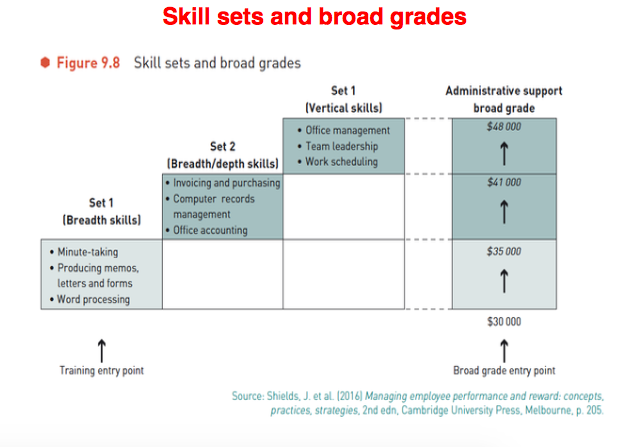
–pay scales (or spines) –narrow grades. - 12person-based pay systems-skill-based pay
-broad grades
-broad banding - 13Skill sets and broad grades
- 14Competency-based base pay• Rewarding deeply embedded abilities or competencies such as leadership, achievement, persistence, composure and problems solving.
• Focuses on personal attributes that are seen to be the most important and reliable drivers of high individual performance. - 15Benefits plans• Mandatory benefits:
–provision for employee economic security –superannuation.
• Voluntary benefits:
–enhance an organisation’s ability to attract and retain
high-value employees and enable it to offer employees a more appealing ‘value proposition’
–includes such benefits as discount company loans, company cars, gym membership, self-education, computers, mobile phones. - 16Performance-related rewards• ‘Performance-related rewards (or incentives) are rewards given in recognition of past performance (individually or collectively) and in order to reinforce and enhance future performance.’
- 17Fixed versus flexible benefits plans• Standard content: the composition being determined by legal requirement and employer choice.
• Flexible content: employees having a degree of choice. - 18Performance Incentives advantages• Agency theory, reinforcement theory, expectancy theory and goal- setting theory all emphasise the centrality of employee cognitive processes to understanding and managing the relationship between rewards and task motivation
• Performance-related rewards operationalise the equity norm of distributive justice - 19Performance Incentives disadvantages• Incentives undermine intrinsic interest in the job
• Rewards motivate people to pursue one thing above all else
• Rewards punish
• Rewards rupture cooperative work
relationships
• Rewards ignore underlying reasons for work problems
• Agency theory, reinforcement theory, expectancy theory and goal- setting theory all emphasise the centrality of employee cognitive processes to understanding and managing the relationship between rewards and task motivation
• Performance-related rewards operationalise the equity norm of distributive justice
• Rewards discourage risk-taking - 20Types of performance pay• Individual performance-related rewards.
• Performance-related pay based on the measured
results of large or small work groups.
• Collective performance-related rewards based on results achieved by the organisation as a whole. - 21Collective short-term incentive plansThere are four plan types:
1.profit-sharing
2.gain-sharing
3.goal-sharing
4.team incentives. - 22Organisation-wide long-term incentive plans• Reward employees for improvements over time in the employing business’ share market performance.
• Potential rewards are:
–share price appreciation
–annual dividend earnings
–special bonus share issues
–special taxation concessions or exemptions. - 23Executive incentive plans• Increasing linkage of executive pay to performance.
Short-term incentives:
–generally of one year and linked to goals in organisational financial performance
–instrumentality and reinforcement
–susceptible to manipulation.
• Long-term incentives:
–generally for three or five years and in the form of company equity rather than cash
–main types are restricted share plans, option plans, performance shares and share appreciation rights. - 24Managing Expatriate pay• Expatriate rewards must be sufficient to attract suitably qualified and capable individuals to the role, and also to retain and motivate the individual or individuals selected for the role for the full duration of the placement.