
Karteikarten
Ohne Titel
Karten in diesem Stapel (112)
- 1isotopeatoms of the same element witht the same number of protons but different numbers of neutrons
- 2relative atomic massthe mass of one atom compared to 1/12th of one atom of carbon-12
- 3spectator ionsdont change state or oxidation number
- 4s orbital2 electrons, spherical shape
- 5p orbital6 electrons, dumbell shape
- 6d/f orbitald = 10 electrons
f = 14 electrons - 7ionic bondelectrostatic force of attraction between oppositley charged ions formed by electron transfer
properties: high melting point, conduct whne molten/solution and soluble in aqueous solution - 8covalent bondstrong electostatic force of attraction between the shared pair of electrons and the neuclei of the bonded atoms
- 9dative bondshared pair of electrons in the covalent bond come from only one of the bonding atoms
- 10shapeslinear: 180, 2 bonding pairs
trigonal planar: 120, 3 bonding pairs
tetrahedral: 109.5, 4 bonding pairs
trigonal pyramidal: 107, 3 bonding pairs, 1 lone pair
bent: 104.5, 2 bonding pairs, 2 lone pairs - 11electronegativityrelative tendancy of an atom in a covalent bond in a molecule to attract electrons in a covalent bond to itself
- 12London forcesoccur between all moleular substances. As electrons are moving constantly and randomly the density fluctuates and parts of the molecule become more or less negative (tempory dipoles). This can cause induced dipoles.
long chain alkanes have a larger SA of contact for london forces to form. - 13permanent dipole-dipoleoccur between polar molecules, they need more energy to overcome than London forces. Polar molecules have a bond where there is significant difference in electronegativity
- 14hydrogen bondingHONF
- 15effects on equilibriumconcentration: more products = shift right, more reactants = shift left
temperature: increase favours endothermic, decrease favours exothermic
pressure: more molecules on one side will cause a change - 16catalystslower Ea
Homogenous - same state as reactants Heterogeneous - different states. Reactants are absorbed and desorbed - 17successful collisionsparticles must have enough energy and be at the correct orientation.
- 18aliphaticstraight chain carbons
- 19alicycliccarbon rings
- 20displayed formulashows all atoms and bonds
- 21structural formulashows atom arrangement
e.g. CH3CH2CH2CH3 - 22skeletal formulashape of carbon skeleton
- 23homologous seriesfamily of compound containing the same functional group and same general formula. Each successive member has a different carbon chain length
- 24halogenalkane-F = floro...
-Cl = chloro...
-Br = bromo...
-I = iodo... - 25amine-NH2 = -amine
- 26alcohol-OH = hydroxyl- OR -ol
- 27aldehyde-C-H=0 = -CHO -al
- 28keytoneR-C=O = -one
- 29esterR-C"O-O-R = -oate
- 30carboxillic acid-C-O-H = -oic acid
=O - 31structural isomersome molecular formula, different structual
- 32sterio isomersame structural, atoms are arranged differently in space (E/Z)
- 33moleamount of substance in grams that has the same number of particles as there is atoms in 12g of carbon-12
- 34molar gas volumevolume of 1 mole of a gas at 1atm and 25degrees, all gasses have this same volume (24)
- 35avagadros constantnumber of atoms, molecules or ions in a substance
- 36molecular formulaactual number of atoms of each element in the compound
- 37hydrated saltcontains water of crystalisation
- 38ideal gas equationPV=nRT
- 39making a solution1. weigh mass of solute
2. add 100cm3 of distilled water and stir with a glass rod
3. pour into flask using funnel
4. add more distilled water until reaching the mark on a graduated flask - 40acidrelease H+ ions
strong acid - completely dissociate when dissolved in water
weak acid - slightly dissociate - 41baseneutralise acid
- 42alkalirelase OH- ions
- 43saltformed when H+ ion of an acid is replaced by a metal ion
acid + base --> salt + water
acid + carbonate --> salt + water + CO2
acid + metal --> salt + hydrogen - 44oxidationloss of electrons, oxidation number increases
- 45reductiongain of electrons, oxidation number decreases
- 46oxidation numbersgroup 1 = +1
group 2 = +2
Al = +3
H = +1 (accept hydrides -1)
F = -1
Cl, Br, I = -1 (accept in compounds of O2 and F2)
O = -2 (accept peroxides -1) - 47periodicityrepeating pattern across different periods
atomic radius = decrease across a period, increase down a group - 48first ionisation energyenergy needed to remove an electron from each atom in one mole of gaseous atoms
- 49factors effecting ionisation energyattraction of nucleus
distance of electrons from nucleus
shielding - 50Mole calculationsMoles to mass = xMr
Moles to volume/pressure/temp of ideal gas = PV=nRT
Moles to volume of gas = x24
Moles to concentration = x100/V
Moles to volume in solution = x100/C
Moles to particles = x6.02x10^23 - 51metallic bondthe electrostatic force of attraction between positive metal ions and negative ions.
properties: insoluble, good conductivity when solid, high boiling and melting points - 52group 2form 2+ ions
ionisation energies decrease down the group
burn in O2
metal + steam --> metal oxide + hydrogen
metal + water(cold) --> metal hydroxide + hydrogen
a hydroxide forming will show: fizzing, metal dissovles, heat - 53halogensF2 - pale yellow, highly reactive
Cl2 - green, reactive gas
Br2 - red liquid, give off poisonous fumes
I2 - shiny grey solid
boiling and melting points decrease down the group - 54displacementCl will displace Br and I
Br will displace I
chlorine - pale green
bromine - yellow
iodine - brown - 55halogens + organic solventCl - colourless
Br - yellow
I - purple - 56disproportionationan element is oxidised and reduced simultaneously
e.g.
Cl + cold dilute NaOH --> NaCl + NaClO + H2O
BLEACH - 57halide ions + silver nitrateF = no precipitate
Cl = white
Br = cream
I - yellow
silver chloride dissolves in dilute ammonia
silver bromide dissolves in concentrated ammonia - 58qualitative analysistest for carbonate: add dilute acid and observe fizzing, CO2 turns limewater cloudy
test for sulphate: reagent = acidified BaCl2, white precipitate will form
test forNH4+: reaction with warm NaOH forms NH3, ammonia gas turns litmus paper blue - 59exothermicfrom system to surroundings
negative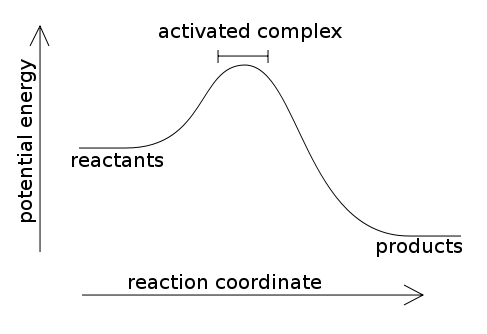
- 60endothermicfrom surroundings to system
positive - 61activation energyEa = minimum energy needed to start a reaction
- 62standard conditions100kPa, 298K, solution 1moldm^-3
- 63enthalpy change of formationone mole of a compound is formed from its elements under standard conditions
(UP) - 64enthalpy change of combustionone mole of a substance is combusted completely in oxygen under standard conditions
(DOWN)
can be calculated by calorimetry, fuel is burnt and heat is used to heat water in a metal cup - 65energy calculationQ = M x C x change in T
- 66bond enthalpymean bond enthalpy: enthalpy change when one mole of gaseous covalent bonds is broken. Energy is required to break a bond so value is positive
- 67bond breakingabsorbs energy - endothermic
- 68bond makingreleases energy - exothermic
- 69Kcright/left
=1 - equilibrium
<1 - towards products
>1 - towards recatants - 70Le ChatelierAt equilibrium, what you do to the reaction the reaction will do the opposite
- 71addition reaction2 become 1
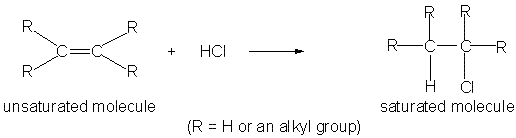
- 72substitution reaction2 make 2 new
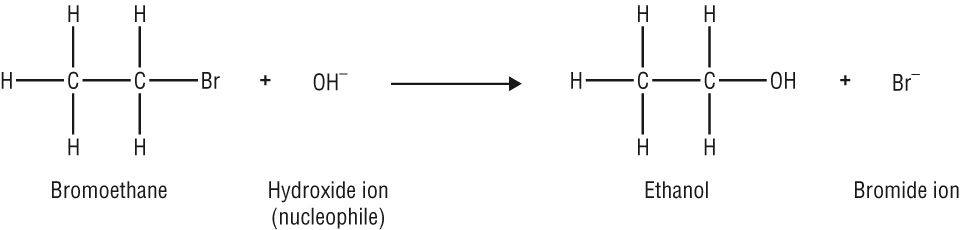
- 73elimination reaction1 makes 2
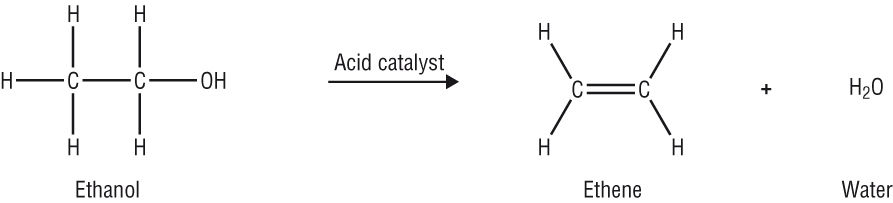
- 74AlkanesCnH2n+2
saturated
substitution - in the presence of UV light a halogen will substitute a hydrogen in an alkane, produces a halogenalkane and hydrogen halide - 75branching effectas branching increases boiling point decreases due to less points of contact between molecules so weaker London forces
- 76free radical substitution1. initiation = Cl2 --> 2Cl. (UV light)
2. propagation = CH4 + Cl. --> CH3. + HCL
CH3. +Cl2 --> CH3Cl + Cl.
3. termination = Cl. + Cl. --> Cl2
CH3. + CH3. --> C2H6
CH3. + Cl. --> CH3Cl - 77alkenesCnH2n
unsaturated
exhibit E/Z - 78alkenes - the double bond- sigma bond: overlap of s-orbitals
- pi bond: weaker (breaks first), sideways overlap of p orbitals - 79for a reaction to occur...1. bond must break
2. breaking bond forms reagent
3. reaction must take place - 80Homolytic fissionforms free radicals
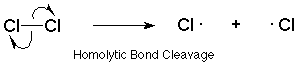
- 81heterolytic fissionfull arrow shows pair of electrons moving, both electrons go to one aom forming a +ion and -ion
- 82electrophileelectron pair acceptor
- 83nucleophileelectron pair donor
- 84position isomerismsame molecular formula and functional group, but functional group is attached to a different carbon
- 85neucleopillic substitution
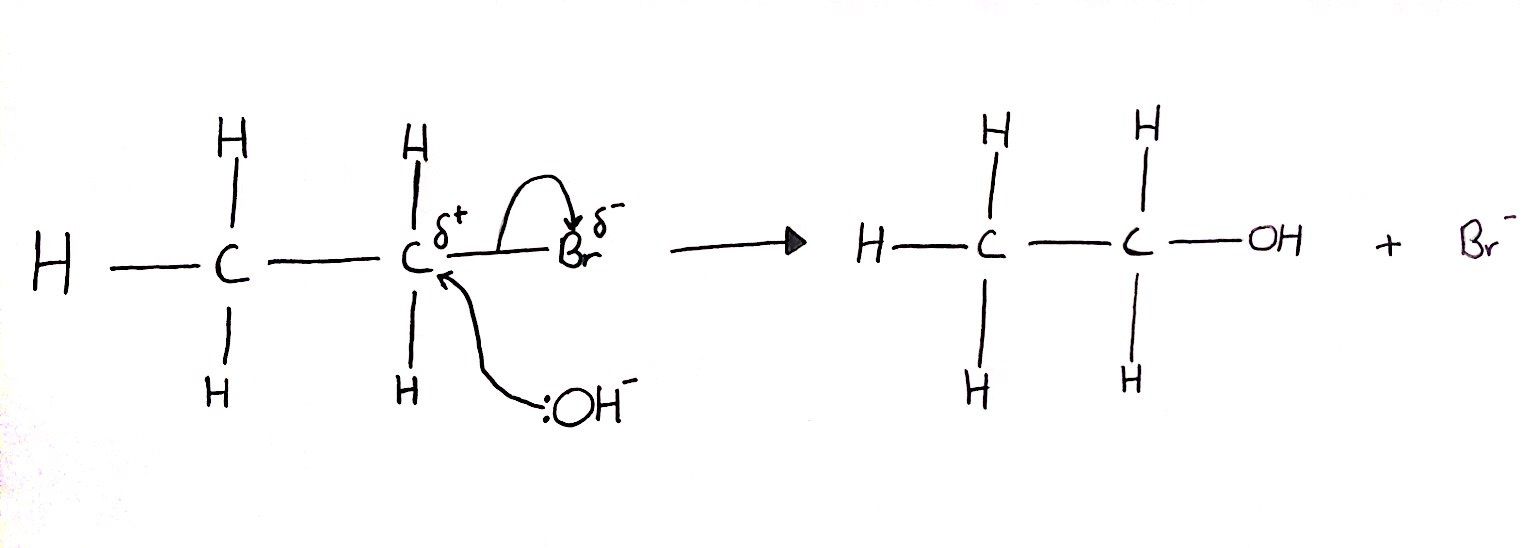
- 86forming alcoholsRCH2Cl + :OH- --> RCH2OH + :Cl-
reagent - aqueous NaOH or KOH
conditions - reflux - 87hydrolysis of halogenalkanerate can be measured with reaction with ethanol and aqueous silver nitrate.
water hydrolyses halogenalkane and halide is released.
Ag+ form precipitate AgX
slowest = 1-florobutane
fastest = 1-iodobutane - 88alcoholsCnH2n+1OH
form hydrogen bonds
primary = the OH is attached to 1 other carbon
secondary = the OH carbon is attached to 2 other carbons
tertiary = the OH carbon is attached to 3 other carbons - 89hydration of etheneH2C=CH2 + H2O <--> CH3CH2OH
conditions - steam, 300 degrees, 60atm, solid H3PO4 catalyst - 90dehydration of an alcoholelimination reaction
C2H5OH --> H2C=CH2 + H2O
catalyst - concentrated H2SO4 and heat - 91oxidation of alcoholsoxidising agent = potassium dichromate/concentrated sulphuric acid
only primary and secondary can be oxidised (orange to green)
primary form an aldehyde then a carboxilic acid - aldehyde has to be distilled, mixture is reluxed and carboxylic acid is distilled
secondary oxidise to form a keytone - 92tests for aldehyde and keytonetollens reagent
aldehyde = silver mirror
keytone = no reaction - 93test for carboxylic acidCOOH reacts with sodium metal like all alcohols, only COOH reacts with sodium carbonate
test: add Na2CO3
collect CO2
bubble through lime water - 94test for alcoholsadd sodium
add K2Cr2O7/ H2SO4 and warm
primary and secondary will turn orange to green - 95IR spectroscopyIR light makes bonds in a molecule vibrate.
- IR spectrum passed through sample
-specific bonds vibrate at frequencies
- absorbs energy when vibrates
-each peak is a bond
-spectrum produced - 96refluxcondenser prevents organic vapours from escaping.
reaction - primary alcohol to carboxylic acid - 97anti-bumping granulesadded to the flask in distillation and reflux to prevent vigorous/uneven boiling
- 98markonikov additionone Is more likely to be formed than the other, there is a major and a minor.
The major product is the more stable one, as the number of alkyl groups increase there is more negative electrons released to the positive charge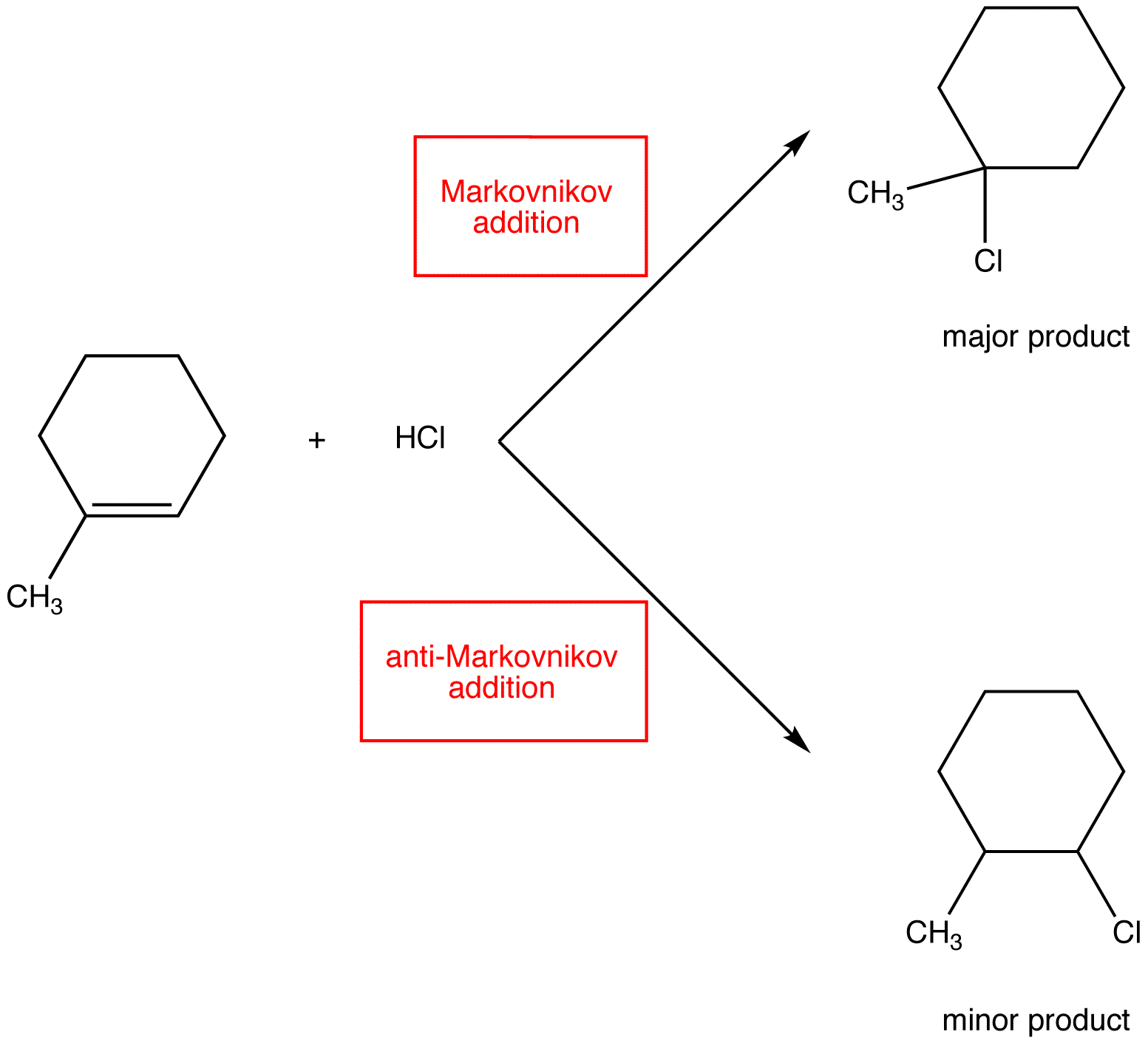
- 99polymerisationwhen an alkene an addition reaction to itself
- 100no branchingpack closely, strong London forces
- 101branchingweak London forces, flexible
- 102cahn-ingold (E/Z)same molecular formula but different special arrangement due to restricted rotation around the C=C
E = opposite side, Z = same side - 103addition of halogensforming dihalogenalkanes
Adding a halogen e.g. Br2 - 104addition of hydrogen halidesforming a halogenalkane
adding a hydrogen halide E.g.HCl - 105hydration of alkenesconditions: steam, phosphoric acid, 300 degrees, 60atm
forms an alcohol - 106PAG - determination of the relative atomic mass of magnesiumhealth and safety - eye protection, flammable gas envolved
1. using a measuring cylinder, add 50.0cm3 of 1.00mol aqueous sulphuric acid to the conical flask
2. weigh between 0.12g and 0.16g of magnesium.
3. remove the stopper and add the magnesium quickly replacing the stopper. collect the gas and record final volume of hydrogen - 107titrations - making a standard solutionusing a precise balance weigh the required mass of solid onto a watch glass. transfer the solid into a beaker. Add water to completely dissolve the solid, using a glass rod stir the solution. Transfer the solution into a volumetric flask, rinse out the beaker and glass rod and add this water to the volumetric flask. use water to fill the volumetric flask up to the graduation line, use a pipette to add the final few drops. invert the flask several times to ensure it is mixed.
- 108concentration of a solutionhow many moles are dissolved per 1dm3 of solution
number of moles = concentration x volume/1000 in cm3 - 109PAG - determination of the formula of MgOhealth and safety: eye protection, don't touch hot apparatus
1. measure the mass of the crucible lid, put the Mg ribbon in the crucible and re-weigh it.
2. heat the crucible strongly raising the lid slightly to control the reaction
3. when the reaction is almost complete, place the crucible lid on a heat-proof mat and heat the crucible strongly for 5 mins. Tap to break up the residue, reweigh the crucible once cool. - 110PAG - determination of concentration of HClhealth and safety: eye protection
part 1: making up a standard solution of aqueous NaHCO3, using 2.1g of NaHCO3
part 2: finding the concentration of HCl by titration with standard solution, transfer the standard solution to a clean dry beaker, use a pipette to transfer 25cm3 of the solution to a 250cm3 conical flask. Add a few drops of methyl orange. Using a funnel, rinse and fill the burette with HCl. Titrate this until its gone yellow to orange. - 111PAG - determination of enthalpy change of neutralisationHCl + NaOH --> NaCl + H2O
1. place a polystyrene cup in 250cm3 glass beaker
2. rinse the measuring cylinder with HCl then measure 25cm3 of HCl and transfer into the polystyrene cup.
3. rinse the second measuring cylinder with NaOH solution then measure 25cm3 of NaOH
4. start the timer and record the initial temperature.
5. record the temperature at 1, 2 and 3 mins
6. at the 4th minute add the NaOH
7. continue to stir and record every minute up to 10. - 112negative ionsanions
Informationen
- Beschreibung
- A-level Chemistry Karteikarten am Ohne Titel, erstellt von Maggie Broomer am 23/05/2017.
- Erstellt von
- Maggie Broomer
- Aufrufe
- 2
- Bewertung