
Karteikarten
Biology - Anne Tindale
Karten in diesem Stapel (33)
- 1Biology for CXCA Concise Revision Course for CSEC Biology
Anne Tindale
(Blue Book) - 2Chapter 1Living Organisms
- 3What are the groups that organisms are divided into from largest to smallest?Kingdom
Phyla
Classes
Orders
Families
Genera
Species - 4What are the 6 Kingdoms?Animals
Plants
Protoctist
Fungi
Bacteria
Virus - 5What are the 7 Characteristics of living thingsG Growth
R Respiration
I Irritability
M Movement
N Nutrition
E Excretion
R Reproduction - 6Define GrowthThe irreversible increase in the dry mass of an organism.
- 7Define RespirationThe ability of an organism to release energy from food.
- 8Define IrritabilityThis is the ability of an organism to detect and respond to spontaneous stimuli.
- 9Define MovementThis is the change in position of the whole, or part of the organism.
- 10Define NutritionThis is the intake of food to be digested to get vitamins and minerals necessary for growth, maintenance and repair of the body.
- 11Define ExcretionThis is the removal of metabolic waste, this is urine or sweat, not defecation.
- 12Define ReproductionThis is the process by which an organism reproduces either Sexually or A - Sexually.
Sexually - This requires a male and female of the species, sexual intercourse occurs, an offspring is produced which is genetically different from the parents.
A - Sexually - This only requires one parent of the species, sexual intercourse does not occur and the offspring is genetically the same as the parent. - 13Chapter 2Cells
- 14What is a Cell?This is the simplest unit of life from which all living organisms are comprised of.
- 15Draw a Diagram of An Unspecialized Animal CellEnsure that you have the Labels:
Cell Membrane
Cytoplasm
Mitochondrion
*Centrioles*
Nucleus *(Nuclear Membrane, Nucleoplasm, Chromatin Threads, Nucleolus)*
Small Vacuole
Glycogen Granules
*optional labels - 16Draw a Diagram of An Unspecialized Plant CellEnsure to have the labels:
Cell Wall
Cell Membrane
Mitochondrion
Cytoplasm
Chloroplast
Starch Grains
Large Central Vacuole
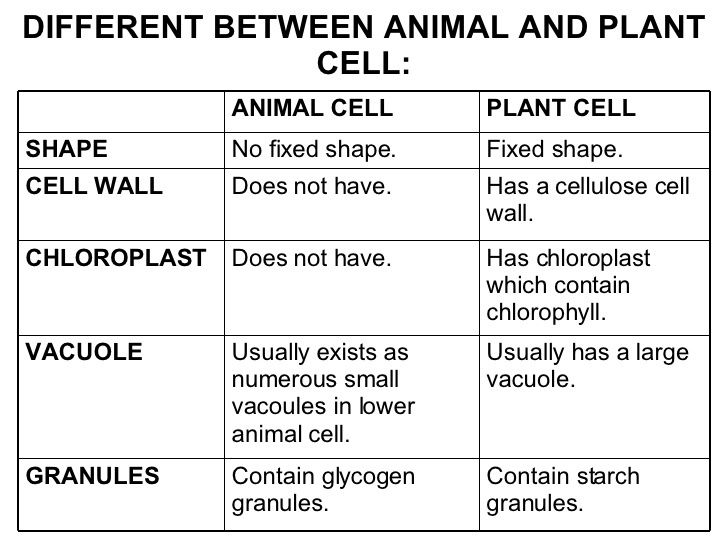
Nucleus - 17What are 5 differences between a Plant cell and an Animal cell?
- 18Define a Unicellular OrganismThis is an organism which is made up of one (1) cell which is capable of carrying out all essentials of life.
- 19Define a Multicellular OrganismThis is an organism comprised of many cells that have been specialized to carry out a process that is essential to life.
The specialization begins with organelles, which work together to form cells. These cells have specific tasks in which they work together on making them Tissues. Tissues work together to form Organs. Organs together to form Organ Systems. This results in a Multicellular Organisms. - 20Chapter 3The Chemistry of Life
- 21What is a Carbohydrate?This is a compound consisting of Carbon, Hydrogen and Oxygen.
There are 3 types of Carbohydrates:
Monosaccharides
Disaccharides
Polysaccharides - 22What is a Monosaccharide?These are single sugars that are sweet and soluble.
Examples are:
Glucose
Fructose
Galactose - 23What is a Disaccharide?These are double sugars that are sweet and soluble, they are formed by the condensation of 2 single sugars.
Examples are:
Maltose (Glucose + Glucose)
Sucrose (Glucose + Fructose)
Lactose (Glucose + Galactose) - 24What is a Polysaccharide?These are multi-sugars that are not sweet or soluble, formed by the condensation of monosaccharides into straight or branched chains.
Examples are:
Starch
Glycogen
Cellulose - 25What is a Lipid?This is a compound consisting of Carbon, Hydrogen and Oxygen.
Each lipid molecule is made up of 4 smaller molecules, 3 Fatty Acids molecules and 1 Glycerol molecule. - 26What is a Protein?These consist of Carbon, Hydrogen, Oxygen and Nitrogen (sometimes Sulphur)
The atoms bond to form Amino Acids which are joined by peptide links which form chains called polypeptides. Several Polypeptides join by peptide links to form Protein Molecules. - 27What is an Enzyme?Enzymes are biological catalysts, which speed up chemical reactions without being changed.
- 28What are the Characteristics of Enzymes?1) Enzymes are proteins. They produced my amino acids obtained by food in animals or manufactured by plants.
2) Enzymes are Specific. They each control one type of chemical reaction and make the same products.
3) Enzymes can be Reused. They do not get altered by reactions.
4) Enzymes are only needed in small amounts because they can be reused.
5) Enzymes work best at Optimum Temperature, around 37 degrees Celsius.
6)High temperatures denature Enzymes.
7) Enzymes work best at optimum pH which is around 7.
8) Enzymes are typically denatured by High or Low pH levels.
9) Enzymes are helped by Vitamins and Minerals
10) Enzymes are inhibited by poison. - 29Chapter 4Nutrition
- 30What are the types of Nutrition?1) Autotrophic
2) Heterotrophic Nutrition - 31What is Autotrophic Nutrition?These are organisms that manufacture organic foods from inorganic compounds such as Carbon Dioxide using a source of energy.
1) Photosynthesis (in green plants) uses energy trapped from sunlight.
2) Chemosynthesis (in some bacteria) uses the energy from the decaying of inorganic compounds. - 32What is Heterotrophic Nutrition?These are organisms that obtain ready made organic food from their environment.
1) Holozoic Nutrition - Organic food is obtained by consuming other organisms.
2) Saprotrophic Nutrition - Soluble Organic food is gained from dead organic matter
3) Parasitic Nutrition - Organic food is obtained from the body of another organism (host) which is harmed. - 33What are the 6 classes of food that all organism require?They are:
1) Carbohydrates
2) Lipids
3) Proteins
4) Vitamins
5) Minerals
6) Water
Informationen
- Beschreibung
- This has everything in Bio for CXC
- Erstellt von
- Caleb Merrique
- Aufrufe
- 50
- Tags
- Bewertung