
Karteikarten
Cofactors
Karten in diesem Stapel (10)
- 1What are cofactors?Non-protein substances which bind to enzymes and allow them to work
- 2What are the 3 types of cofactors?Inorganic cofactors
Coenzymes
Prosthetic groups - 3What is the role of inorganic cofactors?Inorganic cofactors help the enzyme and substrate to bind together. They don't directly participate in the reaction so are not used up or changed
- 4TRUE OR FALSE: Inorganic cofactors remain unchanged in a reactionTRUE
- 5Give an example of an inorganic cofactorAmylase only digests starch to maltose if chloride ions (Cl⁻) are present
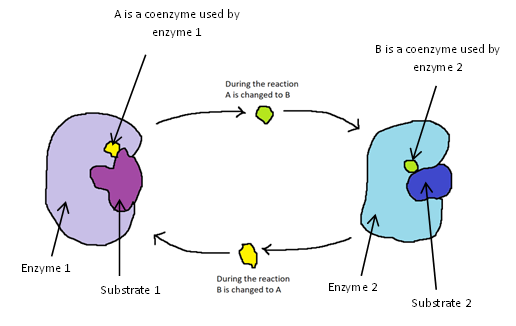
- 6What are coenzymes?Organic molecules that bind temporarily to the active site. They often act as carriers, moving chemical groups between different enzymes; they are continually recycled
- 7TRUE OR FALSE: Coenzymes remain chemically unchanged during a reactionFALSE
Coenzymes are chemically changed and need to be converted to their original state before reuse - 8Give an example of coenzymesVitamins are sources of coenzymes
Therefore, a lack of vitamins means enzymes will not work properly - 9How do prosthetic groups work?They permanently bind to an enzyme by covalent bonds
- 10Give an example of prosthetic groupsZinc ions (Zn²⁺) are a prosthetic group for carbonic anhydrase (an enzyme in red blood cells which catalyses the production of carbonic acid from water and CO₂)
Informationen
- Beschreibung
- A level Biology (2.1.4 Enzymes) Karteikarten am Cofactors, erstellt von Yinka F am 27/01/2018.
- Erstellt von
- Yinka F
- Aufrufe
- 161
- Bewertung