
Karteikarten
Computer Science Flash Cards
Karten in diesem Stapel (48)
- 1What does CPU stand for and what is it?Central Processing Unit
Known as the brain of the computer and its job is to process data by searching, sorting, calculating and decision making. - 2What is the fetch-execute cycle?It gets the data from memory where it is stored in temporary memory called registers, it then decodes the instruction to understand what it is saying then it executes the instruction where the data processing takes place.
- 3What is the address bus?They are a collection of wires that connect the CPU with main memory that is used to identify particular locations in main memory. Used to locate data from RAM. The data that is located are called addresses and the bus transfers data addresses to and from the control unit.
- 4What is Clock Speed?The operating speed of a computer or its microprocessor expressed in cycles per second. It is measured in Megahertz.
- 5How does the number of cores your computer has affect the speed?A CPU contains one or more processing unit, each unit is called a core. A core contains ALU, control unit and registers. It is common for computers to have dual, quad or more cores. CPUs with multiple cores have more power to run multiple programs at the same time.
- 6What is a cache?It is similar to a RAM, they are both temporary memory locations, it's where data is stored that needs to be recalled quickly. The larger the cache the faster your computer would potentially run.
- 7What are the base numbers for binary?128, 64, 32, 16, 8, 4, 2, 1
- 8How many digits is hexadecimal made of?16
- 9What are the 16 digits for hexadecimal?0,1,2,3,4,5,6,7,8,9,A,B,C,D,E,F
- 10What is an overflow?The generation of a number or other data item which is too large for the assigned location or memory space.
- 11What is a GPU?Graphics processing unit, single chip processor that makes lighting effects and transforms objects every time a 3D scene is redrawn. It is used for 3D applications.
- 12What is parallel computing?Software written for serial computation, problem is broken into a discrete series of instructions, instructions are executed sequentially one after another, executed on single processor, only one instruction may execute at any moment in time.
- 13What is the difference between CISC and RISC?Both are computing systems developed for computers. The difference is critical to understanding how a computer follows your instructions. The number of cycles each instruction takes. CISC may have more cycles before completion than RISC.
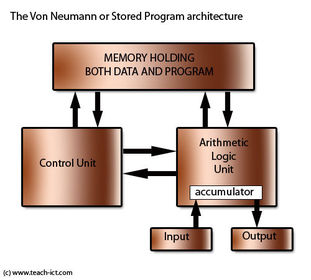
- 14What are the features of the von Neumann architecture?Memory, control unit, input-output, Logic unit, bus, conclusion.
- 15Explain the diagram of the Von Neumann Architecture?
- 16What is the difference between main memory and cache memory?A CPU cache is used by the CPU of a computer to reduce the average time to access memory. Cache is smaller, faster memory which stores copies of the data from the most frequently used main memory locations.
- 17What is Harvard architecture?Separate storage and signal pathways for instructions and data.
- 18What is the DPA?Data Protection Act is a law designed to protect personal data stored on computers or in a paper filing system.
- 19What are the 8 principles of the DPA?Fairly and lawfully processed.
Processed for limited purposes.
Adequate, relevant and not excessive.
Accurate.
Not kept for longer than necessary.
Processed in line with rights.
Secure.
Not transferred to other countries. - 20What is the Computer Misuse Act?Developed to cope with hackers and viruses.
- 21Who is the information commissioner?Person who has the power to enforce the act.
- 22Who is the Data Controller?Person or company that collects and keeps data about people.
- 23Who is the Data Subject?Person who has data about them stored outside their direct control.
- 24What is personal data?It's about living people and could be your address, name or phone number etc.
- 25What is sensitive data?Also about living people, but it includes one or more details of a data subject for example religion and criminal record.
- 26Who is exempt from the DPA?Any data held for national security reasons, police can access data to solve crimes.
- 27What is the definition of a Virus?They copy and transfer themselves without any user helping them and can cause great harm even if all they do is consume network resources and slow down the network.
- 28What is the definition of a worm?Program that enters computer without permission by attaching themselves to files and emails, where it corrupts and deletes files on your computer.
- 29What is a Trojan horse?Pretends to be something useful so the user downloads it onto their system where it then causes damage to the files and computer.
- 30What is spyware?Collects information, about users without knowledge. They get installed and take names, numbers and addresses also passwords.
- 31What is Copyright?Exclusive, legal right given to originator to print, film, record and to authorize others to do the same.
- 32What is the purpose of the copyright law?To ensure people are rewarded for creativity. Give protection to copyright holder.
- 33What is a RFID?Provides a unique identifier for that object. And, just as a bar code or magnetic strip must be scanned to get the information.
- 34What are the advantages of RFID?Use to pay, swap contacts, doctors, access doors, tracker, size of tablet, monitor health.
- 35What are the disadvantages of RFID?Tracked anywhere, medical records, address.
- 36Advantages of Star Topology?Reliable if cable fails, high performing.
- 37Disadvantages of Star Topology?Expensive to install, extra hardware, if the hub fails there is no internet connection.
- 38Advantages of Ring Topology?Transfer data quickly, no data collisions.
- 39Disadvantages of Ring Topology?If cable is faulty or fails then the entire network will fail.
- 40Advantages of Bus Topology?Easy to install, Cheap.
- 41Disadvantages of Bus Topology?Network fails if cable fails, there are more work stations so it is slower.
- 42What is a computer network?Two or more devices connected to share information and resources.
- 43What is a protocol?Set of rules followed to be achieved. Affects what type of computer your network connects.
- 44What is packet switching?Message broken into parts then sent separately and then reassembled at the destination.
- 45What does CAN stand for and give one characteristic?Campus area network - used in universities, it is larger than LAN but smaller than MAN.
- 46What does PAN stand for and give one characteristic?Personal area network - hotspot to sync phones and laptops together.
- 47What does WAN stand for and give one characteristic?Wide area network - Spans large physical distance.
- 48What does LAN stand for and give one characteristic?Local area network - network devices connected over short distance.
Informationen
- Beschreibung
- Revision cards to print off to help with revision
- Erstellt von
- PRO PENGUIN GAMER · Jul 2018
- Aktualisiert
- 13 Jul 2018
- Aufrufe
- 2
- Tags
- Verlauf
-
- Erstellt von Harman Rai · 7 Dez 2015
- Kopiert von PRO PENGUIN GAMER · 13 Jul 2018
- Bewertung