
Karteikarten
electronic structure
Karten in diesem Stapel (80)
- 1Only electrons are involved in thechanges that happen during chemical reactions.
- 2The Bohr Model of the atom and electron shellsQuantum theory to electrons and proposed:-
Electrons can only be found in specific energy levels called shells or quantum shells.
The electrons in the shell closest to the nucleus have lowest energy. Energy increases as the shells become further from the nucleus.
If an electron moves from a lower energy shell to a higher energy shell a ‘packet’ of energy known as a quantum has to be absorbed.
Each shell can only hold a set maximum number of electrons.
Lower energy shells are occupied first. - 3Each principal quantum shell is composed of a number ofsubshells of slightly different energy.
- 4The different subshells are given the notations, p, d and f.
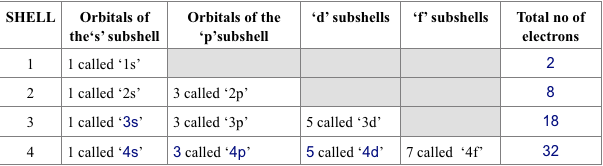
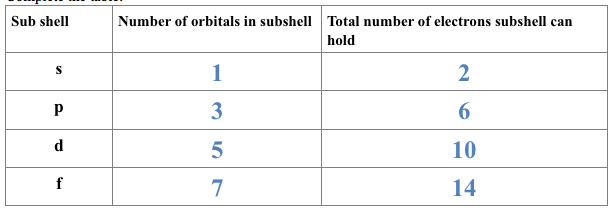
- 5The subshells contain orbitals:-each ‘s’ subshell contains one orbital
each ‘p’ subshell contains three orbitals
each ‘d’ subshell contains five orbitals
each ‘f’ subshell contains seven orbitals - 6An orbital isa region of space which represents the mathematical probability of finding an electron.
- 7An orbital can hold a maximum oftwo electrons.
They have ‘opposite spins’ to reduce repulsion. This is sometimes called spin pairing. - 8Apply this information to complete the table and work out the maximum electrons in each shell:
- 9The first orbital to be filled would therefore be the1s
- 10Which orbital would you expect to be filled next?2s
- 11ORDER OF FILLING THE ORBITALS WITH ELECTRONS
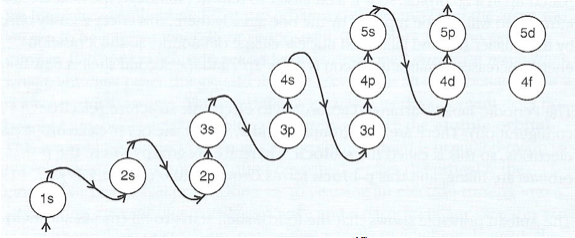
- 12aufbau principle:Electrons will fill the lowest energy orbital available, one at a time.
No more than two electrons occupy any one orbital.
If there are several orbitals of the same energy available electrons will enter the orbitals singly with the same spin before pairing up.
When pairing up electrons will have opposite spins. - 13SHORTENED ‘ELECTRONIC CONFIGURATIONS’ When considering the electronic structure of an atom we now need to state:-the principal quantum shell
the subshells
and finally the number of electrons in each subshell. - 14sodium electron configuration atomic number 11Na = 1s2 2s2 2p6 3s1
- 15K = atomic number 191s2 2s2 2p6 3s2 3p6 4s1
- 16N = atomic number 71s2 2s2 2p3
- 17O = atomic number 81s2 2s2 2p4
- 18F = atomic number 91s2 2s2 2p5
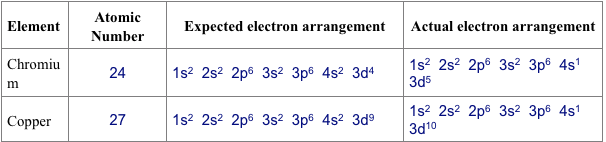
- 19There are 2 exceptions to this ruleCopper and Chromium.
half and full shells are more stable, both copper and chromium are one electron away from these configurations, therefore they ‘borrow’ an electron from the 4s orbital - 20Cr = atomic number 241s2 2s2 2p6 3s2 3p6 4s1 3d5
- 21Cu = atomic number 29

- 22These can become somewhat lengthy to write out and so can be abbreviated by putting the structure of the next lowest noble gas in brackets. So the structure of potassium can be writtenK = [Ar],4s1
where [Ar] = 1s2 2s2 2p6 3s2 3p6 - 23ELECTRON STRUCTURE AND IONSWhen an atom forms a positive ion, electrons are lost from the highest energy orbital
When an atom forms a negative ion, electrons are added to the highest energy orbital - 24Sodium cation, Na+ = atomic number 111s2 2s2 2p6 = [Ne]
We can see that the stable ion formed has the electronic structure, is isoelectronic with the nearest noble gas, in this case neon. - 25Fluoride anion, F- = atomic number 91s2 2s2 2p6 = [Ne]
We can see that the stable ion formed has the electronic structure, is isoelectronic with the nearest noble gas, in this case neon. - 26Define what you understand by an orbital.3D region of space where there is a high mathematical probability of finding an electron.
- 27An appreciation of their shapes allows us to :-deduce the bonds between atoms
predict the shapes of ions and molecules
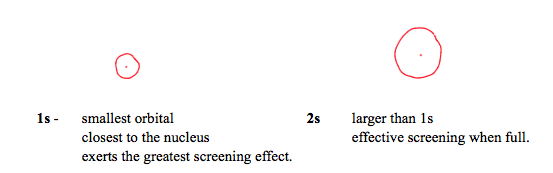
explain the stability of certain structures. - 28s orbitalsSpherical orbitals which can hold up to 2 electrons.
Full orbitals are more stable. - 29s orbitals
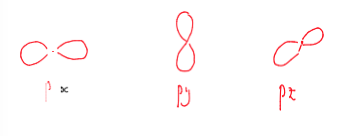
- 30p orbitalsDumb-bell shaped orbitals centred on the nucleus
Three orbitals have the same energy level.
They are aligned along the x, y, and z axis and given the notation px, py, and pz.
Each orbital fills with 1 electron first.
Half filled sub-shell px1 py1 pz1 is relatively stable.
Subsequent electrons pair up with opposite spins.
(Draw diagrams to show the orbitals and orientation) - 31p orbitals~
- 32d orbitalsMore complex shapes.
Five orbitals at the same energy level
Half filled orbitals occupied by electrons with the same spin are more stable.
Full subshell is even more stable. - 33d orbitals
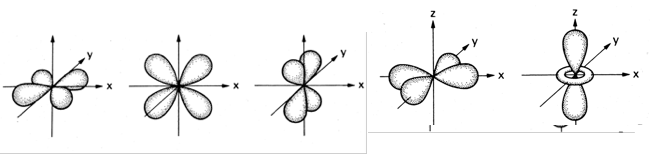
- 34ELECTRON DENSITY PLOTS FOR s AND p ORBITALSIt is not really correct to refer to atomic orbitals as having a specific ‘shape’. The regions of highest electron density appear to describe shapes in space, and it is useful for us to remember those shapes when thinking about atomic properties and chemical bonding.
The following cloud plots are more accurate representations of the atomic orbitals, and familiarity with the actual electron distribution patterns is invaluable to understanding the resulting chemical behaviours. - 35What would you expect 2px to look like?Same as 2pz but orientated in and out of the page
- 36What is the difference (if any) between these orbitals? 2s and 3s2s is smaller than 3s and lies within it
- 37SUMMARY OF SUBSHELLS
- 38Remind yourself of the order in which electrons enter the subshells by writing in the order starting with 1s and finishing with 4f.1s2 2s2 2p6 3s2 3p6 4s2 3d10 4p6 5s2 4d10 5p6 6s2 4f14 5d10 6p6
- 39Because the ‘d’ subshell of the previous shell is slightly higher in energy than the next ‘s’ subshell, it is normally filled after the ‘s’ subshell. E.g. 4s is filled before 3d. However, this is not true ifa stable half filled or full d subshell can be formed.
- 40Remember the following 2 exceptions
- 41What do you understand by the process of ionisation?Loss of electrons
from an atom or group of atoms or ions or molecule or particle - 42Why does this process occur?. When an electron gains sufficient energy to escape from the pull of the nucleus
- 43If an atom loses one or more electrons it is said to have been ionised and forms a positively charged cation. This process requires energy, the amount depends on:-distance of the electron(s) from the nucleus
degree of attraction by positive protons
shielding of nuclear charge by complete inner shells of electrons - 44For the first ionisation energy of an element M this process may be written:-

- 45The symbol used to represent the energy change is ΔHi(1) whereΔH is the heat energy or enthalpy change, units kJ mole-1.
i refers to ionisation energy
(1) is the first ionisation energy i.e. removal of the first electron - 46Define the first ionisation energy of an elementThe energy required to
remove one mole of electrons from one mole of gaseous atoms
to form one mole of gaseous ions each with a +1 charge. - 47How many ionisation energies can an element have?As many as there are electrons to remove.
Same number as the atomic number. - 48Explain why the second ionisation energy is much greater than the first.Second electron is held more strongly by the excess of protons in the +ve ion
- 49Why does sodium form an ion of one positive charge, Na+, whereas magnesium forms the ion Mg2+?To remove the second electron from Na+ requires ten times the amount of energy that was needed to remove the first.
Removal of the second electron from Mg+ only requires ⅓ energy compared to ΔHi(Na) - 50Aluminium forms both ionic and covalent compounds. Suggest a reason for the covalent nature of aluminium in some compoundsLarge amount of energy to remove 3e- (5140 kJ mol-1) is not compensated by formation of
ionic lattice so sharing electrons(covalent bonding) is more energetically favourable. - 51Predict the relative values for the first and second ionisation energies of potassium.ΔHi(1)K would be lower than ΔHi(1)Na. ΔHi(2)K would be approx 10 x ΔHi(1)K
- 52Define the second ionisation energy of potassiumThe energy required to remove one mole of electrons from one mole of gaseous K+ ions to form one mole of gaseous K2+ ions each with a 2+ charge.
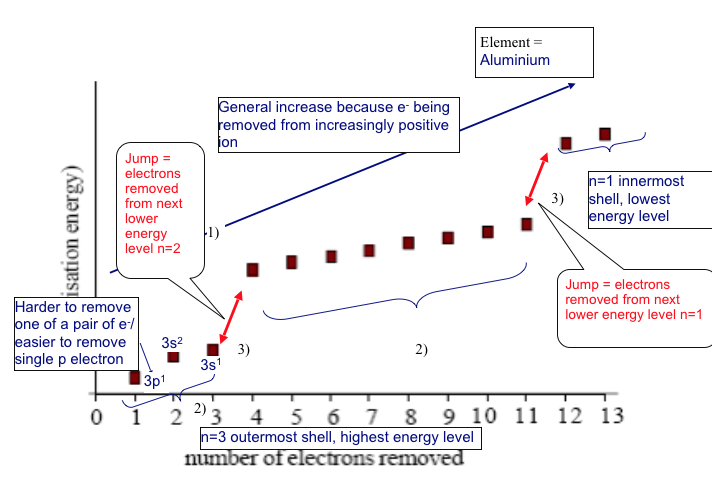
- 53WHAT DO IONISATION ENERGIES TELL US ABOUT SHELLS AND SUBSHELLS? We are going to look in detail at two processes:-1) The loss of all electrons from one atom.
This will provide us with evidence on how electrons are arranged in quantum shells.
2) Loss of one electron from successive atoms in the periodic table.
This will provide us with evidence for sub-shells. - 54Successive ionisation energies: …the energy required to remove an electron one by one from the same atom
- 55The energy required to remove successive electrons from an atom depends on:-size of the +ve nuclear charge, number of protons
screening effect of completed inner electron shells
distance of the electron from the nucleus - 56a) A sketch graph of the log10 of the successive ionisation energies for sodium
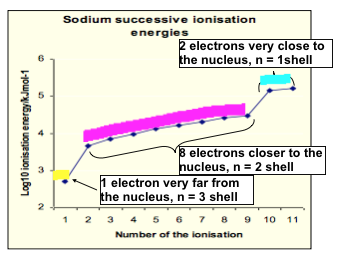
- 57Explain the discontinuities in the graphElectrons are being removed from a shell closer to the nucleus (lower Energy level) so require more addition of energy to remove them
- 58Why is there a gradual increase in ΔHi as electrons are successively removed from a particular shell.Removal of an electron from an increasingly +ve ion will require more energy as it is held more strongly.
- 59Why is a logarithmic scale used?The range of values is too great, provides a better scale allowing patterns to be seen.
- 60How would you expect ionisation energies to vary with increasing proton number?ΔHi increases – greater attraction of electrons to positive nuclear charge
- 61How would you expect ionisation energy to vary with more shieldingΔHi decreases – less attraction of electrons to positive nuclear charge
- 62How would you expect ionisation energy to vary with the size of the original atom?ΔHi decreases as ionic radius increases
- 63In general how does the first ionisation energy vary across a period (L to R). ................................... Explain in terms of proton number, inner shielding and effective nuclear charge.proton number increases by one, inner shielding remains constant so there is a greater attraction of outer electrons to nucleus so the radius decreases and ΔHi increases
- 64How does the first ionisation energy change on going down a group? Explain why.Proton number increases but there is one extra completed inner shell of electrons so radius increases and ΔHi decreases
- 65PERIODICITY -a repeating pattern across successive periods of the periodic table.
- 66What is the general trend across a period?increase
- 67State the group with the highest ionisation energy within a period.Group VIII
- 68State the group with the lowest ionisation energy within a period.Group I
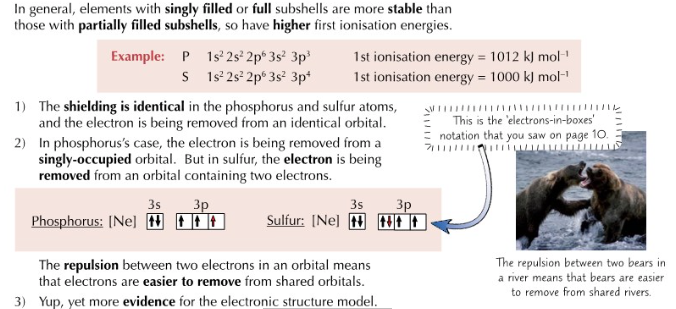
- 69Between which elements and groups are there minor discontinuities?Between Groups II and III (Be-B and Mg-Al) and between Groups V and VI (N-O and P-S)
- 70—.
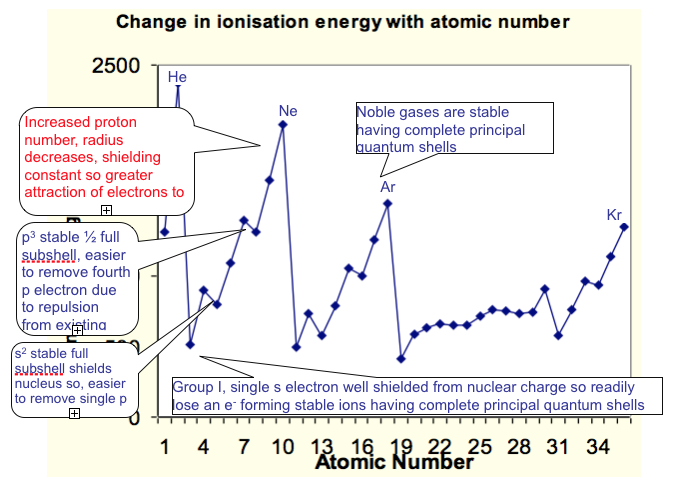
- 71First ionisation energies of successive elements 1) Within a period:- Why does ΔHi increase?.. Increased proton number, radius decreases, shielding constant so greater attraction of electrons to nucleus
- 72First ionisation energies of successive elements 1) Within a period:- Why is there a small decrease between the elements Be and B as well as between Mg and Al?s2 stable full subshell, easier to remove single p electron
- 73First ionisation energies of successive elements 1) Within a period:- Why is there a small decrease between the elements N and O as well as between P and S?p3 stable ½ full subshell, easier to remove fourth p electron due to repulsion from existing electron
- 74First ionisation energies of successive elements 1) Within a period:- Why are the Noble gases at peaks?They are stable having complete principal quantum shells
- 75First ionisation energies of successive elements 1) Within a period:- Why do Group I elements have the lowest ΔHi(1)?Group I, single s electron well shielded from nuclear charge so readily lose an e- forming stable ions having complete principal quantum shells
- 76First ionisation energies of successive elements Down a group:- Why does the ΔHi(1) decrease? (give three reasons.)Increased nuclear charge BUT increased shielding so effective nuclear charge constant.
Increased radius
Electron is in a higher energy level shell - 77—.
- 78electron configuration decides the chemical properties of an element
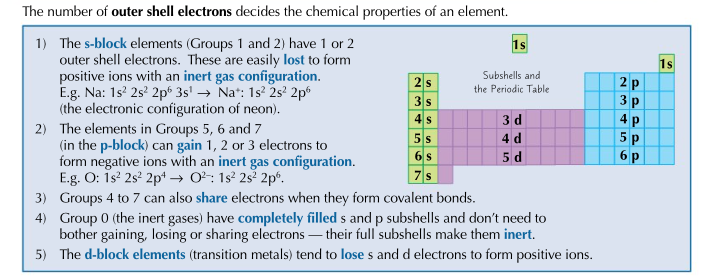
- 79The drop between groups 2 and 3 shows subshell structure
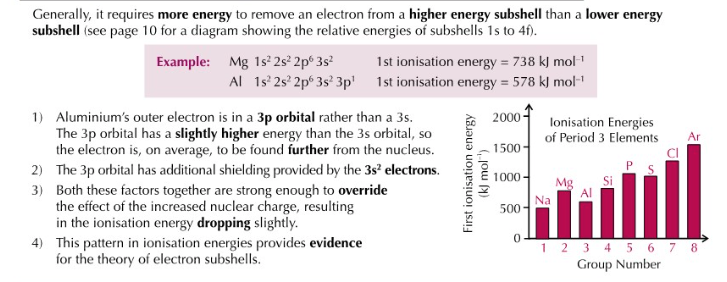
- 80The drop between groups 5 and 6is due to electron repulsion
Informationen
- Beschreibung
- A level Chemistry Karteikarten am electronic structure , erstellt von megan trent am 19/03/2019.
- Erstellt von
- megan trent
- Aufrufe
- 0
- Bewertung