
Karteikarten
Biology B3
Karten in diesem Stapel (113)
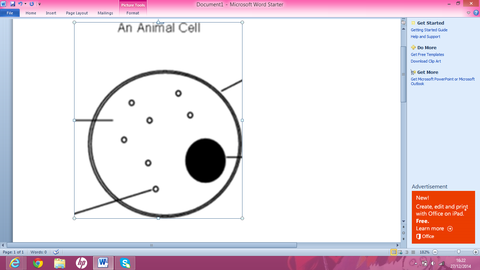
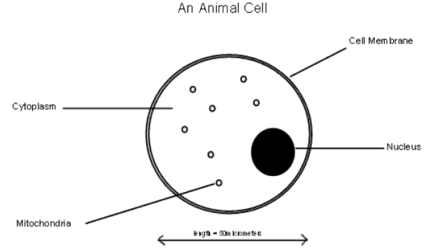
- 1—nucleus, cytoplasm, cell membrane, mitochondria, ribosome
- 2WHAT DOES THE RIBOSOME DO IN A CELL?The ribosome controls which substances can come in and out of the cell
- 3WHAT IS THE NUCLEUS' ROLE?It carries the cells genetic info(DNA)
- 4WHAT IS THE MITOCHONDRIA FOR?Energy is release during respiration here
- 5WHICH BASES GO WHITH WHICH IN THE DOUBLE HELIX?A goes with T and G goes with C
- 6WHERE IS THE GENETIC INFO CARRIED IN THE DOUBLE HELIX?In its chromosomes
- 7WHO DISCOVERED THE DOUBLE HELIX STRUCTURE? (3)Rosalyn Franklyn,
Francis Crick and Jim Whatson - 8WHAT IS THE PURPOSE OF THE DNA?To make protiens
- 9HOW ARE PROTIENS MADE? (5)1.The DNA code/sequence of bases are copied to make mRNA
2.It is then carried to the RIBOSOMES
3. Proteins are made in the cytoplasm by the ribosomes
4.A group of 3 bases code for an amino acid.
5.The amino acids join and make a protien - 10WHERE DOES THE AMINO ACIDS JOIN TOGETHER IN THE CELL?Ribosome
- 11WHAT IS A MUTATION? WHAT DOES IT DO? (4)-The change in the GINETIC CODE
-The base sequence changes the AMINO ACID sequence.
-The SHAPE of the protein is altered which changes how it FUNCTIONS.
- A mutation can also stop a protein from being made. - 12WHAT IS AN ENZYME? WHAT IS IT MADE OF?An enzyme is a BIOLOGICAL CATALYST that is made of protein
- 13HOW DOES THE LOCK AND KEY THEORY WORK? (4)-There are many different subtrates that fit in specific enzymes.
-The reaction takes place in the active site (between the enzyme and subtrate)
-The subtrate complex is formed.
-The product is then released - 14WHAT IS A STUBSTRATE?It is the molecule at the start of the reaction
- 15WHAT IS THE ACTIVE SITE?The place in which the ENZYME and SUBTRATE BOND
- 16WHAT FACTORS EFFECT ENZYME ACTIVITY?Temperature and pH
- 17HOW DOES TEMEPERATURE AFFECT ENZYME ACTIVITY? (3)- If the temp is LOW, it is hard for the enzyme to collide with the substrate because of low energy
-If the temperature is OPTIMUM (the right amount) then the enzymes collide with the subtrates a lot.
-If it is TO HOT for the enzymes and subtrates, it makes it the hardest for the subtrates and enzymes to collide. - 18HOW DOES PH EFFECT ENZYME ACTIVITY?Less enzymes react with subtrates because the subtrates are DE-NATURED
The optimum pH allow enzymes to react a lot more with subtrates.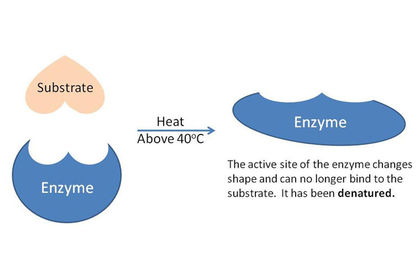
- 19WHAT IS THE TYPE AND FUNCTION OF THE COLLAGEN PROTEIN?SRTUCTRAL
It make the walls of arteries stronger - 20WHAT IS THE TYPE AND FUNCTION OF THE INSULIN PROTEIN?HORMONE
To control blood glucose levels - 21WHAT IS THE TYPE AND FUNCTION OF THE HOEMOGLOBIN PROTEIN?MOLECULE CARRIER
Carries oxygen around the body - 22WHAT IS AN INDEPPENDENT VARIABLE?Something that can be changed
- 23WHAT IS DEPENDENT VARIABLE?Something that you need to measure
- 24WHAT IS CONTROL?Something that stays the same
- 25RESPIRATION WORD EQUATION?Oxygen + glucose --- carbon dioxide + water
- 26RESPIRATION QUOTIENT FORMULA?RQ= carbon dioxide produced
---------------------------------------
oxygen made - 27HOW DO YOU MEASURE REPIRATION RATE?With a RESPORIMETER, it measures the respiration rate by calculation of the volume of carbon dioxide of oxygen made
- 28WHAT IS RESPIRATION FOR?To carry out life processes (making proteins, temperature and muscle contractions)
- 29WHERE DOES RESPIRATION OCCUR IN A CELL?Mitochondria
- 30WHAT IS THE ATP? WHAT IS IT USED FOR?It is an energy source that is used for the cells processes
- 31WHAT DOES BLOOD CONSTIST OF?-Red blood cells
-white blood cell
-platelets - 32WHAT DO RED BLOOD CEELLS DO?It carries the oxygen around the body
- 33WHAT DO WHITE BLOOD CELLS DO?Kills viruses, unhealthy bacteria and fights diseases.
- 34WHAT DOO PLATELETS DO?Clots blood which is used to heal open wounds and cuts.
- 35WHAT FACTORS DO RED BLOOD CELLS HAVE THAT ARE EFICIANT FOR ITS FUNCTIONS? (5)-A dent in the centre allows more oxygen to be absorbed.
-It has a small shape but large surface area
- They are small so they can carry oxygen to all parts of the body
-there is no nucleus so it can carry more oxygen
-they are able to join onto a chemical called haemoglobin which allows it to be transported around the body - 36WHAT FEATURES DOES A ARTERY HAVE? (4)-a small lumen
- the blood is at a high pressure
-carries blood away from the heart
-blood is oxygenated - 37WHAT FEATURES DO RED BLOOD CELLS HAVE THAT ARE EFFICIENT FOR THEIR FUNCTIONS? (5)-No nucleus so more oxygen can be absorbed
-very small so they can carry oxygen to all parts of the body
-has a large surface area
- have a dent in the middle to absorb a lot of oxygen
-join onto a chemical(haemoglobin) so it can be transported around the body - 38WHAT FACTORS DOES AN ARTERY HAVE? (4)-blood pressure is high
-carries blood away from the heart
-has a large vacuole
-blood is OXYGENATED - 39WHAT FACTORS DOES A VEIN HAVE? (5)-blood is at a low pressure
-carries blood to the heart
-has a large lumen
-blood is DE-OXYGENATED
-has valves to stop blood from flowing the wrong way - 40WHAT FACTORS DOES A CAPILLARY HAVE? WHAT IS IT USED FOR? (5)-its wall is one cell thick
-it joins arteries and veins
-carries blood to the tissues
-permeable to allow materials to pass through
-has a small lumen (only fits on blood cell at a time) - 41WHAT IS THE SINGLE CIRCULATORY SYSTEM?The blood only passes through the heart once in one circuit. There are only two chamber in the heart. (only fish)

- 42WHAT IS A DOULE CIRCULATORY SYSTEM?The blood passes through the heart twice in one circuit. it has 4 chambers in the heart (only birds and mammals)
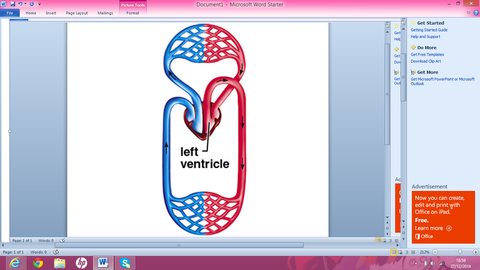
- 43WHAT IS THE FUNCTION OF THE HEART? THE RIGHT SIDE? THE LEFT SIDE?-The function of the heart is to pump blood around the body.
-The right side pumps blood to the lings
-The left side pumps blood to the rest of the body - 44—
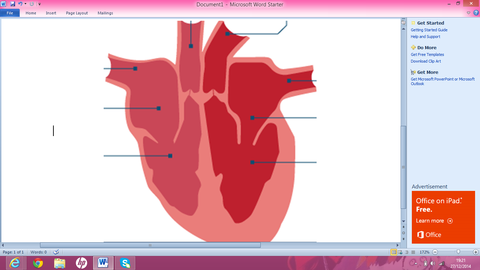
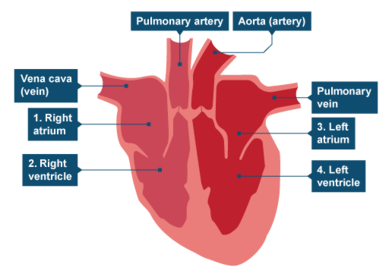
- 45DESCRIBE THE JOURNEY OF THE RED BLOOD CELL (8)-The red blood cells become oxygenated from when they come from the lungs
-the blood then goes into the PULMONARY VEIN (bringing oxygen from the lungs to the LEFT ATRIUM
-its then pumped out through the LEFT VENTICAL then the AORTA to the body.
-the oxygenated blood is pumped around the body.
-It eventually becomes deoxygenated
-it is then pumped back into the heart through the VENA CAVA
-passes through the RIGHT ATRIUM, RIGHT VENTRICLE and out of the PULMONRY ARTERY into the lungs
-process begins again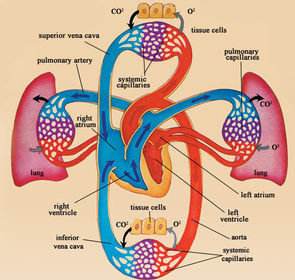
- 46WHAT IS AN ATRIA?Chambers that receive blood
- 47WHAT ARE VENTICLES?Chamber that pump the blood
- 48WHAT ARE BICUSPID/ TRICUSPID/ SEMI LUNA VALVES FOR?They prevent blood flowing backwards
- 49WHAT ARE AORTAS FOR?Takes oxygenated blood to the body
- 50WHAT DOES THE VENA CAVA DO?Takes de-oxygenated blood to the heart
- 51WHAT DOES THE PULMONARY ARTERY DO?Takes the de-oxygenated blood to the heart also
- 52WHAT IS ANEROBIC RESPIRATION?Is something that takes place during hard exercise when there is insufficient oxygen available.
- 53WHAT IS THE WORD EQUATION FOR ANAEROBIC RESPIRATION?GLUCOSE---- LACTIC ACID(+ ENERGY)
- 54DISSADVANTAGES OF ANAEROBIC RESPIRATION? (2)-The lactic acid that is made by anaerobic respiration builds up in muscles which causes PAIN and FATIGUE
-Anaerobic resp releases a lot less energy than aerobic resp. - 55WHAT IS OXYGEN DEPT?The incomplete breakdown of glucose resulting in the build up of lactic acid .
- 56HOW DOES THE BODY RECOVER FROM ANAEROBIC RESPIRATION?High BREATHING rate and high HEART rate
- 57HOW DOES HIGH HEART AND BREATHING RATE HELP RECOVER FRO ANAEROBIC RESPIRATION? (2)-rapid blood flow can carry the lactic acid to the liver faster.
-extra oxygen can be supplied which enables the liver to break down the lactic acid - 58WHAT IS MEANT BY UNICELLULAR?Things are only consist of one cell
- 59WHAT IS MEANT BY MULTICELLULAR?Made of more than one type of cell?
- 60HOW DO UNICELLULAR ORGANISMS REPRODUCE?The organisms cells divide to form two new cells
- 61WHAT ARE THEIR CELLS SURFACE AREA TO VOLUME RATIO?Unicellular organisms have a small volume but a large surface area
- 62HOW DOES OXYGEN AND NUTRIENTS GET INTO A UNICELLULAR ORGANISM?They absorb it
- 63HOW DO MULTICELLULAR ORGANISMS REPRODUCE?Through sexual reproduction, it needs a partner to produce
- 64WHAT IS A MULTICELLULAR ORGANISMS CELL SURFACE AREA TO VOLUME RATIO?A large volume but a small surface area
- 65HOW DO OXYGEN AND NUTRIENTS GET INTO A MULTICELLULAR ORGANISMS CELLS?They have a specialised organ system
(nervous system, transport system, respiratory system) - 66WHAT IS CELL DIFFERENCIATION?When cells become specialised
- 67HOW DOES DNA REPLICATE? (3)-An enzyme unzips the DNA (double helix)
-the free bases join with their complimentary pair(A and T, G and C)
-a new double helix is made - 68WHAT ARE THE TWO TYPES OF CELL DEVISION?Mitosis and Meioosis
- 69WHAT IS THE MITOSIS CELL DEVISION USED FOR?Cell repair and replacement of the body cells
- 70WHAT IS MEIOSIS CELL DEVISION USED FOR?Making new gamete/sex cells
- 71WHAT IS CELL DEVISION NEEDED FOR? (3)-To replace dead cells
-To repair broken or damaged cells
-Asexual reproduction - 72WHAT ARE THE STEPS OF MITOSIS CELL DEVISION? (5)-Chromosomes in nucleus copied
-Chromatids line up
-Chromosomes are pulled apart
-nucleus divides
-two genetically identical cells produced - 73WHAT ARE THE STEPS OF MIEOSIS CELL DEVISION? (4)-chromosomes in a parent cell are copied to give two homologous pairs.
-chromosome pairs separate
-the chromosome strands separate
-4 haploid cells are produced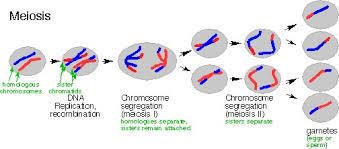
- 74—A. Acrosome- contains enzymes to digest egg cell
B. cell nucleus
C. Mitochondria -to release energy
D. Tail -to swim to the egg with
E. nucleus -contains cells DNA
F. Corona radiate -layer of cells that nourish the cell.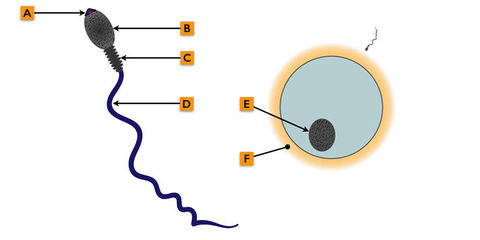
- 75MITOSIS ------------------------------ 1.Number of cells produced? 2.Number of chromosomes(haploid/ diploid) 3. Genetically identical? 4.Used for?1. 2
2. 2 haploid
3.yes
4. repair and replacement of body cells - 76MEIOSIS ------------------------------ 1. Number of cells produced? 2. Number of chromosomes(haploid/ diploid) 3. Genetically identical? 4. Used for?1. 4
2. 4 Haploid
3. No
4. Making sperm and egg cells/gametes/sex cells - 77HOW DO YOU PREPARE AN ONION? (6)-Peel of a layer of onion(epidermis)
-place on a glass slip/microscope slide
-add 4 to 5 drops of iodine
-place the cover slip on top
-put on the microscope stage
-focus the microscope - 78WHAT ARE THE SIMILARITIES BETWEEN PLANT AND ANIMAL GROWTH? (2)-Both cells have special places for cell division to take place.
-cell division takes place in both cells - 79WHAT ARE THE DIFFERENCES BETWEEN PLANT AND ANIMAL GROWTH? (3)-Plants have three phases of rapid growth but animals only have 2
-plant cells retain the ability to differentiate unlike animal cells
-plant cells get larger as well as dividing, animal cells only divide - 80WHAT ARE THE THREE WAYS OF MEASURING MASS? (3)Dry mass
Wet mass
Length - 81WET MASSS ---------------------------------- ADVANTAGES? (1) ======== DISADVANTAGES? (1)the organism can me measured live
=======
water content may change - 82DRY MASS ------------------------------------- ADVANTAGES? (1) ======== DISADVANTAGES? (2)more accurate method
========
cannot measure live organisms with this method - 83LENGTH -------------------------------------- ADVANTAGES? (1) ======== DISADVANTAGES? (1)Quick and easy method
========
organism can change in size - 84WHAT ARE STEM CELLS?An undifferentiated cell of a multicellular organism which is capable of identifying more cells of the same type and from which certain other kinds of cell arise by differentiation
- 85WHAT IS THE DIFFERENCE BETWEEN AN ADULT AND AN EMBRYONIC STEM CELL?-Embryonic stem cells can become all cell types of the body.
-Embryonic stem cells can be grown easier
-Adult stem cells a thought to be limited to differentiating into cell types. - 86WHAT ARE STEM CELLS USED FOR?-They are able to differentiate into different cell types that make tissues. (e.g. liver and muscle) which can cure diseases of the blood.
- 87ARGUEMENT FOR AND AGAINST USING STEM CELLS?-Some people believe it is un-natural and "should not be trying to play god"
========
-stem cell research in the future can lead to knowledge on how to clone humans - 88WHAT IS SELECTIVE BREEDING?The process of making two organisms produce offspring with desired characteristics
- 89WHAT ARE THE STEPS OF SELECTIVE BREEDING?-Two species are chosen with desired characteristics
-The species cross breed
-The offspring with the best characteristics is chosen
-This is repeated over several generations - 90ADVANTAGE OF SELECTIVE BREEDING?An off spring with desired products is produced
- 91DISADVANTAGES OF GENETIC VARIATION?Inbreeding can happen which would make them ill. Also a small gene pool will be created which makes the genes very similar.
- 92WHAT IS GENETIC ENGINERING?The transfer of genes between organisms to produce an organism with different characteristics
- 93WHAT ARE THE STEP BY STEP PROCESS OF GENETIC VARIATION?-SELECT the characteristics
-ISCOLATE the gene
-INSERT the gene into another organism
-REPLICATE the gene multiple times - 94WHAT IS GENETIC ENGINEERING USED FOR?-make crops that are resistant to disease, herbicides and frost
-to help cure diseases like diabetes
-to put vitamin A into rice to prevent night blindness - 95DISADVANTAGE AND ADVANTAGES OF GINETIC VARIATION?-People could be allergic to the new genes or it could become toxic
=======
-Can cure diseases like diabetes and night blindness
-it produces a desired product quickly - 96WHAT IS GENE THERPY?changing the genes in the gametes before firtilisation
- 97WHAAT IS A CLONE?A genetic copy of an original and is an example of ASEXUAL REPRODUCTION
- 98WHY DO WE CLONE?-Mass production of animals with desired characteristics
-producing organs
-producing stem cells - 99WHAT ARE THE STEPS OF CLONING/NUCLEAR TRANSFER?-Nucleus is removed fro an egg cell
-Egg cells nucleus is replaced with the nucleus from a body cell
-The egg cell is given an electric shock so the cells start divide
-Embryo is planted into a surrogate mother
-Embryo grows into a clone of the organism which the body cell came from - 100PROS AND CONS OF CLONING?-It can treat diseases or conditions (diabetes)
-Provides organisms for transplants
========
-Clone embryos can fail to develop
-Not reliable
-Organs aren't developed properly
-Time consuming
-Dangerous to humans
-Not natural
-Creating a life selfishly to benefit others - 101HOW DO POTATOES REPRODUCE?Potatoes grow shoots and roots from itself and produce more potatoes, these come from the eye (bud)
- 102HOW DO STRAWBERRIES REPRODUCE?-They grow stems called runners
-The runners spread over the ground and have buds that grow into tiny strawberry plants called PLANTLETS
-These plantlets put down roots and grow into adult plats - 103HOW DO SPIDER PLANTS REPRODUCE?-Spider plants grow new plants on their stems
-These plants are also called plantlets
-The plantlets are cut off the parent plant and planted in soil, eventually they grow into adult plants - 104WHAT ARE THE TWO WAYS IN WHICH ARTIFICIAL CLONING CAN BE DONE?Cuttings and Tissue culture
- 105WHAT ARE THE STEPS FOR CUTTINGS?-A short STEM is cut off from the parent plant
-The end of the stem is dipped in ROOTING POWDER to help it grow
-The cutting is put into a pot with SANDY SOIL
-A polyethene BAG is put over it to keep the MOISTURE in - 106WHAT ARE THE STEPS OF TISSUE CULTURE?-Plants with DESIRED CHARACTERISTICS are chosen
-A LARGE NUMBER OF SMALL PIECES OF TISSUE are taken from the parent plant.
They are put into a sterile test tube that CONTAINS GROWTH MEDIUM (nutrients and hormones) - 107PROS AND CONS OF PLANT CLONING?-Can be sure of characteristics of the plant since all plants will be genetically identical
-It is possible to mass produce plants that may be difficult to grow from seed
========
-Lack of genetic variation
-If plants become susceptible to disease or there is a change in environmental conditions then all plants will be affected - 108WHAT IS A CLONE?Something that is made to be genetically identical to something else or the original
- 109WHAT IS NUCLEAR TRANSFER?The process that takes place to produce a clone
- 110WHAT ARE PLANTLETS?The off spring that is produced by plants from an asexual reproduction.
- 111WHAT ARE RRUNNERS?The stems that are grown from the buds of the new asexually reproduced offspring
- 112WHAT IS TISSUE CUTTING?A specific way in which plants are cloned from another plant
- 113WHAT IS TISSUE CULTURE?The second technique that is used to clone plants. Lots of pieces of tissue are taken from taken in this process
Informationen
- Beschreibung
- GCSE, Additional science, OCR Gateway B
- Erstellt von
- mimiblue890
- Aufrufe
- 144
- Bewertung