
Karteikarten
Unit 1: Business Studies GCSE
Karten in diesem Stapel (159)
- 1What is a Business?An organisation whose PURPOSE is to produce goods and services to meet the needs of customers
- 2List 5 things to think about before setting up a business...1) Is there a business opportunity?
2) How will the business be financed?
3) What is required to get the business up and running?
4) What legal aspects have to be considered?
5) What products or services will be sold and to whom? - 3What is a supplier?A business that sells (supplies) products to another business.
- 4What is production?Using raw materials, labour and machinery to make products
- 5What is meant by a customer?A person or organisation that buys the product or service
- 6What is a consumer?The person that uses (consumes) the product
- 7What is the market?Where the buyers and sellers meet to exchange goods and services

- 8What is the purpose of a business?To provide goods and services
- 9Which one of the following is most likely to be a supplier to a small business making costumes for parties? A) A clown who entertains children at parties B) A manufacturer of buttons C) People who buy costumes D) A taxi that takes people to partiesB) A manufacturer of buttons
- 10Name 6 things Market Research can tell a business1) What features customers want
2) What age and gender they are
3) If the market is growing or shrinking
4) Where they shop
5) Who the main competitors are
6) How much they are willing to pay
- 11Name 5 things customer needs a based on...Good quality, good product range, convenient location, good customer service and a fair price

- 12What is primary research?Collecting data that did not exist before (eg. questionnaires)

- 13Give 5 examples of Primary research1) Surveys
2) Focus groups
3) Questionnaires
4) Experiments
5) Observations - 14Name 5 advantages of primary research1) More accurate
2) Up to date
3) Specific to needs
4) Effective at collecting qualitative data
5) Direct customer contact - 15What is secondary research?Collecting data that already exists
(eg. internet research)
- 16List 6 examples of secondary research1) Internet sites
2) Market reports
3) Government statistics
4) Telephone directories
5) Local newspapers
6) Sales data - 17Name 3 advantages of secondary research1) More general
2) Less time-consuming
3) Effective at collecting quantitative data - 18What is qualitative data?Information about opinions, judgements and attitudes
- 19What is quantitative data?Data that can be expressed as numbers and statistically analysed

- 20What 3 things should businesses look for when interpreting data?1) Issues to identify the size of the market
2) Trends in the market
3) An indication of what customers want - 21What does market mapping help businesses to do?Identify market segments and position their products through identifying gaps in the market
- 22What is a market segment?A group of buyers with similar characteristics and buying habits

- 23List 5 market segmentsAge (eg. 18-24)
Gender (eg. Female)
Income (eg. socio-economic group)
Lifestyle (eg. adventure)
Life-stage (eg. newlyweds) - 24What are 4 ways in which a business can analyse customer buying habits?1) Finding information about customers
2) Using their own experience
3) Looking at existing businesses and trying competitors' products
4) Observation and surveys
- 25Name 6 things segmentation allows a business to do...1) Meet specific customer needs
2) Differentiate their products
3) Focus on a specific group of customers
4) Target marketing activity
5) Develop a unique brand image
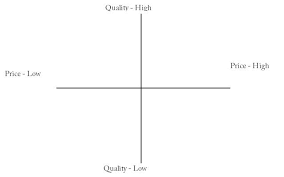
6) Build close customer relationships - 26What is a market map used for?To position and compare products in a market, and identify opportunities where customer needs are not being met.
- 27Name 7 ways in which a business can compete...1) Wider product range
2) Better design
3) More enjoyable experience
4) Higher quality
5) Better product features
6) Stronger brand image
7) Better after-sales service
- 28What is a brand?A named product that customers see as being different from other products, and that they can associate or identify with. A company or product can develop a unique brand image that customers associate them with.

- 29Instead of competing head-to-head, how else can a business compete?Differentiation
Eg. Customer service and Quality etc
- 30What is added value?The increased worth that a business creates for a product; it is the difference between what a business pays its suppliers and the price that it is able to charge for the product.
- 31Name 6 ways a business can add value...1) Unique selling point
2) Branding
3) Improved quality
4) Better design
5) More convenience
6) Greater speed of service
- 32What does the added value of a product go towards?Paying off a company's cost. The higher the added value, the sooner the costs can be paid off and the quicker a business will make a profit. The more value a business can add to its products, the more chance the business has of success, survival and long-term growth.
- 33What is a USP? What does it stand for?A USP is one another way to add value to a product. A USP will also help a business compete.
- 34What is a franchise?The right given by one business to other businesses to sell goods or services using its name.

- 35What is a franchisor?The business that gives franchisees the right to sell its product or service

- 36What is a franchisee?A business that agrees to manufacture, distribute or provide a branded product, under licence by a franchisor

- 37Explain the principle of franchising...The principle behind a franchise is the expansion of an established business through licensing the right for ENTREPRENEURS to set up their own business using the name, equipment and products of the franchise in return for a fee or share of the sales revenue
- 38What does the franchisee get when they buy a franchise?1. An established brand name
2. Training
3. Equipment
4. Ongoing support
5. Access to goods and services
6. Advertising and promotion
7. Operate in an exclusive area
- 39What type of business is set up 'under licence' to use an established business name?Franchise
- 40List 6 benefits of a franchise1. Expensive marketing costs covered by the franchise
2. Brand image/reputation already established
3. Access to tried and tested products
4. Possibly an established customer base
5. Higher chance of survival
6. Specific support and training provided
- 41List 5 drawbacks of a franchise...1. Start-up costs can be expensive
2. Royalty payments
3. Complicated application process
4. Lack of autonomy and control
5. Limited flexibility to make your own decisions
- 42List 4 factors choosing a location might include...1. Cost
2. Busy (passing trade)
3. Access (parking etc.)
4. Proximity to competition
- 43What does the word enterprise represent?The ideas and initiatives involved in starting a new business.
- 44What is an entrepreneur?A person who owns and runs their own business and takes risks

- 45What is Enterprise?The initial spark and idea for a business and the willingness by an individual to show initiative, take a risk and undertake a new venture

- 46Name 3 enterprise skills?Risk-taking
Showing initiative
Willingness to undertake a new venture - 47Explain the importance of riskEntrepreneurs take risks when they start their own business. There is a chance their businesses will not survive and therefore they risk their own time, livelihood and money. Enterprise is important because new businesses create jobs and wealth in the economy
- 48Name 5 outcomes of 'Thinking Creatively'1. Better products
2. Consider 'what if' questions
3. Cheaper production techniques
4. Unique ideas and products
5. Identify new opportunities and markets
- 49What is DELIBERATE CREATIVITY?The intentional creation of new ideas through recognised and accepted techniques. For example:
Creating lists
Mind maps
Make it bigger/smaller
Combining things together - 50What is blue skies thinking?Coming up with as many ideas as possible to solve a problem

- 51What is lateral thinking and what is an example?Involves thinking differently to try and find new and unexpected ideas. DE BONO'S SIX THINKING HATS is an example.
- 52What does the blue hat represent?Thinking about what they are thinking

- 53What does the white hat represent?Facts about an idea

- 54What does the red hat represent?Emotions are gut feelings about an idea

- 55What does the black hat represent?Difficulties of the idea

- 56What does the yellow hat represent?Positive aspects of the idea

- 57What does the green hat represent?How to get around a problem creatively

- 58Why ask questions as an entrepreneur?1. Helps identify business objectives
2. Helps develop aspects of the business plan
3. Identifies potential problems and pitfalls
4. Helps make important decisions - 59What will "WHY?" and "WHY NOT?" questions help to identify?The purpose and direction of the business:
-Why do I want to start my own business?
-Why do I want to change?
- Why not set up my own website business? - 60What do "HOW?", "WHERE?" and "WHEN?" questions help to identify?Specifics about the business that can help form parts of the business plan
-How do I set up the business?
-How do I build a customer base?
-How will I research my market?
-Where can I get help and advice?
-When could I open the business? - 61What do "WHAT IF?" questions allow an entrepreneur to do?Access the value and likelihood of any possible outcome. Solutions can then be identified from these questions.
-What if my business loses money?
-What if my customers do not like my products?
-What if there is too much competition?
-What if I am ill for a long period of time? - 62What is innovation?The ability to develop new ideas that build upon those that already exist
- 63What is invention?To develop a completely new product
- 64What does import mean?The purchase of products and/or services from overseas
- 65What are incentives?Financial or equivalent reward to stimulate action from staff or customers. Examples might include holidays or company cars
- 66What is income tax?A government tax on an individual's income
- 67What is incorporation?The process of becoming a corporate body, meaning that the business has a separate legal entity from its owners
- 68What is indirect cost?A cost not directly related to the production of a product
- 69What is induction?The training programme that is designed to familiarise new workers with the layout, health and safety and security systems in operation in their new place of employment
- 70What is industrial action?Measures taken by the workforce that will slow or halt output. The types of industrial action that can be taken by workers includes: strike, work to rule, overtime ban and go slow
- 71What is inelastic demand?A product that continues to sell at roughly the same rate, despite price increases. This is because consumers believe that they cannot do without it. An example would be petrol
- 72What is inflation?A general and sustained rise in the level of prices over a period of time, which reduces the buying power of money, It is measured by the Consumer Price Index (CPI), and usually expressed as a percentage
- 73What is an interest rate?The cost of borrowing money
- 74Why can invention and innovation be 'risky'?They can be expensive and time consuming, and many new products fail to make it to the market.
- 75What is a patent?A right of ownership of an invention, design or process when it is registered with the government
- 76What is a copyright?Legal ownership of material such as books, music and films which prevent these being copied by others
- 77What are trademarks?The logo, symbol, sign, or other features of a product or business that cannot be copied by others
- 78What does the term CALCULATED RISK mean?Putting a numerical value or probability on a risk and the likelihood of it coming true. Weighing up the risks and rewards of a new business idea is important in judging the outcome and viability of a start-up
- 79What are 5 other important enterprise skillsPlanning, Drive, Thinking ahead, Determination, Seeing opportunities
- 80What does the skill of planning involve?Identifying a direction and plan of action for the business
- 81What does the skill of drive involve?Being hardworking and motivated to achieve success
- 82What does the skill of thinking ahead involve?Having the foresight to identify potential problems
- 83What does the skill of determination involve?Being resilient when things go wrong/not giving up
- 84What does the skill of seeing opportunities involve?Having the creativity and imagination to do things differently
- 85When are mind maps often used and why are they useful?Mind maps are often used in blue skies thinking. They are useful in helping an entrepreneur get their ideas down on paper when thinking ahead, planning the business and trying to identify new opportunities.
- 86What are the objectives of a business?The goals that a business is trying to achieve. they are important for all businesses, especially business start-ups.
- 87What do setting opportunities give a business?A direction and a target to measure success against
- 88What are some examples of financial objectives?Survival, wealth, profit and income and financial security
- 89What are examples of non-financial objectives?Personal satisfaction, independence and control and helping others
- 90What are the 7 entrepreneurial qualities?Planning, initiative, taking risks, determination, making decisions, persuasion and leadership
- 91What does the quality of initiative involve?Being proactive and getting a job done.
- 92What is Revenue/sales revenue/turnover?The amount of income received from selling goods or services over a period of time
- 93What is the formula for total revenue?Price x quantity = total revenue
- 94What does a profit allow a business to do?1. Survive
2. Reinvest profits for expansion
3. Give an incentive to start the business
4. Provide security and savings
5. Reward employees
6. Generate wealth for the owner - 95Name the 4 ways to increase profit1. Lower variable costs
2. Lower fixed costs
3. Increase the sales price
4. Increase the quantity of sales - 96Name the 4 impacts a loss can have on a business1. Unable to repay loans
2. Unable to pay bills such as wages
3. Experiencing cash-flow problems
4. Unable to survive, leading to the business stopping trading - 97What is cash flow?The money flowing into and out of a business on a day-to-day basis
- 98What does a cash flow forecast do?Predicts how cash will flow through a business over time.
- 99What can businesses use a cash flow forecast to do?Identify periods where it could have a cash flow problem, where it does not have enough money flowing into the business in order to pay its day-to-day bills
- 100Give examples of inflows/receipts* Money from owners
* Bank loans
* Cash from sales - 101Give examples of outflows/payments*Wages
*Raw materials
* Interest on loans
* Advertising
*Bills - 102What is the net cash flow?The receipts of a business minus its payments, either positive or negative
- 103What is the opening balance?The amount of money in a business at the start of a month
- 104What is cumulative cash flow?The sum of cash that flows into a business over time
- 105What is the closing balance?The amount of money in a business at the end of a month (net cash flow + opening balance)
- 106What impacts on cash flow?1. Change in costs
2. Seasonality in sales
3. Business expansion or contraction
4. Change in stock levels
5. Change in sales revenue/change in demand
6. Credit terms can change - 107Without sufficient cash within the business what would the business become?INSOLVENT
- 108What does a being 'insolvent' mean for the business?1. Unable to pay its debts
2. Unable to repay bank loans
3. Unable to pay wages to employees
4. Unable to buy raw materials and products to sell
5. Unable to promote the business - 109What is a business plan?The plan for the development of a business, giving forecasts of items such as sales, costs and cash flows
- 110Name 6 purposes of a business plan1. Convince a bank to loan the business money
2. Forecast financial projections
3. Identify the needs of customers
4. Formulate market research into important information
5. Provide information
6. Provide the owner with a 'plan of action' that will minimise risk - 111What goes into a business plan?Over view
Objectives
Market research
Personnel
Finances
Production - 112Name 8 long term sources of finance1. Share capital (limited companies only)
2. Personal savings (from the owner)
3. Venture capitalist
4. Grants
5. Loans
6. Mortgage
7. Retained profit
8. Leasing - 113Name 5 short term sources of finance1. Trade credit
2. Credit cards
3. Bank overdraft
4. Delayed payment
5. Factoring - 114What are the three stages of BEING CUSTOMER FOCUSED?1. Identifying needs - using techniques such as market research to find out what customers want
2. Anticipating needs - the best businesses are able to identify needs in advance to give them a competitive advantage
3. Meeting customer needs - a business must be able to provide whatever customers want - 115What are the 4 parts to the marketing mix?1. PRODUCT
2. PRICE
3. PLACE
4. PROMOTION - 116Who has limited liability?Private limited companies and Private limited companies
- 117Who has unlimited liabilitySole traders and Partnerships
- 118What is unlimited liability?The owner is legally responsible for any debts of the business. Therefore there is potential for the owner to lose their personal belongings to pay off any debts
- 119What is limited liability?The owners and the business are separate legal entities. Any debts incurred by the business belong to the business and the owners can only lose up to the amount that they have invested. Their personal belongings are not liable
- 120What are the benefits to a sole trader over a Ltd?1. The owner has 100% control of decisions
2. The owners keep 100 of the profits
3. There is more privacy - 121What is a disadvantage of a sole trader over a Ltd?More risk
- 122Why do businesses have to adhere to legal requirements?1. So that the government can keep track of business activity
2. So taxes can be collected
3. To protect businesses from illegal activity
4. To protect customers from illegal business practices - 123What are the 4 legal requirements of a small business?1. Register and trade under a unique name that promotes the business
2. Keep records of sales, purchases and names of businesses they have worked with.
3. Register with Her Majesty's Revenue & Customs (the government authority in the UK responsible for collecting tax)
4. Pay the appropriate level of tax to HMRC - 124Name 4 taxes on small businessesValue Added Tax (VAT)
Income Tax
National Insurance Contributions (NIC)
Corporation Tax - 125What is VAT?A tax on the value of sales of a business. Businesses that sell more than a certain amount will register to pay VAT.
- 126What is income tax?A tax on the income earned by workers and sole traders
- 127What is NIC?A tax on earnings of workers and sole traders linked to state benfits
- 128What is corporation tax?A tax paid by limited companies on the profits of the company
- 129What is CUSTOMER SATISFACTION?A measure of how much a business or its products meet customers' expectations
- 130How can effective customer service be achieved?1. Dispatching orders quickly
2. Being 100% accurate in orders
3. Offering excellent after-sales care
4.Providing a personal service
5. Going the 'extra mile' to get what customers want
6. Being convenient
7. Being polite and friendly
8. Responding immediately to any complaints - 131What are benefits of good customer satisfaction?1. Repeat purchase
2. Loyalty
3. Can charge premium price
4. Improves reputation
5. Can differentiate a business and become their USP - 132How can repeat purchases be stimulated?1. Cheaper prices than competitors
2. Easy and convenient service
3. Effective customer service
4. Promotions and special offers
5. Building good relationships with customers - 133Explain the five steps of recruitment1. Draw up recruitment documents -Job ads, descriptions and specifications
2. Receive applications -CVs, application forms and letters
3. Shortlisting - A list of suitable candidates
4. Selection - Interviews and assessments
5. Training - To develop skills using on-the-job and off-the-job training - 134How can a business motivate its staff?1. Paying fair and competitive wages
2. Providing good working conditions
3. Providing perks
4. Delegating power and responsibility
5. Training and nurturing staff development
6. Encouraging teamwork and good relationships - 135Employers must abide by laws that protect employees in what areas?Recruitment
Pay
Discipline
Working hours - 136What is SUPPLY for a product?The amount that sellers are willing and able to sell at any given price
- 137What is DEMAND for a product?The amount that buyers are willing and able to purchase at any given price
- 138What will the surplus and shortage of commodities affect?Prices
- 139What is a market?Where buyers and sellers meet to exchange products and services
- 140What are commodity markets?Markets for raw materials, such as oil, steel and wheat, used in the production of other goods
- 141What are GOODS MARKETS?Markets for everyday products, such as clothes and food
- 142Changes in raw materials and energy costs affect the costs of a small business. How much it affects them depends on what?1. Their production of total costs
2. How much costs go up
3. The ability to pass on costs to customers or to absorb them - 143What is an interest rate?The percentage reward or payment over a period of time that is given to savers on savings or paid by borrowers on loans
- 144What are the impacts of a rise in interest rates?INCREASE THE COST OF BORROWING
1. businesses on a variable rate may struggle to repay loans
2. Small businesses are less likely to borrow money to start up or to expand
3. Customers are less likely to spend money as borrowed money costs more. so consumer spending falls - 145What are the impacts of a fall in interest rates?LOWERS THE COST OF BORROWING
1. Businesses will have more money to spend and cash flow may improve
2. Businesses may borrow money for a start-up or expansion
3. Customers are more likely to borrow and to spend their money. Consumer spending rises - 146Explain a 'Fixed interest rate'Don't change over the life of a loan. A business could lose out on a fixed contract if the interest rate falls
- 147Explain a 'Variable interest rate'Change over the life of a loan. They can be more risky and hard for the business to plan against
- 148What is the exchange rate?The price of buying foreign currency. It tells the UK people and businesses how much foreign currency they get for every pound, or may pounds they have to give up to acquire foreign currency
- 149What are imports?Goods and service bought from abroad
- 150What are exports?Goods and services sold abroad
- 151List the effects of a fall in the value of the pound?1. Good for UK exporters of goods - price of export falls > sales increase
2. Good for UK tourism - prices cheaper to foreigners > tourism increase
3. Good for UK businesses - imports more expensive - more goods bought from UK
4. Bad for UK importers of materials - Imports more expensive > costs rise - 152What are some effects of a rise in the value of the pound?1. Bad for UK exporters of goods - price of exports rises > sales fall
2. Bad for UK tourism - Prices more expensive to foreigners > tourism falls
3. Bad for UK businesses - imports cheaper > fewer but UK goods
4. Good for UK importers of materials - imports cheaper > costs fail - 153What does the business cycle refer to?Fluctuations in the level of economic activity over time
- 154Which businesses are most likely to be affected by the business cycle?Businesses selling luxuries
- 155What are the four sections of the business cycle?1. Boom - strong increase in economic activity
2. Slowdown/downturn - Economic activity begins to slow down
3. Recession - When economic growth is negative
4. Recovery/upturn - Economic activity begins to rise - 156What does ECONOMIC ACTIVITY refer to?The amount of buying and selling that takes place between businesses and consumers in a period of time. If this rises it is known as economic growth
- 157Explain impacts of a boom1. Consumer and business confidence high
2. Consumers borrow and spend more
3. Sales increase
4. Businesses take on more employees
5. Businesses invest and expand - 158Explain the impacts of a downturn or recession1. Consumer & business confidence low
2. Consumers borrow and spend less
3. Sales fall. Prices may have to be cut
4. Businesses may make some employees redundant
5. Businesses may save & cut back spending
6. Likely to suffer cash-flow problems - 159Name 8 stakeholders and what they would want out of the businessThe local community- local investment, limited pollution
Government - low unemployment, competitive markets
Suppliers - regular orders
Owners - profits
Managers - bonuses, long term success
Workers - good pay, conditions
Customers - value for money
Competitors - sometimes support
Informationen
- Beschreibung
- AS - Level Business Karteikarten am Unit 1: Business Studies GCSE, erstellt von Libby Rose am 05/03/2015.
- Erstellt von
- Libby Rose
- Aufrufe
- 1.740
- Tags
- Bewertung