
Karteikarten
MEIOSIS AND VARIATION F215
Karten in diesem Stapel (28)
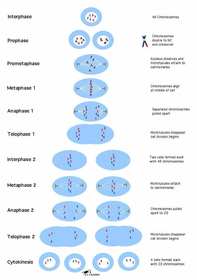
- 1(a) describe, with the aid of diagrams and photographs, the behaviour of chromosomes during meiosis, and the associated behaviour of the nuclear envelope, cell membrane and centrioles. (Names of the main stages are expected, but not the subdivisions of prophase);
- 2explain the term alleleallele: an alternative version of a gene
- 3explain the term locusSpecific position on a chromosome, occupied by a specific gene
- 4explain the term phenotypeObservable characteristics of an organism
- 5explain the term genotypeAlleles present within cells of an individual, for a particular trait/characteristic
- 6explain the term dominantCharacteristic in which the allele responsible is expressed in the phenotype, even in those
with heterozygous genotypes - 7explain the term codominantA characteristic where both alleles contribute to the phenotype
- 8explain the term recessiveCharacteristic in which the allele responsible is only expressed in the phenotype is there is
no dominant allele present - 9explain the term linkageGenes for different characteristics that are present at different loci on the same
chromosome are linked - 10explain the term crossing overWhere non-sister chromatids exchange alleles during prophase I of meiosis
- 11explain how meiosis and fertilisation can lead to variation through the independent assortment of allelesMeiosis:
-Crossing over
-Random distribution and segregation of the chromatids at meiosis II leads to genetic
reassortment
-Random mutations
fertilisation:
-Randomly combining two sets of chromosomes, one from each of two genetically
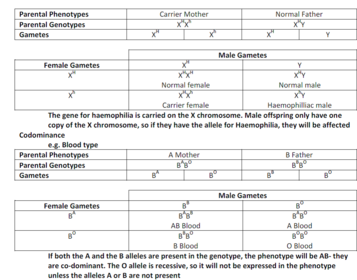
unrelated individuals - 12use genetic diagrams to solve problems involving sex linkage and codominance
- 13describe the interactions between loci (epistasis). (Production of genetic diagrams is not required)Epistasis is the interaction of different gene loci so that one gene locus makes or suppresses the
expression of another gene locus. - 14recessive epistasisThe homozygous presence of a recessive allele prevents the expression of another
allele at a second locus
E.g. flower colour in Salvia
The alleles for purple (B) and pink (b) can only be expressed in
the presence of the allele A. When the genotype is aa-- the
phenotype is white - 15dominant epistasisA dominant allele at one gene locus masks the expression of alleles at the second
gene locus
E.g. feather colour in poultry
If the dominant allele A is present, the chickens will be white;
even if the dominant allele of the second gene, B/b is present.
The genotype must be aaB- for any colour to be expressed - 16predict phenotypic ratios in problems involving epistasisRecessive epistasis
9:3:4
Dominant epistasis
13:3 - 17use the chi-squared (χ2) test to test the significance of the difference between observed and expected results. (The formula for the chi-squared test will be provided);no real difference between predicted and expected, any difference due to chance .testing to see advocacy of null hypothesis, compare X^2 to critical values to see whether to accept/decline null hypothesis.
- 18describe the differences between continuous and discontinuous variationcontinuous= no distinct groups, range of values between two extremes, e.g. height
discontinuous=individuals fall into distinctive classes, e.g. blood group - 19explain the basis of continuous and discontinuous variation by reference to the number of genes which influence the variationdiscontinous: controlled by a single gene/small no. of genes
continuous: combined effect of many genes - 20explain that both genotype and environment contribute to phenotypic variationboth genotype and phenotupe contribute to phenotypic variation
- 21explain why variation is essential in selectionSo when the environment changes, there will be individuals that are better adapted, so they will survive and reproduce, passing on the advantageous alleles to their offspring and allowing the
species to continue as the advantageous allele increases in frequency over MANY generations - 22use the Hardy–Weinberg principle to calculate allele frequencies in populationscan only be applied when:
1.Random mating must take place.
2. No migration must occur either inwards or outwards of the population.
3. No mutations must arise in the population.
4. No natural selection must take place due to one trait being better or worse adapted to the environment.
very rare to find but works for predictions.
The frequency of the dominant allele is noted p while that of the recessive allele is noted q. Both must necessarily account for the whole population, therefore:
p + q = 1
The values are frequencies, so they are noted as percentages. 1 is 100% while 0.5 is 50% and 0.05 is 5%, etc. - 23explain, with examples, how environmental factors can act as stabilising or evolutionary forces of natural selection;In unchanging conditions, stabilising selection maintains existing adaptations and so maintains
existing allele frequencies.
In changing conditions, directional selection alters allele frequencies.
A mutation may be disadvantageous in existing conditions, and so is removed in stabilising
selection, but if the conditions change, the mutation might be advantageous and selected for,
meaning that selection becomes an evolutionary force - 24explain how genetic drift can cause large changes in small populations;Genetic drift is a change in allele frequency that occurs by chance because only some of the
organisms in each generation reproduce. particularly noticeable when a small number of
individuals are separated from the rest of the large population.
Genetic drift will alter the allele frequency still further. allopatric (geographical) sympatric (other reason not to reproduce eg biochemical change) - 25explain the role of isolating mechanisms in the evolution of new species, with reference to ecological (geographic), seasonal (temporal) and reproductive mechanismsIf two sub-populations are separated from each other, they'll evolve differently as they have
different selection pressures and different alleles will be eliminated or increased within each sub
population. Eventually sub populations will not be able to interbreed and so will be different
species.
The sub populations may be split by -Geographical barriers(allopatric) e.g. rivers or mountains
Seasonal barriers e.g. climate change throughout the year
Reproductive mechanisms (sympatric) e.g. their genitals, breeding seasons or courtship rituals may be different - 26explain the significance of the various concepts of the species, with reference to the biological species concept and the phylogenetic (cladistic/evolutionary) species concept.-The phylogenetic species concept
A species is ‘a group of organisms that have similar morphology, physiology, embryology
and behaviour, and occupy the same ecological niche’ 'that can interbreed and reproduce to produce fertile offspring'. This classification shows the
evolutionary relationships, or phylogeny. The phylogenetic linage is called a clade. - 27compare and contrast natural selection and artificial selectionNatural selection
The organisms best adapted for their environment are more likely to survive and pass on the favourable characteristics to their offspring
Artificial selection:
Humans select the organisms with desirable characteristics and
Humans allow those with useful characteristics to breed and prevent those without from breeding,
Thus, humans have a significant impact on the evolution of these populations or species - 28describe how artificial selection has been used to produce the modern dairy cow and to produce bread wheat (Triticum aestivum)Dairy cow
Each cow’s milk yield is measured and recorded. The progeny of bulls is tested to find out which bulls have produced daughters with high milk yields,
Only a few good-quality bulls need to be kept are the semen from one bull can be used to artificially inseminate many cows, Some elite cows are given hormones so they produce many eggs. The eggs are fertilized in vitro and the embryos are implanted into surrogate mothers. These embryos could also be clones and divided into many more identical embryos
Bread wheat:
Wheat can undergo polyplody- the nuclei can contain more than one diploid set of chromosomes. Modern bread wheat is hexaploid, having 42 chromosomes in the nucleus
of each cell, meaning that the cells are bigger
Informationen
- Beschreibung
- biology Karteikarten am MEIOSIS AND VARIATION F215, erstellt von kira.kyne am 17/03/2015.
- Erstellt von
- kira.kyne
- Aufrufe
- 34
- Tags
- Bewertung