
Karteikarten
Heredity
Karten in diesem Stapel (30)
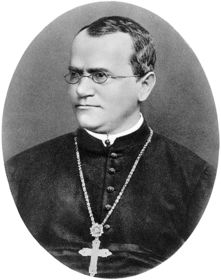
- 1Gregor MendelHe is a monk in the 19th century who is considered the father of genetics. Much of what we know about genetics today was discovered by him.
- 2TraitIt is an expressed characteristic. It is produced by hereditary factors known as genes.
- 3GeneIt is a segment of a chromosome. In each chromosome, there are many different genes controlling the expression of particular traits.
- 4LocusIt is the position of a gene on a chromosome.
- 5AlleleIt is the alternate form of the same gene. In diploid organisms (two sets of chromosomes), there are usually two copies of one gene and they might be alleles.
- 6Dominant AlleleThis means that the if this allele was in an organism, it would be expressed, even if the other (recessive) allele was also present. The dominant allele is represented by a capital letter. In pea plants, the allele tall would be T.
- 7Recessive AlleleIt is the opposite of the dominant allele. It is represented by the lower case of the same letter as the dominant. In pea plants, the recessive allele for short is represented by t.
- 8HomozygousIt is when an organism has two identical alleles for a given trait. The organism can have homozygous dominant (TT) and homozygous recessive (tt).
- 9HeterozygousThis is when the organism has two different alleles for a given trait (Tt).
- 10Mendelian GeneticsMendel liked to cross-breed pea plants. Through his work, he came up with three principles: law of dominance, law of segregation and law of independent assortment.
- 11The Law of DominanceWhen Mendel cross-bred a homozygous dominant plant that was tall with a homozygous recessive plant that was short, it produced a tall plant (the phenotype was still tall). This is because the dominant gene masked the recessive gene.
- 12PhenotypeThis is the physical appearance of an organism. It is what an organism looks like.
- 13GenotypeIt refers to the genetic makeup of an organism. It is which alleles the organism posses.
- 14Parent (P1 Generation)These are the first generation in an experiment.
- 15Filial (F1 Generation)The offspring of the P1 generation are called filial and are represented by F1.
- 16F2 GenerationThis is the grandchildren of the parent and the offspring of the F1 generation.
- 17Monohybrid CrossThis is a cross where only one trait is being studied. It is easily shown through a Punnett square.
- 18Punnett SquareIt is used to predict the results of a cross.
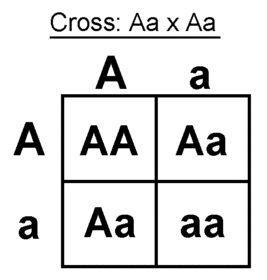
- 19The Law of SegregationIt states that the alleles separate randomly during meiosis and are paired randomly during sexual reproduction and thus will produce different results.
- 20Dihybrid CrossThis is where two characteristics are studied as opposed to one. It can also be represented by a Punnett Square.
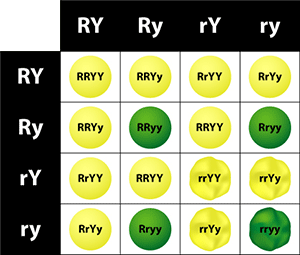
- 21Independent AssortmentIt states that each trait segregate independently from each other and thus are usually not affected by the outcome of the other. When predicting the likelihood of certain results, we should use probability in which we multiply the different possibilities.
- 22Test CrossTo determine if an organism is heterozygous or homozygous dominant, we can set up a test cross in which we cross the unknown organism with a homozygous recessive. If a recessive organism is an offspring, then the unknown is heterozygous, otherwise, it's homozygous dominant.
- 23Incomplete DominanceIn some cases, the traits will blend. For example, a cross between a white snapdragon (dominant) and a red snapdragon (recessive) produces a pink snapdragon.
- 24CodominanceIt is the equal expression of both alleles. For example, an individual can have an AB type blood where each allele is equally expressed.
- 25Polygenetic InheritenceSometimes, one trait results from many different genes acting together. Height, skin colour, and weight are all examples.
- 26Multiple AllelesSome traits are the product of many different alleles that occupy the same specific locus. The ABO blood group system has three alleles which determines blood type.
- 27EpitasisThis is when the gene at one locus influences the expression of a gene at another locus.
- 28PleiotropyIt is when an allele affects numerous characteristics of an organism. In sickle-cell anemia, multiple symptoms are caused by one pair of alleles.
- 29Linked GenesSometimes genes on the same chromosomes stay together during assortment and move as a group. They are usually inherited together. This can be used to map human chromosomes.
- 30Recombination MappingBecause the further apart two linked alleles are on a chromosome, the higher the frequency of them meeting. And thus this can be used to map chromosomes. If A and B have a frequency of 15 , B and C have a frequency of 9 and A and C have a frequency of 24, we can now map all three alleles. A ______________B________C
Informationen
- Beschreibung
- High School AP Biology (Heredity) Karteikarten am Heredity, erstellt von Shirley Zhu am 20/03/2015.
- Erstellt von
- Shirley Zhu
- Aufrufe
- 66
- Tags
- Bewertung