
Karteikarten
IB Biology Topic 10 Genetics (HL)
Karten in diesem Stapel (18)
- 110.1.1 Define MeiosisMeiosis is the division of a cell to form four haploid gametes, all of which may be genetically distinct if recombination occurs in prophase I
- 210.1.1 Desribe the behaviour of chromosomes during interphase prior to meiosisCell Growth and DNA Replication (duplication of DNA creates sister chromatid chromosomes)
- 310.1.1 Describe the behvaiour of DNA during Meiosis IProphase I: DNA supercoils and condenses, nuclear membrane dissolves, homologous CS pair up and form bivalents, crossing over occurs, centroiles move to opposite poles
Metaphase I: Spindle fibres attach to centromeres of bivalent, bivalents line up on the equator
Anaphase I: Spindle fibres contract and split the bivalent, homologous CS move to opposite poles of the cell
Telophase: CS decondense, nuclear membrane may reform, cell divides forming two haploid daughter cells - 410.1.1 What is the stage between Meiosis I and Meiosis II called and what occurs?Interkinesis: An optional rest period between the two meiotic divisions, no DNA replication takes place here
- 510.1.1 Describe the behaviour of CS in Meiosis IIProphase II: CS condense, nuclear membrane broken down and centrioles move to opposing poles (perpendicular to the previous poles)
Metaphase II: Spindles fibres from cenrioles attatch to centromeres of CS, CS line up along the equator of the cell
Anaphase II: Spindles fibres contract and split the CS into sister chromatids, chromatids (now called CS) move to opposite poles
Telophase II: CS decondense, nuclear membrane reforms, cells split into two haploid daughter cells resulting in a total 4 haploid daughter cells from one original cell - 6Define homologous chromosomesChromosomes with the same genes as each other, with the same sequence, but do not necessarily have the same allele for those genes
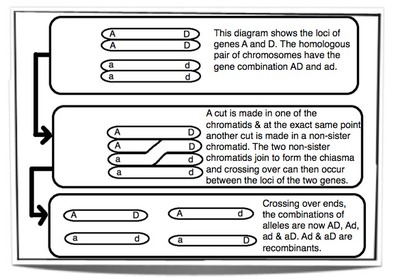
- 710.1.2 Outline the formation of chiasmata in the process of crossing overCrossing over involves the exchange of segments of DNA between homologous chromosomes during prohphase I of meiosis
Homologous CS become connected in a process called synapsis, forming a bivalent
Non-sister chromatids break and recombine with their homologous partner, effectively exchanging genetic material
These remain connected in an x-shaped structure called chiasmata
Chiasma hold homologous CS together as a bivalent until anaphase I - 810.1.2 Define recombinantsRecombinants are formed during crossing over and they are the chromatids whose genetic material has been exchanged. They are called this because chromatids may consist of a combination of DNA derived from both homologues
- 910.1.3 Explain how meiosis results in an effectively infinite genetic variety in gametes through crossing over and random orientationDuring anaphase I, homologous CS seperate, such that each resultant daughter cell contains a CS of either maternal or paternal origin
The orientation of these homologues in metaphase I is random, such hat there is an equality probability of the daughter cells having either the maternal or paternal CS
As humans have a haploid number of 23 CS, this means that there are 2^23 potential gamete combinations
Corssing over in P1, results in an entirely new CS combinations, as recombination through through gene exchange produces wholly original CS containing both maternal and paternal DNA, resulting in near infinite genetic variability
Other sources of genetic variation include random fertilisation, DNA mutation, CS mutation, non-disjunction - 1010.1.4 State Mendel's Law of SegregationEach hereditary characteristic is controlled by two alleles, which segregate and pass into different reproductive cells (gametes)
- 1110.1.4 State Mendel's Law of Independent AssortmetAllele pairs seperate independently during gamete formation which means that the transmission of traits to offspring are independent to one another.
- 1210.1.5 Explain the relationship between Mendels #2 Law and meiosisThe law of indpendent assortment relates to the random orientation of homologous CS during M1 of meiosis
Because the orientation of a homolgous pair is random, and does not affect the orientation of any other pair, any one pair of alleles on a CS has an equal chance ofbeing paired with or seperated from any one of a pair of alleles on another CS
This means the inheritance of two different traits will occur independently of each other (provided the genes aren't linked) - 1310.2.2 Distinguish between autosomes and sex chromosomesAutosomes: Pairs of chromosomes that are identical in appareance and are not involved in sex determination
Chromsomes: Pairs of chromosomes that are not identical in appearance and are involved in sex determination - 1410.2.3 Explain how crossing over in non-sister chromatids of a homologous pair in prophase 1 can result in the exchange of alleles
- 1510.2.4 Define linkage groupA linkage group is a group of genes whose loci are on the same CS and therefore do not follow the law of independent assortment
The only way to seperate linked genes is through recombination during crossing over during synapsis - 1610.3.1 Define polygenic inheritancePolygenic inheritance refers to a single characteristic which is controlled by more than two genes
- 1710.3.2 Explain that polygenic inheritance can contribute to continuous variation using skin colour as an exampleThe colour of human skin is determined by the amount of dark pigment melanin it contains
At least four genes are involved in melanin production; for each gene one allele codes for melaning production, the other does not
The combination of melanin producing alleles determines the degree of pigmentation, leading to continuous variation - 1810.3.2 Explain that polygenic inheritance can contribute to continuous variation using grain colour in wheat as an exampleWheat grains vary in colour from white to dark red, depending on the amount of red pigment they contain
Three genes control the colour and each gene has two alleles
The most frequent combinations have an equal number of 'pigment producing' and 'no pigment' alleles, whereas combinations of one extreme or the other are relatively rare
The overall pattern of inheritance shows continuous variation
Informationen
- Beschreibung
- Karteikarten am IB Biology Topic 10 Genetics (HL), erstellt von R S am 19/04/2015.
- Erstellt von
- R S
- Aufrufe
- 194
- Tags
- Bewertung