
Karteikarten
BIOLOGY 160- CHAPTER 1: THE SCIENTIFIC STUDY OF LIFE
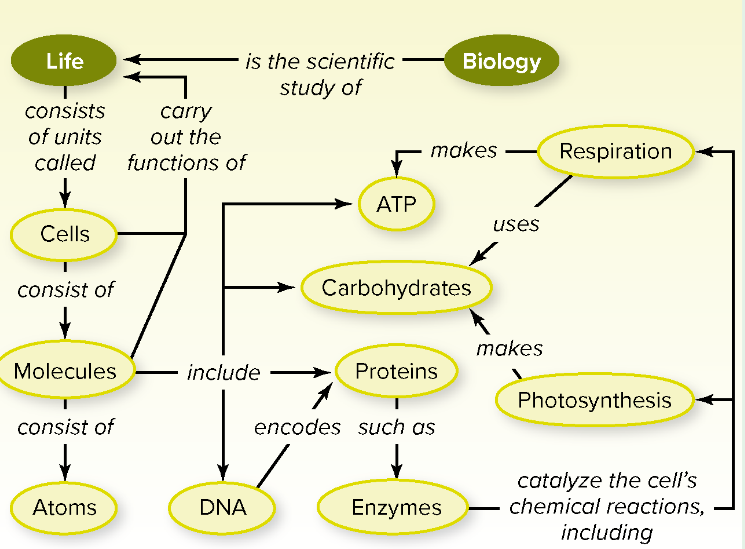
Karten in diesem Stapel (53)
- 1Biologists are:Scientists who use evidence to test hypotheses about life.
-Page 3 - 2CellThe smallest unit of life that can function independently
-Page 4 - 3OrganismA single living individual
-Page 4 - 4Cells use genetic instructions-as encoded in DNA-to:produce proteins, which enable cells to carry out their functions in tissues, organs, and organ systems.
-Page 4 - 5The five qualities that, in combination, constitute life:*Organization
*Energy use
*Maintenance of internal constancy (homeostasis)
*Reproduction, growth, and development
*Evolution
-Page 4 - 6Atoma particle of matter; composed of protons, neutrons, and electrons
*the smallest chemical unit of a type of pure substance (element)*
-Page 4 - 7Moleculetwo or more atoms joined by chemical bonds
-Page 4 - 8OrganelleA compartment of a eukaryotic cell that performs a specialized function
*membrane-bounded*
example: chloroplast
-Page 4 - 9TissueA group of cells that interact and provide a specific function
-Page 4 - 10Organtwo or more tissues that interact and function as an integrated unit
-Page 4 - 11Organ Systemtwo or more physically or functionally linked organs
-Page 4 - 12Organizational Hierarchy of Life-Page 5 Tutorial: Organization of Life
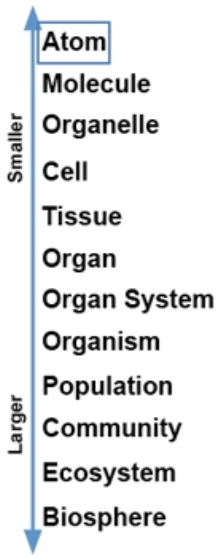
- 13PopulationInterbreeding members of the same species occupying the same region
-Page 5 - 14CommunityGroup of interacting populations that inhabit the same region
-Page 5 - 15EcosystemA community and its nonliving environment
-Page 5 - 16BiospherePart of Earth where life can exist
-Page 5 - 17Emergent PropertyQuality that results from interactions of a system's components
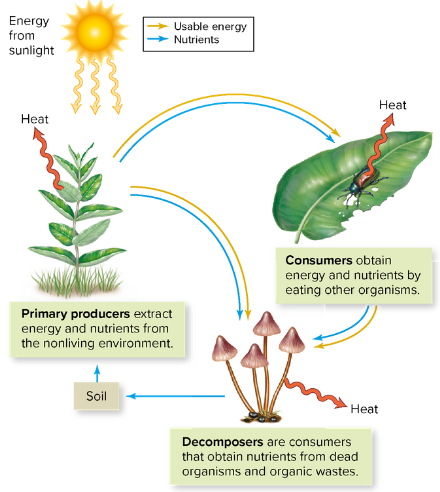
-Page 6 - 18Primary ProducerSpecies forming the base of a food web by extracting energy and nutrients from nonliving sources; an autotroph
-Page 6 - 19ConsumerOrganism that eats other organisms; a heterotroph
-Page 6 - 20DecomposersOrganism that consumes wastes and dead organic matter, returning inorganic nutrients to the ecosystem
-Page 6 - 21Energy Transfer and Heat Loss-Page 6
- 22HomeostasisA state of internal constancy in the presence of changing external conditions
-Page 6 - 23Asexual ReproductionA form of reproduction in which offspring
arise from only one parent
-Page 7 - 24Sexual ReproductionThe combination of genetic material from two individuals to create a third individual
-Page 7 - 25GrowthAn increase in an organism's size, generally via cell division
-Page 7 - 26DevelopmentChanges that occur as an organism matures, including growth, cell specialization, and other processes
-Page 7 - 27AdaptationAn inherited trait that permits an organism to survive and reproduce
-Page 7 - 28Natural SelectionDifferential reproduction of organisms based on inherited traits
-Page 8 - 29EvolutionDescent with modification; change in allele
frequencies in a population over time
-Page 8 - 30TaxonomyThe science of describing, naming, and classifying organisms
-Page 8 - 31SpeciesA distinct type of organism
-Page 8 - 32GenusA taxonomic category that groups closely related species
-Page 8 - 33DomainThe broadest (most inclusive) taxonomic category
-Page 9 - 34The Three Domains:*Bacteria
*Archaea
*Eukarya
-Page 9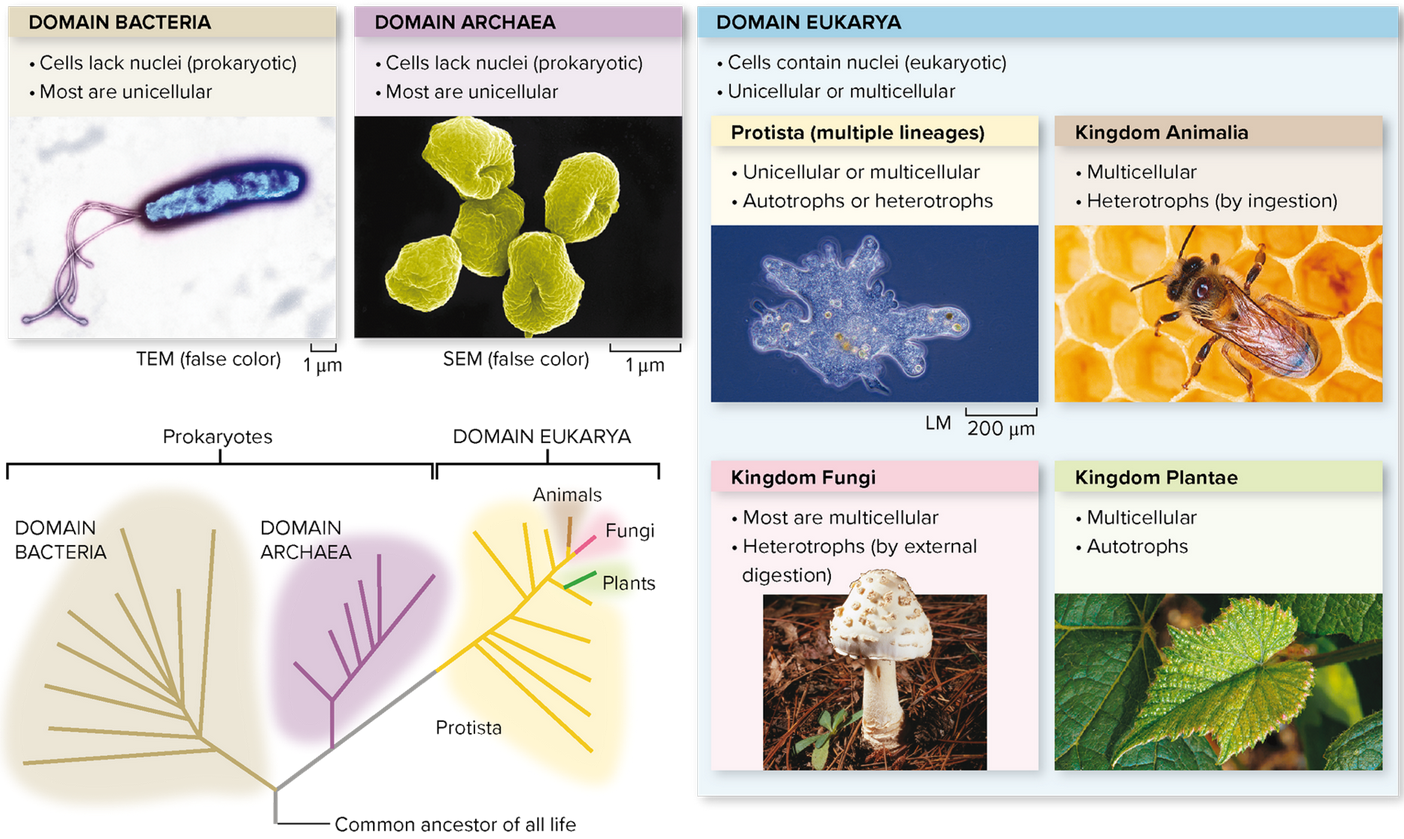
- 35KingdomTaxonomic category below domain
-Page 9 - 36The Taxonomic Hierarchy of Humans
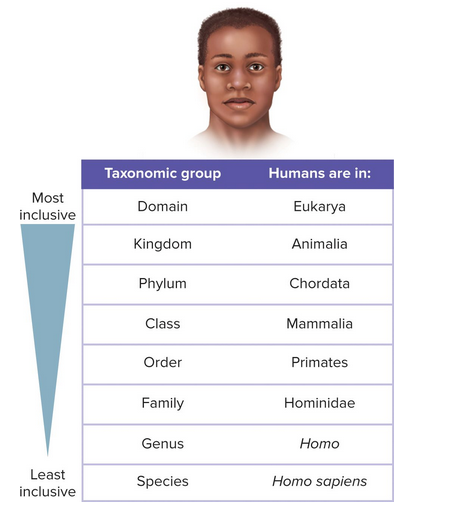
- 37Four Main Groups of Eukaryotes*Protista (multiple lineages); Not animals, fungi, or plants
*Kingdom Animalia; Multicellular, heterotrophs by ingestion
*Kingdom Fungi; Mostly multicellular, heterotrophs by external digestion
*Kingdom Plantae: Multicellular, autotrophs
-Page 9 - 38Scientific MethodA systematic approach to understanding the natural world based on evidence and testable hypotheses.
1. Make an observation.
2. Ask a question.
3. Form a hypothesis or testable explanation.
4. Make a prediction based on the hypothesis.
5. Test the prediction.
6. Iterate: use the results to make new hypotheses or predictions.
-Page 10 - 39HypothesisA testable, tentative explanation based on prior knowledge
-Page 10 - 40PredictionAn anticipated outcome of the test of a hypothesis
-Page 10 - 41Peer ReviewEvaluation of scientific results by experts before publication in a journal
-Page 11 - 42ExperimentA test of a hypothesis under controlled conditions
-Page 11 - 43Sample SizeThe number of subjects in each experimental group
-Page 11 - 44Types of Variables
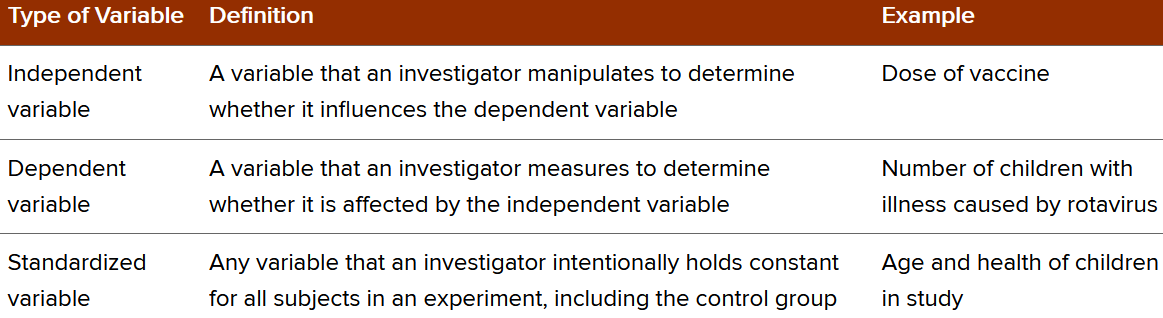
- 45ControlThe untreated group used as a basis for comparison with a treated group in an experiment
-Page 12 - 46PlaceboInert substance used as an experimental control
-Page 12 - 47Statistically SignificantUnlikely to be attributed to chance
-Page 12 - 48TheoryWell-supported scientific explanation
-Page 12 - 49FactA repeatable observation that everyone can agree on
- 50The concentration of salts in the blood remains relatively steady, regardless of a person's diet. This situation best illustrates:Homeostasis
- 51Because plants extract nutrients from the soil and use sunlight as an energy source, they are considered to be:Autotrophs
- 52In an experiment to test the effect of temperature on the rate of bacterial reproduction, temperature would be the:Independent variable
- 53Can a theory be proven wrong?Yes, a new observation or interpretation of data could disprove a theory.
Informationen
- Beschreibung
- Information from: Biology- Concepts and Investigations; Fifth Edition
- Erstellt von
- Amanda Lassiter
- Aufrufe
- 8
- Bewertung