
Karteikarten
ZOO 2090 Final
Karten in diesem Stapel (23)
- 1Aspects of Amphibian SkinMucous glands
Granular glands (poisonous alkaloid compounds)
Thin skin (gas transfer)
More terrestrial = more keratin (prevent desiccation) - 2Why would the loss of an aquatic growth phase in amphibians be effective?Spend less energy transitioning from aquatic lifestyle to dry land; encounter fewer water predators.
- 3Describe unique teeth of amphibiansPedicellate teeth (unique to amphibians and some temnospondyls)
Have uncalcified suture dividing the pedicel from the calcified tip - 4Describe AnuransOrder Anura
Paired limbs, no tail, jump, tympanum present to transmit sound to the inner ear, external fertilization - 5Describe the amphibian skullFlattened and open with big jaws
Palate is highly reduced (allows eyeballs to drop into mouth when swallowing)
Hyomandibula becomes stapes- effects sound transmission - 6Differences of anuran axial skeleton from that of amphibious fishShortened vertebral column
Atlas (cervical vertebrae) allows movable joint through two condyles
Formation of urostyle between elongated pelvic girdle bones - 7Specializations of anuran appendicular skeletonFused radius/ulna to absorb landing shock
Tibia/fibula bones also fused for sturdiness
Longer hind limbs - 8Features of salamandersOrder Caudata
Paired limbs and long tail
Suction feed in water and projectile tongue on land
No tympanum
external or internal fertilization by means of spermatophore transfer - 9Salamander skeletonLong back (10-60 pre-sacral vertebrae)
Flattened open skull
Poor ossification w common reduction and loss of bones - 10How salamanders moveDual locomotion
short walking limbs and swimming tail
both modes of locomotion are distinct and controlled by different sets of neurons in brainstem - 11CaeciliansOrder Gymnophiona
No limbs or girdles
solid and compact skull for burrowing
Tropical habitats
Internal fertilization
60-285 trunk vertebrae w a short or absent tail - 12Describe what we know of the origin of modern amphibiansFossil gap between modern groups and early tetrapods
Originated from Jurassic period (~200 Mya)
Hypothesized to have developed from temnospondyls, lepidospondyls or both - 13What is paedomorphosis and why can it mislead us?when larval characteristics of ancestors appear in adults of descendants
We may conclude that two unrelated species are closely related because they share the same loss of bones and ossification - 14Describe early amniotesevolved in the early/mid-Carboniferous (360-330 Mya)
Small w a slight but highly ossified skeleton ("lizard-like")
Jaws, teeth and neck modified for improved predation - 15What are the major groups of amniotes?Synapsids: Mammals
Sauropsids: reptiles and birds
Diapsids: Lepidosaurs (lizards and snakes); Archosaurs (dinosaurs, birds and crocs)
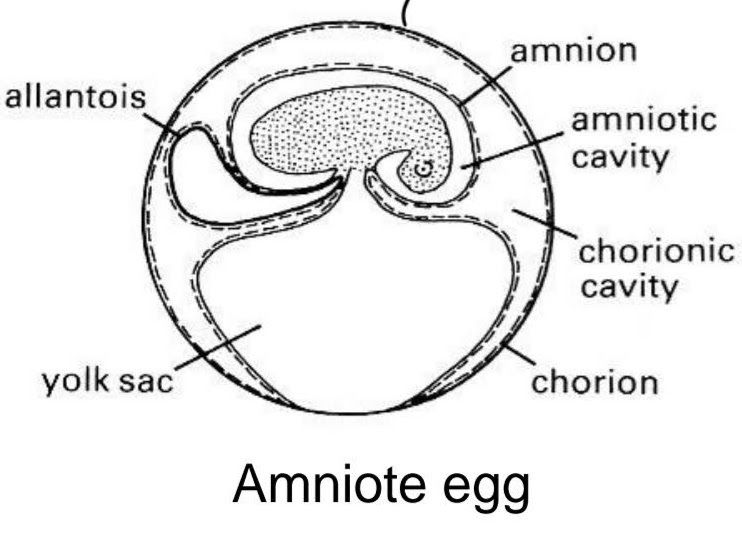
We don't know where turtles fit! - 16What's so special about the cleidoic egg?Semi-permeable shell that allows gas exchange
Extra embryonic membranes
Amnion: surrounds w water
Chorion: surrounds the embryo and yolk sac
Allantois: fills w waste
Allows development entirely on land & no complex metamorphosis
More energy invested in each egg - 17Other derived characteristics of amniotesLow skin permeability - prevent desiccation
Lung ventilation aided by ribs
Increased body support due to increased apparent weight out of water - 18Amniote axial skeletonexpanded regionalization of the vertebral column
lumbar limbs lost in some amniotes to expand hindlimb forward movement -> rapid locomotion - 19Atlas and axis vertebraeSkull-atlas joint (vertical nodding and horizontal tilting of head)
Atlanto-axial joint (twisting movement)
Maintains bony strength of neck and allowing cranial mobility - 20Body support of vertebral columnBody suspended between legs w vertebral column as the 'bridge' between support posts
Makes use of arch designs (trunk vertebrae is held in arch by abdominal muscles and sternum)
Cervical vertebrae held in arch by neck ligaments - 21The role of the hip bone in body supportbalances heavy parts against each other (acts as a fulcrum)
requires a firm vertebral column
vertebrae are tied together by strong ligaments between neural spines - 22Changes in skull openingsopenings evolved to reduce skull weight and provide room for jaw muscles
# of openings varies in amniotes
Anapsids: no fenestrae
Synapsid: one lower temporal fenestra (mammals)
Diapsid: two temporal fenestrae (reptiles, birds, dinosaurs) - 23Describe turtles and their diversity
Informationen
- Beschreibung
- Study cards for the final exam of ZOO 2090. Mostly covering the second half of the course.
- Erstellt von
- Evelyn H
- Aufrufe
- 73
- Tags
- Bewertung