
Karteikarten
Nucleic Acids, Genetic Code and Protein Synthesis
Karten in diesem Stapel (33)
- 1What is the difference between the two pentose sugars?The deoxyribose sugar has one fewer oxygen atoms, lacking an oxygen on carbon 2.
- 2What are the different nitrogenous base pairs and how do they pair up?Adenine, Guanine, Cytocine, Tymine and Uracile.
C,T and U are pyrimidine bases and G and A are purine bases.
DNA - C+G & A+T
RNA - A+U & C+G - 3What is DNA and RNA made of?A pentose sugar (5 carbon sugar)
A nitrogenous base
A Phosphoric acid - 4What is the name of the two different Pentose sugars in DNA/RNA?Deoxyribonucleic acid (DNA) and ribonucleic acid (RNA).
- 5Explain the structure of a Phosphoric AcidOH
|
O -- P-- OH
|
OH - 6How is Phosphoric Acid and the Pentose sugar bonded together, and what is the name of the reaction?The bond formed between the carbon -5 of the sugar and the phosphate is known as a phosphoester bond and results from the elimination of another water molecule.
This is called a condensation reaction.
Strong covalent bond. - 7How is the pentose sugar and the Nitrogenous base bonded together and what is the name of the reaction?A condensation reaction between the carbon -1 of the pentose sugar and the base results in the formation of a nucleoside with the removal of water and the formation of an N-glycosidic bond.
Strong covalent bond. - 8What is a nucleoside?A pentose sugar and a nitrogenous base.
- 9What is a nucleotide?Pentose sugar, nitrogenous base and a Phosphoric Acid.
- 10What is a 5' end and what is a 3' end?DNA is double stranded, each chain has a 5’end and a 3’end. At the 5’ end, the carbon-5 of the pentose sugar is nearest to the end of the chain and at the 3’ end the carbon-3 of the pentose sugar is nearest to the end.
- 11Explain mRNAcarries the sequence information from DNA in nucleus to the site of protein synthesis in the cytoplasm
- 12Explain rRNAcomponent of ribosomes on which protein synthesis occurs
- 13Explain tRNApicks up amino acids and transports them to ribosomes for assembly into polypeptides.
- 14How many chromosomes do humans have?46
- 15Explain TranscriptionTranscription occurs in the nucleus. The hydrogen bonds in DNA are broken and the double helix unwinds. One of the strands of DNA acts as a template and a complementary strand of mRNA is produced from a pool of nucleotides in the nucleus. As it forms the mRNA detaches from the DNA strand and once complete, leaves the nucleus through a pore in the nuclear envelope. Once in the cytoplasm the mRNA becomes attached to a ribosome.
- 16Explain translationTranslation occurs on the ribosomes in the cytoplasm. The mRNA binds to the small subunit of the ribosome and is held there so that its codons (3 bases) are exposed. These codons are recognised and paired up with complementary anticodons (3 bases) on the tRNA molecules.
At the opposite end from the anticodons is the site of attachment of a specific amino acid.As the ribosome moves along the mRNA strand, two tRNA molecules, with their amino acids can be held in position on the large subunit of the ribosome. The complementary anticodons (tRNA) are held in place opposite the codons (mRNA) by hydrogen bonds.The two amino acids lying adjacent to one another are then joined by a peptide bond. Once this has occurred, the tRNA molecules are released and the ribosome moves one triplet further along the mRNA. This allows a further complementary tRNA to be position in the large subunit and another amino acid to be bonded to the growing polypeptide chain.
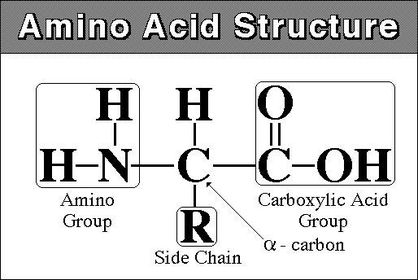
On completion the polypeptide chain leaves the ribosome and is further modified to acquire its secondary and tertiary structure. - 17Explain the structure of an amino acid.A basic amino group and an acidic carboxyl group, a hydrogen atom and a variable side chain often depicted as 'R'.
- 18What four groups of amino acids are there?Acidic amino acids (-)
Basic amino acids (+)
Hydrophilic amino acids (0)
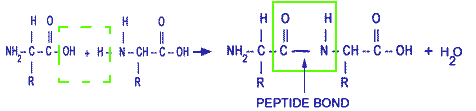
Hydrophobic amino acids (0) - 19What is a peptide bond and how is it made?A condensation reaction between the carboxyl group and the amino group forms this covalent bond.
- 20What is the Primary Structure of Proteins?The primary structure of a protein is the number, type and sequence of amino acids that make up the polypeptide chain.
- 21What is the Secondary Structure of Proteins?In protein molecules, the primary polypeptide chains are either coiled into a spiral, known as the α-helix or linked together into pleated sheets, known as β- pleated sheet.
- 22What is the α-Helix?In an α-helix, the coils in the polypeptide chain are held in place by hydrogen bonds that form between the hydrogen atoms of the amino group of one amino acid and the oxygen atom of the carboxyl group of another amino acid further along the chain.
- 23What are the β-Pleated Sheets?In a β-pleated sheet the hydrogen bond formation takes place between the carboxyl and amino groups of the amino acid residues of one chain and the carboxyl and amino groups of the neighbouring chains.
- 24What is the Tertiary Structure of Proteins?The tertiary structure refers to the three-dimensional (3D) shape of the polypeptide chain.
In most proteins there are various arrangements of α-helices, β-pleating and loops, allowing the polypeptide chain to fold up into a compact globular shape. - 25What are the three different types of bonds you can encounter in the tertiary structure of amino acidsThe types of bonds commonly found in tertiary structure of proteins include hydrogen bonds, disulphide bonds and ionic bonds.
- 26What is a hydrogen bond between two amino acids?Hydrogen bond formed between hydrogen atom on one amino acid and an oxygen atom on a nearby amino acid
- 27What is a disulphide bond between two amino acids?Disulphide bond is a bond between two adjacent cysteine amino acids
- 28What is a ionic bond?Ionic bond formed between a negatively charged carboxyl group on one amino acid and a positively charged amino group on another amino acid.
- 29What is the quaternary structure of proteins?Some complex proteins may consist of more than one polypeptide chain and are described as having a quaternary structure. The polypeptide chains in these complex proteins may be all of one type or of different types.
- 30Explain the build up of a fibrous protein?A fibrous protein is formed by several spiral-shaped polypeptide molecules linked together by cross bridges. This gives the molecule a rope-like structure.It is the secondary structure that is important in fibrous proteins. Fibrous proteins are insoluble in water.
- 31Give an examples of fibrous protein.Actin and myosin found in muscles are contractile and Keratin is made up almost entirely of α-helices (though when stretched can assume a β-pleated arrangement), whilst collagen forms a triple helical arrangement where three polypeptide chains are wound around each other to form a rope like structure.
- 32Explain the build up of a Globular Protein?Globular proteins are bent and folded into spherical shapes and so it is the tertiary structure that is important. Under certain circumstances the three- dimensional shape of the globular protein can change, either temporarily or permanently.
- 33Give an examples of globular protein.Globular proteins make up most of the proteins in living organisms and include enzymes, antibodies and hormones.