
Karteikarten
9.3: Growth in Plants
Karten in diesem Stapel (37)
- 1What is determinate growth?When a defined juvenile/embryonic period growth stops when a certain size is reached, i.e. structure is fully formed. E.g. Humans
- 2What is indeterminate growth?When cells continue to divide indefinitely. E.g. Plants can produce any number of extra branches/stem or root.
- 3What is totipotency?The ability to differentiate into any type of cell. E.g. The capacity to generate whole plants.
- 4What are meristematic regions?Regions where growth in plants usually occur. They are composed of undifferentiated cells that are undergoing active cell division.
- 5What are apical meristems?Primary meristems that are found at the tips of stems and roots.
- 6What are the 2 types of apical meristems, and what are they responsible for?- Root apical meristem: responsible for growth in the root.
- Shoot apical meristem: responsible for the growth in the shoot. - 7What do cells in the meristems undergo continuously?They repeatedly undergo the cell cycle to produce more cells by mitosis and cytokinesis.
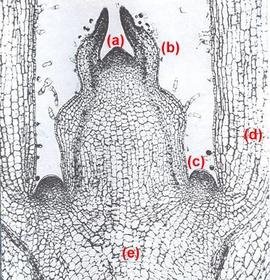
- 8How does the shoot apical meristem work?The shoot apical meristem "throws off" the cells needed for growth of the stem and also produces groups of cells that develop into leaves and flowers.
During each division, one cell remains in meristem to continue to go through cell cycle, while others increase in size and differentiates. - 9What are the three different additional meristems that the different apical meristems can give rise to?- Photoderm: Gives rise to epidermis.
- Procambium: Gives rise to vascular tissue.
- Ground Meristem: Gives rise to pith (soft spongy tissue in plant) - 10What is the shoot of a plant?Stem + leaves
- 11Label.a) Apical meristem
b) Leaf primordia
c) Axillary bud
d) Procambium
e) Ground meristem - 12What is a hormone?A chemical message that is produced and released in one part of an organism to have an effect in another part of an organism. E.g. Auxins
- 13What are 3 examples of the function of auxin?-Initiating growth in roots
-Influencing development of fruits
-Regulating leaf development - 14What is the most abundant auxin?Indole-3-acetic acid (IAA)
- 153 features of Indole-3-acetic acid.-Controls growth in the shoot apex.
-IAA promotes cell elongation in stems.
-IAA is synthesised in apical meristem of shoot and transported down to stem to stimulate growth. - 16What happens when there are high concentrations of IAA?It can inhibit growth.
- 17What is the axillary bud?Shoots that form at the junction of stem and base of a leaf.
- 18How do plants respond to the environment?By tropisms.
- 19Define what is meant by tropism.A tropism is a directional growth response to an external stimuli.
- 20What are the 2 different types of tropisms?- Phototropism: Directional growth response to an external stimuli
- Geotropism: Growth response in gravitational force. - 21In terms of growth, what do plants use hormones for?To control the direction and rate of growth.
- 22What are the 2 environmental factors that influence the direction at which the stems grow?- Light
- Gravity - 23What direction do plants grow in the presence of gravity?Plants grow in opposite direction of gravity.
- 24How do the growth of plants differ in the presence of light and in the absence of light?In the presence of light, plants grow towards the source of the brightest light.
In the absence of light, plants grow upwards. - 25What occurs during the first stage of phototropism?Absorption of light by photoreceptors controlled by proteins (photo tropins), occur.
- 26What happens when the proteins - during first stage of phototropism - absorb light?W
- 27What is the role of PIN3 proteins?PIN3 proteins help transport auxin to where growth is needed.
- 28What occurs when phototropins detect a greater intensity of light on one side of stem than the other?Auxins will be transported by the PIN3 proteins laterally from the brighter side to the shady side.
- 29What occurs when there is a greater concentration of auxin on shady side?It will cause greater growth on one side, causing the stem to curve towards the source of light.
- 30What happens when a root is place on its side?Gravity causes cellular organelles (Statoliths) to accumulate on lower side of cells.
This leads to distribution of PIN3 proteins that direct auxin transport to the bottom of the cells. - 31What happens when there are high concentrations of auxin in the root?This inhibits root cell elongation so top of cells elongate faster than bottom cells causing root to bend downwards.
- 32What are the 2 ways auxins can enter a cell?- Diffusion
- Influx transporter ->Proteins -> ATP - 33How do auxins move between cells?Auxin moves between cells via auxin efflux pumps via symplastic route.
- 34What is micropropagation in plants?A procedure where large numbers of identical plants with desirable characteristics can be produced.
- 35What does micropropagation depend on?Depends on totipotency of plant (the ability of cells to differentiate into any plant part).
- 36What are the 5 steps to propagating a plant?1) Remove a small piece of tissue from shoot apex of a plant being cloned. Sterilise to avoid infections.
2) Place tissue in a sterile nutrient agar gel, containing high auxin concentrations. This will stimulate cell growth and division.
3) Undifferentiated mass called a callus grows
4) Callus is transferred to a nutrient agar gel containing less auxin but high cytokinin which will stimulate plantlets with roots and shoots to develop.
5) Plantlets are then separated and transferred to soil. - 37List 4 reasons why micropropagation is used.- New varieties of plants can be bulked up quicker than previous methods.
- Virus free strains of plants can be produced (as the cells in the apical meristems normally do not contain any viruses).
- Can produce plants with desirable characteristics, producing copies even during out of season.
- Preservation of a species of plant.
Informationen
- Beschreibung
- International Baccalaureate Biology (9. Plant Biology) Karteikarten am 9.3: Growth in Plants, erstellt von Jasmine Wells am 05/01/2016.
- Erstellt von
- Jasmine Wells
- Aufrufe
- 104
- Tags
- Bewertung