
Karteikarten
Fire
Karten in diesem Stapel (58)
- 1What does CFA stand for?Common Fire Accelerant
- 2Which associations agreed to who was present at a fire?The National Agreement for fire investigation 2005
By association of chief police officers, chief fire investigators association and the Scottish forensic science liaison - 3What is the fire brigades role at a fire scene?Save lives, extinguish fire, assess level of investigation, hand over to police
- 4What is the role of the police at a fire scene?Take charge of all suspicious/fatal scenes, assess level of investigation, do crime scene management, bring in forensic team
- 5What is the forensic teams role at a fire scene?To investigate the fire with police and FB. investigate suspicious/ fatal/high value fires
- 6What are some common causes of fire?Candles, smoking materials, cooking, electrics, children with matches, deliberate fire-setting
- 7What are the reasons for deliberate fire-setting?Revenge, fraud, suicide, cover up another crime
- 8What is hypothesis testing?Considering the various causes then ranking them based on likelihood
- 9What is the aim of a fire investigation?To determine and test hypotheses, to find the seats of a fire, to determine how the fire started, to determine how the fire spread, to recover evidence, analyse suspects and compare
- 10What are fire debris samples collected in?Nylon bag, if doubled, polythene on outside, then put in cardboard box
- 11Why are nylon bags used for fire debris?Hydrocarbons are small and volatile, can pass through polythene lattice
- 12What are measures used to stop false positives in the nylon bag?Each batch made in factory is tested for measurable levels of contaminant, control bags are taken at scene to prove bag and person not contaminated.
- 13Why can tape, sticky labels or pen not be used on a nylon bag?Tape and sticky labels contain toluene/xylenes (in petrol) and white spirit
Pen contains a mixture of solvents - 14What is the purpose of the control nylon bag?Proves no contamination since batch test, samplers hands are not contaminated.
- 15What is the meaning of a positive control bag?If the levels of control and sample are similar then there is contamination, +ve result not reported. If control bag levels a lot lower, and only contains CFA, suggests cross contamination and +ve result reported.
- 16How can there be proof there is no contamination?Control bag is negative, blanks run prior to analysis, analysed against known standards, peak area and heights.
- 17How can you avoid cross contamination?Make sure separate samples are contained separately, different samples examined in different rooms, different samples analysed by different scientists
- 18Describe headspace samplingNylon bag heated to 110C for 10min, tenax syringe attached and 10mL taken, bag sealed and tube inserted into ATD-GC-MS
- 19What does ATD-GC-MS stand for?Automated Thermal Desorption Gas Chromatography Mass Spectrometry
- 20How does ATD work?Tenax tube leak tested, heated to 220C, sample desorbed from tube and trapped on cold trap (-30C), rapidly heated to 200C, transferred to GC
- 21How does GC work?Mixture is separated by column, then ionised by electron beam, each frgament has a different mass, the ions are focused and drawn into quads by charged plates (lenses), each mass passed through and abundance measured
- 22What are the two modes of MS?Total Ion Count (TIC) and Selected Ion Recording/Monitoring (SIR/SIM)
- 23What are the advantages of TIC mode of MS?Lots of info, can identify using mass spec databases (NIST), can quantify using peak area
- 24What are the disadvantages of using TIC mode of MS?Can only collect each fragment for a short time (ms), not very much is collected in that time, not sensitive, cannot quantify or identify unresolved peaks
- 25What is selected ion recording/monitoring (SIR/SIM)?A MS mode where only specific ions are allowed through the quadrupole to the detector
- 26What is the advantages of the SIR/SIM mode of the MS?simpler chromatograms, can collect each fragment for longer (20-200 ms), collects more ions, more sensitive (lower LOD), can quantify using peak area
- 27What are the disadvantages of SIR/SIM mode of MS?Provides very little info, cannot use libraries, not all masses are unique to a single compound, can mis-identify/mis-quantify if interferences
- 28What does EIC/EIP stand for?Extracted ion count, Extracted ion profile
- 29What does the EIC/EIP do?It produces chromatographs of specific mass ions that are commonly present in the compounds being analysed
- 30What are the 5 hydrocarbon groups used to identify crude oil?Aromatic Hydrocarbons
Alkanes
Naphthalenes
Indanes
Alkenes/Cycloparaffins - 31What are some characteristics of a petrol chromatogram?short alkanes (C2-C5)
Aromatic compounds (toluene, ethyl benzene, xylene, substituted benzenes) - 32What are some characteristics of white spirit?3 alkane hydrocarbons (C9-C11) with smaller substituted benzene and branched/cyclic alkane peaks in between
- 33What are some characteristics of diesel?alkane hydrocarbon large peaks (C8-C30) with small branch/chained alkanes, alkenes, cycloparaffins and substituted benzenes
- 34What is the most abundant fragment on a mass spectrometry graph?[M]+-1
Molecular ion minus one hydrogen - 35What does pyrolysis mean?When all objects in a room burn
- 36What makes a CFA chromatogram complicated?1. Possible CFA mixtures
2. components present due to other sources (non-CFA)
3. Partial evaporation due to heat of fire or time taken to recover - 37What are the main causes of fires?Electrical (appliance, wiring, fuses)
Human error (smoking, candles
Unguarded fires
Nature (lightning, spontaneous combustion)
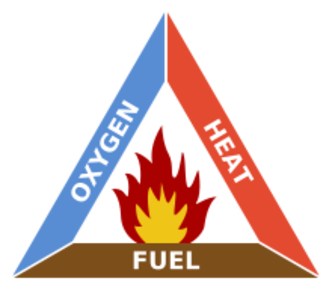
Deliberate (revenge, insurance, cover, fun, terrorism) - 38What is the definition of fire?A chemical reaction involving the oxidation of a fuel which results in the release of energy in the form of heat and light
- 39What is the fire triangle?
- 40What are some ignition sources?flames, arcs (charge from +ve to -ve), sparks, heated objects, electrical heating
- 41What is the explosion triangle?
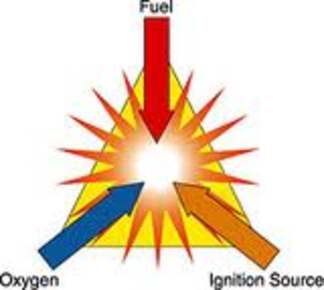
- 42What volume does one mole of gas occupy at STP (standard temperature and pressure) and SATP (Standard ambient temperature and pressure)?STP - 22.41L (273K, 1atm)
SATP - 24.8L (25C, 1x10^5 Pa) - 43What does the mode of burning depend on other than chemical nature?physical state
distribution of fuel
environment - 44What type of fuel burns?Only gaseous fuel, other states can be heated to burn
- 45What is pyrolysis?the chemical decomposition of a substance through heating which is irreversible in the absence of oxygen
- 46What is sublimation?the transition from solid to vapour without chemical decomposition
- 47What is chemical decomposition?The breakdown of a compound into its elements
- 48What are the four aspects of combustion?Thermodynamics (reaction feasibility)
Kinetics (speed of reaction and mechanisms)
Heat transfer
Mass transfer - 49What are flammability limits dependent on?Temperature and Pressure
- 50What is the FLl?lower flammability limit, the % concentration below which fuel cannot burn in air (too lean)
- 51What is the FLu?upper flammability limit, the % concentration above which fuel cannot burn in air (too rich, not enough O2)
- 52What is flashpoint?The lowest temperature that a vapour can be produced by fuel and ignited (FLl)
- 53What is fire point/flame point?The temperature at which the vapour from a fuel can be ignited to produce a continuous flame
- 54What is the spontaneous ignition temperature (SIT) or autoignition temperature (AIT)?The temperature at which fuel can ignite on its own without an external source
- 55What defines a combustible liquid from a flammable liquid?flammable flashpoint lower than 37.8C
combustible flashpoint higher than 37.8C - 56What is flaming combustion?when the liquid fuel vapourizes to gas which is igniting
- 57What is glowing combustion/smouldering?There is no flame, just heat, occurs in low oxygen, is very slow, increases with less water and smaller particles
- 58What is spontaneous combustion?A fire caused by natural heat produced in the presence of enough air and fuel
Informationen
- Beschreibung
- Flashcards that cover the basics of fire analysis
- Erstellt von
- Bereka
- Aufrufe
- 183
- Tags
- Bewertung